Browse by Subject

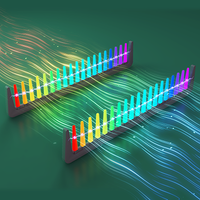
Emergent Dynamics of Active Elastic Microbeams

Q. Martinet, Y. I. Li, A. Aubret, E. Hannezo, and J. Palacci

Phys. Rev. X 15, 041017 (2025) - Published 31 October, 2025

Active solids—elastic materials built from energy-consuming parts—in the shape of microbeams rotate or oscillate and reveal tunable lifelike motion, paving the way for adaptive, shape-shifting materials and microscopic machines.

Fast Quantum Simulation of Electronic Structure by Spectral Amplification

Guang Hao Low, Robbie King, Dominic W. Berry, Qiushi Han, A. Eugene DePrince, III, Alec F. White, Ryan Babbush, Rolando D. Somma, and Nicholas C. Rubin

Phys. Rev. X 15, 041016 (2025) - Published 31 October, 2025

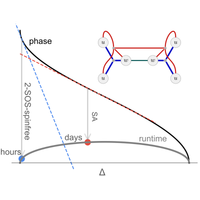
A new quantum algorithm framework reduces gate counts for ground-state energy estimation in molecular simulations by combining spectral amplification, sum-of-squares Hamiltonian representations, and integral compression.

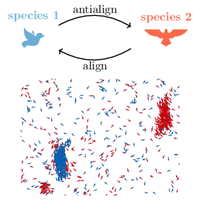
Transition to Collective Motion in Nonreciprocal Active Matter: Coarse Graining Agent-Based Models into Fluctuating Hydrodynamics

David Martin, Daniel Seara, Yael Avni, Michel Fruchart, and Vincenzo Vitelli

Phys. Rev. X 15, 041015 (2025) - Published 30 October, 2025

Nonreciprocal interactions—where influence is not mutual—dramatically reshape the phenomenology of flocking in active matter. Competing species form dynamic, synchronized clusters with time-dependent motion in the thermodynamic limit.

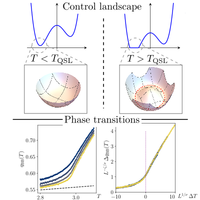
Toward a Theory of Phase Transitions in Quantum Control Landscapes

Nicolò Beato, Pranay Patil, and Marin Bukov

Phys. Rev. X 15, 041014 (2025) - Published 29 October, 2025

Analytical and numerical tools adapted from statistical physics reveal phase transitions in quantum control landscapes, explaining when new optimal strategies emerge and guiding the design of more efficient quantum technologies.

Generalized Rényi Entropy Accumulation Theorem and Generalized Quantum Probability Estimation

Amir Arqand, Thomas A. Hahn, and Ernest Y.-Z. Tan

Phys. Rev. X 15, 041013 (2025) - Published 28 October, 2025

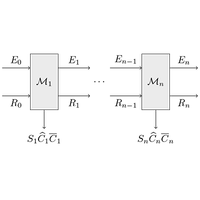
A unified framework combining entropy accumulation and quantum probability estimation provides tight, practical bounds on certified randomness generation, paving the way for simpler and stronger security analyses in quantum cryptography.

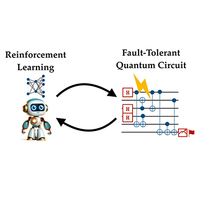
Quantum Circuit Discovery for Fault-Tolerant Logical State Preparation with Reinforcement Learning

Remmy Zen, Jan Olle, Luis Colmenarez, Matteo Puviani, Markus Müller, and Florian Marquardt

Phys. Rev. X 15, 041012 (2025) - Published 22 October, 2025

Using reinforcement learning to design fault-tolerant quantum circuits leads to efficient logical state preparation schemes with fewer gates and flag qubits than human-designed methods, advancing quantum error correction.

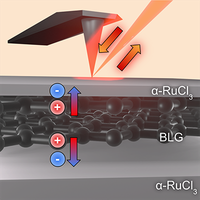
Collective Modes in Multilayer Graphene/α−RuCl3 Heterostructures

Samuel L. Moore, Miguel Sánchez Sánchez, M. C. Strasbourg, Y. Shao, J. Pack, Y. Wang, D. J. Rizzo, B. S. Jessen, Matthew Cothrine, David G. Mandrus, Takashi Taniguchi, Kenji Watanabe, K. S. Burch, C. R. Dean, J. Hone, M. Fogler, A. J. Millis, A. Rubio, P. J. Schuck, T. Stauber, and D. N. Basov

Phys. Rev. X 15, 041011 (2025) - Published 21 October, 2025

A new, gate-free, highly tunable platform for controlling charge-carrier density in multilayer graphene reveals how phonons and plasmons in the material respond to unexplored extremes of doping and electric fields.

Clustering of Conditional Mutual Information and Quantum Markov Structure at Arbitrary Temperatures

Tomotaka Kuwahara

Phys. Rev. X 15, 041010 (2025) - Published 16 October, 2025

Quantum systems at equilibrium are more localized than previously thought when looked at through the lens of conditional mutual information, a key way of measuring three-part correlations.

Entangled Dual-Comb Spectroscopy

Abdulkarim Hariri, Shuai Liu, Haowei Shi, Quntao Zhuang, Xudong Fan, and Zheshen Zhang

Phys. Rev. X 15, 041009 (2025) - Published 15 October, 2025

Entangled dual-comb spectroscopy combines a classical comb with an entangled quantum comb to suppress photon noise, achieving faster, more precise measurements than classical methods and enabling advanced sensing and metrology applications.

Experimental Demonstration of High-Fidelity Logical Magic States from Code Switching

Lucas Daguerre, Robin Blume-Kohout, Natalie C. Brown, David Hayes, and Isaac H. Kim

Phys. Rev. X 15, 041008 (2025) - Published 14 October, 2025

A new trapped-ion experiment creates the most reliable “magic state” yet, protecting the state from environmental noise using minimal overhead and advancing practical quantum computing.

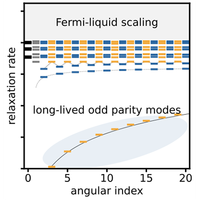
Nonequilibrium Relaxation and Odd-Even Effect in Finite-Temperature Electron Gases

Eric Nilsson, Ulf Gran, and Johannes Hofmann

Phys. Rev. X 15, 041007 (2025) - Published 14 October, 2025

Analysis of the equations governing a two-dimensional Fermi liquid with Coulomb interactions uncovers long-lived odd-parity collective modes that decay far more slowly than standard theory predicts.

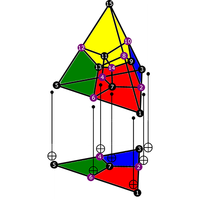
Tensor Networks for Noninvertible Symmetries in 3+1D and Beyond

Pranay Gorantla, Shu-Heng Shao, and Nathanan Tantivasadakarn

Phys. Rev. X 15, 041006 (2025) - Published 8 October, 2025

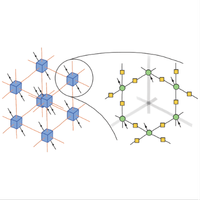
Relying on tensor networks and ZX-calculus, a visual framework for studying noninvertible symmetries in quantum systems reveals how these novel transformations constrain ground states and reshape our understanding of dualities.

Beyond Homes Scaling: Disorder, the Planckian Bound, and a New Universality

D. M. Broun, Vivek Mishra, J. S. Dodge, and P. J. Hirschfeld

Phys. Rev. X 15, 041005 (2025) - Published 8 October, 2025

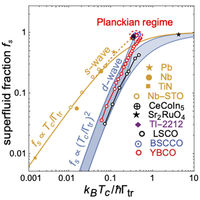
A newly uncovered fundamental form of universality classifies all superconductors into a unified framework by accounting for chemical impurities and inelastic scattering.

Experimental Signatures of a New Channel of the Deuteron-Deuteron Reaction at Very Low Energy

R. Dubey, K. Czerski, Gokul Das H., A. Kowalska, N. Targosz-Sleczka, M. Kaczmarski, and M. Valat

Phys. Rev. X 15, 041004 (2025) - Published 7 October, 2025

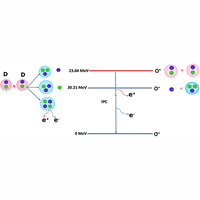
Deuteron-deuteron fusion at energies below 5 keV occurs mainly via a helium-4 resonance that decays by emitting electron-positron pairs, a newly observed, dominant reaction channel important for stellar nucleosynthesis and fusion models.

Heralded Entanglement of On-Demand Spin-Wave Solid-State Quantum Memories for Multiplexed Quantum Network Links

Jonathan Hänni, Alberto E. Rodríguez-Moldes, Félicien Appas, Soeren Wengerowsky, Dario Lago-Rivera, Markus Teller, Samuele Grandi, and Hugues de Riedmatten

Phys. Rev. X 15, 041003 (2025) - Published 3 October, 2025

Heralded entanglement between two solid-state quantum memories with on-demand retrieval and temporal multimodality demonstrates a crucial building block for scalable quantum repeaters and long-distance quantum networks.

Sensing and Control of Single Trapped Electrons above 1 K

K. E. Castoria, N. R. Beysengulov, G. Koolstra, H. Byeon, E. O. Glen, M. Sammon, S. A. Lyon, J. Pollanen, and D. G. Rees

Phys. Rev. X 15, 041002 (2025) - Published 2 October, 2025

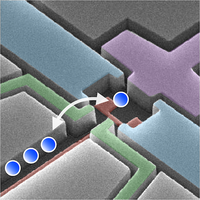
A microchannel quantum dot integrated with a superconducting resonator allows for the precision trapping and detection of single electrons on superfluid helium above 1 K, demonstrating control in conditions suited for scalable quantum processors.

High-Performance and Reliable Probabilistic Ising Machine Based on Simulated Quantum Annealing

Eleonora Raimondo, Esteban Garzón, Yixin Shao, Andrea Grimaldi, Stefano Chiappini, Riccardo Tomasello, Noraica Davila-Melendez, Jordan A. Katine, Mario Carpentieri, Massimo Chiappini, Marco Lanuzza, Pedram Khalili Amiri, and Giovanni Finocchio

Phys. Rev. X 15, 041001 (2025) - Published 1 October, 2025

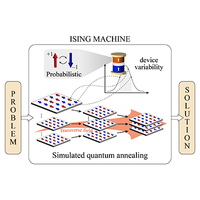
Simulated quantum annealing enhances probabilistic Ising Machines by enabling faster, more reliable solutions to complex optimization problems using interacting copies of the system guided by a time-dependent field.

Radon Removal in XENONnT down to the Solar Neutrino Level

E. Aprile et al. (XENON Collaboration)

Phys. Rev. X 15, 031079 (2025) - Published 30 September, 2025

Using advanced cryogenic distillation, the XENONnT experiment cuts radon levels in its 10-tonne liquid xenon detector to just 430 atoms per tonne, enabling ultrapure conditions for detecting faint dark matter signals.

Exciton Formation in Two-Dimensional Semiconductors

K. Mourzidis, V. Jindal, M. Glazov, A. Balocchi, C. Robert, D. Lagarde, P. Renucci, L. Lombez, T. Taniguchi, K. Watanabe, T. Amand, S. Francoeur, and X. Marie

Phys. Rev. X 15, 031078 (2025) - Published 29 September, 2025

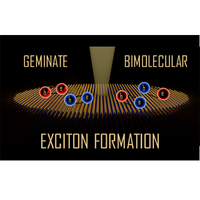
Excitons in two-dimensional transition-metal dichalcogenide monolayers form through both geminate and bimolecular pathways, resolving a key debate and enabling new control over exciton properties for quantum applications.

Thermal Transport in a 2D Amorphous Material

Yuxi Wang, Nianjie Liang, Xingxing Zhang, Wujuan Yan, Haiyu He, Alfredo Fiorentino, Xinwei Tao, Ang Li, Fuwei Yang, Buxuan Li, Te-Huan Liu, Jia Zhu, Wu Zhou, Wei Wang, Stefano Baroni, Lin Zhou, and Bai Song

Phys. Rev. X 15, 031077 (2025) - Published 26 September, 2025
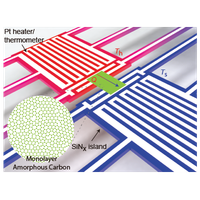
Monolayer amorphous carbon shows unexpectedly high in-plane thermal conductivity compared to its 3D form, revealing how reduced dimensionality can reshape heat transport in disordered materials.

Sign In to Your Journals Account

Filter

Subject

Filter

Article Lookup

Enter a citation