

- Open Access
Fast Quantum Simulation of Electronic Structure by Spectral Amplification
Phys. Rev. X 15, 041016 – Published 31 October, 2025
DOI: https://doi.org/10.1103/pb2g-j9cw
Abstract
The most advanced techniques using fault-tolerant quantum computers to estimate the ground-state energy of a chemical Hamiltonian involve compression of the Coulomb operator through tensor factorizations, enabling efficient block encodings of the Hamiltonian. A natural challenge of these methods is the degree to which block-encoding costs can be reduced. We address this challenge through the technique of spectral amplification, which magnifies the spectrum of the low-energy states of Hamiltonians that can be expressed as sums of squares. Spectral amplification enables estimating ground-state energies with significantly improved cost scaling in the block encoding normalization factor to just , where is the lowest energy of the sum-of-squares Hamiltonian. To achieve this, we show that sum-of-squares representations of the electronic structure Hamiltonian are efficiently computable by a family of classical simulation techniques that approximate the ground-state energy from below. In order to further optimize, we also develop a novel factorization that provides a trade-off between the two leading Coulomb integral factorization schemes—namely, double factorization and tensor hypercontraction—that when combined with spectral amplification yields a factor of 4 to 195 speedup over the state of the art in ground-state energy estimation for models of iron-sulfur complexes and a -fixation catalyst.
Physics Subject Headings (PhySH)
Popular Summary
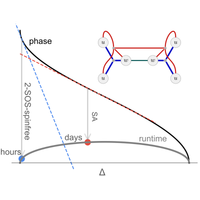
Simulating molecular systems is widely expected to be one of the first valuable applications of quantum computers, but a primary challenge lies in estimating ground-state energies with low quantum gate costs. Over the past several years, quantum algorithms for this task have improved dramatically, but progress has recently slowed, signaling the need for fresh strategies. In this work, we introduce a new approach that reduces the number of quantum gates needed by combining two ideas: spectral amplification and sum-of-squares representations of the Hamiltonian.
Spectral amplification works by lowering the precision requirements for energy estimation when we are already working in the low-energy regime. However, for this method to be applied, the Hamiltonian—which describes the total energy of a system—must be written in a special mathematical form called a sum of squares. We show how to construct this representation effectively and explain the trade-offs involved. Building on this, we develop a way of factoring Coulomb integrals that fits naturally into the sum-of-squares framework. This not only makes spectral amplification possible but also optimizes other important aspects of the quantum circuits used for estimating ground-state energies.
This is the first demonstration of combining spectral amplification, optimized sum-of-squares representations, and integral compression into a single framework. Looking ahead, we expect these methods to apply broadly, not only in quantum chemistry but also in other quantum and classical simulations where low-energy problems are central.
Article Text
References (65)
- A. Y. Kitaev, Quantum measurements and the Abelian stabilizer problem, arXiv:quant-ph/9511026.
- D. S. Abrams and S. Lloyd, Simulation of many-body Fermi systems on a universal quantum computer, Phys. Rev. Lett. 79, 2586 (1997).
- A. Aspuru-Guzik, A. D. Dutoi, P. J. Love, and M. Head-Gordon, Simulated quantum computation of molecular energies, Science 309, 1704 (2005).
- D. Wecker, B. Bauer, B. K. Clark, M. B. Hastings, and M. Troyer, Gate-count estimates for performing quantum chemistry on small quantum computers, Phys. Rev. A 90, 022305 (2014).
- E. Campbell, Random compiler for fast Hamiltonian simulation, Phys. Rev. Lett. 123, 070503 (2019).
- I. D. Kivlichan, C. E. Granade, and N. Wiebe, Phase estimation with randomized Hamiltonians, arXiv:1907.10070.
- J. Lee, D. W. Berry, C. Gidney, W. J. Huggins, J. R. McClean, N. Wiebe, and R. Babbush, Even more efficient quantum computations of chemistry through tensor hypercontraction, PRX Quantum 2, 030305 (2021).
- A. Caesura, C. L. Cortes, W. Poll, S. Sim, M. Steudtner, G.-L. R. Anselmetti, M. Degroote, N. Moll, R. Santagati, M. Streif et al., Faster quantum chemistry simulations on a quantum computer with improved tensor factorization and active volume compilation, arXiv:2501.06165.
- V. von Burg, G. H. Low, T. Häner, D. S. Steiger, M. Reiher, M. Roetteler, and M. Troyer, Quantum computing enhanced computational catalysis, Phys. Rev. Res. 3, 033055 (2021).
- D. W. Berry, Y. Tong, T. Khattar, A. White, T. I. Kim, G. H. Low, S. Boixo, Z. Ding, L. Lin, S. Lee, G. Kin-Lic Chan, R. Babbush, and N. C. Rubin, Rapid initial-state preparation for the quantum simulation of strongly correlated molecules, PRX Quantum 6, 020327 (2025).
- J. J. Goings, A. White, J. Lee, C. S. Tautermann, M. Degroote, C. Gidney, T. Shiozaki, R. Babbush, and N. C. Rubin, Reliably assessing the electronic structure of cytochrome P450 on today’s classical computers and tomorrow’s quantum computers, Proc. Natl. Acad. Sci. U.S.A. 119, e2203533119 (2022).
- N. C. Rubin, D. W. Berry, F. D. Malone, A. F. White, T. Khattar, A. Eugene DePrince, S. Sicolo, M. Küehn, M. Kaicher, J. Lee, and R. Babbush, Fault-tolerant quantum simulation of materials using Bloch orbitals, PRX Quantum 4, 040303 (2023).
- D. Poulin, A. Kitaev, D. S. Steiger, M. B. Hastings, and M. Troyer, Quantum algorithm for spectral measurement with a lower gate count, Phys. Rev. Lett. 121, 010501 (2018).
- R. Babbush, C. Gidney, D. W. Berry, N. Wiebe, J. McClean, A. Paler, A. Fowler, and H. Neven, Encoding electronic spectra in quantum circuits with linear T complexity, Phys. Rev. X 8, 041015 (2018).
- D. W. Berry, M. Kieferová, A. Scherer, Y. R. Sanders, G. H. Low, N. Wiebe, C. Gidney, and R. Babbush, Improved techniques for preparing eigenstates of fermionic Hamiltonians, npj Quantum Inf. 4, 22 (2018).
- G. H. Low and I. L. Chuang, Hamiltonian simulation by qubitization, Quantum 3, 163 (2019).
- D. W. Berry, C. Gidney, M. Motta, J. R. McClean, and R. Babbush, Qubitization of arbitrary basis quantum chemistry leveraging sparsity and low rank factorization, Quantum 3, 208 (2019).
- I. Loaiza and A. F. Izmaylov, Block-invariant symmetry shift: Preprocessing technique for second-quantized Hamiltonians to improve their decompositions to linear combination of unitaries, J. Chem. Theory Comput. 19, 8201 (2023).
- S. Patel, A. S. Brahmachari, J. T. Cantin, L. Wang, and A. F. Izmaylov, Global minimization of electronic Hamiltonian 1-norm via linear programming in the block invariant symmetry Shift (BLISS) method, J. Chem. Theory Comput. 21, 703 (2025).
- C. L. Cortes, D. Rocca, J. F. Gonthier, P. J. Ollitrault, R. M. Parrish, Gian-Luca R. Anselmetti, M. Degroote, N. Moll, R. Santagati, and M. Streif, Assessing the query complexity limits of quantum phase estimation using symmetry-aware spectral bounds, Phys. Rev. A 110, 022420 (2024).
- R. D. Somma and S. Boixo, Spectral gap amplification, SIAM J. Comput. 42, 593 (2013).
- G. H. Low and I. L. Chuang, Hamiltonian simulation by uniform spectral amplification, arXiv:1707.05391.
- A. Zlokapa and R. D. Somma, Hamiltonian simulation for low-energy states with optimal time dependence, Quantum 8, 1449 (2024).
- S. Gu, R. D. Somma, and B. Şahinoğlu, Fast-forwarding quantum evolution, Quantum 5, 577 (2021).
- A. Gilyén, Y. Su, G. H. Low, and N. Wiebe, Quantum singular value transformation and beyond: Exponential improvements for quantum matrix arithmetics, in Proceedings of the 51st Annual ACM SIGACT Symposium on Theory of Computing, STOC 2019 (Association for Computing Machinery, New York, NY, USA, 2019), p. 193–204.
- A. N. Chowdhury and R. D. Somma, Quantum algorithms for Gibbs sampling and hitting-time estimation, Quantum Inf. Comput. 17, 41 (2017).
- A. W. Harrow, A. Hassidim, and S. Lloyd, Quantum algorithm for linear systems of equations, Phys. Rev. Lett. 103, 150502 (2009).
- A. J. Coleman, The convex structure of electrons, Int. J. Quantum Chem. 11, 907 (1977).
- D. A. Mazziotti, Quantum chemistry without wave functions: Two-electron reduced density matrices, Acc. Chem. Res. 39, 207 (2006).
- S. Pironio, M. Navascués, and A. Acin, Convergent relaxations of polynomial optimization problems with noncommuting variables, SIAM J. Optim. 20, 2157 (2010).
- H. Kummer, -representability problem for reduced density matrices, J. Math. Phys. (N.Y.) 8, 2063 (1967).
- R. M. Erdahl, Representability, Int. J. Quantum Chem. 13, 697 (1978).
- J. Eisert, A note on lower bounds to variational problems with guarantees, arXiv:2301.06142.
- W. Hall, Compatibility of subsystem states and convex geometry, Phys. Rev. A 75, 032102 (2007).
- D. A. Mazziotti, Structure of fermionic density matrices: Complete -representability conditions, Phys. Rev. Lett. 108, 263002 (2012).
- Y.-K. Liu, Consistency of local density matrices is qma-complete, in Approximation, Randomization, and Combinatorial Optimization. Algorithms and Techniques: 9th International Workshop on Approximation Algorithms for Combinatorial Optimization Problems, APPROX 2006 and 10th International Workshop on Randomization and Computation, RANDOM 2006, Barcelona, Spain, 2006. Proceedings (Springer, New York, 2006), pp. 438–449.
- M. Reiher, N. Wiebe, K. M. Svore, D. Wecker, and M. Troyer, Elucidating reaction mechanisms on quantum computers, Proc. Natl. Acad. Sci. U.S.A. 114, 7555 (2017).
- Z. Li, J. Li, N. S. Dattani, C. Umrigar, and G. K. Chan, The electronic complexity of the ground-state of the FeMo cofactor of nitrogenase as relevant to quantum simulations, J. Chem. Phys. 150, 024302 (2019).
- D. Rocca, C. L. Cortes, J. F. Gonthier, P. J. Ollitrault, R. M. Parrish, G.-L. Anselmetti, M. Degroote, N. Moll, R. Santagati, and M. Streif, Reducing the runtime of fault-tolerant quantum simulations in chemistry through symmetry-compressed double factorization, J. Chem. Theory Comput. 20, 4639 (2024).
- Z. Li and G. K.-L. Chan, Spin-projected matrix product states: Versatile tool for strongly correlated systems, J. Chem. Theory Comput. 13, 2681 (2017).
- M. Mörchen, G. H. Low, T. Weymuth, H. Liu, M. Troyer, and M. Reiher, Classification of electronic structures and state preparation for quantum computation of reaction chemistry, arXiv:2409.08910.
- A. M. Childs, On the relationship between continuous- and discrete-time quantum walk, Commun. Math. Phys. 294, 581 (2010).
- D. W. Berry, A. M. Childs, and R. Kothari, Hamiltonian simulation with nearly optimal dependence on all parameters, in Foundations of Computer Science (FOCS), 2015 IEEE 56th Annual Symposium on (IEEE, New York, 2015), pp. 792–809, 10.1109/FOCS.2015.54.
- T. S. Motzkin, The arithmetic-geometric inequality, Inequalities (Proc. Sympos. Wright-Patterson Air Force Base, Ohio, 1965); T. S. MotzkinThe arithmetic-geometric inequality, Inequalities205, 54 (1967).
- J. W. Helton, “Positive” noncommutative polynomials are sums of squares, Ann. Math. 156, 675 (2002).
- D. A. Mazziotti, Variational minimization of atomic and molecular ground-state energies via the two-particle reduced density matrix, Phys. Rev. A 65, 062511 (2002).
- N. C. Rubin and D. A. Mazziotti, Comparison of one-dimensional and quasi-one-dimensional Hubbard models from the variational two-electron reduced-density-matrix method, Theor. Chem. Acc. 133, 1492 (2014).
- J. W. Mullinax, E. Maradzike, L. N. Koulias, M. Mostafanejad, E. Epifanovsky, G. Gidofalvi, and A. E. DePrince III, Heterogeneous algorithm for variational two-electron reduced-density matrix-driven complete active-space self-consistent field theory, J. Chem. Theory Comput. 15, 6164 (2019).
- Q. Han, Z. Lin, H. Liu, C. Chen, Q. Deng, D. Ge, and Y. Ye, Accelerating low-rank factorization-based semidefinite programming algorithms on GPU, arXiv:2407.15049.
- Q. Han, C. Li, Z. Lin, C. Chen, Q. Deng, D. Ge, H. Liu, and Y. Ye, A low-rank ADMM splitting approach for semidefinite programming, arXiv:2403.09133.
- A. M.-C. So, Y. Ye, and J. Zhang, A unified theorem on SDP rank reduction, Math. Oper. Res. 33, 910 (2008).
- I. Waldspurger and A. Waters, Rank optimality for the Burer-Monteiro factorization, SIAM J. Optim. 30, 2577 (2020).
- J. Povh, F. Rendl, and A. Wiegele, A boundary point method to solve semidefinite programs, Computing 78, 277 (2006).
- M. Motta, E. Ye, J. R. McClean, Z. Li, A. J. Minnich, R. Babbush, and G. K.-L. Chan, Low rank representations for quantum simulation of electronic structure, npj Quantum Inf. 7, 83 (2021).
- O. Oumarou, M. Scheurer, R. M. Parrish, E. G. Hohenstein, and C. Gogolin, Accelerating quantum computations of chemistry through regularized compressed double factorization, Quantum 8, 1371 (2024).
- G. H. Low, V. Kliuchnikov, and L. Schaeffer, Trading T gates for dirty qubits in state preparation and unitary synthesis, Quantum 8, 1375 (2024).
- G. H. Low, Halving the cost of quantum multiplexed rotations, arXiv:2110.13439.
- S. Burer and R. D. Monteiro, A nonlinear programming algorithm for solving semidefinite programs via low-rank factorization, Math. Program., Ser. B 95, 329 (2003).
- M. Nakata, H. Nakatsuji, M. Ehara, M. Fukuda, K. Nakata, and K. Fujisawa, Variational calculations of fermion second-order reduced density matrices by semidefinite programming algorithm, J. Chem. Phys. 114, 8282 (2001).
- M. B. Hastings, Perturbation theory and the sum of squares, arXiv:2205.12325.
- C. Gidney, N. Shutty, and C. Jones, Magic state cultivation: Growing T states as cheap as cnot gates, arXiv:2409.17595.
- M. B. Hastings, Improving perturbation theory with the sum-of-squares: Third order, arXiv:2412.03564.
- M. B. Hastings, Field theory and the sum-of-squares for quantum systems, arXiv:2302.14006.
- Y. R. Sanders, D. W. Berry, P. C. S. Costa, L. W. Tessler, N. Wiebe, C. Gidney, H. Neven, and R. Babbush, Compilation of fault-tolerant quantum heuristics for combinatorial optimization, PRX Quantum 1, 020312 (2020).
- N. Rubin, Fast quantum simulation of electronic structure by spectral amplification, Zenodo (2025), 10.5281/zenodo.17066718.

