

- Open Access
Collective Modes in Multilayer Heterostructures
Phys. Rev. X 15, 041011 – Published 21 October, 2025
DOI: https://doi.org/10.1103/rp3q-svws
Abstract
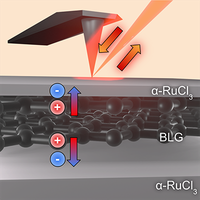
Collective modes in multilayer graphene, such as plasmons and phonons, exhibit sensitivity to displacement fields and interlayer coupling, distinguishing them from their counterparts in single-layer graphene. Here, we engineer collective modes in charge-transfer heterostructures composed of multilayer graphene and . In heterostructures with a single interface, the charge transfer generates displacement fields up to 7 V/nm at the interface between and the adjacent graphene layer—the highest value achieved through charge-transfer methods. As a result of the broken inversion symmetry, we discover enhanced nonlinear optical response and modified phonon selection rules. Conversely, we find that multilayer graphene sandwiched between two flakes causes displacement fields to cancel. There, we achieve carrier densities as high as in multilayer graphene and restore the phonon selection rules to their unperturbed state. Meanwhile, we demonstrate that plasmonic properties derive from the depletion of multiple valence bands. As a result of the quasilinear band dispersion, these “Dirac multiband plasmons” are relatively unaffected by displacement fields. On the other hand, the inverted heterostructure sequence—two multilayer graphene sheets encapsulating —activates significant alteration of the plasmons via interlayer plasmon-plasmon coupling. Hence, multilayer graphene and heterostructures offer a gate-free platform for engineering collective modes derived from inversion symmetry and interlayer coupling.
Physics Subject Headings (PhySH)
Corrections
3 December, 2025
Correction: A funding statement was missing from the Acknowledgments and has been inserted.
Popular Summary
Collective modes—coordinated oscillations of many interacting particles—are key to understanding how complex materials behave. Examples include plasmons—oscillations of free electrons responding to electromagnetic fields—and phonons—atomic vibrations in a solid that propagate as waves. While single-layer graphene has been studied extensively in this context, multilayer graphene is less explored. Here, we investigate how plasmons and phonons in multilayer graphene respond under extreme conditions of ultrahigh doping and strong electric fields.
We find that phonon modes become highly sensitive to electric fields, a result of inversion symmetry breaking. Meanwhile, plasmons remain largely unaffected, akin to what is observed in single-layer graphene. However, when the distance between two graphene layers aligns with the plasmon oscillation wavelength, we see a strong coupling effect where the plasmon mode splits in two and the wavelength shrinks dramatically.
Typically, charge-carrier density is controlled via a gate electrode. We instead utilize a gate-free method rooted in interfacial charge transfer from . This approach provides much higher carrier densities and lets us tune electric fields and charge distributions with precision. It also permits optical interrogation with a suite of experimental tools. We employ second-harmonic generation to track symmetry changes, Raman spectroscopy to monitor phonons, and near-field nanoscopy to visualize ultrashort plasmon wavelengths. We also use theoretical models to estimate carrier concentrations and electric field strengths in our samples.
Our results show that this gate-free, highly tunable platform opens new pathways for studying collective modes in multilayer graphene. Looking ahead, we plan to explore how other exotic states of matter—such as excitons and superconducting Cooper pairs—behave in this regime, especially at low temperatures.
Article Text
References (44)
- J. Yan, T. Villarson, E. A. Henriksen, P. Kim, and A. Pinczuk, Optical phonon mixing in bilayer graphene with a broken inversion symmetry, Phys. Rev. B 80, 241417(R) (2009).
- J. Jahng, S. Lee, S. G. Hong, C. J. Lee, S. G. Menabde, M. S. Jang, D. H. Kim, J. Son, and E. S. Lee, Characterizing and controlling infrared phonon anomaly of bilayer graphene in optical-electrical force nanoscopy, Light 12, 281 (2023).
- J. A. Yan, K. Varga, and M. Y. Chou, Optical phonon anomaly in Bernal stacked bilayer graphene with ultrahigh carrier densities, Phys. Rev. B 86, 035409 (2012).
- F. J. Bezares, A. D. Sanctis, J. R. Saavedra, A. Woessner, P. Alonso-González, I. Amenabar, J. Chen, T. H. Bointon, S. Dai, M. M. Fogler, D. N. Basov, R. Hillenbrand, M. F. Craciun, F. J. García De Abajo, S. Russo, and F. H. Koppens, Intrinsic plasmon-phonon interactions in highly doped graphene: A near-field imaging study, Nano Lett. 17, 5908 (2017).
- A. B. Kuzmenko, L. Benfatto, E. Cappelluti, I. Crassee, D. Van Der Marel, P. Blake, K. S. Novoselov, and A. K. Geim, Gate tunable infrared phonon anomalies in bilayer graphene, Phys. Rev. Lett. 103, 116804 (2009).
- Z. Fei, E. G. Iwinski, G. X. Ni, L. M. Zhang, W. Bao, A. S. Rodin, Y. Lee, M. Wagner, M. K. Liu, S. Dai, M. D. Goldflam, M. Thiemens, F. Keilmann, C. N. Lau, A. H. Castro-Neto, M. M. Fogler, and D. N. Basov, Tunneling plasmonics in bilayer graphene, Nano Lett. 15, 4973 (2015).
- Y. Luan, J. Qian, M. Kim, K. M. Ho, Y. Shi, Y. Li, C. Z. Wang, M. C. Tringides, and Z. Fei, Imaging stacking-dependent surface plasmon polaritons in trilayer graphene, Phys. Rev. Appl. 18, 024052 (2022).
- T. Stauber, P. San-Jose, and L. Brey, Optical conductivity, Drude weight and plasmons in twisted graphene bilayers, New J. Phys. 15, 113050 (2013).
- I. H. Lee, L. Martin-Moreno, P. Avouris, T. Low, and S. H. Oh, Switching the symmetry of graphene plasmons with nanoemitters for ultimate infrared-light confinement, Phys. Rev. Appl. 19, 064039 (2023).
- C. Hu, A. Deng, P. Shen, X. Luo, X. Zhou, T. Wu, X. Huang, Y. Dong, K. Watanabe, T. Taniguchi, G. Xie, X. Li, Q. Liang, and Z. Shi, Direct imaging of interlayer-coupled symmetric and antisymmetric plasmon modes in graphene/hBN/graphene heterostructures, Nanoscale 13, 14628 (2021).
- A. C. Gadelha et al., Localization of lattice dynamics in low-angle twisted bilayer graphene, Nature (London) 590, 405 (2021).
- D. J. Rizzo, B. S. Jessen, Z. Sun, F. L. Ruta, J. Zhang, J. Q. Yan, L. Xian, A. S. McLeod, M. E. Berkowitz, K. Watanabe, T. Taniguchi, S. E. Nagler, D. G. Mandrus, A. Rubio, M. M. Fogler, A. J. Millis, J. C. Hone, C. R. Dean, and D. N. Basov, Charge-transfer plasmon polaritons at interfaces, Nano Lett. 20, 8438 (2020).
- G. Tenasini, D. Soler-Delgado, Z. Wang, F. Yao, D. Dumcenco, E. Giannini, K. Watanabe, T. Taniguchi, C. Moulsdale, A. Garcia-Ruiz, V. I. Fal’ko, I. Gutiérrez-Lezama, and A. F. Morpurgo, Band gap opening in bilayer van der Waals interfaces, Nano Lett. 22, 6760 (2022).
- Z. Fei, A. S. Rodin, G. O. Andreev, W. Bao, A. S. McLeod, M. Wagner, L. M. Zhang, Z. Zhao, M. Thiemens, G. Dominguez, M. M. Fogler, A. H. Castro Neto, C. N. Lau, F. Keilmann, and D. N. Basov, Gate-tuning of graphene plasmons revealed by infrared nano-imaging, Nature (London) 487, 82 (2012).
- Y. Wang et al., Modulation doping via a two-dimensional atomic crystalline acceptor, Nano Lett. 20, 8446 (2020).
- M. Zhang, N. Han, J. Wang, Z. Zhang, K. Liu, Z. Sun, J. Zhao, and X. Gan, Strong second harmonic generation from bilayer graphene with symmetry breaking by redox-governed charge doping, Nano Lett. 22, 4287 (2022).
- Y. Shan, Y. Li, D. Huang, Q. Tong, W. Yao, W. T. Liu, and S. Wu, Stacking symmetry governed second harmonic generation in graphene trilayers, Sci. Adv. 4, eaat0074 (2018).
- W. T. Liu, S. W. Wu, P. J. Schuck, M. Salmeron, Y. R. Shen, and F. Wang, Nonlinear broadband photoluminescence of graphene induced by femtosecond laser irradiation, Phys. Rev. B 82, 081408 (2010).
- E. Cappelluti, L. Benfatto, and A. B. Kuzmenko, Infrared phonon activity and Fano interference in multilayer graphenes, Phys. Scr. T162, 014018 (2014).
- D. L. Mafra, P. Gava, L. M. Malard, R. S. Borges, G. G. Silva, J. A. Leon, F. Plentz, F. Mauri, and M. A. Pimenta, Characterizing intrinsic charges in top gated bilayer graphene device by Raman spectroscopy, Carbon 50, 3435 (2012).
- Y. Dong, L. Xiong, I. Y. Phinney, Z. Sun, R. Jing, A. S. McLeod, S. Zhang, S. Liu, F. L. Ruta, H. Gao, Z. Dong, R. Pan, J. H. Edgar, P. Jarillo-Herrero, L. S. Levitov, A. J. Millis, M. M. Fogler, D. A. Bandurin, and D. N. Basov, Fizeau drag in graphene plasmonics, Nature (London) 594, 513 (2021).
- G. X. Ni, A. S. McLeod, Z. Sun, L. Wang, L. Xiong, K. W. Post, S. S. Sunku, B. Y. Jiang, J. Hone, C. R. Dean, M. M. Fogler, and D. N. Basov, Fundamental limits to graphene plasmonics, Nature (London) 557, 530 (2018).
- S. Moore, Raw data for Figs. 2 and 3, figshare.com/projects/nlg-rucl3/248669, 2025.
- A. Woessner, M. B. Lundeberg, Y. Gao, A. Principi, P. Alonso-González, M. Carrega, K. Watanabe, T. Taniguchi, G. Vignale, M. Polini, J. Hone, R. Hillenbrand, and F. H. Koppens, Highly confined low-loss plasmons in graphene–boron nitride heterostructures, Nat. Mater. 14, 421 (2014).
- S. Kim, J. Hong, K. Watanabe, T. Taniguchi, J. Falson, J. Kim, and Y. Kim, Spin and valley-polarized multiple Fermi surfaces of /bilayer graphene heterostructure, Appl. Phys. Lett. 123, 173101 (2023).
- Y. Zhang, T. T. Tang, C. Girit, Z. Hao, M. C. Martin, A. Zettl, M. F. Crommie, Y. R. Shen, and F. Wang, Direct observation of a widely tunable bandgap in bilayer graphene, Nature (London) 459, 820 (2009).
- E. N. Economou, Surface plasmons in thin films, Phys. Rev. 182, 539 (1969).
- B. Wang, X. Zhang, X. Yuan, and J. Teng, Optical coupling of surface plasmons between graphene sheets, Appl. Phys. Lett. 100, 131111 (2012).
- B. S. Kim et al., Ambipolar charge-transfer graphene plasmonic cavities, Nat. Mater. 22, 838 (2023).
- E. H. Hasdeo and J. C. Song, Long-lived domain wall plasmons in gapped bilayer graphene, Nano Lett. 17, 7252 (2017).
- L. J. Yin, H. Jiang, J. B. Qiao, and L. He, Direct imaging of topological edge states at a bilayer graphene domain wall, Nat. Commun. 7, 11760 (2016).
- E. Viñas Boström, A. Fischer, J. B. Profe, J. Zhang, D. M. Kennes, and A. Rubio, Phonon-mediated unconventional superconductivity in Rhombohedral stacked multilayer graphene, npj Comput. Mater. 10, 163 (2024).
- K. W. Plumb, J. P. Clancy, L. J. Sandilands, V. V. Shankar, Y. F. Hu, K. S. Burch, H. Y. Kee, and Y. J. Kim, : A spin-orbit assisted Mott insulator on a honeycomb lattice, Phys. Rev. B 90, 041112(R) (2014).
- N. Ocelic, A. Huber, and R. Hillenbrand, Pseudoheterodyne detection for background-free near-field spectroscopy, Appl. Phys. Lett. 89 (2006).
- J. Shi and A. H. MacDonald, Magnetic states of graphene proximitized Kitaev materials, Phys. Rev. B 108, 064401 (2023).
- J. Jung and A. H. MacDonald, Accurate tight-binding models for the bands of bilayer graphene, Phys. Rev. B 89, 035405 (2014).
- A. A. Zibrov, P. Rao, C. Kometter, E. M. Spanton, J. I. A. Li, C. R. Dean, T. Taniguchi, K. Watanabe, M. Serbyn, and A. F. Young, Emergent Dirac gullies and gully-symmetry-breaking quantum Hall states in trilayer graphene, Phys. Rev. Lett. 121, 167601 (2018).
- A. B. Kuzmenko, I. Crassee, D. van der Marel, P. Blake, and K. S. Novoselov, Determination of the gate-tunable band gap and tight-binding parameters in bilayer graphene using infrared spectroscopy, Phys. Rev. B 80, 165406 (2009).
- T. Stauber, N. M. R. Peres, and A. K. Geim, Optical conductivity of graphene in the visible region of the spectrum, Phys. Rev. B 78, 085432 (2008).
- T. Stauber and G. Gómez-Santos, Plasmons in layered structures including graphene, New J. Phys. 14, 105018 (2012).
- B. Wunsch, T. Stauber, F. Sols, and F. Guinea, Dynamical polarization of graphene at finite doping, New J. Phys. 8, 318 (2006).
- P. Coleman, Electron transport theory, Introduction to Many-Body Physics (Cambridge University Press, Cambridge, England, 2015), pp. 332–356.
- N. W. Ashcroft and N. Mermin, Solid State Physics (Brooks/Cole, Florence, KY, 1976).
- S. Slizovskiy, A. Garcia-Ruiz, A. I. Berdyugin, N. Xin, T. Taniguchi, K. Watanabe, A. K. Geim, N. D. Drummond, and V. I. Fal’ko, Out-of-plane dielectric susceptibility of graphene in twistronic and Bernal bilayers, Nano Lett. 21, 6678 (2021).

