

- Open Access
Thermal Transport in a 2D Amorphous Material
Phys. Rev. X 15, 031077 – Published 26 September, 2025
DOI: https://doi.org/10.1103/fjww-9pm3
Abstract
Two-dimensional (2D) crystals proved revolutionary soon after graphene was discovered in 2004. However, 2D amorphous materials down to a single layer of atoms only became accessible in 2020, and they remain largely unexplored. In particular, the thermophysical properties of amorphous materials are of great interest upon transition from 3D to 2D. Here, we probe and simulate thermal transport in monolayer amorphous carbon (MAC). An ultralow cross-plane thermal conductivity () is measured for van der Waals stacked multilayers, which is comparable to that of randomly stacked graphene despite the extra disorder in MAC. This result reveals the predominant role of the weak interlayer interactions in 2D materials. Meanwhile, an unexpectedly high in-plane is obtained for freestanding monolayers, which is a few times higher than what is predicted by conventional wisdom for 3D amorphous carbon with a similar fraction. This observation is primarily attributed to the dimensionality-induced reduction of anharmonicity and the unique low-frequency out-of-plane vibrational modes in MAC. Amorphous materials at the 2D limit open up new avenues for understanding and manipulating heat at the atomic scale.
Physics Subject Headings (PhySH)
Popular Summary
Glasses and other amorphous solids are critically important across countless industries and daily life, but their lack of crystal structure makes their thermal behavior difficult to predict. One major open question is how heat flows in such materials when they are reduced to a single atomic layer. Using a combination of experiments, atomistic simulations, and advanced theoretical modeling, we uncover surprising thermal transport properties in monolayer amorphous carbon (MAC), revealing that the transition from three dimensions to two produces dramatic changes in how heat moves.
For stacked layers of MAC, we find that heat transport across the layers is extremely low due to both structural disorder and weak interlayer van der Waals forces, which resist heat flow. In contrast, when we examine single freestanding MAC sheets, we discover unusually high in-plane thermal conductivity—several times greater than expected from traditional models of amorphous carbon. This enhancement comes from reduced anharmonic vibrations and unique low-frequency modes that emerge only in two dimensions.
These results show that 2D amorphous materials have thermal transport properties very different from their 3D counterparts. By uncovering the link between dimensionality, structure, and heat flow, our work points to new strategies for controlling heat at the atomic scale.
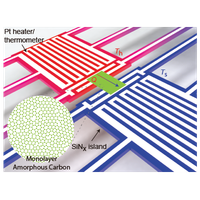
Article Text
Supplemental Material
References (69)
- Physical Properties of Amorphous Materials (Springer Science & Business Media, New York, 1985).
- L. Berthier and G. Biroli, Theoretical perspective on the glass transition and amorphous materials, Rev. Mod. Phys. 83, 587 (2011).
- M. M. J. Treacy and K. B. Borisenko, The local structure of amorphous silicon, Science 335, 950 (2012).
- P. Y. Huang, S. Kurasch, J. S. Alden, A. Shekhawat, A. A. Alemi, P. L. McEuen, J. P. Sethna, U. Kaiser, and D. A. Muller, Imaging atomic rearrangements in two-dimensional silica glass: Watching silica’s dance, Science 342, 224 (2013).
- Y. Yang, J. Zhou, F. Zhu, Y. Yuan, D. J. Chang, D. S. Kim, M. Pham, A. Rana, X. Tian, Y. Yao, S. J. Osher, A. K. Schmid, L. Hu, P. Ercius, and J. Miao, Determining the three-dimensional atomic structure of an amorphous solid, Nature (London) 592, 60 (2021).
- W. H. Zachariasen, The atomic arrangement in glass, J. Am. Chem. Soc. 54, 3841 (1932).
- S. Hong et al., Ultralow-dielectric-constant amorphous boron nitride, Nature (London) 582, 511 (2020).
- Y. Shang, Z. Liu, J. Dong, M. Yao, Z. Yang, Q. Li, C. Zhai, F. Shen, X. Hou, L. Wang, N. Zhang, W. Zhang, R. Fu, J. Ji, X. Zhang, H. Lin, Y. Fei, B. Sundqvist, W. Wang, and B. Liu, Ultrahard bulk amorphous carbon from collapsed fullerene, Nature (London) 599, 599 (2021).
- L. Isaeva, G. Barbalinardo, D. Donadio, and S. Baroni, Modeling heat transport in crystals and glasses from a unified lattice-dynamical approach, Nat. Commun. 10, 3853 (2019).
- M. Simoncelli, N. Marzari, and F. Mauri, Unified theory of thermal transport in crystals and glasses, Nat. Phys. 15, 809 (2019).
- V. L. Deringer, N. Bernstein, G. Csányi, C. Ben Mahmoud, M. Ceriotti, M. Wilson, D. A. Drabold, and S. R. Elliott, Origins of structural and electronic transitions in disordered silicon, Nature (London) 589, 59 (2021).
- H. Zhao, X. Chen, G. Wang, Y. Qiu, and L. Guo, Two-dimensional amorphous nanomaterials: Synthesis and applications, 2D Mater. 6, 032002 (2019).
- K. S. Novoselov, A. K. Geim, S. V. Morozov, D. Jiang, Y. Zhang, S. V. Dubonos, I. V. Grigorieva, and A. A. Firsov, Electric field effect in atomically thin carbon films, Science 306, 666 (2004).
- C.-T. Toh, H. Zhang, J. Lin, A. S. Mayorov, Y.-P. Wang, C. M. Orofeo, D. B. Ferry, H. Andersen, N. Kakenov, Z. Guo, I. H. Abidi, H. Sims, K. Suenaga, S. T. Pantelides, and B. Özyilmaz, Synthesis and properties of free-standing monolayer amorphous carbon, Nature (London) 577, 199 (2020).
- H. Tian et al., Disorder-tuned conductivity in amorphous monolayer carbon, Nature (London) 615, 56 (2023).
- X. Bai, P. Hu, A. Li, Y. Zhang, A. Li, G. Zhang, Y. Xue, T. Jiang, Z. Wang, H. Cui, J. Kang, H. Zhao, L. Gu, W. Zhou, L.-M. Liu, X. Qiu, and L. Guo, Nitrogen-doped amorphous monolayer carbon, Nature (London) 634, 80 (2024).
- X. Gu, Y. Wei, X. Yin, B. Li, and R. Yang, Colloquium: Phononic thermal properties of two-dimensional materials, Rev. Mod. Phys. 90, 041002 (2018).
- N. Liang, Y. Wang, and B. Song, Disordered hyperuniformity and thermal transport in monolayer amorphous carbon, Sci. China Phys. Mech. Astron. 68, 226111 (2025).
- F. Tian et al., Unusual high thermal conductivity in boron arsenide bulk crystals, Science 361, 582 (2018).
- X. Qian, J. Zhou, and G. Chen, Phonon-engineered extreme thermal conductivity materials, Nat. Mater. 20, 1188 (2021).
- P. B. Allen and J. L. Feldman, Thermal conductivity of disordered harmonic solids, Phys. Rev. B 48, 12581 (1993).
- F. DeAngelis, M. G. Muraleedharan, J. Moon, H. R. Seyf, A. J. Minnich, A. J. H. McGaughey, and A. Henry, Thermal transport in disordered materials, Nanoscale Microscale Thermophys. Eng. 23, 81 (2019).
- C. J. Morath, H. J. Maris, J. J. Cuomo, D. L. Pappas, A. Grill, V. V. Patel, J. P. Doyle, and K. L. Saenger, Picosecond optical studies of amorphous diamond and diamondlike carbon: Thermal conductivity and longitudinal sound velocity, J. Appl. Phys. 76, 2636 (1994).
- A. Giri, C. J. Dionne, and P. E. Hopkins, Atomic coordination dictates vibrational characteristics and thermal conductivity in amorphous carbon, npj Comput. Mater. 8, 55 (2022).
- S. E. Kim, F. Mujid, A. Rai, F. Eriksson, J. Suh, P. Poddar, A. Ray, C. Park, E. Fransson, Y. Zhong, D. A. Muller, P. Erhart, D. G. Cahill, and J. Park, Extremely anisotropic van der Waals thermal conductors, Nature (London) 597, 660 (2021).
- See Supplemental Material at http://link.aps.org/supplemental/10.1103/fjww-9pm3 for Supplemental Notes 1–14, Figs. S1–S24, and Tables S1–S3, which provide details of the sample preparation, thermal measurements, and atomistic simulations.
- D. Estrada, Z. Li, G.-M. Choi, S. N. Dunham, A. Serov, J. Lee, Y. Meng, F. Lian, N. C. Wang, A. Perez, R. T. Haasch, J.-M. Zuo, W. P. King, J. A. Rogers, D. G. Cahill, and E. Pop, Thermal transport in layer-by-layer assembled polycrystalline graphene films, npj 2D Mater. Appl. 3, 10 (2019).
- G. A. Slack, Anisotropic thermal conductivity of pyrolytic graphite, Phys. Rev. 127, 694 (1962).
- F. Yang, W. Zhou, Z. Zhang, X. Huang, J. Zhang, N. Liang, W. Yan, Y. Wang, M. Ding, Q. Guo, Y. Han, T.-H. Liu, K. Liu, Q. Zheng, and B. Song, Ultrahigh thermal conductance across superlubric interfaces in twisted graphite, Phys. Rev. Lett. 134, 146302 (2025).
- S. Mukhopadhyay, D. S. Parker, B. C. Sales, A. A. Puretzky, M. A. McGuire, and L. Lindsay, Two-channel model for ultralow thermal conductivity of crystalline , Science 360, 1455 (2018).
- Q. D. Gibson, T. Zhao, L. M. Daniels, H. C. Walker, R. Daou, S. Hébert, M. Zanella, M. S. Dyer, J. B. Claridge, B. Slater, M. W. Gaultois, F. Corà, J. Alaria, and M. J. Rosseinsky, Low thermal conductivity in a modular inorganic material with bonding anisotropy and mismatch, Science 373, 1017 (2021).
- A. J. Bullen, K. E. O’Hara, D. G. Cahill, O. Monteiro, and A.von Keudell, Thermal conductivity of amorphous carbon thin films, J. Appl. Phys. 88, 6317 (2000).
- M. Shamsa, W. L. Liu, A. A. Balandin, C. Casiraghi, W. I. Milne, and A. C. Ferrari, Thermal conductivity of diamond-like carbon films, Appl. Phys. Lett. 89, 161921 (2006).
- S. Chen, Q. Wu, C. Mishra, J. Kang, H. Zhang, K. Cho, W. Cai, A. A. Balandin, and R. S. Ruoff, Thermal conductivity of isotopically modified graphene, Nat. Mater. 11, 203 (2012).
- R. C. Yu, N. Tea, M. B. Salamon, D. Lorents, and R. Malhotra, Thermal conductivity of single crystal , Phys. Rev. Lett. 68, 2050 (1992).
- J. R. Olson, K. A. Topp, and R. O. Pohl, Specific heat and thermal conductivity of solid fullerenes, Science 259, 1145 (1993).
- L. Wei, P. K. Kuo, R. L. Thomas, T. R. Anthony, and W. F. Banholzer, Thermal conductivity of isotopically modified single crystal diamond, Phys. Rev. Lett. 70, 3764 (1993).
- C. N. Hooker, A. R. Ubbelohde, and D. A. Young, Anisotropy of thermal conductance in near-ideal graphite, Proc. Math. Phys. Eng. Sci. 284, 17 (1965).
- H. Wang, S. Hu, K. Takahashi, X. Zhang, H. Takamatsu, and J. Chen, Experimental study of thermal rectification in suspended monolayer graphene, Nat. Commun. 8, 15843 (2017).
- C. Yu, L. Shi, Z. Yao, D. Li, and A. Majumdar, Thermal conductance and thermopower of an individual single-wall carbon nanotube, Nano Lett. 5, 1842 (2005).
- A. Hirsch, The era of carbon allotropes, Nat. Mater. 9, 868 (2010).
- O. Hod, E. Meyer, Q. Zheng, and M. Urbakh, Structural superlubricity and ultralow friction across the length scales, Nature (London) 563, 485 (2018).
- F. Eriksson, E. Fransson, C. Linderälv, Z. Fan, and P. Erhart, Tuning the through-plane lattice thermal conductivity in van der Waals structures through rotational (dis)ordering, ACS Nano 17, 25565 (2023).
- G. Chen, Non-Fourier phonon heat conduction at the microscale and nanoscale, Nat. Rev. Phys. 3, 555 (2021).
- S. Ghosh, W. Bao, D. L. Nika, S. Subrina, E. P. Pokatilov, C. N. Lau, and A. A. Balandin, Dimensional crossover of thermal transport in few-layer graphene, Nat. Mater. 9, 555 (2010).
- L. Yang, Y. Tao, Y. Zhu, M. Akter, K. Wang, Z. Pan, Y. Zhao, Q. Zhang, Y. Q. Xu, R. Chen, T. T. Xu, Y. Chen, Z. Mao, and D. Li, Observation of superdiffusive phonon transport in aligned atomic chains, Nat. Nanotechnol. 16, 764 (2021).
- Y. Wang, Z. Fan, P. Qian, M. A. Caro, and T. Ala-Nissila, Density dependence of thermal conductivity in nanoporous and amorphous carbon with machine-learned molecular dynamics, Phys. Rev. B 111, 094205 (2025).
- J. Moon and Z. Tian, Crystal-like thermal transport in amorphous carbon, npj Comput. Mater. 11, 137 (2025).
- J. Yang, E. Ziade, C. Maragliano, R. Crowder, X. Wang, M. Stefancich, M. Chiesa, A. K. Swan, and A. J. Schmidt, Thermal conductance imaging of graphene contacts, J. Appl. Phys. 116, 023515 (2014).
- A. J. Schmidt, R. Cheaito, and M. Chiesa, A frequency-domain thermoreflectance method for the characterization of thermal properties, Rev. Sci. Instrum. 80, 094901 (2009).
- K. Chen et al., Ultrahigh thermal conductivity in isotope-enriched cubic boron nitride, Science 367, 555 (2020).
- L. Shi, D. Li, C. Yu, W. Jang, D. Kim, Z. Yao, P. Kim, and A. Majumdar, Measuring thermal and thermoelectric properties of one-dimensional nanostructures using a microfabricated device, J. Heat Transfer 125, 881 (2003).
- Y. Wang, R. Lin, P. Zhu, Q. Zheng, Q. Wang, D. Li, and J. Zhu, Cation dynamics governed thermal properties of lead halide perovskite nanowires, Nano Lett. 18, 2772 (2018).
- J. Zhuang, R. Zhao, J. Dong, T. Yan, and F. Ding, Evolution of domains and grain boundaries in graphene: A kinetic Monte Carlo simulation, Phys. Chem. Chem. Phys. 18, 2932 (2016).
- S. Le Roux and V. Petkov, ISAACS—interactive structure analysis of amorphous and crystalline systems, J. Appl. Crystallogr. 43, 181 (2010).
- K. Hermann, Periodic overlayers and moiré patterns: Theoretical studies of geometric properties, J. Phys. Condens. Matter 24, 314210 (2012).
- A. Stukowski, Visualization and analysis of atomistic simulation data with ovito–the Open Visualization Tool, Modelling Simul. Mater. Sci. Eng. 18, 015012 (2010).
- A. P. Thompson, H. M. Aktulga, R. Berger, D. S. Bolintineanu, W. M. Brown, P. S. Crozier, P. J. in ’t Veld, A. Kohlmeyer, S. G. Moore, T. D. Nguyen, R. Shan, M. J. Stevens, J. Tranchida, C. Trott, and S. J. Plimpton, LAMMPS—a flexible simulation tool for particle-based materials modeling at the atomic, meso, and continuum scales, Comput. Phys. Commun. 271, 108171 (2022).
- F. Müller-Plathe, A simple nonequilibrium molecular dynamics method for calculating the thermal conductivity, J. Chem. Phys. 106, 6082 (1997).
- L. Lindsay and D. A. Broido, Optimized Tersoff and Brenner empirical potential parameters for lattice dynamics and phonon thermal transport in carbon nanotubes and graphene, Phys. Rev. B 81, 205441 (2010).
- Y.-T. Zhang, Y.-P. Wang, Y.-Y. Zhang, S. Du, and S. T. Pantelides, Thermal transport of monolayer amorphous carbon and boron nitride, Appl. Phys. Lett. 120, 222201 (2022).
- G. C. Loh, E. H. T. Teo, and B. K. Tay, Phonon localization around vacancies in graphene nanoribbons, Diamond Relat. Mater. 23, 88 (2012).
- E. Fransson, M. Slabanja, P. Erhart, and G. Wahnström, dynasor—A tool for extracting dynamical structure factors and current correlation functions from molecular dynamics simulations, Adv. Theory Simul. 4, 2000240 (2021).
- A. Togo and I. Tanaka, First principles phonon calculations in materials science, Scr. Mater. 108, 1 (2015).
- G. Barbalinardo, Z. Chen, N. W. Lundgren, and D. Donadio, Efficient anharmonic lattice dynamics calculations of thermal transport in crystalline and disordered solids, J. Appl. Phys. 128, 135104 (2020).
- J. M. Larkin and A. J. H. McGaughey, Thermal conductivity accumulation in amorphous silica and amorphous silicon, Phys. Rev. B 89, 144303 (2014).
- Y. Liu, H. Liang, L. Yang, G. Yang, H. Yang, S. Song, Z. Mei, G. Csányi, and B. Cao, Unraveling thermal transport correlated with atomistic structures in amorphous gallium oxide via machine learning combined with experiments, Adv. Mater. 35, 2210873 (2023).
- A. Fiorentino, P. Pegolo, and S. Baroni, Hydrodynamic finite-size scaling of the thermal conductivity in glasses, npj Comput. Mater. 9, 157 (2023).
- A. Fiorentino, E. Drigo, S. Baroni, and P. Pegolo, Unearthing the foundational role of anharmonicity in heat transport in glasses, Phys. Rev. B 109, 224202 (2024).

