

- Open Access
Exciton Formation in Two-Dimensional Semiconductors
Phys. Rev. X 15, 031078 – Published 29 September, 2025
DOI: https://doi.org/10.1103/66rj-jbqw
Abstract
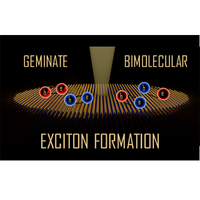
The optical properties of atomically thin semiconductors are dominated by excitons, tightly bound electron-hole pairs, which give rise to particularly rich and remarkable physics. Despite their importance, the microscopic formation mechanisms of excitons remain very poorly understood due to the complex interplay of concurrent phenomena occurring on an ultrafast timescale. Here, we investigate the exciton formation processes in 2D materials based on transition-metal dichalcogenide (TMD) monolayers using a technique based on the control of excitation light polarization. It allows us to distinguish between the two competing models of exciton formation: geminate and bimolecular formation. The geminate process is the direct formation of the exciton from the initially photogenerated electron-hole pair before the loss of correlation between them, whereas the bimolecular process corresponds to the random binding of free-electron-hole pairs from the initially photogenerated plasma. These processes control the exciton formation time. Our findings reveal that the luminescence intensity is higher by up to 40% for circularly polarized excitation compared to linearly polarized excitation for laser energy above the free-carrier gap. We show that this spin-dependent exciton emission is a fingerprint of the bimolecular formation process. Importantly, we observe that exciton linear polarization (valley coherence) persists even for laser excitation energies exceeding the gap. We demonstrate that it is the result of a fraction of excitons formed by a geminate process. This shows that two formation processes coexist for excitation energies above the gap, where both mechanisms operate concurrently. Similar results obtained on the two most emblematic materials of the TMD semiconductor family, and monolayers, confirm this dual formation mechanism. These findings overturn the prevailing simplistic view of purely geminate or bimolecular exciton formation and provide crucial insights into exciton physics and means to preserve spin or valley coherence. Our methodology can be applied to a broader range of semiconductor for investigating the intricate interplay between nonresonant excitation conditions, Coulomb interactions, electron-phonon couplings, excitonic dynamics, and quantum coherence.
Physics Subject Headings (PhySH)
Popular Summary
Excitons, bound pairs of electrons and holes, govern the optical behavior of atomically thin semiconductors such as and . A central question has been whether excitons form directly from the initial electron-hole pair, known as the geminate process, or randomly from a pool of free carriers, known as the bimolecular process. In this study, we resolve this debate by showing that excitons in 2D transition-metal dichalcogenide monolayers form through both pathways simultaneously.
To reveal this, we use polarized light to control how excitons are generated and analyze the resulting emission. For excitation energies above the free-carrier gap, we find that circularly polarized light produces up to 40% stronger exciton emission than linearly polarized light, a hallmark of the bimolecular mechanism. At the same time, we observe linearly polarized exciton emission even at energies above the gap, which indicates that geminate formation is also at play, since it preserves electron-hole correlations. We confirm this dual formation pathway in both and monolayers and support our findings with an analytical model that explains how the two processes contribute together.
Our results explain discrepancies in past ultrafast measurements and provide new tools for controlling exciton properties, such as spin and valley coherence, that are essential for quantum information processing. Looking forward, applying this approach to other nanostructures could guide the design of advanced optoelectronic devices and future quantum technologies.
Article Text
References (100)
- G. H. Wannier, The structure of electronic excitation levels in insulating crystals, Phys. Rev. 52, 191 (1937).
- R. J. Elliott, Intensity of optical absorption by excitons, Phys. Rev. 108, 1384 (1957).
- J. Shah, Ultrafast Spectroscopy of Semiconductors and Semiconductor Nanostructures (Springer, Berlin, Heidelberg, 1999), Vol. 115.
- E. L. Ivchenko, Optical Spectroscopy of Semiconductor Nanostructures (Alpha Science International Ltd, Oxford, 2005).
- C. Weisbuch, R. C. Miller, R. Dingle, A. C. Gossard, and W. Wiegman, Intrinsic radiative recombination from quantum states in multi-quantum well structures, Solid State Commun. 37, 219 (1981).
- S. Datta and X. Marie, Excitons and excitonic materials, MRS Bull. 49, 852 (2024).
- G. Wang, A. Chernikov, M. M. Glazov, T. F. Heinz, X. Marie, T. Amand, and B. Urbaszek, Colloquium: Excitons in atomically thin transition metal dichalcogenides, Rev. Mod. Phys. 90, 2 (2018).
- T. Amand, J. Collet, and B. S. Razbirin, Exciton dynamics in highly excited studied by picosecond gain-absorption spectroscopy, Phys. Rev. B 34, 2718 (1986).
- C. Piermarocchi, F. Tassone, V. Savona, A. Quattropani, and P. Schwendimann, Exciton formation rates in quantum wells, Phys. Rev. B 55, 1333 (1997).
- K. Siantidis, V. M. Axt, and T. Kuhn, Dynamics of exciton formation for near band-gap excitations, Phys. Rev. B 65, 035303 (2001).
- X. Xu, W. Yao, D. Xiao, and T. F. Heinz, Spin and pseudospins in layered transition metal dichalcogenides, Nat. Phys. 10, 343 (2014).
- J. Barrau, M. Heckmann, and M. Brousseau, Determination experimentale du coefficient de formation d’excitons dans le silicium, J. Phys. Chem. Solids 34, 381 (1973).
- T. C. Damen, J. Shah, D. Y. Oberli, D. S. Chemla, J. E. Cunningham, and J. M. Kuo, Dynamics of exciton formation and relaxation in quantum wells, Phys. Rev. B 42, 7434 (1990).
- T. Amand, B. Dareys, B. Baylac, X. Marie, J. Barrau, M. Brousseau, D. J. Dunstan, and R. Planel, Exciton formation and hole-spin relaxation in intrinsic quantum wells, Phys. Rev. B 50, 11624 (1994).
- D. Robart, X. Marie, B. Baylac, T. Amand, M. Brousseau, G. Bacquet, G. Debart, R. Planel, and J. M. Gerard, Dynamical equilibrium between excitons and free carriers in quantum wells, Solid State Commun. 95, 287 (1995).
- S. Grosse, R. Arnold, G. Von Plessen, M. Koch, J. Feldmann, V. M. Axt, T. Kuhn, R. Rettig, and W. Stolz, Relaxation dynamics of electron–hole pairs studied by spatiotemporal pump and probe experiments, Phys. Status Solidi (b) 204, 147 (1997).
- I.-K. Oh, J. Singh, A. Thilagam, and A. S. Vengurlekar, Exciton formation assisted by LO phonons in quantum wells, Phys. Rev. B 62, 2045 (2000).
- R. Strobel, R. Eccleston, J. Kuhl, and K. Köhler, Measurement of the exciton-formation time and the electron- and hole-tunneling times in a double-quantum-well structure, Phys. Rev. B 43, 12564 (1991).
- J. Szczytko, L. Kappei, J. Berney, F. Morier-Genoud, M. T. Portella-Oberli, and B. Deveaud, Determination of the exciton formation in quantum wells from time-resolved interband luminescence, Phys. Rev. Lett. 93, 137401 (2004).
- A. Amo, D. Ballarini, D. Sanvitto, E. Kozhemyakina, L. Viña, A. Lemaître, D. Bajoni, and J. Bloch, Optically induced ultrafast quenching of the semiconductor quantum well luminescence, Appl. Phys. Lett. 92, 061912 (2008).
- E. Kozhemyakina, K. Zhuravlev, A. Amo, and L. Viña, Exciton-formation time obtained from the spin splitting dynamics, J. Phys. Conf. Ser. 210, 012002 (2010).
- R. Kumar, A. S. Vengurlekar, A. Venu Gopal, T. Mélin, F. Laruelle, B. Etienne, and J. Shah, Exciton formation and relaxation dynamics in quantum wires, Phys. Rev. Lett. 81, 2578 (1998).
- I. Robel, B. A. Bunker, P. V. Kamat, and M. Kuno, Exciton recombination dynamics in nanowires: Bimolecular to three-carrier auger kinetics, Nano Lett. 6, 1344 (2006).
- C. K. Yong, H. J. Joyce, J. Lloyd-Hughes, Q. Gao, H. H. Tan, C. Jagadish, M. B. Johnston, and L. M. Herz, Ultrafast dynamics of exciton formation in semiconductor nanowires, Small 8, 1725 (2012).
- A. Bonnot, R. Planel, and C. B. À La Guillaume, Optical orientation of excitons in , Phys. Rev. B 9, 690 (1974).
- F. Ceballos, Q. Cui, M. Z. Bellus, and H. Zhao, Exciton formation in monolayer transition metal dichalcogenides, Nanoscale 8, 11681 (2016).
- A. Thilagam, Exciton formation assisted by longitudinal optical phonons in monolayer transition metal dichalcogenides, J. Appl. Phys. 120, 124306 (2016).
- P. Steinleitner, P. Merkl, P. Nagler, J. Mornhinweg, C. Schüller, T. Korn, A. Chernikov, and R. Huber, Direct observation of ultrafast exciton formation in a monolayer of , Nano Lett. 17, 1455 (2017).
- C. Trovatello, F. Katsch, N. J. Borys, M. Selig, K. Yao, R. Borrego-Varillas, F. Scotognella, I. Kriegel, A. Yan, A. Zettl et al., The ultrafast onset of exciton formation in 2D semiconductors, Nat. Commun. 11, 5277 (2020).
- S. Dong, M. Puppin, T. Pincelli, S. Beaulieu, D. Christiansen, H. Hübener, C. W. Nicholson, R. P. Xian, M. Dendzik, Y. Deng et al., Direct measurement of key exciton properties: Energy, dynamics, and spatial distribution of the wave function, Nat. Sci. 1, e10010 (2021).
- J. Madéo, M. K. L. Man, C. Sahoo, M. Campbell, V. Pareek, E. L. Wong, A. Al-Mahboob, N. S. Chan, A. Karmakar, B. M. K. Mariserla et al., Directly visualizing the momentum-forbidden dark excitons and their dynamics in atomically thin semiconductors, Science 370, 1199 (2020).
- T. Handa, M. Holbrook, N. Olsen, L. N. Holtzman, L. Huber, H. I. Wang, M. Bonn, K. Barmak, J. C. Hone, A. N. Pasupathy et al., Spontaneous exciton dissociation in transition metal dichalcogenide monolayers, Sci. Adv. 10, eadj4060 (2024).
- A. Chernikov, T. C. Berkelbach, H. M. Hill, A. Rigosi, Y. Li, B. Aslan, D. R. Reichman, M. S. Hybertsen, and T. F. Heinz, Exciton binding energy and nonhydrogenic Rydberg series in monolayer , Phys. Rev. Lett. 113, 076802 (2014).
- C. Robert, D. Lagarde, F. Cadiz, G. Wang, B. Lassagne, T. Amand, A. Balocchi, P. Renucci, S. Tongay, B. Urbaszek et al., Exciton radiative lifetime in transition metal dichalcogenide monolayers, Phys. Rev. B 93, 205423 (2016).
- S. Brem, M. Selig, G. Berghaeuser, and E. Malic, Exciton relaxation cascade in two-dimensional transition metal dichalcogenides, Sci. Rep. 8, 8238 (2018).
- M. Selig, G. Berghäuser, M. Richter, R. Bratschitsch, A. Knorr, and E. Malic, Dark and bright exciton formation, thermalization, and photoluminescence in monolayer transition metal dichalcogenides, 2D Mater. 5, 035017 (2018).
- R. Wallauer, R. Perea-Causin, L. Münster, S. Zajusch, S. Brem, J. Güdde, K. Tanimura, K.-Q. Lin, R. Huber, E. Malic et al., Momentum-resolved observation of exciton formation dynamics in monolayer , Nano Lett. 21, 5867 (2021).
- A. M. Jones, H. Yu, N. J. Ghimire, S. Wu, G. Aivazian, J. S. Ross, B. Zhao, J. Yan, D. G. Mandrus, D. Xiao et al., Optical generation of excitonic valley coherence in monolayer , Nat. Nanotechnol. 8, 634 (2013).
- G. Wang, X. Marie, I. Gerber, T. Amand, D. Lagarde, L. Bouet, M. Vidal, A. Balocchi, and B. Urbaszek, Giant enhancement of the optical second-harmonic emission of monolayers by laser excitation at exciton resonances, Phys. Rev. Lett. 114, 097403 (2015).
- R. Schmidt, A. Arora, G. Plechinger, P. Nagler, A. Granados Del Águila, M. V. Ballottin, P. C. M. Christianen, S. Michaelis De Vasconcellos, C. Schüller, T. Korn et al., Magnetic-field-induced rotation of polarized light emission from monolayer , Phys. Rev. Lett. 117, 077402 (2016).
- C. Robert, M. A. Semina, F. Cadiz, M. Manca, E. Courtade, T. Taniguchi, K. Watanabe, H. Cai, S. Tongay, B. Lassagne et al., Optical spectroscopy of excited exciton states in monolayers in van der Waals heterostructures, Phys. Rev. Mater. 2, 011001 (2018).
- K. F. Mak, D. Xiao, and J. Shan, Light–valley interactions in 2D semiconductors, Nat. Photonics 12, 451 (2018).
- G. Gupta, K. Watanabe, T. Taniguchi, and K. Majumdar, Observation of valley-coherent excitons in monolayer through giant enhancement of valley coherence time, Light Sci. Appl. 12, 173 (2023).
- N. V. Leppenen, L. E. Golub, and E. L. Ivchenko, Sommerfeld enhancement factor in two-dimensional Dirac materials, Phys. Rev. B 103, 235311 (2021).
- Q. Wei, X. Li, C. Liang, Z. Zhang, J. Guo, G. Hong, G. Xing, and W. Huang, Recent progress in metal halide perovskite micro- and nanolasers, Adv. Opt. Mater. 7, 1900080 (2019).
- T. T. H. Do, A. Granados Del Águila, D. Zhang, J. Xing, S. Liu, M. A. Prosnikov, W. Gao, K. Chang, P. C. M. Christianen, and Q. Xiong, Bright exciton fine-structure in two-dimensional lead halide perovskites, Nano Lett. 20, 5141 (2020).
- S. G. Motti, M. Kober-Czerny, M. Righetto, P. Holzhey, J. Smith, H. Kraus, H. J. Snaith, M. B. Johnston, and L. M. Herz, Exciton formation dynamics and band-like free charge-carrier transport in 2D metal halide perovskite semiconductors, Adv. Funct. Mater. 33, 2300363 (2023).
- E. Csányi, Y. Liu, S. D. Rezaei, H. Y. L. Lee, F. Tjiptoharsono, Z. Mahfoud, S. Gorelik, X. Zhao, L. J. Lim, D. Zhu et al., Engineering and controlling perovskite emissions via optical quasi-bound-states-in-the-continuum, Adv. Funct. Mater. 34, 2309539 (2024).
- X. Wang, A. M. Jones, K. L. Seyler, V. Tran, Y. Jia, H. Zhao, H. Wang, L. Yang, X. Xu, and F. Xia, Highly anisotropic and robust excitons in monolayer black phosphorus, Nat. Nanotechnol. 10, 517 (2015).
- M. Wurdack, N. Lundt, M. Klaas, V. Baumann, A. V. Kavokin, S. Höfling, and C. Schneider, Observation of hybrid Tamm-plasmon exciton- polaritons with quantum wells and a monolayer, Nat. Commun. 8, 259 (2017).
- Y. Shimazaki, I. Schwartz, K. Watanabe, T. Taniguchi, M. Kroner, and A. Imamoǧlu, Strongly correlated electrons and hybrid excitons in a moiré heterostructure, Nature (London) 580, 472 (2020).
- K. F. Mak and J. Shan, Semiconductor moiré materials, Nat. Nanotechnol. 17, 686 (2022).
- Optical Orientation, edited by F. Meier and B. P. Zakharchenia (North-Holland; Sole distributors for the U.S.A. and Canada, Elsevier Science Pub. Co, Amsterdam; New York: New York, 1984).
- M. R. Molas, C. Faugeras, A. O. Slobodeniuk, K. Nogajewski, M. Bartos, D. M. Basko, and M. Potemski, Brightening of dark excitons in monolayers of semiconducting transition metal dichalcogenides, 2D Mater. 4, 021003 (2017).
- M. He, P. Rivera, D. Van Tuan, N. P. Wilson, M. Yang, T. Taniguchi, K. Watanabe, J. Yan, D. G. Mandrus, H. Yu et al., Valley phonons and exciton complexes in a monolayer semiconductor, Nat. Commun. 11, 618 (2020).
- C. Robert, H. Dery, L. Ren, D. Van Tuan, E. Courtade, M. Yang, B. Urbaszek, D. Lagarde, K. Watanabe, T. Taniguchi et al., Measurement of conduction and valence bands g -factors in a transition metal dichalcogenide monolayer, Phys. Rev. Lett. 126, 6 (2021).
- J. P. Echeverry, B. Urbaszek, T. Amand, X. Marie, and I. C. Gerber, Splitting between bright and dark excitons in transition metal dichalcogenide monolayers, Phys. Rev. B 93, 121107 (2016).
- G. Wang, C. Robert, M. M. Glazov, F. Cadiz, E. Courtade, T. Amand, D. Lagarde, T. Taniguchi, K. Watanabe, B. Urbaszek et al., In-plane propagation of light in transition metal dichalcogenide monolayers: Optical selection rules, Phys. Rev. Lett. 119, 4 (2017).
- L. Ren, C. Robert, M. Glazov, M. Semina, T. Amand, L. Lombez, D. Lagarde, T. Taniguchi, K. Watanabe, and X. Marie, Control of the bright-dark exciton splitting using the Lamb shift in a two-dimensional semiconductor, Phys. Rev. Lett. 131, 116901 (2023).
- A. M. Jones, H. Yu, J. R. Schaibley, J. Yan, D. G. Mandrus, T. Taniguchi, K. Watanabe, H. Dery, W. Yao, and X. Xu, Excitonic luminescence upconversion in a two-dimensional semiconductor, Nat. Phys. 12, 323 (2016).
- E. Courtade, M. Semina, M. Manca, M. M. Glazov, C. Robert, F. Cadiz, G. Wang, T. Taniguchi, K. Watanabe, M. Pierre et al., Charged excitons in monolayer : Experiment and theory, Phys. Rev. B 96, 8 (2017).
- M. Yang, L. Ren, C. Robert, D. Van Tuan, L. Lombez, B. Urbaszek, X. Marie, and H. Dery, Relaxation and darkening of excitonic complexes in electrostatically doped monolayer : Roles of exciton-electron and trion-electron interactions, Phys. Rev. B 105, 8 (2022).
- A. V. Stier, N. P. Wilson, K. A. Velizhanin, J. Kono, X. Xu, and S. A. Crooker, Magnetooptics of exciton Rydberg states in a monolayer semiconductor, Phys. Rev. Lett. 120, 5 (2018).
- M. Goryca, J. Li, A. V. Stier, T. Taniguchi, K. Watanabe, E. Courtade, S. Shree, C. Robert, B. Urbaszek, X. Marie et al., Revealing exciton masses and dielectric properties of monolayer semiconductors with high magnetic fields, Nat. Commun. 10, 4172 (2019).
- D. Lagarde, M. Glazov, V. Jindal, K. Mourzidis, I. Gerber, A. Balocchi, L. Lombez, P. Renucci, T. Taniguchi, K. Watanabe et al., Efficient electron spin relaxation by chiral phonons in monolayers, Phys. Rev. B 110, 195403 (2024).
- C. Robert, S. Park, F. Cadiz, L. Lombez, L. Ren, H. Tornatzky, A. Rowe, D. Paget, F. Sirotti, M. Yang et al., Spin/valley pumping of resident electrons in and monolayers, Nat. Commun. 12, 5455 (2021).
- G. Wang, X. Marie, B. L. Liu, T. Amand, C. Robert, F. Cadiz, P. Renucci, and B. Urbaszek, Control of exciton valley coherence in transition metal dichalcogenide monolayers, Phys. Rev. Lett. 117, 187401 (2016).
- R. E. Worsley, N. J. Traynor, T. Grevatt, and R. T. Harley, Transient linear birefringence in quantum wells: Magnetic field dependence of coherent exciton spin dynamics, Phys. Rev. Lett. 76, 3224 (1996).
- Spin Physics in Semiconductors, edited by M. I. Dyakonov (Springer, Berlin, Heidelberg, 2008), Vol. 157.
- M. Amani, D.-H. Lien, D. Kiriya, J. Xiao, A. Azcatl, J. Noh, S. R. Madhvapathy, R. Addou, S. Kc, M. Dubey et al., Near-unity photoluminescence quantum yield in , Science 350, 1065 (2015).
- B. Han, C. Robert, E. Courtade, M. Manca, S. Shree, T. Amand, P. Renucci, T. Taniguchi, K. Watanabe, X. Marie et al., Exciton states in monolayer and probed by upconversion spectroscopy, Phys. Rev. X 8, 031073 (2018).
- C. Robert, B. Han, P. Kapuscinski, A. Delhomme, C. Faugeras, T. Amand, M. R. Molas, M. Bartos, K. Watanabe, T. Taniguchi et al., Measurement of the spin-forbidden dark excitons in and monolayers, Nat. Commun. 11, 4037 (2020).
- K. F. Mak, C. Lee, J. Hone, J. Shan, and T. F. Heinz, Atomically thin : A new direct-gap semiconductor, Phys. Rev. Lett. 105, 136805 (2010).
- M. Koperski, M. R. Molas, A. Arora, K. Nogajewski, A. O. Slobodeniuk, C. Faugeras, and M. Potemski, Optical properties of atomically thin transition metal dichalcogenides: Observations and puzzles, Nanophotonics 6, 6 (2017).
- M. Goryca, N. P. Wilson, P. Dey, X. Xu, and S. A. Crooker, Detection of thermodynamic “valley noise” in monolayer semiconductors: Access to intrinsic valley relaxation time scales, Sci. Adv. 5, eaau4899 (2019).
- J. Li, M. Goryca, K. Yumigeta, H. Li, S. Tongay, and S. A. Crooker, Valley relaxation of resident electrons and holes in a monolayer semiconductor: Dependence on carrier density and the role of substrate-induced disorder, Phys. Rev. Mater. 5, 4 (2021).
- Y. Song and H. Dery, Transport theory of monolayer transition-metal dichalcogenides through symmetry, Phys. Rev. Lett. 111, 2 (2013).
- H. Zhu, J. Yi, M.-Y. Li, J. Xiao, L. Zhang, C.-W. Yang, R. A. Kaindl, L.-J. Li, Y. Wang, and X. Zhang, Observation of chiral phonons, Science 359, 579 (2018).
- M. Z. Maialle, E. A. De Andrada E Silva, and L. J. Sham, Exciton spin dynamics in quantum wells, Phys. Rev. B 47, 15776 (1993).
- C. R. Zhu, K. Zhang, M. Glazov, B. Urbaszek, T. Amand, Z. W. Ji, B. L. Liu, and X. Marie, Exciton valley dynamics probed by Kerr rotation in monolayers, Phys. Rev. B 90, 161302 (2014).
- T. Yu and M. W. Wu, Valley depolarization dynamics and valley Hall effect of excitons in monolayer and bilayer , Phys. Rev. B 93, 045414 (2016).
- T. Korn, S. Heydrich, M. Hirmer, J. Schmutzler, and C. Schüller, Low-temperature photocarrier dynamics in monolayer , Appl. Phys. Lett. 99, 102109 (2011).
- H. H. Fang, B. Han, C. Robert, M. A. Semina, D. Lagarde, E. Courtade, T. Taniguchi, K. Watanabe, T. Amand, B. Urbaszek et al., Control of the exciton radiative lifetime in van der Waals heterostructures, Phys. Rev. Lett. 123, 067401 (2019).
- C. Rogers, D. Gray, N. Bogdanowicz, T. Taniguchi, K. Watanabe, and H. Mabuchi, Coherent feedback control of two-dimensional excitons, Phys. Rev. Res. 2, 1 (2020).
- Y. Zhou, G. Scuri, J. Sung, R. J. Gelly, D. S. Wild, K. De Greve, A. Y. Joe, T. Taniguchi, K. Watanabe, P. Kim et al., Controlling excitons in an atomically thin membrane with a mirror, Phys. Rev. Lett. 124, 2 (2020).
- Y. Tang, K. F. Mak, and J. Shan, Long valley lifetime of dark excitons in single-layer , Nat. Commun. 10, 4047 (2019).
- S. Permogorov, Hot excitons in semiconductors, Phys. Status Solidi (b) 68, 9 (1975).
- C. Weisbuch, Photocarrier thermalization by laser excitation spectroscopy, Solid-State Electron. 21, 179 (1978).
- D. W. Langer, Y. S. Park, and R. N. Euwema, Phonon coupling in edge emission and photoconductivity of , , and , Phys. Rev. 152, 788 (1966).
- P. W. M. Blom, P. J. Van Hall, C. Smit, J. P. Cuypers, and J. H. Wolter, Selective exciton formation in thin As quantum wells, Phys. Rev. Lett. 71, 3878 (1993).
- P. E. Selbmann, M. Gulia, F. Rossi, E. Molinari, and P. Lugli, Coupled free-carrier and exciton relaxation in optically excited semiconductors, Phys. Rev. B 54, 4660 (1996).
- Q. Cai, B. Wei, Q. Sun, A. H. Said, and C. Li, Monolayer-like lattice dynamics in bulk , Mater. Today Phys. 28, 100856 (2022).
- A. Molina-Sánchez and L. Wirtz, Phonons in single-layer and few-layer and , Phys. Rev. B 84, 155413 (2011).
- B. Miller, J. Lindlau, M. Bommert, A. Neumann, H. Yamaguchi, A. Holleitner, A. Högele, and U. Wurstbauer, Tuning the Fröhlich exciton-phonon scattering in monolayer , Nat. Commun. 10, 807 (2019).
- K. Gołasa, M. Grzeszczyk, P. Leszczyński, C. Faugeras, A. A. L. Nicolet, A. Wysmołek, M. Potemski, and A. Babiński, Multiphonon resonant Raman scattering in , Appl. Phys. Lett. 104, 092106 (2014).
- P. Le Jeune, X. Marie, T. Amand, F. Romstad, F. Perez, J. Barrau, and M. Brousseau, Spin-dependent exciton-exciton interactions in quantum wells, Phys. Rev. B 58, 4853 (1998).
- T. C. Sum, N. Mathews, G. Xing, S. S. Lim, W. K. Chong, D. Giovanni, and H. A. Dewi, Spectral features and charge dynamics of lead halide perovskites: Origins and interpretations, Acc. Chem. Res. 49, 294 (2016).
- A. Castellanos-Gomez, M. Buscema, R. Molenaar, V. Singh, L. Janssen, H. S. J. van der Zant, and G. A. Steele, Deterministic transfer of two-dimensional materials by all-dry viscoelastic stamping, 2D Mater. 1, 1 (2014).
- R. R. Parsons, Optical pumping and optical detection of spin-polarized electrons in a conduction band, Can. J. Phys. 49, 1850 (1971).
- A. Thränhardt, S. Kuckenburg, A. Knorr, T. Meier, and S. W. Koch, Quantum theory of phonon-assisted exciton formation and luminescence in semiconductor quantum wells, Phys. Rev. B 62, 2706 (2000).

