

- Open Access
Beyond Homes Scaling: Disorder, the Planckian Bound, and a New Universality
Phys. Rev. X 15, 041005 – Published 8 October, 2025
DOI: https://doi.org/10.1103/xbv7-3s3h
Abstract
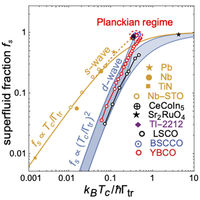
Beginning with high- cuprate materials, it has been observed that many superconductors exhibit so-called “Homes scaling,” in which the zero-temperature superfluid density is proportional to the product of the normal-state dc conductivity and the superconducting transition temperature . For conventional, -wave superconductors, such scaling has been shown to be a natural consequence of elastic-scattering disorder, not only in the extreme dirty limit, but across a broad range of scattering parameters. Here we show that when an analogous calculation is carried out for elastic scattering in -wave superconductors, a stark contrast emerges, with in the dirty limit, in apparent violation of Homes scaling. Within a simple approximate Migdal-Eliashberg treatment of inelastic scattering, we show how the observed Homes scaling is recovered. The normal-state behavior of near-optimally-doped cuprates is dominated by inelastic scattering, but significant deviations from Homes scaling occur for disorder-dominated cuprate systems, such as underdoped and overdoped , and in very clean materials with little inelastic scattering, such as . We present a revised analysis where both axes of the original Homes scaling plot are normalized by the Drude plasma weight and show that a new universal scaling emerges, in which the superfluid fractions of dirty -wave and dirty -wave superconductors coalesce to a single point at which normal-state scattering is occurring at the Planckian bound. The combined result is a new tool for classifying superconductors in terms of order parameter symmetry, as well as scattering strength and character. Although our model starts from a Fermi-liquid assumption, it describes underdoped cuprates surprisingly well.
Physics Subject Headings (PhySH)
Popular Summary
In condensed matter physics, understanding universal behavior across different materials helps reveal fundamental principles. One such universal relation is Homes scaling, which links the zero-temperature superfluid density of a superconductor to the product of its normal-state conductivity and critical temperature. While this relation holds for many materials, its theoretical origin has remained unclear, with existing explanations working only for certain classes of superconductors. In this study, we uncover a more fundamental form of universality by considering the effects of chemical impurities and inelastic scattering, showing that all superconductors can be classified in a unified framework when carrier density is properly accounted for.
We analyze superconductors with different symmetries of their electron pair wave functions, including those with zero and nonzero angular momentum. By incorporating both impurity scattering and inelastic scattering from fluctuations in the electronic liquid, we construct a revised scaling plot. This plot removes the influence of carrier density and reveals that all superconductors fall on one of two branches. Notably, Planckian-limit superconductors, where the scattering rate is comparable to the critical temperature, all collapse to the same point on the new plot. This approach highlights the role of scattering and symmetry in determining superfluid behavior across diverse materials.
Our findings provide a powerful classification scheme for superconductors, which can guide the discovery and characterization of new superconducting materials and may help identify which systems approach the Planckian limit.
Article Text
References (67)
- J. Bardeen, L. N. Cooper, and J. R. Schrieffer, Theory of superconductivity, Phys. Rev. 108, 1175 (1957).
- K. G. Wilson, The renormalization group: Critical phenomena and the Kondo problem, Rev. Mod. Phys. 47, 773 (1975).
- S. V. Dordevic, E. J. Singley, D. N. Basov, S. Komiya, Y. Ando, E. Bucher, C. C. Homes, and M. Strongin, Global trends in the interplane penetration depth of layered superconductors, Phys. Rev. B 65, 134511 (2002).
- C. C. Homes, S. V. Dordevic, M. Strongin, D. A. Bonn, R.-X. Liang, W. N. Hardy, S. Komiya, Y. Ando, G. Yu, N. Kaneko, X. Zhao, M. Greven, D. N. Basov, and T. Timusk, A universal scaling relation in high-temperature superconductors, Nature (London) 430, 539 (2004).
- J. Zaanen, Why the temperature is high, Nature (London) 430, 512 (2004).
- J. L. Tallon, J. R. Cooper, S. H. Naqib, and J. W. Loram, Scaling relation for the superfluid density of cuprate superconductors: Origins and limits, Phys. Rev. B 73, 180504(R) (2006).
- D. N. Basov and A. V. Chubukov, Manifesto for a higher , Nat. Phys. 7, 272 (2011).
- J. Erdmenger, P. Kerner, and S. Müller, Towards a holographic realization of Homes’ law, J. High Energy Phys. 10 (2012) 021.
- Y. Imry, M. Strongin, and C. C. Homes, correlations in granular superconductors, Phys. Rev. Lett. 109, 067003 (2012).
- C. C. Homes, S. V. Dordevic, T. Valla, and M. Strongin, Scaling of the superfluid density in high-temperature superconductors, Phys. Rev. B 72, 134517 (2005).
- V. G. Kogan, Homes scaling and BCS, Phys. Rev. B 87, 220507(R) (2013).
- S. V. Dordevic, D. N. Basov, and C. C. Homes, Do organic and other exotic superconductors fail universal scaling relations?, Sci. Rep. 3, 1713 (2013).
- A. J. Millis, S. Sachdev, and C. M. Varma, Inelastic scattering and pair breaking in anisotropic and isotropic superconductors, Phys. Rev. B 37, 4975 (1988).
- E. Schachinger, J. P. Carbotte, and F. Marsiglio, Effect of suppression of the inelastic scattering rate on the penetration depth and conductivity in a superconductor, Phys. Rev. B 56, 2738 (1997).
- S. A. Hartnoll and A. P. Mackenzie, Colloquium: Planckian dissipation in metals, Rev. Mod. Phys. 94, 041002 (2022).
- P. Romaniello, P. L. de Boeij, F. Carbone, and D. van der Marel, Optical properties of bcc transition metals in the range 0–40 eV, Phys. Rev. B 73, 075115 (2006).
- A. V. Pronin, M. Dressel, A. Pimenov, A. Loidl, I. V. Roshchin, and L. H. Greene, Direct observation of the superconducting energy gap developing in the conductivity spectra of niobium, Phys. Rev. B 57, 14416 (1998).
- O. Klein, E. J. Nicol, K. Holczer, and G. Grüner, Conductivity coherence factors in the conventional superconductors Nb and Pb, Phys. Rev. B 50, 6307 (1994).
- M. A. Ordal, R. J. Bell, R. W. Alexander, L. L. Long, and M. R. Querry, Optical properties of fourteen metals in the infrared and far infrared: Al, Co, Cu, Au, Fe, Pb, Mo, Ni, Pd, Pt, Ag, Ti, V, and W., Appl. Opt. 24, 4493 (1985).
- F. Pfuner, L. Degiorgi, T. I. Baturina, V. M. Vinokur, and M. R. Baklanov, Optical properties of thin films close to the superconductor–insulator transition, New J. Phys. 11, 113017 (2009).
- U. S. Pracht, M. Scheffler, M. Dressel, D. F. Kalok, C. Strunk, and T. I. Baturina, Direct observation of the superconducting gap in a thin film of titanium nitride using terahertz spectroscopy, Phys. Rev. B 86, 184503 (2012).
- D. van der Marel, J. L. M. van Mechelen, and I. I. Mazin, Common Fermi-liquid origin of resistivity and superconductivity in -type , Phys. Rev. B 84, 205111 (2011).
- M. Thiemann, M. H. Beutel, M. Dressel, N. R. Lee-Hone, D. M. Broun, E. Fillis-Tsirakis, H. Boschker, J. Mannhart, and M. Scheffler, Single-gap superconductivity and dome of superfluid density in Nb-doped , Phys. Rev. Lett. 120, 237002 (2018).
- M. A. Quijada, D. B. Tanner, F. C. Chou, D. C. Johnston, and S. W. Cheong, Optical properties of single-crystal , Phys. Rev. B 52, 15485 (1995).
- D. Tanner, H. Liu, M. Quijada, A. Zibold, H. Berger, R. Kelley, M. Onellion, F. Chou, D. Johnston, J. Rice, D. Ginsberg, and J. Markert, Superfluid and normal fluid density in high- superconductors, Physica (Amsterdam) 244B, 1 (1998).
- H. L. Liu, M. A. Quijada, A. M. Zibold, Y.-D. Yoon, D. B. Tanner, G. Cao, J. E. Crow, H. Berger, G. Margaritondo, L. Forró, B.-H. O, J. T. Markert, R. J. Kelly, and M. Onellion, Doping-induced change of optical properties in underdoped cuprate superconductors, J. Phys. Condens. Matter 11, 239 (1999).
- A. M. Zibold, D. B. Tanner, and H. Berger, Far-infrared study of superconducting , Physica (Amsterdam) 244B, 27 (1998).
- M. A. Quijada, D. B. Tanner, R. J. Kelley, M. Onellion, H. Berger, and G. Margaritondo, Anisotropy in the ab-plane optical properties of , Phys. Rev. B 60, 14917 (1999).
- F. Mahmood, X. He, I. Božović, and N. P. Armitage, Locating the missing superconducting electrons in the overdoped cuprates , Phys. Rev. Lett. 122, 027003 (2019).
- W. J. Padilla, Y. S. Lee, M. Dumm, G. Blumberg, S. Ono, K. Segawa, S. Komiya, Y. Ando, and D. N. Basov, Constant effective mass across the phase diagram of high- cuprates, Phys. Rev. B 72, 060511(R) (2005).
- D. M. Broun, W. A. Huttema, P. J. Turner, S. Özcan, B. Morgan, R. Liang, W. N. Hardy, and D. A. Bonn, Superfluid density in a highly underdoped superconductor, Phys. Rev. Lett. 99, 237003 (2007).
- A. Tamai et al., High-resolution photoemission on reveals correlation-enhanced effective spin-orbit coupling and dominantly local self-energies, Phys. Rev. X 9, 021048 (2019).
- R. Khasanov, A. Ramires, V. Grinenko, I. Shipulin, N. Kikugawa, D. A. Sokolov, J. A. Krieger, T. J. Hicken, Y. Maeno, H. Luetkens, and Z. Guguchia, In-plane magnetic penetration depth in : Muon-spin rotation and relaxation study, Phys. Rev. Lett. 131, 236001 (2023).
- J. F. Landaeta, K. Semeniuk, J. Aretz, K. R. Shirer, D. A. Sokolov, N. Kikugawa, Y. Maeno, I. Bonalde, J. Schmalian, A. P. Mackenzie, and E. Hassinger, Evidence for vertical line nodes in from nonlocal electrodynamics, Phys. Rev. B 110, L100503 (2024).
- M. E. Barber, A. S. Gibbs, Y. Maeno, A. P. Mackenzie, and C. W. Hicks, Resistivity in the vicinity of a van Hove singularity: under uniaxial pressure, Phys. Rev. Lett. 120, 076602 (2018).
- C. J. S. Truncik, W. A. Huttema, P. J. Turner, S. Özcan, N. C. Murphy, P. R. Carrière, E. Thewalt, K. J. Morse, A. J. Koenig, J. L. Sarrao, and D. M. Broun, Nodal quasiparticle dynamics in the heavy fermion superconductor revealed by precision microwave spectroscopy, Nat. Commun. 4, 2477 (2013).
- P. J. Hirschfeld, W. O. Putikka, and D. J. Scalapino, d-wave model for microwave response of high- superconductors, Phys. Rev. B 50, 10250 (1994).
- L. P. Gor’kov and P. A. Kalugin, Defects and an unusual superconductivity, JETP Lett. 41, 253 (1985), http://jetpletters.ru/ps/1444/article_21972.shtml.
- K. Ueda and T. M. Rice, Heavy electron superconductors—Some consequences of the p-wave pairing, in Theory of Heavy Fermions and Valence Fluctuations, edited by T. Kasuya and T. Saso (Springer, Berlin, Heidelberg, 1985), pp. 267–276, 10.1007/978-3-642-82618-4_20.
- S. Schmitt-Rink, K. Miyake, and C. M. Varma, Transport and thermal properties of heavy-fermion superconductors: A unified picture, Phys. Rev. Lett. 57, 2575 (1986).
- P. Hirschfeld, D. Vollhardt, and P. Wölfle, Resonant impurity scattering in heavy fermion superconductors, Solid State Commun. 59, 111 (1986).
- M. Prohammer and J. P. Carbotte, London penetration depth of -wave superconductors, Phys. Rev. B 43, 5370 (1991).
- S. B. Nam, Theory of electromagnetic properties of superconducting and normal systems. I, Phys. Rev. 156, 470 (1967).
- P. W. Anderson, Theory of dirty superconductors, J. Phys. Chem. Solids 11, 26 (1959).
- P. J. Hirschfeld and N. Goldenfeld, Effect of strong scattering on the low-temperature penetration depth of a -wave superconductor, Phys. Rev. B 48, 4219 (1993).
- E. J. Singley, D. N. Basov, E. D. Bauer, and M. B. Maple, Optical conductivity of the heavy fermion superconductor , Phys. Rev. B 65, 161101(R) (2002).
- W. Lee, D. Rainer, and W. Zimmermann, Holstein effect in the far-infrared conductivity of high superconductors, Physica (Amsterdam) 159C, 535 (1989).
- W. N. Hardy, D. A. Bonn, D. C. Morgan, R. Liang, and K. Zhang, Precision measurements of the temperature dependence of in : Strong evidence for nodes in the gap function, Phys. Rev. Lett. 70, 3999 (1993).
- V. J. Emery and S. A. Kivelson, Importance of phase fluctuations in superconductors with small superfluid density, Nature (London) 374, 434 (1995).
- M. C. Nuss, P. M. Mankiewich, M. L. O’Malley, E. H. Westerwick, and P. B. Littlewood, Dynamic conductivity and coherence peak in superconductors, Phys. Rev. Lett. 66, 3305 (1991).
- J. Corson, R. Mallozzi, J. Orenstein, J. N. Eckstein, and I. Božović, Vanishing of phase coherence in underdoped , Nature (London) 398, 221 (1999).
- L. S. Bilbro, R. V. Aguilar, G. Logvenov, O. Pelleg, I. Božović, and N. P. Armitage, Temporal correlations of superconductivity above the transition temperature in probed by terahertz spectroscopy, Nat. Phys. 7, 298 (2011).
- N. R. Lee-Hone, V. Mishra, D. M. Broun, and P. J. Hirschfeld, Optical conductivity of overdoped cuprate superconductors: Application to , Phys. Rev. B 98, 054506 (2018).
- T. Yoshida, X. J. Zhou, K. Tanaka, W. L. Yang, Z. Hussain, Z. X. Shen, A. Fujimori, S. Sahrakorpi, M. Lindroos, R. S. Markiewicz, A. Bansil, S. Komiya, Y. Ando, H. Eisaki, T. Kakeshita, and S. Uchida, Systematic doping evolution of the underlying Fermi surface of , Phys. Rev. B 74, 224510 (2006).
- G. Kim, K. S. Rabinovich, A. V. Boris, A. N. Yaresko, Y. E. Suyolcu, Y.-M. Wu, P. A. van Aken, G. Christiani, G. Logvenov, and B. Keimer, Optical conductivity and superconductivity in highly overdoped thin films, Proc. Natl. Acad. Sci. U.S.A. 118, e2106170118 (2021).
- L. D. Rotter, Z. Schlesinger, R. T. Collins, F. Holtzberg, C. Field, U. W. Welp, G. W. Crabtree, J. Z. Liu, Y. Fang, K. G. Vandervoort, and S. Fleshler, Dependence of the infrared properties of single-domain on oxygen content, Phys. Rev. Lett. 67, 2741 (1991).
- Y. Ando, S. Komiya, K. Segawa, S. Ono, and Y. Kurita, Electronic phase diagram of high- cuprate superconductors from a mapping of the in-plane resistivity curvature, Phys. Rev. Lett. 93, 267001 (2004).
- S. M. Quinlan, P. J. Hirschfeld, and D. J. Scalapino, Infrared conductivity of a -wave superconductor with impurity and spin-fluctuation scattering, Phys. Rev. B 53, 8575 (1996).
- W. Zimmermann, E. Brandt, M. Bauer, E. Seider, and L. Genzel, Optical conductivity of BCS superconductors with arbitrary purity, Physica (Amsterdam) 183C, 99 (1991).
- H. U. Özdemir, V. Mishra, N. R. Lee-Hone, X. Kong, T. Berlijn, D. M. Broun, and P. J. Hirschfeld, Effect of realistic out-of-plane dopant potentials on the superfluid density of overdoped cuprates, Phys. Rev. B 106, 184510 (2022).
- D. M. Broun, H. U. Özdemir, V. Mishra, N. R. Lee-Hone, X. Kong, T. Berlijn, and P. J. Hirschfeld, Optical conductivity of overdoped cuprates from ab initio out-of-plane impurity potentials, Phys. Rev. B 109, 174519 (2024).
- D. C. Mattis and J. Bardeen, Theory of the anomalous skin effect in normal and superconducting metals, Phys. Rev. 111, 412 (1958).
- T. Mori, E. J. Nicol, S. Shiizuka, K. Kuniyasu, T. Nojima, N. Toyota, and J. P. Carbotte, Optical self-energy of superconducting Pb in the terahertz region, Phys. Rev. B 77, 174515 (2008).
- N. R. Lee-Hone, J. S. Dodge, and D. M. Broun, Disorder and superfluid density in overdoped cuprate superconductors, Phys. Rev. B 96, 024501 (2017).
- N. R. Lee-Hone, H. U. Özdemir, V. Mishra, D. M. Broun, and P. J. Hirschfeld, Low energy phenomenology of the overdoped cuprates: Viability of the Landau–BCS paradigm, Phys. Rev. Res. 2, 013228 (2020).
- H. U. Özdemir, V. Mishra, N. R. Lee-Hone, X. Kong, T. Berlijn, D. M. Broun, and P. J. Hirschfeld, Comment on “Anisotropic scattering caused by apical oxygen vacancies in thin films of overdoped high-temperature cuprate superconductors”, Phys. Rev. Lett. 131, 049701 (2023).
- A. J. Millis, H. Monien, and D. Pines, Phenomenological model of nuclear relaxation in the normal state of , Phys. Rev. B 42, 167 (1990).

