

- Open Access
Experimental Signatures of a New Channel of the Deuteron-Deuteron Reaction at Very Low Energy
Phys. Rev. X 15, 041004 – Published 7 October, 2025
DOI: https://doi.org/10.1103/chlp-b215
Abstract
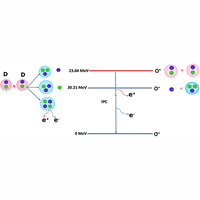
The discovery of a new, reaction channel in deuteron-deuteron (DD) fusion at very low energies might have major implications for understanding primordial and stellar nucleosynthesis, where electron-positron reaction channels are typically not considered. It could also enable research on metal hydride fusion, potentially paving the way for the design and construction of next-generation fusion energy sources. Following the first experimental indications of electron emission, we present here an extensive experimental study confirming emission of high-energy electrons from DD reaction at very low energy. A simultaneous use of Si charged particle detectors of different thicknesses and large-volume NaI(Tl) and HPGe detectors has allowed the determination of the branching ratios between emitted protons, neutrons, and pairs for deuteron energies down to 5 keV. The high-energy positrons could be unambiguously detected by their bremsstrahlung spectra and annihilation radiation, supported by the geant4 Monte Carlo simulations. The theoretical calculations, based on a destructive interference between the threshold resonance and the known broad resonance in , agree very well with experimentally observed increase of branching ratios for lowering projectile energies. The partial width of the threshold resonance for the internal pair creation should be at least 10 times larger than that of the proton channel.
Physics Subject Headings (PhySH)
Popular Summary
Deuteron-deuteron fusion reactions are essential for understanding the formation of the first light elements in the early Universe and for explaining how stars generate energy. However, the recently suggested threshold resonance in helium-4 can strongly increase their reaction rates at very low energies. In our study, we present extensive experimental evidence confirming a previously unobserved channel for this reaction: At deuteron energies below 5 keV, deuteron-deuteron fusion is dominated by the formation of this resonance, which then decays by emitting an electron-positron pair.
We use a low-energy accelerator to bombard a deuterium-implanted zirconium target with a deuteron beam, employing multiple detector types to simultaneously observe all reaction products. Thick silicon detectors enable us to distinguish the partial energy signature of the high-energy electron-positron pairs from the protons produced in conventional deuteron-deuteron fusion. For the first time, we also use large volume NaI(Tl) and HPGe detectors to observe the rays produced. These detectors provide unambiguous evidence of positron emission by measuring an excess of 511 keV photons from positron annihilation, as well as the bremsstrahlung radiation from the high-energy electron-positron pairs.
Theoretical calculations show excellent agreement with our data, indicating that the probability of this electron-positron decay is at least 10 times that of the standard proton channel. Taken together, our findings suggest that internal pair creation should be incorporated into future models of stellar nucleosynthesis. This work could also pave the way for new, clean fusion energy sources by using materials that enhance these low-energy reactions.
Article Text
References (37)
- W. A. Fowler, Experimental and theoretical nuclear astrophysics: The quest for the origin of the elements, Rev. Mod. Phys. 56, 149 (1984).
- C. Rolfs and W. S. Rodney, Cauldrons in the Cosmos (University of Chicago Press, Chicago, 1988).
- C. Iliadis, Nuclear Physics of Stars (Wiley-VCH Verlag GmbH & Co., Weinheim, 2015), Chap. 4, p. 323.
- Rachid Ouyed, W. R. Fundamenski, G. R. Cripps, and P. G. Sutherland, D-D fusion in the interior of Jupiter?, Astrophys. J. 501, 367 (1998).
- S. Ichimaru and H. Kitamura, Pycnonuclear reactions in dense astrophysical and fusion plasmas, Phys. Plasmas 6, 2649 (1999).
- K. Czerski, DD nuclear reactions at extremely low energies, Phys. Rev. C 106, L011601 (2022).
- K. Czerski, D. Weissbach, A. I. Kilic, G. Ruprecht, A. Huke, M. Kaczmarski, N. Targosz-Ślęczka, and K. Maass, Screening and resonance enhancements of the reaction yield in metallic environments, Europhys. Lett. 113, 22001 (2016).
- V. A. Sergeyev, New levels and the difference in angular distributions for the reactions and , Phys. Lett. 38B, 286 (1972).
- D. R. Tilley, H. R. Weller, and G. M. Hale, Energy levels of light nuclei , Nucl. Phys. A541, 1 (1992).
- K. Czerski, R. Dubey, M. Kaczmarski, A. Kowalska, N. Targosz-Ślęczka, G. Das Haridas, and M. Valat, Indications of electron emission from the DD threshold resonance, Phys. Rev. C 109, L021601 (2024).
- R. Dubey, K. Czerski, H. Gokul Das, M. Kaczmarski, A. Kowalska, N. Targosz-Ślęczkaczka, and M. Valat, Observation of a new decay channel of the DD threshold resonance, Acta Phys. Pol. B 17, 3-A35 (2024).
- A. Csótó and G. M. Hale, Nature of the first excited state of , Phys. Rev. C 55, 2366 (1997).
- E. Hiyama, B. F. Gibson, and M. Kamimura, Four-body calculation of the first excited state of using a realistic NN interaction: and the monopole sum rule, Phys. Rev. C 70, 031001(R) (2004).
- N. Michel, W. Nazarewicz, and M. Płoszajczak, Description of the proton-decaying resonance of the alpha particle, Phys. Rev. Lett. 131, 242502 (2023).
- H. M. Hoffmann and G. M. Hale, experiments can serve as a database for determining the three-nucleon force, Phys. Rev. C 77, 044002 (2008).
- K. Arai, S. Aoyama, Y. Suzuki, P. Descouvemont, and D. Baye, Tensor force manifestations in ab initio study of the , , and reactions, Phys. Rev. Lett. 107, 132502 (2011).
- S. Aoyama, K. Arai, Y. Suzuki, P. Descouvemont, and D. Baye, Tensor force manifestations in ab initio study of , Few-Body Syst. 52, 97 (2012).
- A. Cvetinović et al., Electron screening in palladium, Phys. Lett. B 838, 137684 (2023).
- A. Kowalska et al., Crystal lattice defects in deuterated Zr in the presence of O and C impurities studied by PAS and XRD for electron screening effect, Materials 16, 6255 (2023).
- M. Kaczmarski, A. I. Kilic, K. Czerski, A. Kowalska, D. Weissbach, N. Targosz-Sleczka, A. Huke, and G. Ruprecht, New accelerator facility for measurements of nuclear reactions at energies below 1 keV, Acta Phys. Pol. B 45, 509 (2014).
- H. Gokul Das, R. Dubey, K. Czerski, M. Kaczmarski, A. Kowalska, N. Targosz-Ślęczka, and M. Valat, High-energy electron measurements with thin Si detectors, Measurement 228, 114392 (2024).
- S. Agostinelli, Ll. Font, and C. Baixeras, geant4—A simulation toolkit, Nucl. Instrum. Methods Phys. Res., Sect. A 506, 186 (2003).
- R. Dubey, H. Gokul Das, K. Czerski, M. Kaczmarski, A. Kowalska, N. Targosz-Ślęczka, and M. Valat, Energy spectra assessment of , NE113, and NE213 scintillators in very low-energy fusion studies, Fusion Sci. Technol., 10.1080/15361055.2025.2520724 (2025).
- B. A. Faddegon, L. Van der Zwan, D. W. O. Rogers, and C. K. Ross, Precision response estimation, energy calibration, and unfolding of spectra measured with a large detector, Nucl. Instrum. Methods Phys. Res., Sect. A 301, 138 (1991).
- C. W. Sandifer and M. Taherzadeh, Measurement of linac thick-target bremsstrahlung spectra using a large scintillation spectrometer, IEEE Trans. Nucl. Sci. 15, 336 (1968).
- M. Morhac, Deconvolution methods and their applications in the analysis of -ray spectra, Nucl. Instrum. Methods Phys. Res., Sect. A 559, 119 (2006).
- Y. Nagai, T. Kikuchi, T. Kii, T. S. Suzuki, T. Murakami, T. Shima, and T. Ohsaki, reaction in due to cosmic-ray muon capture by Pb, Nucl. Instrum. Methods Phys. Res., Sect. A 368, 498 (1996).
- C. Hagmann, D. Lange, and D. Wright, Cosmic-ray shower generator (CRY) for Monte Carlo transport codes, in Proceedings of the IEEE Nuclear Science Symposium and Medical Imaging Conference (NSS/MIC 2007): Honolulu, Hawaii, (2007), p. 1143.
- Joseph W. Fowler et al., Spectroscopic measurements and models of energy deposition in the substrate of quantum circuits by natural ionizing radiation, PRX Quantum 5, 040323 (2024).
- M. B. Chadwick et al., ENDF/B-VII.0: Next generation evaluated nuclear data library for nuclear science and technology, Nucl. Data Sheets 107, 2931 (2006).
- A. I. Blokhin, E. V. Gai, A. V. Ignatyuk, I. I. Koba, V. N. Manokhin, and V. G. Pronyaev, New version of neutron evaluated data library BROND-3.1, Probl. At. Sci. Technol. Ser. Nucl. React. Constants 2, 2 (2016).
- A. A. J. M. Plompen, O. Cabellos, C. De Saint Jean, M. Fleming, A. Algora, M. Angelone, P. Archier, E. Bauge, O. Bersillon, A. Blokhin, and F. Cantargi, The joint evaluated fission and fusion nuclear data library, JEFF-3.3, Eur. Phys. J. A 56, 181 (2020).
- O. Iwamoto, K. Shibata, N. Iwamoto, S. Kunieda, F. Minato, A. Ichihara, and S. Nakayama, Status of the JENDL project, EPJ Web Conf. 146, 02005 (2017).
- Reference database for neutron activation analysis, International Atomic Energy Agency, https://www-nds.iaea.org/naa/.
- K. Bergaoui, N. Reguigui, C. K. Gary, C. Brown, J. T. Cremer, J. H. Vainionpaa, and M. A. Piestrup, Monte Carlo simulation of explosive detection system based on a deuterium–deuterium (D-D) neutron generator, Appl. Radiat. Isot. 94, 118 (2014).
- R. Dubey, K. Czerski, H. Gokul Das, M. Kaczmarski, A. Kowalska, N. Targosz-Ślęczka, and M. Valat, Observation of electron emissions from the DD reaction: Its implications in fundamental and applied research, Acta Phys. Pol. A 146, 5 (2024).
- K. Czerski, R. Dubey, M. Kaczmarski, A. Kowalska, N. Targosz-Ślęczka, G. Das Haridas, and M. Valat, Observation of thermal deuteron-deuteron fusion in ion tracks, arXiv:2409.02112.

