

- Open Access
Experimental Demonstration of High-Fidelity Logical Magic States from Code Switching
Phys. Rev. X 15, 041008 – Published 14 October, 2025
DOI: https://doi.org/10.1103/dck4-x9c2
Abstract
Preparation of high-fidelity logical magic states has remained as a necessary but daunting step towards building a large-scale fault-tolerant quantum computer. One approach is to fault-tolerantly prepare a magic state in one code and then switch to another, a method known as code switching. We experimentally demonstrate this protocol on an ion-trap quantum processor, yielding a logical magic state encoded in an error-correcting code with state-of-the-art logical fidelity. Our experiment is based on the first demonstration of code switching between color codes, from the fifteen-qubit quantum Reed-Muller code to the seven-qubit Steane code. We prepare an encoded magic state in the Steane code with 82.58% probability, with an infidelity of at most . The reported infidelity is lower than the leading infidelity of the physical operations utilized in the protocol by a factor of at least 2.7, indicating the quantum processor is below the pseudothreshold. Furthermore, we create two copies of the magic state in the same quantum processor and perform a logical Bell basis measurement for a sample-efficient certification of the encoded magic state. The high-fidelity magic state can be combined with the already-demonstrated fault-tolerant Clifford gates, state preparation, and measurement of the 2D color code, completing a universal set of fault-tolerant computational primitives with logical error rates equal or better than the physical two-qubit error rate.
Physics Subject Headings (PhySH)
Popular Summary
One of the biggest challenges in building a large-scale quantum computer is dealing with environmental noise, which can damage fragile quantum states. While scientists have shown that it is possible to detect and remove noise, one critical step has remained especially difficult: creating a reliable “magic state,” a type of quantum state required for universal computation. Earlier studies predicted that producing such states would be extremely expensive, using far more resources than other parts of the computation. In this study, we show that this bottleneck can be reduced much more effectively than previously thought.
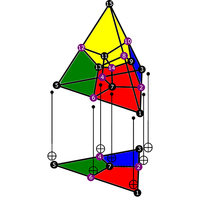
We demonstrate this by creating the most reliable magic state yet encoded in any quantum error-correcting code, using a trapped-ion quantum processor. Our method relies on a process called code switching between color codes. These codes can be thought of as a duo with different strengths: The 3D color code can more easily generate magic while the 2D one can more effectively combat noise. We prepare the magic state in the 3D color code, then switch it to a 2D one, ensuring the magic generated by the 3D code gets protected by its 2D companion. This not only produces a high-quality magic state but also marks the first experimental demonstration of code switching between color codes, as well as the first efficient experimental method for characterizing a magic state.
Our results show that generating reliable magic states does not require the huge overhead previously expected. Looking ahead, our approach could help accelerate the development of practical quantum computers, bringing us closer to solving problems that are intractable for classical machines.
Article Text
References (53)
- P. Shor, Algorithms for quantum computation: Discrete logarithms and factoring, in Proceedings 35th Annual Symposium on Foundations of Computer Science, Santa Fe, NM, USA (1994), pp. 124–134, 10.1109/SFCS.1994.365700.
- S. Lloyd, Universal quantum simulators, Science 273, 1073 (1996).
- J. Preskill, Quantum computing in the NISQ era and beyond, Quantum 2, 79 (2018).
- D. Aharonov and M. Ben-Or, Fault-tolerant quantum computation with constant error, in Proceedings of the Twenty-Ninth Annual ACM Symposium on Theory of Computing, STOC ’97 (Association for Computing Machinery, New York, USA, 1997), pp. 176–188, 10.1145/258533.258579.
- C. Ryan-Anderson et al., Realization of real-time fault-tolerant quantum error correction, Phys. Rev. X 11, 041058 (2021).
- A. Erhard et al., Entangling logical qubits with lattice surgery, Nature (London) 589, 220 (2021).
- L. Postler et al., Demonstration of fault-tolerant universal quantum gate operations, Nature (London) 605, 675 (2022).
- D. Bluvstein et al., Logical quantum processor based on reconfigurable atom arrays, Nature (London) 626, 58 (2024).
- R. Acharya et al., Suppressing quantum errors by scaling a surface code logical qubit, Nature (London) 614, 678 (2023).
- B. W. Reichardt et al., Demonstration of quantum computation and error correction with a tesseract code, arXiv:2409.04628.
- B. W. Reichardt et al., Logical computation demonstrated with a neutral atom quantum processor, arXiv:2411.11822.
- A. Paetznick et al., Demonstration of logical qubits and repeated error correction with better-than-physical error rates, arXiv:2404.02280.
- K. Mayer et al., Benchmarking logical three-qubit quantum Fourier transform encoded in the Steane code on a trapped-ion quantum computer, arXiv:2404.08616.
- S. Bravyi and A. Kitaev, Universal quantum computation with ideal Clifford gates and noisy ancillas, Phys. Rev. A 71, 022316 (2005).
- D. Litinski, Magic state distillation: Not as costly as you think, Quantum 3, 205 (2019).
- J. T. Anderson, G. Duclos-Cianci, and D. Poulin, Fault-tolerant conversion between the Steane and Reed-Muller quantum codes, Phys. Rev. Lett. 113, 080501 (2014).
- H. Bombín, Dimensional jump in quantum error correction, New J. Phys. 18, 043038 (2016).
- M. E. Beverland, A. Kubica, and K. M. Svore, Cost of universality: A comparative study of the overhead of state distillation and code switching with color codes, PRX Quantum 2, 020341 (2021).
- I. Pogorelov, F. Butt, L. Postler, C. D. Marciniak, P. Schindler, M. Müller, and T. Monz, Experimental fault-tolerant code switching, Nat. Phys. 21, 298 (2025).
- L. Daguerre and I. H. Kim, Code switching revisited: Low-overhead magic state preparation using color codes, Phys. Rev. Res. 7, 023080 (2025).
- H. Bombin and M. A. Martin-Delgado, Topological quantum distillation, Phys. Rev. Lett. 97, 180501 (2006).
- H. Bombin and M. A. Martin-Delgado, Topological computation without braiding, Phys. Rev. Lett. 98, 160502 (2007).
- A. Steane, Quantum Reed-Muller codes, arXiv:quant-ph/9608026.
- A. Steane, Multiple particle interference and quantum error correction, Proc. R. Soc. A 452, 2551 (1996).
- L. Egan et al., Fault-tolerant control of an error-corrected qubit, Nature (London) 598, 281 (2021).
- J. F. Marques et al., Logical-qubit operations in an error-detecting surface code, Nat. Phys. 18, 80 (2022).
- R. S. Gupta et al., Encoding a magic state with beyond break-even fidelity, Nature (London) 625, 259 (2024).
- Y. Ye et al., Logical magic state preparation with fidelity beyond the distillation threshold on a superconducting quantum processor, Phys. Rev. Lett. 131, 210603 (2023).
- Y. Kim, M. Sevior, and M. Usman, Magic state injection on IBM quantum processors above the distillation threshold, arXiv:2412.01446.
- P. S. Rodriguez et al., Experimental demonstration of logical magic state distillation, arXiv:2412.15165.
- N. Lacroix et al., Scaling and logic in the color code on a superconducting quantum processor, arXiv:2412.14256.
- S. Dasu, S. Burton, K. Mayer, D. Amaro, J. A. Gerber, K. Gilmore, D. Gresh, A. C. Potter, and D. Hayes, Breaking even with magic: demonstration of a high-fidelity logical non-Clifford gate, arXiv:2506.14688.
- S.-u. Lee, M. Yuan, S. Chen, K. Tsubouchi, and L. Jiang, Efficient benchmarking of logical magic state, arXiv:2505.09687.
- B. Eastin and E. Knill, Restrictions on transversal encoded quantum gate sets, Phys. Rev. Lett. 102, 110502 (2009).
- S. Bravyi and R. Konig, Classification of topologically protected gates for local stabilizer codes, Phys. Rev. Lett. 110, 170503 (2013).
- X. Zhou, D. W. Leung, and I. L. Chuang, Methodology for quantum logic gate construction, Phys. Rev. A 62, 052316 (2000).
- R. Chao and B. W. Reichardt, Quantum error correction with only two extra qubits, Phys. Rev. Lett. 121, 050502 (Aug, 2018).
- H. Goto, Minimizing resource overheads for fault-tolerant preparation of encoded states of the Steane code, Sci. Rep. 6, 19578 (2016).
- F. Butt, S. Heußen, M. Rispler, and M. Müller, Fault-tolerant code-switching protocols for near-term quantum processors, PRX Quantum 5, 020345 (2024).
- M. Sullivan, Code conversion with the quantum Golay code for a universal transversal gate set, Phys. Rev. A 109, 042416 (2024).
- S. Heußen and J. Hilder, Efficient fault-tolerant code switching via one-way transversal cnot gates, arXiv:2409.13465.
- A. Barenco, A. Berthiaume, D. Deutsch, A. Ekert, R. Jozsa, and C. Macchiavello, Stabilization of quantum computations by symmetrization, SIAM J. Comput. 26, 1541 (2006).
- D. J. Wineland, C. Monroe, W. M. Itano, D. Leibfried, B. E. King, and D. M. Meekhof, Experimental issues in coherent quantum state manipulation of trapped atomic ions, J. Res. Natl. Inst. Stand. Technol. 103, 259 (1998).
- S. A. Moses et al., A race-track trapped-ion quantum processor, Phys. Rev. X 13, 041052 (2023).
- E. T. Campbell, Early fault-tolerant simulations of the Hubbard model, Quantum Sci. Technol. 7, 015007 (2022).
- M. Reiher, N. Wiebe, K. M. Svore, D. Wecker, and M. Troyer, Elucidating reaction mechanisms on quantum computers, Proc. Natl. Acad. Sci. U.S.A. 114, 7555 (2017).
- Z. Li, J. Li, N. S. Dattani, C. J. Umrigar, and G. K.-L. Chan, The electronic complexity of the ground-state of the cofactor of nitrogenase as relevant to quantum simulations, J. Chem. Phys. 150, 024302 (2019).
- G. H. Low, R. King, D. W. Berry, Q. Han, A. E. DePrince, A. White, R. Babbush, R. D. Somma, and N. C. Rubin, Fast quantum simulation of electronic structure by spectrum amplification, arXiv:2502.15882.
- T. Itogawa, Y. Takada, Y. Hirano, and K. Fujii, Even more efficient magic state distillation by zero-level distillation, arXiv:2403.03991.
- C. Gidney, N. Shutty, and C. Jones, Magic state cultivation: Growing T states as cheap as cnot gates, arXiv:2409.17595.
- C. M. Löschnauer et al., Scalable, high-fidelity all-electronic control of trapped-ion qubits, arXiv:2407.07694.
- A. Kubica, B. Yoshida, and F. Pastawski, Unfolding the color code, New J. Phys. 17, 083026 (2015).
- J. A. Hanley and A. Lippman-Hand, If nothing goes wrong, is everything all right? Interpreting zero numerators, JAMA, J. Am. Med. Assoc. 249, 1743 (1983).

