

- Featured in Physics
- Open Access
Radon Removal in XENONnT down to the Solar Neutrino Level
Phys. Rev. X 15, 031079 – Published 30 September, 2025
DOI: https://doi.org/10.1103/zc1w-88p6
Abstract
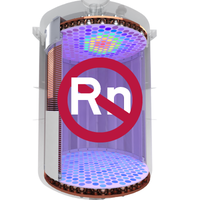
The XENONnT experiment has achieved an exceptionally low activity concentration within its inner 5.9 tonne liquid xenon detector of , equivalent to about 430 atoms per tonne of xenon. This was achieved by active online radon removal via cryogenic distillation after stringent material selection. The achieved activity concentration is 5 times lower than that in other currently operational multitonne liquid xenon detectors engaged in dark matter searches. This breakthrough enables the pursuit of various rare event searches that lie beyond the confines of the standard model of particle physics, with world-leading sensitivity. The ultralow levels have diminished the radon-induced background rate in the detector to a point where it is for the first time comparable to the solar neutrino-induced background, which is poised to become the primary irreducible background in liquid xenon-based detectors.
Physics Subject Headings (PhySH)
 synopsis

Dark-Matter Sensitivity Improved with a Xenon Still
The most troublesome contaminant in dark-matter searches that use xenon can be removed using a centuries-old concept.
See more in Physics
Popular Summary
Why construct a massive, 10 tonne liquid xenon detector operating at a frigid 178 K deep underground? Scientists are on the hunt for incredibly rare particle interactions that could unveil the nature of dark matter. However, tiny amounts of natural radioactivity generate background noise that can obscure these faint signals. The XENONnT experiment has made significant progress by dramatically reducing one of the most troublesome contaminants: radon.
The detector’s ability to uncover new physics hinges on exceptional purity of the liquid xenon. Even trace amounts of dissolved radon can produce light flashes that mimic the sought-after signals. Since radon is a by-product of long-lived isotopes dating back to the early solar system, it is found in nearly all materials, accounting for a significant portion of the natural radiation exposure to humans. To combat this issue, the XENONnT team developed a cryogenic distillation system that continuously purifies the xenon, specifically targeting radon. This process achieves a concentration of about 430 radon atoms per tonne of liquid xenon. Remarkably, the detector’s radioactivity from radon is only 1 billionth of the radioactivity found in a human body and is even lower than the neutrino background from the sun.
This achievement is crucial for the future of low-background science. It demonstrates the potential of advanced purification techniques, paving the way for larger, more sensitive detectors. By creating such a radio-pure environment, XENONnT brings the field closer to uncovering dark matter and exploring new frontiers in particle physics.
Article Text
References (55)
- E. Aprile et al. (XENON Collaboration), The XENONnT dark matter experiment, Eur. Phys. J. C 84, 784 (2024).
- E. Aprile et al. (XENON Collaboration), First dark matter search with nuclear recoils from the XENONnT experiment, Phys. Rev. Lett. 131, 041003 (2023).
- E. Aprile et al. (XENON Collaboration), Search for new physics in electronic recoil data from XENONnT, Phys. Rev. Lett. 129, 161805 (2022).
- D. S. Akerib et al., The LUX-ZEPLIN (LZ) experiment, Nucl. Instrum. Methods Phys. Res., Sect. A 953, 163047 (2020).
- J. Aalbers et al., First dark matter search results from the LUX-ZEPLIN (LZ) experiment, Phys. Rev. Lett. 131, 041002 (2023).
- Yue Meng et al., Dark matter search results from the PandaX-4T commissioning run, Phys. Rev. Lett. 127, 261802 (2021).
- P. Agnes et al., DarkSide-50 532-day dark matter search with low-radioactivity argon, Phys. Rev. D 98, 102006 (2018).
- Gianfranco Bertone, Dan Hooper, and Joseph Silk, Particle dark matter: Evidence, candidates and constraints, Phys. Rep. 405, 279 (2005).
- Leszek Roszkowski, Enrico Maria Sessolo, and Sebastian Trojanowski, WIMP dark matter candidates and searches—Current status and future prospects, Rep. Prog. Phys. 81, 066201 (2018).
- E. Aprile et al. (XENON Collaboration), Design and performance of the XENON10 dark matter experiment, Astropart. Phys. 34, 679 (2011).
- E. Aprile et al., The XENON100 dark matter experiment, Astropart. Phys. 35, 573 (2012).
- E. Aprile et al. (XENON Collaboration), The XENON1T dark matter experiment, Eur. Phys. J. C 77, 881 (2017).
- G. J. Alner et al., First limits on WIMP nuclear recoil signals in ZEPLIN-II: A two-phase xenon detector for dark matter detection, Astropart. Phys. 28, 287 (2007).
- D. Yu. Akimov et al., The ZEPLIN-III dark matter detector: Instrument design, manufacture and commissioning, Astropart. Phys. 27, 46 (2007).
- D. S. Akerib et al., The Large Underground Xenon (LUX) experiment, Nucl. Instrum. Methods Phys. Res., Sect. A 704, 111 (2013).
- Laura Baudis, Dual-phase xenon time projection chambers for rare-event searches, Phil. Trans. R. Soc. A 382, 20230083 (2023).
- C. E Aalseth et al., DarkSide-20k: A 20 tonne two-phase LAr TPC for direct dark matter detection at LNGS, Eur. Phys. J. Plus 133, 131 (2018).
- Matteo Agostini, Giovanni Benato, Jason A. Detwiler, Javier Menéndez, and Francesco Vissani, Toward the discovery of matter creation with neutrinoless decay, Rev. Mod. Phys. 95, 025002 (2023).
- J. Martín-Albo et al. (NEXT Collaboration), Sensitivity of NEXT-100 to neutrinoless double beta decay, J. High Energy Phys. 05 (2016) 159.
- M. Auger et al., The EXO-200 detector, part I: Detector design and construction, J. Instrum. 7, P05010 (2012).
- G. Adhikari et al., nEXO: Neutrinoless double beta decay search beyond half-life sensitivity, J. Phys. G 49, 015104 (2021).
- E. Aprile et al. (XENON Collaboration), Observation of two-neutrino double electron capture in with XENON1T, Nature (London) 568, 532 (2019).
- E. Aprile et al. (XENON Collaboration), Double-weak decays of and in the XENON1T and XENONnT experiments, Phys. Rev. C 106, 024328 (2022).
- E. Aprile et al. (XENON Collaboration), Removing krypton from xenon by cryogenic distillation to the ppq level, Eur. Phys. J. C 77, 275 (2017).
- ENSDF database, http://www.nndc.bnl.gov/ensarchivals/ (2023).
- E. Aprile et al. (XENON Collaboration), Offline tagging of radon-induced backgrounds in XENON1T and applicability to other liquid xenon time projection chambers, Phys. Rev. D 110, 012011 (2024).
- J. Aalbers et al. (LZ Collaboration), Dark matter search results from of exposure of the LUX-ZEPLIN (LZ) experiment, Phys. Rev. Lett. 135, 011802 (2025).
- Ethan Brown et al., Magnetically-coupled piston pump for high-purity gas applications, Eur. Phys. J. C 78, 604 (2018).
- E. Aprile et al. (XENON Collaboration), emanation measurements for the XENON1T experiment, Eur. Phys. J. C 81, 337 (2021).
- J. Aalbers et al., A next-generation liquid xenon observatory for dark matter and neutrino physics, J. Phys. G 50, 013001 (2023).
- G. Plante, E. Aprile, J. Howlett, and Y. Zhang, Liquid-phase purification for multi-tonne xenon detectors, Eur. Phys. J. C 82, 860 (2022).
- E. Aprile et al. (XENON Collaboration), Material radiopurity control in the XENONnT experiment, Eur. Phys. J. C 82, 599 (2022).
- M. Murra, D. Schulte, C. Huhmann, and C. Weinheimer, Design, construction and commissioning of a high-flow radon removal system for XENONnT, Eur. Phys. J. C 82, 1104 (2022).
- Eric W. Lemmon, Ian H. Bell, Marcia L. Huber, and Mark O. McLinden, Thermophysical Properties of Fluid Systems, edited by P. J. Linstrom and W. G. Mallard, NIST Chemistry WebBook, NIST Standard Reference Database Number 69 (National Institute of Standards and Technology, Gaithersburg, MD, 2024).
- M. Murra et al., Cryogenic bath-type heat exchangers for ultra-pure noble gas applications, J. Instrum. 17, P05037 (2022).
- D. Schulte et al., Ultra-clean radon-free four cylinder magnetically-coupled piston pump, J. Instrum. 16, P09011 (2021).
- M.-M. Bé, V. Chisté, C. Dulieu, E. Browne, V. Chechev, N. Kuzmenko, F. Kondev, A. Luca, M. Galán, A. Pearce, and X. Huang, Table of Radionuclides, Monographie BIPM-5 (Bureau International des Poids et Mesures, Pavillon de Breteuil, F-92310 Sèvres, France, 2008), Vol. 4.
- J. F. Ziegler, M. D. Ziegler, and J. P. Biersack, SRIM—The stopping and range of ions in matter, Nucl. Instrum. Methods Phys. Res., Sect. B 268, 1818 (2010).
- E. Aprile et al. (XENON Collaboration), XENONnT analysis: Signal reconstruction, calibration and event selection, Phys. Rev. D 111, 062006 (2025).
- E. Aprile et al. (XENON Collaboration), First indication of solar neutrinos via coherent elastic neutrino-nucleus scattering with XENONnT, Phys. Rev. Lett. 133, 191002 (2024).
- Matteo Guida, Position reconstruction based on prompt scintillation light in XENONnT exploiting deep learning, Master’s thesis, Padua University, 2021.
- J. Aalbers et al. (XLZD Collaboration), The XLZD design book: Towards the next-generation liquid xenon observatory for dark matter and neutrino physics, arXiv:2410.17137.
- E. Aprile et al. (XENON100 Collaboration), Online removal by cryogenic distillation in the XENON100 experiment, Eur. Phys. J. C 77, 358 (2017).
- J. B. Albert et al. (EXO-200 Collaboration), Investigation of radioactivity-induced backgrounds in EXO-200, Phys. Rev. C 92, 015503 (2015).
- A. Bradley et al., Radon-related backgrounds in the LUX dark matter search, Phys. Procedia 61, 658 (2015); Proceedings of the 13th International Conference on Topics in Astroparticle and Underground Physics, TAUP 2013, Phys. Dark Universe 4, 1 (2014).
- A. Tan et al. (PandaX-II Collaboration), Dark matter results from first 98.7 days of data from the PandaX-II experiment, Phys. Rev. Lett. 117, 121303 (2016).
- K. Abe et al., XMASS detector, Nucl. Instrum. Methods Phys. Res., Sect. A 716, 78 (2013).
- J. Aalbers et al. (The LUX-ZEPLIN Collaboration), Background determination for the LUX-ZEPLIN dark matter experiment, Phys. Rev. D 108, 012010 (2023).
- Abdusalam Abdukerim et al. (PandaX Collaboration), PandaX-xT: A multi-ten-tonne liquid xenon observatory at the China Jinping Underground Laboratory, Sci. China Phys. Mech. Astron. 68, 221011 (2025).
- J.-W. Chen et al., Low-energy electronic recoil in xenon detectors by solar neutrinos, Phys. Lett. B 774, 656 (2017).
- F. Jörg et al., Production and characterization of a -emanating stainless steel source, Appl. Radiat. Isot. 194, 110666 (2023).
- M. Agostini et al. (BOREXINO Collaboration), Comprehensive measurement of pp-chain solar neutrinos with Borexino, Proc. Sci., EPS-HEP2019 (2020) 400.
- Z. Bo et al. (PandaX Collaboration), First indication of solar neutrino flux through coherent elastic neutrino-nucleus scattering in PandaX-4T, Phys. Rev. Lett. 133, 191001 (2024).
- European Research Council Advanced Grant, Low radon and low internal radioactivity for dark matter and rare event xenon detectors (2022), 10.3030/101055063.
- Ciaran A. J. O’Hare, New definition of the neutrino floor for direct dark matter searches, Phys. Rev. Lett. 127, 251802 (2021).

