

- Open Access
High-Performance and Reliable Probabilistic Ising Machine Based on Simulated Quantum Annealing
Phys. Rev. X 15, 041001 – Published 1 October, 2025
DOI: https://doi.org/10.1103/pcmz-w776
Abstract
Probabilistic computing with p-bits is emerging as a computational paradigm for machine learning and for facing combinatorial optimization problems (COPs) with the so-called probabilistic Ising machines (PIMs). From a hardware point of view, the key elements that characterize a PIM are the random number generation, the nonlinearity, the network of coupled probabilistic bits, and the energy-minimization algorithm. Regarding the energy-minimization algorithm in this work we show that PIMs using the simulated quantum annealing (SQA) schedule exhibit better performance as compared to simulated annealing and parallel tempering in solving a number of COPs, such as maximum satisfiability problems, the planted Ising problem, and the traveling salesman problem. Additionally, we design and simulate the architecture of a fully connected CMOS-based PIM that is able to run the SQA algorithm having a spin-update time of 8 ns with a power consumption of 0.22 mW. Our results also show that SQA increases the reliability and the scalability of PIMs by compensating for device variability at an algorithmic level enabling the development of their implementation combining CMOS with different technologies such as spintronics. This work shows that the characteristics of the SQA are hardware agnostic and can be applied in the codesign of any hybrid analog-digital Ising machine implementation. Our results open a promising direction for the implementation of a new generation of reliable and scalable PIMs.
Physics Subject Headings (PhySH)
Popular Summary
Finding the lowest-energy configuration of a complex system, like arranging magnets to minimize their conflict, is an NP-hard problem in the field of combinatorial optimization that can describe many real-world situations such as route planning or scheduling. One way to tackle it is by using specialized hardware called Ising machines, which are designed to mimic the behavior of spins in magnetic materials to find the best solution. Among these, probabilistic Ising machines use “p-bits,” elements that randomly switch between two states with a probability that can be controlled. In our study, we explore a new direction to help these machines find solutions more quickly and reliably, using a method called simulated quantum annealing working with a large number of replicas.
In our implementation, simulated quantum annealing creates multiple copies of the vector state of the probabilistic machine that interact with each other through a time-dependent, transverse field. This interaction helps the system explore different configurations and gradually settle into one of the lower-energy states, and eventually the best solution. Our results show that this method not only speeds up the process (at the cost of larger hardware resources) but also makes the machine more robust against differences or imperfections in the hardware itself.
Combining probabilistic bits with simulated quantum annealing can lead to faster, more stable hardware for solving tough combinatorial optimization problems. This advance could make it easier to tackle complex challenges across fields such as transportation, finance, and logistics.
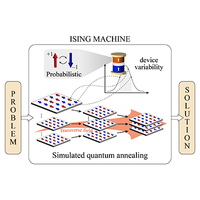
Article Text
Supplemental Material
References (65)
- N. Mohseni, P. L. McMahon, and T. Byrnes, Ising machines as hardware solvers of combinatorial optimization problems, Nat. Rev. Phys. 4, 363 (2022).
- Y. Fu and P. W. Anderson, Application of statistical mechanics to NP-complete problems in combinatorial optimisation, J. Phys. A 19, 1605 (1986).
- A. Lucas, Ising formulations of many NP problems, Front. Phys. 2, 1 (2014).
- M. R. Bartolacci, L. J. LeBlanc, Y. Kayikci, and T. A. Grossman, Optimization modeling for logistics: Options and implementations, J. Bus. Logist. 33, 118 (2012).
- H. M. V. Samani and A. Mottaghi, Optimization of water distribution networks using integer linear programming, J. Hydraul. Eng. 132, 501 (2006).
- T. Albash and D. A. Lidar, Demonstration of a scaling advantage for a quantum annealer over simulated annealing, Phys. Rev. X 8, 031016 (2018).
- A. D. King et al., Quantum critical dynamics in a 5,000-qubit programmable spin glass, Nature (London) 617, 61 (2023).
- K. Tatsumura, M. Yamasaki, and H. Goto, Scaling out Ising machines using a multi-chip architecture for simulated bifurcation, Natl. Electron. Rev. 4, 208 (2021).
- T. Honjo et al., 100,000-spin coherent Ising machine, Sci. Adv. 7, 952 (2021).
- A. Litvinenko, R. Khymyn, V. H. González, R. Ovcharov, A. A. Awad, V. Tyberkevych, A. Slavin, and J. Åkerman, A spinwave Ising machine, Commun. Phys. 6, 227 (2023).
- S. Dutta, A. Khanna, A. S. Assoa, H. Paik, D. G. Schlom, Z. Toroczkai, A. Raychowdhury, and S. Datta, An Ising Hamiltonian solver based on coupled stochastic phase-transition nano-oscillators, Natl. Electron. Rev. 4, 502 (2021).
- J. Vaidya, R. S. Surya Kanthi, and N. Shukla, Creating electronic oscillator-based Ising machines without external injection locking, Sci. Rep. 12, 981 (2022).
- S. Chowdhury et al., A full-stack view of probabilistic computing with p-bits: Devices, architectures, and algorithms, IEEE J. Explor. Solid-State Comput. Devices Circuits 9, 1 (2023).
- N. A. Aadit, A. Grimaldi, M. Carpentieri, L. Theogarajan, J. M. Martinis, G. Finocchio, and K. Y. Camsari, Massively parallel probabilistic computing with sparse Ising machines, Natl. Electron. Rev. 5, 460 (2022).
- N. A. Aadit, A. Grimaldi, G. Finocchio, and K. Y. Camsari, Physics-inspired Ising computing with ring oscillator activated p-bits, in 2022 IEEE 22nd International Conference on Nanotechnology (NANO), Palma de Mallorca, Spain, Vols. 2022 (IEEE, 2022), pp. 393–396, 10.1109/NANO54668.2022.9928681.
- C. Roques-Carmes, Y. Salamin, J. Sloan, S. Choi, G. Velez, E. Koskas, N. Rivera, S. E. Kooi, J. D. Joannopoulos, and M. Soljačić, Biasing the quantum vacuum to control macroscopic probability distributions, Science 381, 205 (2023).
- K. Y. Camsari, R. Faria, B. M. Sutton, and S. Datta, Stochastic p-bits for invertible logic, Phys. Rev. X 7, 031014 (2017).
- G. Finocchio, M. Di Ventra, K. Y. Camsari, K. Everschor-Sitte, P. Khalili Amiri, and Z. Zeng, The promise of spintronics for unconventional computing, J. Magn. Magn. Mater. 521, 167506 (2021).
- A. Grimaldi, L. Sánchez-Tejerina, N. Anjum Aadit, S. Chiappini, M. Carpentieri, K. Camsari, and G. Finocchio, Spintronics-compatible approach to solving maximum-satisfiability problems with probabilistic computing, invertible logic, and parallel tempering, Phys. Rev. Appl. 17, 024052 (2022).
- A. Grimaldi et al., Experimental evaluation of simulated quantum annealing with MTJ-augmented p-bits, in 2022 International Electron Devices Meeting (IEDM), San Francisco, CA, Vols. 2022 (IEEE, 2022), pp. 22.4.1-22.4.4, 10.1109/IEDM45625.2022.10019530.
- Y. Shao, C. Duffee, E. Raimondo, N. Davila, V. Lopez-Dominguez, J. A. Katine, G. Finocchio, and P. Khalili Amiri, Probabilistic computing with voltage-controlled dynamics in magnetic tunnel junctions, Nanotechnology 34, 495203 (2023).
- A. Grimaldi, L. Mazza, E. Raimondo, P. Tullo, D. Rodrigues, K. Y. Camsari, V. Crupi, M. Carpentieri, V. Puliafito, and G. Finocchio, Evaluating spintronics-compatible implementations of Ising machines, Phys. Rev. Appl. 20, 024005 (2023).
- J. Si et al., Energy-efficient superparamagnetic Ising machine and its application to traveling salesman problems, Nat. Commun. 15, 3457 (2024).
- P. L. McMahon et al., A fully programmable 100-spin coherent Ising machine with all-to-all connections, Science 354, 614 (2016).
- A. Grimaldi, E. Raimondo, A. Giordano, K. Y. Çamsar𝚤, and G. Finocchio, A comparison of energy minimization algorithms for solving max-sat problem with probabilistic Ising machines, in 2023 IEEE 23rd International Conference on Nanotechnology (NANO), Jeju City, Korea, Vols. 2023 (IEEE, 2023), pp. 698–702, 10.1109/NANO58406.2023.10231311.
- A. Z. Pervaiz, S. Datta, and K. Y. Camsari, Probabilistic computing with binary stochastic neurons, in 2019 IEEE BiCMOS and Compound Semiconductor Integrated Circuits and Technology Symposium (BCICTS), Nashville, TN (IEEE, 2019), pp. 1–6, 10.1109/BCICTS45179.2019.8972719.
- W. A. Borders, A. Z. Pervaiz, S. Fukami, K. Y. Camsari, H. Ohno, and S. Datta, Integer factorization using stochastic magnetic tunnel junctions, Nature (London) 573, 390 (2019).
- B. A. Cipra, An introduction to the Ising model, Am. Math. Mon. 94, 937 (1987).
- M. Suzuki, Relationship between D-dimensional quantal spin systems and ()-dimensional Ising systems: Equivalence, critical exponents and systematic approximants of the partition function and spin correlations, Prog. Theor. Phys. 56, 1454 (1976).
- T. Okuyama, M. Hayashi, and M. Yamaoka, An Ising computer based on simulated quantum annealing by path integral Monte Carlo method, in 2017 IEEE International Conference on Rebooting Computing (ICRC), Vols. 2017 (IEEE, 2017), pp. 1–6.
- See Supplemental Material at http://link.aps.org/supplemental/10.1103/pcmz-w776 for a performance comparison of CMOS-based PIM with other Ising machines, as well as details on parameter optimization.
- E. Crosson and A. W. Harrow, Simulated quantum annealing can be exponentially faster than classical simulated annealing, in 2016 IEEE 57th Annual Symposium on Foundations of Computer Science (FOCS), New Brunswick, NJ, Vols. 2016 (IEEE, 2016), pp. 714–723, 10.1109/FOCS.2016.81.
- D. Blackman and S. Vigna, Scrambled linear pseudorandom number generators, ACM Trans. Math. Softw. 47, 1 (2021).
- N. S. Singh et al., CMOS plus stochastic nanomagnets enabling heterogeneous computers for probabilistic inference and learning, Nat. Commun. 15, 2685 (2024).
- A. Stillmaker and B. Baas, Scaling equations for the accurate prediction of CMOS device performance from 180 Nm to 7 Nm, Integration, The VLSI Journal 58, 74 (2017).
- R. Iimura, S. Kitamura, and T. Kawahara, Annealing processing architecture of 28-Nm CMOS chip for Ising model With 512 fully connected spins, IEEE Trans. Circuits Syst. I 68, 5061 (2021).
- K. Kawamura et al., Amorphica: 4-replica 512 fully connected spin 336 MHz metamorphic annealer with programmable optimization strategy and compressed-spin-transfer multi-chip extension, in 2023 IEEE International Solid-State Circuits Conference (ISSCC) (IEEE, 2023), pp. 42–44.
- H. M. Waidyasooriya and M. Hariyama, Highly-parallel FPGA accelerator for simulated quantum annealing, IEEE Trans. Emerg. Top. Comput. 9, 2019 (2021).
- S. Xie, S. R. S. Raman, C. Ni, M. Wang, M. Yang, and J. P. Kulkarni, Ising-CIM: A reconfigurable and scalable compute within memory analog Ising accelerator for solving combinatorial optimization problems, IEEE J. Solid-State Circuits 57, 3453 (2022).
- Y. Su, H. Kim, and B. Kim, CIM-Spin: A scalable CMOS annealing processor with digital in-memory spin operators and register spins for combinatorial optimization problems, IEEE J. Solid-State Circuits 57, 2263 (2022).
- P. Meinerzhagen, A. Teman, R. Giterman, N. Edri, A. Burg, and A. Fish, Gain-Cell Embedded DRAMs for Low-Power VLSI Systems-on-Chip (Springer International Publishing, Cham, 2018).
- E. Garzon, Y. Greenblatt, O. Harel, M. Lanuzza, and A. Teman, Gain-cell embedded DRAM under cryogenic operation-a first study, IEEE Transactions on Very Large Scale Integration (VLSI) Systems 29, 1319 (2021).
- M. Yamaoka, C. Yoshimura, M. Hayashi, T. Okuyama, H. Aoki, and H. Mizuno, A 20k-spin Ising chip to solve combinatorial optimization problems with CMOS annealing, IEEE J. Solid-State Circuits 51, 303 (2016).
- K. Yamamoto, K. Kawamura, K. Ando, N. Mertig, T. Takemoto, M. Yamaoka, H. Teramoto, A. Sakai, S. Takamaeda-Yamazaki, and M. Motomura, STATICA: A 512-spin 0.25M-weight annealing processor with an all-spin-updates-at-once architecture for combinatorial optimization with complete spin-spin interactions, IEEE J. Solid-State Circuits 56, 165 (2021).
- D. Jiang, X. Wang, Z. Huang, Y. Yang, and E. Yao, A network-on-chip-based annealing processing architecture for large-scale fully connected Ising model, IEEE Trans. Circuits Syst. I 70, 2868 (2023).
- T. Takemoto, K. Yamamoto, C. Yoshimura, M. Hayashi, M. Tada, H. Saito, M. Mashimo, and M. Yamaoka, 4.6 A 144Kb annealing system composed of 9×16Kb annealing processor chips with scalable chip-to-chip connections for large-scale combinatorial optimization problems, in 2021 IEEE International Solid- State Circuits Conference (ISSCC), San Francisco, CA (IEEE, 2021), pp. 64–66, 10.1109/ISSCC42613.2021.9365748.
- N. Dattani, S. Szalay, and N. Chancellor, Pegasus: The second connectivity graph for large-scale quantum annealing hardware, arXiv:1901.07636.
- K. Boothby, A. D. King, and J. Raymond, Zephyr topology of D-wave quantum processors, D-Wave Technical Report Series No. 14-1056A-A, 2021.
- S. Choi, Y. Salamin, C. Roques-Carmes, R. Dangovski, D. Luo, Z. Chen, M. Horodynski, J. Sloan, S. Z. Uddin, and M. Soljacic, Photonic probabilistic machine learning using quantum vacuum noise, arXiv:2403.04731v1.
- S. Luo, Y. He, B. Cai, X. Gong, and G. Liang, Probabilistic-bits based on ferroelectric field-effect transistors for probabilistic computing, IEEE Electron Device Lett. 44, 1356 (2023).
- V. K. Joshi, P. Barla, S. Bhat, and B. K. Kaushik, From MTJ device to hybrid CMOS/MTJ circuits: A review, IEEE Access 8, 194105 (2020).
- H. Lee, F. Ebrahimi, P. K. Amiri, and K. L. Wang, Design of high-throughput and low-power true random number generator utilizing perpendicularly magnetized voltage-controlled magnetic tunnel junction, AIP Adv. 7, 055934 (2017).
- D. Vodenicarevic et al., Low-energy truly random number generation with superparamagnetic tunnel junctions for unconventional computing, Phys. Rev. Appl. 8, 054045 (2017).
- K. Y. Camsari, M. M. Torunbalci, W. A. Borders, H. Ohno, and S. Fukami, Double-free-layer magnetic tunnel junctions for probabilistic bits, Phys. Rev. Appl. 15, 044049 (2021).
- K. Y. Camsari, S. Salahuddin, and S. Datta, Implementing p-bits with embedded MTJ, IEEE Electron Device Lett. 38, 1767 (2017).
- A. Fukushima, T. Yamamoto, T. Nozaki, K. Yakushiji, H. Kubota, and S. Yuasa, Recent progress in random number generator using voltage pulse-induced switching of nano-magnet: A perspective, APL Mater. 9, 030905 (2021).
- C. Safranski, J. Kaiser, P. Trouilloud, P. Hashemi, G. Hu, and J. Z. Sun, Demonstration of nanosecond operation in stochastic magnetic tunnel junctions, Nano Lett. 21, 2040 (2021).
- K. Hayakawa, S. Kanai, T. Funatsu, J. Igarashi, B. Jinnai, W. A. Borders, H. Ohno, and S. Fukami, Nanosecond random telegraph noise in in-plane magnetic tunnel junctions, Phys. Rev. Lett. 126, 117202 (2021).
- L. Soumah, L. Desplat, N.-T. Phan, A. S. El Valli, A. Madhavan, F. Disdier, S. Auffret, R. Sousa, U. Ebels, and P. Talatchian, Nanosecond stochastic operation in perpendicular superparamagnetic tunnel junctions, arXiv:2402.03452.
- L. Schnitzspan, M. Kläui, and G. Jakob, Nanosecond true-random-number generation with superparamagnetic tunnel junctions: Identification of joule heating and spin-transfer-torque effects, Phys. Rev. Appl. 20, 024002 (2023).
- Y. Shao, S. L. Sinaga, I. O. Sunmola, A. S. Borland, M. J. Carey, J. A. Katine, V. Lopez-Dominguez, and P. K. Amiri, Implementation of artificial neural networks using magnetoresistive random-access memory-based stochastic computing units, IEEE Magn. Lett. 12, 4501005 (2021).
- K. Kobayashi, W. A. Borders, S. Kanai, K. Hayakawa, H. Ohno, and S. Fukami, Sigmoidal curves of stochastic magnetic tunnel junctions with perpendicular easy axis, Appl. Phys. Lett. 119, 132406 (2021).
- I. Hen, J. Job, T. Albash, T. F. Rønnow, M. Troyer, and D. A. Lidar, Probing for quantum speedup in spin-glass problems with planted solutions, Phys. Rev. A 92, 042325 (2015).
- A. Biere, M. Heule, H. Van Maaren, and T. Walsh, Handbook of Satisfiability: Volume 185 Frontiers in Artificial Intelligence and Applications (IOS Press, Amsterdam, 2009).
- Y. Shao, V. Lopez-Dominguez, N. Davila, Q. Sun, N. Kioussis, J. A. Katine, and P. Khalili, Amiri, Sub-volt switching of nanoscale voltage-controlled perpendicular magnetic tunnel junctions, Commun. Mater. 3, 87 (2022).

