

- Open Access
Nonequilibrium Relaxation and Odd-Even Effect in Finite-Temperature Electron Gases
Phys. Rev. X 15, 041007 – Published 14 October, 2025
DOI: https://doi.org/10.1103/ly37-5gdw
Abstract
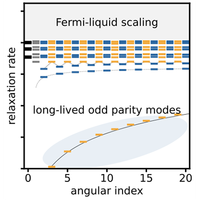
Pauli blocking in Fermi liquids imposes strong phase-space constraints on quasiparticle lifetimes, leading to a well-known quadratic-in-temperature decay rate of quasiparticle modes at low temperatures. In two-dimensional systems, however, even longer-lived modes are predicted (dubbed “odd-parity” modes) that involve a collective deformation of the Fermi distribution. Here, we present an efficient method to evaluate the full spectrum of relaxational eigenmodes of a Fermi liquid within kinetic theory. We employ this method to study the experimentally relevant case of a Fermi liquid with screened Coulomb interactions and map out the decay rates of quasiparticle modes beyond the asymptotic low-temperature limit up to the Fermi temperature, thus covering the entire temperature range of typical experiments. We confirm the existence of anomalously long-lived odd-parity modes and provide a comprehensive classification and detailed analysis of the relaxation spectrum. In particular, we find that (i) the odd-parity effect in the decay rates extends to temperatures as large as , (ii) there is only a small number of long-lived odd-parity modes, with an infinite number of remaining modes that show standard Fermi-liquid scaling, and (iii) the ratio between the odd- and even-parity lifetimes is tunable with the Coulomb interaction strength, in addition to temperature, which reflects a difference in the microscopic relaxation mechanism of the modes. Our findings provide a comprehensive description of the nonequilibrium relaxation behavior of two-dimensional electron gases and bridge a significant gap in our understanding of these systems.
Physics Subject Headings (PhySH)
Popular Summary
For decades, physicists have relied on Landau’s Fermi-liquid theory to explain how electrons in metals behave like weakly interacting quasiparticles, even though their interactions are strong. This theory has also been used to describe how electrons flow collectively like a liquid in clean materials, where their motion is dominated by interactions. Until recently, it was thought that all such collective flows relax at the same rate. In this study, we give further evidence that this expectation is incomplete: A finite number of odd-parity collective excitations survive much longer than expected, changing our understanding of electron hydrodynamics.
To demonstrate this, we solve the full microscopic equations governing a 2D Fermi liquid with realistic Coulomb interactions. This approach allows us to examine in detail how quasiparticle collisions give rise to dissipative processes. We confirm that even-parity modes decay according to standard Fermi-liquid scaling, and we find all odd-parity modes that decay much more slowly. Our results reveal these long-lived modes in experimentally relevant conditions, suggesting they should have observable effects.
The presence of these slow-decaying modes means that electron fluids are richer and more complex than classical liquids, and that existing theories of hydrodynamic transport need to be updated. Looking forward, identifying clear experimental signatures of odd-parity transport will be an important step, especially at low temperatures where these effects become more pronounced.
Article Text
References (61)
- D. Pines and P. Nozières, The Theory of Quantum Liquids: Normal Fermi Liquids, 1st ed. (CRC Press, Boca Raton, FL, 2018), Vol. 1, 10.4324/9780429492662.
- G. Baym and C. Pethick, Landau Fermi-Liquid Theory: Concepts and Applications (Wiley, New York, 1991), 10.1002/9783527617159.
- E. H. Sondheimer, The theory of the transport phenomena in metals, Proc. R. Soc. A 203, 75 (1950).
- D. A. Bandurin, I. Torre, R. K. Kumar, M. Ben Shalom, A. Tomadin, A. Principi, G. H. Auton, E. Khestanova, K. S. Novoselov, I. V. Grigorieva, L. A. Ponomarenko, A. K. Geim, and M. Polini, Negative local resistance caused by viscous electron backflow in graphene, Science 351, 1055 (2016).
- J. Crossno, J. K. Shi, K. Wang, X. Liu, A. Harzheim, A. Lucas, S. Sachdev, P. Kim, T. Taniguchi, K. Watanabe, T. A. Ohki, and K. C. Fong, Observation of the Dirac fluid and the breakdown of the Wiedemann-Franz law in graphene, Science 351, 1058 (2016).
- R. Krishna Kumar, D. A. Bandurin, F. M. D. Pellegrino, Y. Cao, A. Principi, H. Guo, G. H. Auton, M. Ben Shalom, L. A. Ponomarenko, G. Falkovich, K. Watanabe, T. Taniguchi, I. V. Grigorieva, L. S. Levitov, M. Polini, and A. K. Geim, Superballistic flow of viscous electron fluid through graphene constrictions, Nat. Phys. 13, 1182 (2017).
- Y. Nam, D.-K. Ki, D. Soler-Delgado, and A. F. Morpurgo, Electron–hole collision limited transport in charge-neutral bilayer graphene, Nat. Phys. 13, 1207 (2017).
- A. I. Berdyugin, S. G. Xu, F. M. D. Pellegrino, R. Krishna Kumar, A. Principi, I. Torre, M. Ben Shalom, T. Taniguchi, K. Watanabe, I. V. Grigorieva, M. Polini, A. K. Geim, and D. A. Bandurin, Measuring Hall viscosity of graphene’s electron fluid, Science 364, 162 (2019).
- D. A. Bandurin, A. V. Shytov, L. S. Levitov, R. K. Kumar, A. I. Berdyugin, M. Ben Shalom, I. V. Grigorieva, A. K. Geim, and G. Falkovich, Fluidity onset in graphene, Nat. Commun. 9, 4533 (2018).
- B. A. Braem, F. M. D. Pellegrino, A. Principi, M. Röösli, C. Gold, S. Hennel, J. V. Koski, M. Berl, W. Dietsche, W. Wegscheider, M. Polini, T. Ihn, and K. Ensslin, Scanning gate microscopy in a viscous electron fluid, Phys. Rev. B 98, 241304(R) (2018).
- J. Gooth, F. Menges, N. Kumar, V. Süß, C. Shekhar, Y. Sun, U. Drechsler, R. Zierold, C. Felser, and B. Gotsmann, Thermal and electrical signatures of a hydrodynamic electron fluid in tungsten diphosphide, Nat. Commun. 9, 4093 (2018).
- P. J. W. Moll, P. Kushwaha, N. Nandi, B. Schmidt, and A. P. Mackenzie, Evidence for hydrodynamic electron flow in , Science 351, 1061 (2016).
- G. M. Gusev, A. D. Levin, E. V. Levinson, and A. K. Bakarov, Viscous electron flow in mesoscopic two-dimensional electron gas, AIP Adv. 8, 025318 (2018).
- L. V. Ginzburg, C. Gold, M. P. Röösli, C. Reichl, M. Berl, W. Wegscheider, T. Ihn, and K. Ensslin, Superballistic electron flow through a point contact in a As heterostructure, Phys. Rev. Res. 3, 023033 (2021).
- A. Aharon-Steinberg, T. Völkl, A. Kaplan, A. K. Pariari, I. Roy, T. Holder, Y. Wolf, A. Y. Meltzer, Y. Myasoedov, M. E. Huber, B. Yan, G. Falkovich, L. S. Levitov, M. Hücker, and E. Zeldov, Direct observation of vortices in an electron fluid, Nature (London) 607, 74 (2022).
- C. Kumar, J. Birkbeck, J. A. Sulpizio, D. Perello, T. Taniguchi, K. Watanabe, O. Reuven, T. Scaffidi, A. Stern, A. K. Geim, and S. Ilani, Imaging hydrodynamic electrons flowing without Landauer–Sharvin resistance, Nature (London) 609, 276 (2022).
- M. L. Palm, C. Ding, W. S. Huxter, T. Taniguchi, K. Watanabe, and C. L. Degen, Observation of current whirlpools in graphene at room temperature, Science 384, 465 (2024).
- Y. Zeng, H. Guo, O. M. Ghosh, K. Watanabe, T. Taniguchi, L. S. Levitov, and C. R. Dean, Quantitative measurement of viscosity in two-dimensional electron fluids, arXiv:2407.05026.
- J. Estrada-Álvarez, J. Salvador-Sánchez, A. Pérez-Rodríguez, C. Sánchez-Sánchez, V. Clericò, D. Vaquero, K. Watanabe, T. Taniguchi, E. Diez, F. Domínguez-Adame, M. Amado, and E. Díaz, Superballistic conduction in hydrodynamic antidot graphene superlattices, Phys. Rev. X 15, 011039 (2025).
- D. I. Sarypov, D. A. Pokhabov, A. G. Pogosov, E. Y. Zhdanov, A. A. Shevyrin, A. A. Shklyaev, and A. K. Bakarov, Slip electron flow in GaAs microscale constrictions, arXiv:2506.10276.
- C. Hodges, H. Smith, and J. W. Wilkins, Effect of Fermi surface geometry on electron-electron scattering, Phys. Rev. B 4, 302 (1971).
- G. F. Giuliani and J. J. Quinn, Lifetime of a quasiparticle in a two-dimensional electron gas, Phys. Rev. B 26, 4421 (1982).
- B. Laikhtman, Electron-electron angular relaxation in a two-dimensional electron gas, Phys. Rev. B 45, 1259 (1992).
- R. N. Gurzhi, A. N. Kalinenko, and A. I. Kopeliovich, Electron-electron momentum relaxation in a two-dimensional electron gas, Phys. Rev. B 52, 4744 (1995).
- J. Nilsson and A. H. Castro Neto, Heat bath approach to Landau damping and Pomeranchuk quantum critical points, Phys. Rev. B 72, 195104 (2005).
- P. Ledwith, H. Guo, and L. Levitov, Angular superdiffusion and directional memory in two-dimensional electron fluids, arXiv:1708.01915.
- P. J. Ledwith, H. Guo, and L. Levitov, The hierarchy of excitation lifetimes in two-dimensional Fermi gases, Ann. Phys. (Amsterdam) 411, 167913 (2019).
- J. Hofmann and U. Gran, Anomalously long lifetimes in two-dimensional Fermi liquids, Phys. Rev. B 108, L121401 (2023).
- P. Ledwith, H. Guo, A. Shytov, and L. Levitov, Tomographic dynamics and scale-dependent viscosity in 2D electron systems, Phys. Rev. Lett. 123, 116601 (2019).
- J. Hofmann and S. Das Sarma, Collective modes in interacting two-dimensional tomographic Fermi liquids, Phys. Rev. B 106, 205412 (2022).
- S. Kryhin and L. Levitov, Collinear scattering and long-lived excitations in two-dimensional electron fluids, Phys. Rev. B 107, L201404 (2023).
- J. Hofmann and H. Rostami, Nonlinear thermoelectric probes of anomalous electron lifetimes in topological Fermi liquids, Phys. Rev. Res. 6, L042042 (2024).
- L. Levitov, Collinear electron-electron scattering and cat’s-eye retroreflection effect probed by electron transport through point contacts, J. Club Condens. Matter Phys. (2024), 10.36471/JCCM_July_2024_02.
- I. Moiseenko, E. Mönch, K. Kapralov, D. Bandurin, S. Ganichev, and D. Svintsov, Testing the tomographic Fermi liquid hypothesis with high-order cyclotron resonance, Phys. Rev. Lett. 134, 226902 (2025).
- G. F. Giuliani and G. Vignale, Quantum Theory of the Electron Liquid (Cambridge University Press, New York, 2005), 10.1017/CBO9780511619915.
- U. Gran, E. Nilsson, and J. Hofmann, Shear viscosity in interacting two-dimensional Fermi liquids, arXiv:2312.09977.
- A. A. Abrikosov and I. M. Khalatnikov, The theory of a Fermi liquid (the properties of liquid at low temperatures), Rep. Prog. Phys. 22, 329 (1959).
- D. Enskog, Kinetische Theorie Der Vorgänge in Mässig Verdünnten Gasen., Ph.D. thesis, Lund University, 1917.
- S. Chapman and T. G. Cowling, The Mathematical Theory of Non-Uniform Gases: An Account of the Kinetic Theory of Viscosity, Thermal Conduction and Diffusion in Gases (Cambridge University Press, Cambridge, England, 1990).
- H. Grad, On the kinetic theory of rarefied gases, Commun. Pure Appl. Math. 2, 331 (1949).
- D. Burnett, The distribution of velocities in a slightly non-uniform gas, Proc. London Math. Soc. s2-39, 385 (1935).
- L. Zheng and S. Das Sarma, Coulomb scattering lifetime of a two-dimensional electron gas, Phys. Rev. B 53, 9964 (1996).
- S. D. Sarma and Y. Liao, Know the enemy: 2D Fermi liquids, Ann. Phys. (Amsterdam) 435, 168495 (2021).
- J. Lux and L. Fritz, Interaction-dominated transport and Coulomb drag in bilayer graphene, Phys. Rev. B 87, 075423 (2013).
- B. Tanatar and D. M. Ceperley, Ground state of the two-dimensional electron gas, Phys. Rev. B 39, 5005 (1989).
- R. Jamei, S. Kivelson, and B. Spivak, Universal aspects of Coulomb-frustrated phase separation, Phys. Rev. Lett. 94, 056805 (2005).
- P. S. Alekseev and A. P. Dmitriev, Viscosity of two-dimensional electrons, Phys. Rev. B 102, 241409(R) (2020).
- Z. M. Raines, V. I. Fal’ko, and L. I. Glazman, Spin-valley collective modes of the electron liquid in graphene, Phys. Rev. B 103, 075422 (2021).
- A. C. Keser, D. Q. Wang, O. Klochan, D. Y. H. Ho, O. A. Tkachenko, V. A. Tkachenko, D. Culcer, S. Adam, I. Farrer, D. A. Ritchie, O. P. Sushkov, and A. R. Hamilton, Geometric control of universal hydrodynamic flow in a two-dimensional electron fluid, Phys. Rev. X 11, 031030 (2021).
- A. V. Chaplik, Energy spectrum and electron scattering processes in inversion layers, Sov. Phys.-JETP 33, 997 (1971), http://www.jetp.ras.ru/cgi-bin/e/index/e/33/5/p997?a=list.
- T. Hahn, Cuba—A library for multidimensional numerical integration, Comput. Phys. Commun. 168, 78 (2005).
- J. Hofmann, E. Barnes, and S. Das Sarma, Why does graphene behave as a weakly interacting system?, Phys. Rev. Lett. 113, 105502 (2014).
- R. E. Throckmorton, J. Hofmann, E. Barnes, and S. Das Sarma, Many-body effects and ultraviolet renormalization in three-dimensional Dirac materials, Phys. Rev. B 92, 115101 (2015).
- T. Holder and W. Metzner, Anomalous dynamical scaling from nematic and gauge field fluctuations in two-dimensional metals, Phys. Rev. B 92, 041112(R) (2015).
- D. Tong, Kinetic Theory: A University of Cambridge Graduate Course (2012), https://www.damtp.cam.ac.uk/user/tong/kinetic.html.
- N. Ben-Shachar and J. Hofmann, Magnetotransport of tomographic electrons in a channel, arXiv:2503.14431.
- N. Ben-Shachar and J. Hofmann, Tomographic electron flow in confined geometries: Beyond the dual-relaxation time approximation, arXiv:2503.14461.
- H. Rostami, N. Ben-Shachar, S. Moroz, and J. Hofmann, Magnetic field suppression of tomographic electron transport, Phys. Rev. B 111, 155434 (2025).
- F. H. Essler, A short introduction to generalized hydrodynamics, Physica (Amsterdam) 631A, 127572 (2023).
- E. I. Kiselev and J. Schmalian, Lévy flights and hydrodynamic superdiffusion on the Dirac cone of graphene, Phys. Rev. Lett. 123, 195302 (2019).
- E. I. Kiselev and J. Schmalian, Nonlocal hydrodynamic transport and collective excitations in Dirac fluids, Phys. Rev. B 102, 245434 (2020).

