

- Open Access
Toward a Theory of Phase Transitions in Quantum Control Landscapes
Phys. Rev. X 15, 041014 – Published 29 October, 2025
DOI: https://doi.org/10.1103/27nn-cb3t
Abstract
Control landscape phase transitions (CLPTs) occur as abrupt changes in the cost function landscape upon varying a control parameter and can be revealed by nonanalytic points in statistical order parameters. A prime example are quantum speed limits, which mark the onset of controllability as the protocol duration is increased. Here, we lay the foundations of an analytical theory for CLPTs by developing Dyson, Magnus, and cumulant expansions for the cost function that capture the behavior of CLPTs with a controlled precision. Using linear and quadratic stability analysis, we reveal that CLPTs can be associated with different types of instabilities of the optimal protocol. This allows us to explicitly relate CLPTs to critical structural rearrangements in the extrema of the control landscape: Utilizing path-integral methods from statistical field theory, we trace back the critical scaling of the order parameter at the quantum speed limit to the topological and geometric properties of the set of optimal protocols, such as the number of connected components and its dimensionality. We verify our predictions by introducing a numerical sampling algorithm designed to explore this optimal set via a homotopic stochastic update rule. We apply this new toolbox explicitly to analyze CLPTs in the single- and two-qubit control problems whose landscapes are analytically tractable and compare the landscapes for bang-bang and piecewise continuous protocols. Our work provides the first steps toward a systematic theory of CLPTs and paves the way for utilizing statistical field theory techniques for generic complex control landscapes.
Physics Subject Headings (PhySH)
Popular Summary
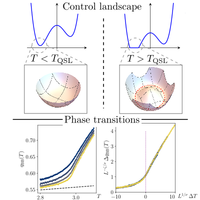
Controlling quantum systems is essential for building powerful technologies like quantum computers and sensors, but figuring out the best way to do so is not straightforward. The challenge is often compared to scaling a mountain range: Without knowing the correct path, it is easy to get lost in the local landscape. What makes the problem even more complex is that this “control landscape” can change suddenly as experimental conditions vary, much like water abruptly freezing into ice. These sudden shifts, called control landscape phase transitions, mark points where new optimal strategies appear. In our work, we develop analytical and numerical methods to describe these transitions, adapting tools from statistical physics normally used to study complex systems such as magnets and glasses.
We apply these methods to prototypical quantum systems and show how the control phase transitions are connected to fundamental physical properties, such as the minimum time required to steer a system from one state to another. Our approach reveals why these transitions occur and allows us to map out the conditions under which they arise. Interestingly, the behavior we find has features in common with that of disordered materials like spin glasses, suggesting that concepts from condensed matter physics can provide valuable insights into quantum control.
This work provides a foundation for understanding the complexity of control landscapes in a systematic way. By identifying and characterizing these transitions, we not only gain a deeper theoretical understanding but also move closer to harnessing them in practice. Such knowledge could lead to more efficient control strategies, helping us design more reliable and scalable quantum devices in the future.
Article Text
References (83)
- D. D’Alessandro (2nd ed.) Introduction to Quantum Control and Dynamics (Chapman and Hall/CRC, London, 2021).
- H. A. Rabitz, M. M. Hsieh, and C. M. Rosenthal, Quantum optimally controlled transition landscapes, Science 303, 1998 (2004).
- U. Boscain, M. Sigalotti, and D. Sugny, Introduction to the Pontryagin maximum principle for quantum optimal control, PRX Quantum 2, 030203 (2021).
- Q. Ansel, E. Dionis, F. Arrouas, B. Peaudecerf, S. Guérin, D. Guéry-Odelin, and D. Sugny, Introduction to theoretical and experimental aspects of quantum optimal control, J. Phys. B 57, 133001 (2024).
- C. P. Koch et al., Quantum optimal control in quantum technologies. strategic report on current status, visions and goals for research in Europe, Eur. Phys. J. Quantum Technol. 9, 19 (2022).
- S. J. Glaser et al., Training Schrödinger’s cat: Quantum optimal control: Strategic report on current status, visions and goals for research in Europe, Eur. Phys. J. D 69, 1 (2015).
- A. Acín et al., The quantum technologies roadmap: A European Community view, New J. Phys. 20, 080201 (2018).
- A. Ungar, P. Cappellaro, A. Cooper, and Won Kyu Calvin Sun, Control of an environmental spin defect beyond the coherence limit of a central spin, PRX Quantum 5, 010321 (2024).
- Z. Li, X. Ye, X. Kong, T. Xie, Z. Yang, P. Zhao, Y. Wang, F. Shi, and J. Du, Zero-field quantum sensing via precise geometric controls for a spin-1 system, Phys. Rev. Appl. 21, 054011 (2024).
- G. Wang, Y.-X. Liu, J. M. Schloss, S. T. Alsid, D. A. Braje, and P. Cappellaro, Sensing of arbitrary-frequency fields using a quantum mixer, Phys. Rev. X 12, 021061 (2022).
- P. Rembold, N. Oshnik, M. M. Müller, S. Montangero, T. Calarco, and E. Neu, Introduction to quantum optimal control for quantum sensing with nitrogen-vacancy centers in diamond, AVS Quantum Sci. 2, 024701 (2020).
- C. L. Degen, F. Reinhard, and P. Cappellaro, Quantum sensing, Rev. Mod. Phys. 89, 035002 (2017).
- J. E. Gough and V. P. Belavkin, Quantum control and information processing, Quantum Inf. Process. 12, 1397 (2013).
- J. M. Gertler, B. Baker, J. Li, S. Shirol, J. Koch, and C. Wang, Protecting a bosonic qubit with autonomous quantum error correction, Nature (London) 590, 243 (2021).
- S. Zhou and L. Jiang, Optimal approximate quantum error correction for quantum metrology, Phys. Rev. Res. 2, 013235 (2020).
- K. Khodjasteh and L. Viola, Dynamical quantum error correction of unitary operations with bounded controls, Phys. Rev. A 80, 032314 (2009).
- C. Ahn, A. C. Doherty, and A. J. Landahl, Continuous quantum error correction via quantum feedback control, Phys. Rev. A 65, 042301 (2002).
- C. Altafini and F. Ticozzi, Modeling and control of quantum systems: An introduction, IEEE Trans. Autom. Control 57, 1898 (2012).
- C. Brif, R. Chakrabarti, and H. Rabitz, Control of quantum phenomena: Past, present and future, New J. Phys. 12, 075008 (2010).
- N. Khaneja, T. Reiss, C. Kehlet, T. Schulte-Herbrüggen, and S. J. Glaser, Optimal control of coupled spin dynamics: design of NMR pulse sequences by gradient ascent algorithms, J. Magn. Reson. 172, 296 (2005).
- D. M. Reich, M. Ndong, and C. P. Koch, Monotonically convergent optimization in quantum control using Krotov’s method, J. Chem. Phys. 136, 104103 (2012).
- T. Caneva, T. Calarco, and S. Montangero, Chopped random-basis quantum optimization, Phys. Rev. A 84, 022326 (2011).
- P. Doria, T. Calarco, and S. Montangero, Optimal control technique for many-body quantum dynamics, Phys. Rev. Lett. 106, 190501 (2011).
- T. Mahesh, P. Batra, and M. H. Ram, Quantum optimal control: Practical aspects and diverse methods, J. Indian Inst. Sci. 103, 591 (2023).
- S. Machnes, U. Sander, S. J. Glaser, P. de Fouquières, A. Gruslys, S. Schirmer, and T. Schulte-Herbrüggen, Comparing, optimizing, and benchmarking quantum-control algorithms in a unifying programming framework, Phys. Rev. A 84, 022305 (2011).
- R. Chakrabarti and H. Rabitz, Quantum control landscapes, Int. Rev. Phys. Chem. 26, 671 (2007).
- X. Ge, R.-B. Wu, and H. Rabitz, The optimization landscape of hybrid quantum–classical algorithms: From quantum control to NISQ applications, Annu. Rev. Control 54, 314 (2022).
- X. Ge, R. Wu, and H. Rabitz, Optimization landscape of quantum control systems, Complex Syst. Model. Simul. 1, 77 (2021).
- A. G. R. Day, M. Bukov, P. Weinberg, P. Mehta, and D. Sels, Glassy phase of optimal quantum control, Phys. Rev. Lett. 122, 020601 (2019).
- S. van Frank, M. Bonneau, J. Schmiedmayer, S. Hild, C. Gross, M. Cheneau, I. Bloch, T. Pichler, A. Negretti, T. Calarco et al., Optimal control of complex atomic quantum systems, Sci. Rep. 6, 34187 (2016).
- M. G. Bason, M. Viteau, N. Malossi, P. Huillery, E. Arimondo, D. Ciampini, R. Fazio, V. Giovannetti, R. Mannella, and O. Morsch, High-fidelity quantum driving, Nat. Phys. 8, 147 (2012).
- M. Dalgaard, F. Motzoi, and J. Sherson, Predicting quantum dynamical cost landscapes with deep learning, Phys. Rev. A 105, 012402 (2022).
- G. Matos, S. Johri, and Z. Papić, Quantifying the efficiency of state preparation via quantum variational eigensolvers, PRX Quantum 2, 010309 (2021).
- T. Caneva, A. Silva, R. Fazio, S. Lloyd, T. Calarco, and S. Montangero, Complexity of controlling quantum many-body dynamics, Phys. Rev. A 89, 042322 (2014).
- S. Hernández-Gómez, F. Balducci, G. Fasiolo, P. Cappellaro, N. Fabbri, and A. Scardicchio, Optimal control of a quantum sensor: A fast algorithm based on an analytic solution, SciPost Phys. 17, 004 (2024).
- A. P. Solon and J. M. Horowitz, Phase transition in protocols minimizing work fluctuations, Phys. Rev. Lett. 120, 180605 (2018).
- G. Folena, A. Manacorda, and F. Zamponi, Introduction to the dynamics of disordered systems: Equilibrium and gradient descent, Physica (Amsterdam) 631A, 128152 (2023).
- H. Nishimori, Statistical Physics of Spin Glasses and Information Processing: An Introduction (Oxford University Press, New York, 2001).
- M. Bukov, A. G. R. Day, D. Sels, P. Weinberg, A. Polkovnikov, and P. Mehta, Reinforcement learning in different phases of quantum control, Phys. Rev. X 8, 031086 (2018).
- M. Bukov, A. G. R. Day, P. Weinberg, A. Polkovnikov, P. Mehta, and D. Sels, Broken symmetry in a two-qubit quantum control landscape, Phys. Rev. A 97, 052114 (2018).
- N. Beato, P. Patil, and M. Bukov, Topological phase transitions in a constrained two-qubit quantum control landscape, Phys. Rev. Lett. 135, 110803 (2025).
- V. Ros and Y. V. Fyodorov, The high-d landscapes paradigm: Spin-glasses, and beyond, arXiv:2209.07975.
- Y. V. Fyodorov and R. Tublin, Optimization landscape in the simplest constrained random least-square problem, J. Phys. A 55, 244008 (2022).
- D. Gamarnik, C. Moore, and L. Zdeborová, Disordered systems insights on computational hardness, J. Stat. Mech. (2022) 114015.
- P. Urbani, A continuous constraint satisfaction problem for the rigidity transition in confluent tissues, J. Phys. A 56, 115003 (2023).
- L. Zdeborová and F. Krzakala, Statistical physics of inference: Thresholds and algorithms, Adv. Phys. 65, 453 (2016).
- D. Hu, P. Ronhovde, and Z. Nussinov, Stability-to-instability transition in the structure of large-scale networks, Phys. Rev. E 86, 066106 (2012).
- S. C. Morampudi, B. Hsu, S. L. Sondhi, R. Moessner, and C. R. Laumann, Clustering in Hilbert space of a quantum optimization problem, Phys. Rev. A 96, 042303 (2017).
- F. Krzakala and J. Kurchan, Landscape analysis of constraint satisfaction problems, Phys. Rev. E 76, 021122 (2007).
- M. Mézard, M. Palassini, and O. Rivoire, Landscape of solutions in constraint satisfaction problems, Phys. Rev. Lett. 95, 200202 (2005).
- R. Monasson and R. Zecchina, Statistical mechanics of the random -satisfiability model, Phys. Rev. E 56, 1357 (1997).
- M. Mézard, G. Parisi, and R. Zecchina, Analytic and algorithmic solution of random satisfiability problems, Science 297, 812 (2002).
- M. Mezard, G. Parisi, and M. Virasoro, Spin Glass Theory and Beyond (World Scientific, Singapore, 1986).
- M. Bukov, D. Sels, and A. Polkovnikov, Geometric speed limit of accessible many-body state preparation, Phys. Rev. X 9, 011034 (2019).
- H. Schättler and U. Ledzewicz, Geometric Optimal Control (Springer, New York, 2012).
- L. T. Brady, C. L. Baldwin, A. Bapat, Y. Kharkov, and A. V. Gorshkov, Optimal protocols in quantum annealing and quantum approximate optimization algorithm problems, Phys. Rev. Lett. 126, 070505 (2021).
- G. C. Hegerfeldt, Driving at the quantum speed limit: Optimal control of a two-level system, Phys. Rev. Lett. 111, 260501 (2013).
- M. Bukov, L. D’Alessio, and A. Polkovnikov, Universal high-frequency behavior of periodically driven systems: From dynamical stabilization to Floquet engineering, Adv. Phys. 64, 139 (2015).
- W. Magnus, On the exponential solution of differential equations for a linear operator, Commun. Pure Appl. Math. 7, 649 (1954).
- S. Blanes, F. Casas, J. Oteo, and J. Ros, The Magnus expansion and some of its applications, Phys. Rep. 470, 151 (2009).
- S. Blanes, F. Casas, J. A. Oteo, and J. Ros, A pedagogical approach to the Magnus expansion, Eur. J. Phys. 31, 907 (2010).
Here, we use the shorthand notation and .
Observe that, by construction, is the real and symmetric kernel of a Hilbert-Schmidt integral operator; i.e., it satisfies the following properties: (i) , (ii) , and (iii) . Then, if we search for eigenfunctions in the functional space , the associated eigenvalues exist well defined, are real, and have a finite range and an accumulation point at zero. In this case, we may estimate the eigenvalues by first discretizing the time domain in steps and, subsequently, consider the limit .
The choice of as a starting protocol is arbitrary but convenient. For other choices , finding the optimal protocol requires more attention.
This argument should not be considered as rigorous. In our case, it is sufficient to guess the structure of the optimal protocol for . In general, a more quantitative analysis is required to obtain the optimal protocol structure past a given CLPT (see Ref. [35] for an example).
- G. O. Roberts and J. S. Rosenthal, Optimal scaling of discrete approximations to Langevin diffusions, J. R. Stat. Soc. Ser. B 60, 255 (2002).
Note that here is different from the corresponding hyperparameter of the LMC algorithm in Sec. 5.
More formally, we rewrite and expand the exponent in the right-hand side at second order in .
- C. Tsallis, Possible generalization of Boltzmann-Gibbs statistics, J. Stat. Phys. 52, 479 (1988).
- M. Orozco-Ruiz, N. H. Le, and F. Mintert, Quantum control without quantum states, PRX Quantum 5, 040346 (2024).
- S. H. Sack, R. A. Medina, R. Kueng, and M. Serbyn, Recursive greedy initialization of the quantum approximate optimization algorithm with guaranteed improvement, Phys. Rev. A 107, 062404 (2023).
- R. A. Medina and M. Serbyn, A recursive lower bound on the energy improvement of the quantum approximate optimization algorithm, arXiv:2405.10125.
The quantum speed limit may be infinite, e.g., when a large number of local minima preclude any practical optimization procedure from finding optima with an arbitrarily small infidelity.
- S. Kirchhoff, T. Keßler, P. J. Liebermann, E. Assémat, S. Machnes, F. Motzoi, and F. K. Wilhelm, Optimized cross-resonance gate for coupled transmon systems, Phys. Rev. A 97, 042348 (2018).
- E. Farhi, J. Goldstone, and S. Gutmann, A quantum approximate optimization algorithm, arXiv:1411.4028.
- A. Lerose, M. Sonner, and D. A. Abanin, Influence matrix approach to many-body Floquet dynamics, Phys. Rev. X 11, 021040 (2021).
- N. Beato, P. Pranay, and M. Bukov, Toward a theory of phase transitions in quantum control landscapes, Zenodo (2025), 10.5281/zenodo.17102346.
- J. M. Dominy, T.-S. Ho, and H. A. Rabitz, Characterization of the critical sets of quantum unitary control landscapes, IEEE Trans. Autom. Control 59, 2083 (2014).
- L. I. Nicolaescu et al., An Invitation to Morse theory (Springer, New York, 2007).
- S. Donaldson, Riemann Surfaces (Oxford University Press, New York, 2011).
- J. D. Murray, Asymptotic Analysis (Springer Science & Business Media, New York, 2012), Vol. 48.
- O. Melchert, autoscale.py—A program for automatic finite-size scaling analyses: A user’s guide, arXiv:0910.5403.
- A. Sorge, pyfssa 0.7.6 (2015), 10.5281/zenodo.35293.

