

- Open Access
Tensor Networks for Noninvertible Symmetries in and Beyond
Phys. Rev. X 15, 041006 – Published 8 October, 2025
DOI: https://doi.org/10.1103/p32z-v884
Abstract
Tensor networks provide a natural language for noninvertible symmetries in general Hamiltonian lattice models. We use ZX-diagrams, which are tensor network presentations of quantum circuits, to define a noninvertible operator implementing the Wegner duality in lattice gauge theory. The noninvertible algebra, which mixes with lattice translations, can be efficiently computed using ZX-calculus. We further deform the gauge theory while preserving the duality and find a model with nine exactly degenerate ground states on a torus, consistent with the Lieb-Schultz-Mattis-type constraint imposed by the symmetry. Finally, we provide a ZX-diagram presentation of the noninvertible duality operators (including noninvertible parity and reflection symmetries) of generalized Ising models based on graphs, encompassing the Ising model, the three-spin Ising model, the Ashkin-Teller model, and the plaquette Ising model. The mixing (or lack thereof) with spatial symmetries is understood from a unifying perspective based on graph theory.
Physics Subject Headings (PhySH)
Popular Summary
In quantum physics, symmetries are often viewed as reversible transformations—like rotating or flipping an object and then returning it to its original state. However, recent discoveries have uncovered a new class of symmetries that are not invertible: Once applied, these transformations cannot be reversed. These noninvertible symmetries are proving to be powerful tools for understanding the behavior of quantum many-body systems. In this study, we explore how to describe and analyze these symmetries using graphical tools from quantum information theory.
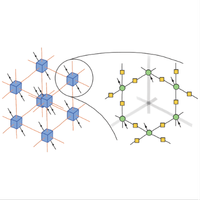
We use tensor networks and a diagrammatic method called ZX-calculus to create a concrete, visual framework for studying noninvertible symmetries. First, we reinterpret a classic example known as Kramers-Wannier duality in 1D systems, revealing new structural insights. Next, we apply our approach to a more complex system—a 3D quantum lattice model called lattice gauge theory—to examine a duality known as Wegner duality. Our diagrams illustrate how this duality interacts with spatial symmetries and imposes restrictions on the system’s ground states. We demonstrate how our method captures noninvertible symmetries across a wide range of generalized Ising models, which describe quantum spins on a lattice, thereby deepening our understanding of well-known phenomena in condensed matter physics.
Looking ahead, this study paves the way for new insights into quantum phases of matter. These graphical methods will aid researchers in understanding symmetries in concrete lattice models and establishing connections to symmetries in continuum quantum field theories, such as quantum electrodynamics.
Article Text
References (199)
- J. McGreevy, Generalized symmetries in condensed matter, Annu. Rev. Condens. Matter Phys. 14, 57 (2023).
- C. Cordova, T. T. Dumitrescu, K. Intriligator, and S.-H. Shao, Snowmass White Paper: Generalized symmetries in quantum field theory and beyond, in Snowmass 2021 (2022), 5, arXiv:2205.09545.
- T. D. Brennan and S. Hong, Introduction to generalized global symmetries in QFT and particle physics, arXiv:2306.00912.
- L. Bhardwaj, L. E. Bottini, L. Fraser-Taliente, L. Gladden, D. S. W. Gould, A. Platschorre, and H. Tillim, Lectures on generalized symmetries, Phys. Rep. 1051, 1 (2024).
- S. Schafer-Nameki, ICTP lectures on (non-)invertible generalized symmetries, arXiv:2305.18296.
- R. Luo, Q.-R. Wang, and Y.-N. Wang, Lecture notes on generalized symmetries and applications, Phys. Rep. 1065, 1 (2024).
- S.-H. Shao, What’s done cannot be undone: TASI lectures on non-invertible symmetries, arXiv:2308.00747.
- N. Carqueville, M. Del Zotto, and I. Runkel, Topological defects, Encycl. Math. Phys. 5, 621 (2025).
- U. Grimm and G. M. Schutz, The spin XXZ Heisenberg chain, the quantum algebra , and duality transformations for minimal models, J. Stat. Phys. 71, 921 (1993).
- M. Oshikawa and I. Affleck, Boundary conformal field theory approach to the critical two-dimensional Ising model with a defect line, Nucl. Phys. B495, 533 (1997).
- W. W. Ho, L. Cincio, H. Moradi, D. Gaiotto, and G. Vidal, Edge-entanglement spectrum correspondence in a nonchiral topological phase and Kramers-Wannier duality, Phys. Rev. B 91, 125119 (2015).
- M. Hauru, G. Evenbly, W. W. Ho, D. Gaiotto, and G. Vidal, Topological conformal defects with tensor networks, Phys. Rev. B 94, 115125 (2016).
- D. Aasen, R. S. K. Mong, and P. Fendley, Topological defects on the lattice I: The Ising model, J. Phys. A 49, 354001 (2016).
- N. Seiberg and S.-H. Shao, Majorana chain and Ising model—(non-invertible) translations, anomalies, and emanant symmetries, SciPost Phys. 16, 064 (2024).
- N. Seiberg, S. Seifnashri, and S.-H. Shao, Non-invertible symmetries and LSM-type constraints on a tensor product Hilbert space, SciPost Phys. 16, 154 (2024).
On the other hand, a general fusion category can be realized with no mixing with the lattice translation on an anyonic chain [17, 18], which generally does not have a tensor product Hilbert space.
- A. Feiguin, S. Trebst, A. W. W. Ludwig, M. Troyer, A. Kitaev, Z. Wang, and M. H. Freedman, Interacting anyons in topological quantum liquids: The golden chain, Phys. Rev. Lett. 98, 160409 (2007).
- D. Aasen, P. Fendley, and R. S. K. Mong, Topological defects on the lattice: Dualities and degeneracies, arXiv:2008.08598.
- M. Levin, Constraints on order and disorder parameters in quantum spin chains, Commun. Math. Phys. 378, 1081 (2020).
- K. Inamura, On lattice models of gapped phases with fusion category symmetries, J. High Energy Phys. 03 (2022) 036.
- M. T. Tan, Y. Wang, and A. Mitra, Topological defects in Floquet circuits, SciPost Phys. 16, 075 (2024).
- L. Eck and P. Fendley, From the XXZ chain to the integrable Rydberg-blockade ladder via non-invertible duality defects, SciPost Phys. 16, 127 (2024).
- A. Mitra, H.-C. Yeh, F. Yan, and A. Rosch, Nonintegrable Floquet Ising model with duality twisted boundary conditions, Phys. Rev. B 107, 245416 (2023).
- M. Sinha, F. Yan, L. Grans-Samuelsson, A. Roy, and H. Saleur, Lattice realizations of topological defects in the critical ()-d three-state Potts model, arXiv:2310.19703.
- C. Fechisin, N. Tantivasadakarn, and V. V. Albert, Non-invertible symmetry-protected topological order in a group-based cluster state, Phys. Rev. X 15, 011058 (2025).
- H. Yan and L. Li, Generalized Kramers-Wanier duality from bilinear phase map, arXiv:2403.16017.
- M. Okada and Y. Tachikawa, Non-invertible symmetries act locally by quantum operations, Phys. Rev. Lett. 133, 191602 (2024).
- S. Seifnashri and S.-H. Shao, Cluster state as a noninvertible symmetry-protected topological phase, Phys. Rev. Lett. 133, 116601 (2024).
- L. Bhardwaj, L. E. Bottini, S. Schafer-Nameki, and A. Tiwari, Illustrating the categorical Landau paradigm in lattice models, Phys. Rev. B 111, 054432 (2025).
- A. Chatterjee, O. M. Aksoy, and X.-G. Wen, Quantum phases and transitions in spin chains with non-invertible symmetries, SciPost Phys. 17, 115 (2024).
- L. Bhardwaj, L. E. Bottini, S. Schafer-Nameki, and A. Tiwari, Lattice models for phases and transitions with non-invertible symmetries, arXiv:2405.05964.
- M. Khan, S. A. B. Z. Khan, and A. Mohd, Quantum operations for Kramers-Wannier duality, arXiv:2405.09361.
- Z. Jia, Generalized cluster states from Hopf algebras: Non-invertible symmetry and Hopf tensor network representation, J. High Energy Phys. 09 (2024) 147.
- D.-C. Lu, Z. Sun, and Y.-Z. You, Realizing triality and -ality by lattice twisted gauging in quantum spin systems, SciPost Phys. 17, 136 (2024).
- Y. Li and M. Litvinov, Non-invertible SPT, gauging and symmetry fractionalization, arXiv:2405.15951.
- T. Ando, A journey on self--ality, arXiv:2405.15648.
- N. O’Dea, Level statistics detect generalized symmetries, arXiv:2406.03983.
- C. Delcamp and A. Tiwari, Higher categorical symmetries and gauging in two-dimensional spin systems, SciPost Phys. 16, 110 (2024).
- K. Inamura and K. Ohmori, Fusion surface models: lattice models from fusion 2-categories, SciPost Phys. 16, 143 (2024).
- H. Moradi, O. M. Aksoy, J. H. Bardarson, and A. Tiwari, Symmetry fractionalization, mixed-anomalies and dualities in quantum spin models with generalized symmetries, SciPost Phys. 18, 097 (2025).
- W. Cao, L. Li, M. Yamazaki, and Y. Zheng, Subsystem non-invertible symmetry operators and defects, SciPost Phys. 15, 155 (2023).
- W. Cao and Q. Jia, Symmetry TFT for subsystem symmetry, arXiv:2310.01474.
- A. Parayil Mana, Y. Li, H. Sukeno, and T.-C. Wei, Kennedy-Tasaki transformation and non-invertible symmetry in lattice models beyond one dimension, Phys. Rev. B 109, 245129 (2024).
- R. C. Spieler, Non-invertible duality interfaces in field theories with exotic symmetries, arXiv:2402.14944.
- Y. Choi, Y. Sanghavi, S.-H. Shao, and Y. Zheng, Non-invertible and higher-form symmetries in lattice gauge theories, SciPost Phys. 18, 008 (2025).
- P.-S. Hsin, R. Kobayashi, and C. Zhang, Fractionalization of coset non-invertible symmetry and exotic Hall conductance, SciPost Phys. 17, 095 (2024).
- W. Cao, L. Li, and M. Yamazaki, Generating lattice non-invertible symmetries, SciPost Phys. 17, 104 (2024).
- F. J. Wegner, Duality in generalized Ising models and phase transitions without local order parameters, J. Math. Phys. (N.Y.) 12, 2259 (1971).
Note that, in , the Ising lattice model is not self-dual under gauging; rather, it is mapped to the lattice gauge theory. The corresponding noninvertible symmetry in gauge theory coupled to Ising matter is constructed in Ref. [45] and generalized in Sec. 6f6. This is related to the fact that gauging a symmetry in returns a dual symmetry [50, 51]. [The superscript () denotes the form degree of a -form global symmetry.] Hence, the dual symmetry can be isomorphic to the original one only if , and , .
- D. Gaiotto, A. Kapustin, N. Seiberg, and B. Willett, Generalized global symmetries, J. High Energy Phys. 02 (2015) 172.
- Y. Tachikawa, On gauging finite subgroups, SciPost Phys. 8, 015 (2020).
- M. Koide, Y. Nagoya, and S. Yamaguchi, Non-invertible topological defects in 4-dimensional pure lattice gauge theory, Prog. Theor. Exp. Phys. 2022, 013B03 (2022).
- Y. Choi, C. Cordova, P.-S. Hsin, H. T. Lam, and S.-H. Shao, Noninvertible duality defects in dimensions, Phys. Rev. D 105, 125016 (2022).
- J. Kaidi, K. Ohmori, and Y. Zheng, Kramers-Wannier-like duality defects in gauge theories, Phys. Rev. Lett. 128, 111601 (2022).
- R. Orús, Tensor networks for complex quantum systems, Nat. Rev. Phys. 1, 538 (2019).
- J. I. Cirac, D. Perez-Garcia, N. Schuch, and F. Verstraete, Matrix product states and projected entangled pair states: Concepts, symmetries, theorems, Rev. Mod. Phys. 93, 045003 (2021).
- F. Verstraete, J. J. García-Ripoll, and J. I. Cirac, Matrix product density operators: Simulation of finite-temperature and dissipative systems, Phys. Rev. Lett. 93, 207204 (2004).
- M. Zwolak and G. Vidal, Mixed-state dynamics in one-dimensional quantum lattice systems: A time-dependent superoperator renormalization algorithm, Phys. Rev. Lett. 93, 207205 (2004).
- N. Bultinck, M. Mariën, D. J. Williamson, M. B. Şahinoğlu, J. Haegeman, and F. Verstraete, Anyons and matrix product operator algebras, Ann. Phys. (Amsterdam) 378, 183 (2017).
- R. Vanhove, M. Bal, D. J. Williamson, N. Bultinck, J. Haegeman, and F. Verstraete, Mapping topological to conformal field theories through strange correlators, Phys. Rev. Lett. 121, 177203 (2018).
- L. Lootens, C. Delcamp, G. Ortiz, and F. Verstraete, Dualities in one-dimensional quantum lattice models: Symmetric Hamiltonians and matrix product operator intertwiners, PRX Quantum 4, 020357 (2023).
- J. Garre-Rubio, L. Lootens, and A. Molnár, Classifying phases protected by matrix product operator symmetries using matrix product states, Quantum 7, 927 (2023).
- A. Molnar, A. R. de Alarcón, J. Garre-Rubio, N. Schuch, J. I. Cirac, and D. Pérez-García, Matrix product operator algebras I: Representations of weak Hopf algebras and projected entangled pair states, arXiv:2204.05940.
- A. Ruiz-de Alarcón, J. Garre-Rubio, A. Molnár, and D. Pérez-García, Matrix product operator algebras II: Phases of matter for 1D mixed states, Lett. Math. Phys. 114, 43 (2024).
- L. Lootens, C. Delcamp, and F. Verstraete, Dualities in one-dimensional quantum lattice models: Topological sectors, PRX Quantum 5, 010338 (2024).
- L. Lootens, C. Delcamp, D. Williamson, and F. Verstraete, Low-depth unitary quantum circuits for dualities in one-dimensional quantum lattice models, Phys. Rev. Lett. 134, 130403 (2025).
- B. Coecke and R. Duncan, Interacting quantum observables, Lect. Notes Comput. Sci. 5126, 298 (2008).
- R. Duncan and B. Coecke, Interacting quantum observables: Categorical algebra and diagrammatics, New J. Phys. 13, 043016 (2011).
- J. van de Wetering, -calculus for the working quantum computer scientist, arXiv:2012.13966.
- P. Selinger, A survey of graphical languages for monoidal categories, in New Structures for Physics (Springer, Berlin Heidelberg, 2010), pp. 289–355.
- B. Coecke and A. Kissinger, Picturing Quantum Processes: A First Course in Quantum Theory and Diagrammatic Reasoning (Cambridge University Press, Cambridge, England, 2017).
- A. Kissinger and J. van de Wetering, Reducing the number of non-Clifford gates in quantum circuits, Phys. Rev. A 102, 022406 (2020).
- N. de Beaudrap, X. Bian, and Q. Wang, Techniques to reduce -parity-phase circuits, motivated by the calculus, Electron, Proc. Theor. Comput. Sci. 318, 131 (2020).
- N. de Beaudrap, X. Bian, and Q. Wang, Fast and effective techniques for T-count reduction via spider nest identities, Leibniz Int. Proc. Inf. 158, 11:1 (2020).
- N. de Beaudrap and D. Horsman, The calculus is a language for surface code lattice surgery, Quantum 4, 218 (2020).
- A. Kissinger, Phase-free diagrams are CSS codes (...or how to graphically grok the surface code), arXiv:2204.14038.
- A. B. Khesin, J. Z. Lu, and P. W. Shor, Graphical quantum Clifford-encoder compilers from the calculus, arXiv:2301.02356.
- H. Bombin, D. Litinski, N. Nickerson, F. Pastawski, and S. Roberts, Unifying flavors of fault tolerance with the calculus, Quantum 8, 1379 (2024).
- A. Bauer, Topological error correcting processes from fixed-point path integrals, Quantum 8, 1288 (2024).
- H. Bombin, C. Dawson, T. Farrelly, Y. Liu, N. Nickerson, M. Pant, F. Pastawski, and S. Roberts, Fault-tolerant complexes, arXiv:2308.07844.
- A. Townsend-Teague, J. M. de la Fuente, and M. Kesselring, Floquetifying the colour code, EPTCS 384, 265 (2023).
- E. O’Brien and P. Fendley, Lattice supersymmetry and order-disorder coexistence in the tricritical Ising model, Phys. Rev. Lett. 120, 206403 (2018).
This includes states (or kets), which are linear maps with domain , and their adjoints (or bras), which are linear maps with codomain .
Here, a helpful mnemonic is that the GHZ state is constructed from the green spider.
Unless otherwise specified, we place the inputs (outputs) on the left (right) so that “time” flows from left to right. Where this is not possible—for example, in higher-dimensional systems—we use ingoing (outgoing) arrows to represent the inputs (outputs).
One has to add more rules to the list above so that the calculus is complete. We do not go into the details here and point interested readers to Ref. [69].
- X. Chen, A. Dua, M. Hermele, D. T. Stephen, N. Tantivasadakarn, R. Vanhove, and J.-Y. Zhao, Sequential quantum circuits as maps between gapped phases, Phys. Rev. B 109, 075116 (2024).
- N. Tantivasadakarn, R. Thorngren, A. Vishwanath, and R. Verresen, Long-range entanglement from measuring symmetry-protected topological phases, Phys. Rev. X 14, 021040 (2024).
- L. Li, M. Oshikawa, and Y. Zheng, Noninvertible duality transformation between symmetry-protected topological and spontaneous symmetry breaking phases, Phys. Rev. B 108, 214429 (2023).
In deriving the first expression using calculus, it is useful to note the Euler decomposition of the Hadamard gate,
- N. Tantivasadakarn, A. Vishwanath, and R. Verresen, Hierarchy of topological order from finite-depth unitaries, measurement, and feedforward, PRX Quantum 4, 020339 (2023).
- P. Pfeuty, The one-dimensional Ising model with a transverse field, Ann. Phys. (N.Y.) 57, 79 (1970).
Moreover, the model with has an additional (nontopological) magnetic 2-form symmetry. This is analogous to the (topological) 1-form and 2-form symmetries in the modified Villain (integer BF) Euclidean lattice model for the gauge theory [94].
- P. Gorantla, H. T. Lam, N. Seiberg, and S.-H. Shao, A modified Villain formulation of fractons and other exotic theories, J. Math. Phys. (N.Y.) 62, 102301 (2021).
- N. Seiberg, Field theories with a vector global symmetry, SciPost Phys. 8, 050 (2020).
- M. Qi, L. Radzihovsky, and M. Hermele, Fracton phases via exotic higher-form symmetry-breaking, Ann. Phys. (Amsterdam) 424, 168360 (2021).
Topological and nontopological 1-form symmetries are, respectively, referred to as relativistic or nonrelativistic 1-form symmetries in Ref. [95] and as nonfaithful or faithful in Ref. [96]. Here, we adopt the terminology topological (nontopological) symmetries as in Ref. [45] because it directly reflects the property of the operators.
- X.-G. Wen, Emergent anomalous higher symmetries from topological order and from dynamical electromagnetic field in condensed matter systems, Phys. Rev. B 99, 205139 (2019).
- Y.-A. Chen, T. D. Ellison, and N. Tantivasadakarn, Disentangling supercohomology symmetry-protected topological phases in three spatial dimensions, Phys. Rev. Res. 3, 013056 (2021).
- M. Levin and Z.-C. Gu, Braiding statistics approach to symmetry-protected topological phases, Phys. Rev. B 86, 115109 (2012).
- B. Yoshida, Topological phases with generalized global symmetries, Phys. Rev. B 93, 155131 (2016).
The relation between and quantum cellular automata will be discussed in Ref. [103].
- P.-S. Hsin and C. Zhang, Kramers-Wannier dualities and quantum cellular automata (to be published).
Recall that is the link obtained by translating from the plaquette by , and is the plaquette obtained by translating from the link by .
The Wilson line operator, which is charged under the 1-form symmetry, is well defined even when is noncontractible.
- Y. Choi, H. T. Lam, and S.-H. Shao, Noninvertible global symmetries in the standard model, Phys. Rev. Lett. 129, 161601 (2022).
The first line is obtained as follows: First, the diagram of is obtained by reversing the arrows (exchanging inputs and outputs) in the diagram of (since there are no nontrivial phases in any of the spiders, flipping the signs of the phases does not change the diagram). It is clear that the resulting diagram is the same as that of , so . It follows that Similarly, it can be shown that .
- Y. Choi, C. Cordova, P.-S. Hsin, H. T. Lam, and S.-H. Shao, Non-invertible condensation, duality, and triality defects in dimensions, Commun. Math. Phys. 402, 489 (2023).
The continuum duality operator is self-adjoint, , but on the lattice and differ by a lattice translation . In the continuum, the duality operator associated with a symmetry with is not self-adjoint; and differ by a charge conjugation.
- K. Roumpedakis, S. Seifnashri, and S.-H. Shao, Higher gauging and non-invertible condensation defects, Commun. Math. Phys. 401, 3043 (2023).
Technically, the rotational part of this group exists only when or when the lattice is infinite.
One can think of as labeling the space diagonal along that direction. Note that and label the same space diagonal.
The half-translation map transforms into under the rotation . Here, maps the physical qubit on link to the auxiliary qubit on plaquette , where is the half-translation in the direction. The desired relation then follows from the simple observation . Similar statements apply to the other half-translation map .
- M. Creutz, L. Jacobs, and C. Rebbi, Monte Carlo study of Abelian lattice gauge theories, Phys. Rev. D 20, 1915 (1979).
Indeed, starting with the Hamiltonian Eq. (4.5), which has the same ground states as Eq. (4.2) for , and setting gives the Hamiltonian of the toric code. The normalization of is chosen such that .
Comparing with the discussion in Sec. 3d, the basis is the analog of in , while the basis is the analog of .
On the other hand, the state can be obtained by acting a condensation operator for a 2-form symmetry on the product state . See Appendix pp1-s4, in particular, Eq. (a28).
- E. Lieb, T. Schultz, and D. Mattis, Two soluble models of an antiferromagnetic chain, Ann. Phys. (N.Y.) 16, 407 (1961).
A noninvertible global symmetry is sometimes said to have a ’t Hooft anomaly if it is incompatible with a trivially gapped phase [53, 120, 121] (see also Refs. [108, 122, 123, 124, 125, 126]). See Refs. [127, 128, 129] for the relation between this definition of anomalies and the obstruction to gauging.
- C.-M. Chang, Y.-H. Lin, S.-H. Shao, Y. Wang, and X. Yin, Topological defect lines and renormalization group flows in two dimensions, J. High Energy Phys. 01 (2019) 026.
- R. Thorngren and Y. Wang, Fusion category symmetry I: Anomaly In-flow and gapped phases, arXiv:1912.02817.
- Y. Choi, H. T. Lam, and S.-H. Shao, Noninvertible time-reversal symmetry, Phys. Rev. Lett. 130, 131602 (2023).
- J. Kaidi, E. Nardoni, G. Zafrir, and Y. Zheng, Symmetry TFTs and anomalies of non-invertible symmetries, J. High Energy Phys. 10 (2023) 053.
- C. Zhang and C. Córdova, Anomalies of dimensional categorical symmetries, Phys. Rev. B 110, 035155 (2024).
- C. Cordova, P.-S. Hsin, and C. Zhang, Anomalies of non-invertible symmetries in , SciPost Phys. 17, 131 (2024).
- A. Antinucci, F. Benini, C. Copetti, G. Galati, and G. Rizi, Anomalies of non-invertible self-duality symmetries: fractionalization and gauging, arXiv:2308.11707.
- Z. Komargodski, K. Ohmori, K. Roumpedakis, and S. Seifnashri, Symmetries and strings of adjoint , J. High Energy Phys. 03 (2021) 103.
- Y. Choi, B. C. Rayhaun, Y. Sanghavi, and S.-H. Shao, Remarks on boundaries, anomalies, and noninvertible symmetries, Phys. Rev. D 108, 125005 (2023).
- Y. Choi, D.-C. Lu, and Z. Sun, Self-duality under gauging a non-invertible symmetry, Phys. Rev. B 110, 035155 (2024).
- P. Gorantla and T.-C. Huang, Duality-preserving deformation of lattice gauge theory with exact gapped ground states, Phys. Rev. B 111, 245110 (2025).
To see this, note that .
Generally, a bosonic SPT phase is labeled by an integer modulo if is even, and modulo if is odd [50, 133]. Under gauging the symmetry, the phase remains invertible if . Under this condition, gauging maps for even , and for odd [53]. In particular, when , the and SPT phases are exchanged under gauging , and there is no bosonic SPT phase invariant under the gauging. In Ref. [134], the authors further show that, for some values of , there is no fermionic topological quantum field theory (TQFT) (with a unique local operator) that is invariant under gauging . However, their result does not exclude the possibility of a bosonic TQFT invariant under gauging .
- A. Kapustin and R. Thorngren, Higher symmetry and gapped phases of gauge theories, in Algebra, Geometry, and Physics in the 21st Century, edited by D. Auroux, L. Katzarkov, T. Pantev, Y. Soibelman, Y. Tschinkel, Progress in Mathematics Vol. 324 (Birkhäuser, Cham, 2017), 10.1007/978-3-319-59939-7_5.
- A. Apte, C. Cordova, and H. T. Lam, Obstructions to gapped phases from noninvertible symmetries, Phys. Rev. B 108, 045134 (2023).
- O. Aharony, N. Seiberg, and Y. Tachikawa, Reading between the lines of four-dimensional gauge theories, J. High Energy Phys. 08 (2013) 115.
We thank Nathan Seiberg for discussions on this point.
- S. Vijay, J. Haah, and L. Fu, Fracton topological order, generalized lattice gauge theory and duality, Phys. Rev. B 94, 235157 (2016).
- D. J. Williamson, Fractal symmetries: Ungauging the cubic code, Phys. Rev. B 94, 155128 (2016).
- W. Shirley, K. Slagle, and X. Chen, Foliated fracton order from gauging subsystem symmetries, SciPost Phys. 6, 041 (2019).
- N. Tantivasadakarn, Jordan-Wigner dualities for translation-invariant Hamiltonians in any dimension: Emergent fermions in fracton topological order, Phys. Rev. Res. 2, 023353 (2020).
- N. Tantivasadakarn, R. Thorngren, A. Vishwanath, and R. Verresen, Pivot Hamiltonians as generators of symmetry and entanglement, SciPost Phys. 14, 012 (2023).
- S. Liu and W. Ji, Towards non-invertible anomalies from generalized Ising models, SciPost Phys. 15, 150 (2023).
- T. Rakovszky and V. Khemani, The physics of (good) LDPC codes I. Gauging and dualities, arXiv:2310.16032.
- T. Rakovszky and V. Khemani, The physics of (good) LDPC Codes II. Product constructions, arXiv:2402.16831.
- T. Okuda, A. Parayil Mana, and H. Sukeno, Anomaly inflow for CSS and fractonic lattice models and dualities via cluster state measurement, arXiv:2405.15853.
Throughout this section, we use to denote a set of vertices that host physical qubits. This is not to be confused with , the number of sites on the cubic lattice in Sec. 5.
In the quantum information literature, and are called the parity-check matrix and the corresponding Tanner graph, respectively.
An automorphism of a graph is a bijection from its vertex set to itself such that and have an edge between them if and only if and have an edge between them. For a bipartite graph, an automorphism is said to be preserving if it fixes the two parts of the vertex set, i.e., and , whereas it is said to be reversing if it exchanges the two parts of the vertex set, i.e., and .
- E. Cobanera, G. Ortiz, and Z. Nussinov, The bond-algebraic approach to dualities, Adv. Phys. 60, 679 (2011).
- J. Haegeman, K. Van Acoleyen, N. Schuch, J. I. Cirac, and F. Verstraete, Gauging quantum states: From global to local symmetries in many-body systems, Phys. Rev. X 5, 011024 (2015).
- B. Yoshida, Gapped boundaries, group cohomology and fault-tolerant logical gates, Ann. Phys. (Amsterdam) 377, 387 (2017).
- D. J. Williamson, N. Bultinck, and F. Verstraete, Symmetry-enriched topological order in tensor networks: Defects, gauging and anyon condensation, arXiv:1711.07982.
- A. Kubica and B. Yoshida, Ungauging quantum error-correcting codes, arXiv:1805.01836.
- D. Radičević, Systematic constructions of fracton theories, arXiv:1910.06336.
- N. Tantivasadakarn and S. Vijay, Searching for fracton orders via symmetry defect condensation, Phys. Rev. B 101, 165143 (2020).
- K. Dolev, V. Calvera, S. S. Cree, and D. J. Williamson, Gauging the bulk: Generalized gauging maps and holographic codes, J. High Energy Phys. 05 (2022) 158.
- B. C. Rayhaun and D. J. Williamson, Higher-form subsystem symmetry breaking: Subdimensional criticality and fracton phase transitions, SciPost Phys. 15, 017 (2023).
Two necessary conditions for the existence of a reversing automorphism are (i) and (ii) the degree sequences of vertices in and match. However, they are not sufficient—a bipartite graph that satisfies these conditions but does not have a reversing automorphism can be found in Ref. [159].
- R. A. Brualdi, F. Harary, and Z. Miller, Bigraphs versus digraphs via matrices, Journal of Graph Theory 4, 51 (1980).
The diagram in the second line is well defined because, for each , there is only one and one that it is incident to. In other words, there are no dangling wires and no junctions of wires at any .
- J. Ashkin and E. Teller, Statistics of two-dimensional lattices with four components, Phys. Rev. 64, 178 (1943).
- C. Fan, On critical properties of the Ashkin-Teller model, Phys. Lett. A 39, 136 (1972).
- J. Sólyom, Duality of the block transformation and decimation for quantum spin systems, Phys. Rev. B 24, 230 (1981).
- M. Kohmoto, M. den Nijs, and L. P. Kadanoff, Hamiltonian studies of the Ashkin-Teller model, Phys. Rev. B 24, 5229 (1981).
- H. Saleur, Partition functions of the two-dimensional Ashkin-Teller model on the critical line, J. Phys. A 20, L1127 (1987).
It is also equivalent to the dipole Ising model [167], so one can interpret this duality as the dipole KW duality [47, 168].
- P. Gorantla, H. T. Lam, N. Seiberg, and S.-H. Shao, Global dipole symmetry, compact Lifshitz theory, tensor gauge theory, and fractons, Phys. Rev. B 106, 045112 (2022).
- S. D. Pace, G. Delfino, H. T. Lam, and O. M. Aksoy, Gauging modulated symmetries: Kramers-Wannier dualities and non-invertible reflections, SciPost Phys. 18, 021 (2025).
- J. C. Bridgeman, A. O’Brien, S. D. Bartlett, and A. C. Doherty, Multiscale entanglement renormalization ansatz for spin chains with continuously varying criticality, Phys. Rev. B 91, 165129 (2015).
- J. C. Bridgeman and D. J. Williamson, Anomalies and entanglement renormalization, Phys. Rev. B 96, 125104 (2017).
- R. Thorngren and Y. Wang, Fusion category symmetry II: Categoriosities at and beyond, arXiv:2106.12577.
- O. Diatlyk, C. Luo, Y. Wang, and Q. Weller, Gauging non-invertible symmetries: Topological interfaces and generalized orbifold groupoid in 2d QFT, J. High Energy Phys. 03 (2024) 127.
- A. Perez-Lona, D. Robbins, E. Sharpe, T. Vandermeulen, and X. Yu, Notes on gauging noninvertible symmetries, part 1: Multiplicity-free cases, J. High Energy Phys. 02 (2024) 154.
- L. Turban, Self-dual Ising chain in a transverse field with multispin interactions, J. Phys. C 15, L65 (1982).
- A. Maritan, A. Stella, and C. Vanderzande, First- and second-order phase transitions in a system with multispin interactions, Phys. Rev. B 29, 519 (1984).
- K. A. Penson, R. Jullien, and P. Pfeuty, Phase transitions in systems with multispin interactions, Phys. Rev. B 26, 6334 (1982).
- M. Kolb and K. A. Penson, Conformal invariance and the phase transition of a spin chain with three-spin interaction, J. Phys. A 19, L779 (1986).
- F. Igloi, D. V. Kapor, M. Skrinjar, and J. Solyom, Series expansion study of first- and second-order phase transitions in a model with multispin coupling, J. Phys. A 19, 1189 (1986).
- F. C. Alcaraz and M. N. Barber, Conformal invariance and the critical behaviour of a quantum spin Hamiltonian with three-spin coupling, J. Phys. A 20, 179 (1987).
- A. Udupa, S. Sur, S. Nandy, A. Sen, and D. Sen, Weak universality, quantum many-body scars, and anomalous infinite-temperature autocorrelations in a one-dimensional spin model with duality, Phys. Rev. B 108, 214430 (2023).
- G. Abay-Asmerom, R. H. Hammack, C. E. Larson, and D. T. Taylor, Direct product factorization of bipartite graphs with bipartition-reversing involutions, SIAM J. Discrete Math. 23, 2042 (2010).
Given two graphs and , the tensor (Kronecker) product is defined as the graph with vertex set such that there is an edge between and if and only if there is an edge between and in for , 2. The name is inspired by the fact that the adjacency matrix of is the tensor (Kronecker) product of the adjacency matrices of and .
An isomorphism from to is a bijective map such that and have an edge between them if and only if and have an edge between them. Disjoint union of graphs is also known as graph sum, which explains this notation. The canonical isomorphism from to is given by the obvious inclusions,
While does not necessarily have a duality symmetry, it always has a condensation operator , which is simply the sum of all the symmetry operators up to a normalization.
- W. Cui, B. Haghighat, and L. Ruggeri, Non-invertible surface defects in QFTs from half spacetime gauging, J. High Energy Phys. 11 (2024) 159.
P. G. would like to thank Richard Hammack for pointing out a related graph.
- Q. Wang and X. Bian, Qutrit dichromatic calculus and its universality, Electron. Proc. Theor. Comput. Sci. 172, 92 (2014).
- Q. Wang, Qufinite -calculus: A unified framework of qudit -calculi, arXiv:2104.06429.
- B. Poór, R. A. Shaikh, and Q. Wang, -calculus is complete for finite-dimensional Hilbert spaces, arXiv:2405.10896.
- M. Cheng and N. Seiberg, Lieb-Schultz-Mattis, Luttinger, and ’t Hooft—anomaly matching in lattice systems, SciPost Phys. 15, 051 (2023).
- S. Seifnashri, Lieb-Schultz-Mattis anomalies as obstructions to gauging (non-on-site) symmetries, SciPost Phys. 16, 098 (2024).
- T. Kennedy and H. Tasaki, Hidden symmetry breaking and the haldane phase in quantum spin chains, Commun. Math. Phys. 147, 431 (1992).
- T. Kennedy and H. Tasaki, Hidden symmetry breaking in Haldane-gap antiferromagnets, Phys. Rev. B 45, 304 (1992).
The matrix element can be interpreted as the partition function of the 3D (classical) topological gauge theory on . This is the lattice counterpart of the continuum result in the second line of Eq. (5.32), where the fusion coefficient is the partition function of the 3D gauge theory.
Since is multiplied by in Eq. (a23), the choice of does not matter.
- D. J. Williamson, C. Delcamp, F. Verstraete, and N. Schuch, On the stability of topological order in tensor network states, Phys. Rev. B 104, 235151 (2021).
- C. Delcamp and N. Schuch, On tensor network representations of the toric code, Quantum 5, 604 (2021).
- C. Vafa, Quantum symmetries of string vacua, Mod. Phys. Lett. A 04, 1615 (1989).
The counterpart of this equation is where can be viewed as the condensation operator for an ordinary symmetry. The higher quantum symmetry is .

