Browse Issues:

HIGHLIGHTED ARTICLES

Radiative heat transfer in topological nodal-ring semimetals

Cheng-Long Zhou, Jun-Yu Chu, Xiao-Qi Sun, Yong Zhang, Hong-Liang Yi, and Ashutosh Singh

Phys. Rev. B 114, 235130 (2026) - Published 27 October, 2026

Can electronic band topology leave a fingerprint in thermal radiation? Here, the authors theoretically show that the evolution from a nodal point to a nodal ring shifts spectral heat flux to higher frequencies and reduces the contribution of large-wave-vector photon tunneling channels. Together, these effects broaden the near-field radiation spectrum while suppressing heat transfer. The resulting temperature-sensitive radiative response connects topological electronic states with nanoscale energy modulation and offers a platform for thermal switching, thermal rectification, and thermal stabilization.

Exactly solvable models hosting altermagnetic quantum spin liquids

João Augusto Sobral, Pietro M. Bonetti, Subrata Mandal, and Mathias S. Scheurer

Phys. Rev. B 114, 235132 (2026) - Published 28 October, 2026

While altermagnets have been primarily studied for their magnetic properties, another important aspect is the impact of strong quantum fluctuations that can lead to the loss of magnetic order. Here, the authors construct exactly solvable models for quantum-disordered altermagnets. They identify altermagnetic spin liquids—states that preserve spin-rotation and translation symmetries, yet break time-reversal symmetry through orbital moments, whose net value vanishes by symmetry— and study their excitations, and competing phases.

Time-dependent terahertz dielectric function of ZnTe under two-photon optical excitation at 800 nm wavelength

Farell Keiser, Wentao Zhang, Dominik Johannesmann, Nicolas S. Beermann, Yuhao Meng, Hassan A. Hafez, Savio Fabretti, and Dmitry Turchinovich

Phys. Rev. B 114, 235205 (2026) - Published 14 October, 2026

Zinc telluride (ZnTe) is widely used to generate and detect terahertz radiation with 800-nm laser pulses, yet its dielectric response at typical THz generation intensities remains unclear. Here, the authors show that two-photon absorption creates a transient free-carrier plasma strongly coupled to the lattice, modifying the THz dielectric function and markedly enhancing the 1.55-THz phonon resonance. These findings refine the physical description of THz generation in ZnTe and identify excitation-induced constraints on efficiency and bandwidth.

Dynamic pressure induced phase transition in Cu4TiSe4: Lower lattice thermal conductivity from a shallow potential well

Hui Zhang, Zhihao Li, Maheen Kanwal, Panpan Peng, Jianhong Hu, Jinze Zhai, and Hongchao Wang

Phys. Rev. B 114, 235207 (2026) - Published 19 October, 2026

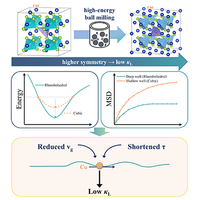
Multiple structures of Cu4TiSe4 have been predicted theoretically, but how they are related experimentally remains unclear. Here, the authors synthesize the rhombohedral phase and show that dynamic pressure during ball milling induces a transition to the cubic phase, with both phases stable at ambient conditions. Counterintuitively, the higher-symmetry cubic phase exhibits lower lattice thermal conductivity, which they attribute to Cu atoms in shallow potential wells that enhance atomic displacement and thereby reduce phonon group velocities and shorten phonon lifetimes.

Discerning Hall and non-Hall transverse currents in linear and nonlinear regimes

Yu-Fei Liu, Jinchen Liu, Tiema Qian, Hou Chen Li, Tianye Huang, Jian-Xiang Qiu, Xiaoyu Zeng, Peng Guo, Jian Tang, Thao Dinh, Qiong Ma, Xufan Li, Ni Ni, Anyuan Gao, and Su-Yang Xu

Phys. Rev. B 114, 235407 (2026) - Published 7 October, 2026

Rapid advances in nonlinear Hall transport provide new probes of quantum geometry, but transverse signals generally mix Hall and non-Hall contributions that are difficult to disentangle. Here, the authors introduce a unified experimental protocol that exchanges current and voltage directions to identify antisymmetric Hall and symmetric non-Hall responses. Measurements across representative quantum materials validate the method in both linear and nonlinear regimes.

Gyrotropy from extrinsic geometry in twisted materials

Spenser Talkington and Eugene J. Mele

Phys. Rev. B 114, 235408 (2026) - Published 13 October, 2026

Two-dimensional moiré materials feature widely tunable electronic structures. When these materials are illuminated by light, they exhibit optical gyrotropy in the form of circular dichroism and birefringence. Here, the authors show that this gyrotropy naturally decomposes into an intrinsic contribution due to interlayer electronic coupling and an extrinsic contribution due to the twisted embedding of the material in physical space. The authors conduct a general symmetry analysis applicable to moiré materials and identify regimes in which the intrinsic, and in which the extrinsic contributions dominate the gyrotropy. Finally, they apply the analysis to twisted bilayer graphene and twisted MoTe2.

Many-body Euler topology

Axel Fünfhaus, Titus Neupert, Thilo Kopp, and Roser Valentí

Phys. Rev. B 114, L231104 (2026) - Published 8 October, 2026

The authors introduce here many-body Euler numbers as a counterpart to many-body Chern numbers to diagnose the spontaneous breaking of time reversal symmetry in (fractional) Chern insulators. In addition, a classification scheme to realize different topological phases in interacting systems using symmetry indicators is laid out.

Highly uniaxial stress-tunable orbital-driven magnetism in CrAs

Kousuke Ishida, Hsiao-Yi Chen, Shumpei Seto, Hisashi Kotegawa, Ryoga Takahara, Yoichi Nii, Eiichi Matsuoka, Yusuke Wakabayashi, Clifford W. Hicks, Yusuke Nomura, and Yoshinori Onose

Phys. Rev. B 114, L231105 (2026) - Published 14 October, 2026

CrAs undergoes a first-order helimagnetic transition accompanied by a huge lattice distortion whose microscopic mechanism remains unresolved. Here, the authors demonstrate through stress-strain measurements that the helimagnetic transition in CrAs is substantially more sensitive to uniaxial stress than to hydrostatic pressure. First-principles calculations reveal that this strong response originates from an entanglement between anisotropic strain and orbital-dependent correlations, showing that local correlations can drive nonlinear elastic responses in strongly correlated systems.

Quantum Hall transformer in a quantum point contact over the full range of transmission

Stuart Yi-Thomas and Jay D. Sau

Phys. Rev. B 114, L231406 (2026) - Published 28 October, 2026

A quantum point contact between fractional quantum Hall states with different fillings can act as a dissipationless voltage transformer and provide a physical realization of the boundary sine-Gordon model. However, the microscopic understanding across the full range of transmission has remained unclear, complicating the interpretation of a recent experiment. Here, the authors use analytical and tensor network calculations of a sliding charge density wave to solve this open problem and quantitatively connect the conductance to the boundary sine-Gordon model.

Gate-tunable superconductor-semiconductor coupling and its impact on zero-energy modes in PbTe-Pb nanowires

Ruidong Li, Shuai Yang, Wenyu Song, Zeyu Yan, Yuhao Wang, Zehao Yu, Li Chen, Zixun Xia, Zonglin Li, Shan Zhang, Jiaye Xu, Lining Yang, Weizhao Wang, Xiao Feng, Tiantian Wang, Yunyi Zang, Lin Li, Runan Shang, Dong E. Liu, Qi-Kun Xue, Ke He, and Hao Zhang

Phys. Rev. B 114, L231407 (2026) - Published 29 October, 2026

Superconductor–semiconductor coupling plays a crucial role in realizing Majorana zero modes in hybrid nanowire devices. Here, the authors demonstrate controllable and tunable coupling in PbTe–Pb hybrid nanowires. More importantly, they establish a direct connection between the coupling strength and the emergence of robust zero modes. These findings provide valuable insights into engineering Majorana zero modes in this promising material platform.

LETTERS

Electronic structure and strongly correlated systems

NMR evidence of pressure-induced structural transition and enhanced spin fluctuations up to 14 GPa in SrCu2(BO3)2

Zhanlong Wu, Kefan Du, Shuo Li, Tong Shi, Ying Chen, Qingxin Dong, Rui Zhou, Rong Yu, Juanjuan Liu, Bosen Wang, Jinguang Cheng, Weiqiang Yu, and Yi Cui

Phys. Rev. B 114, L231101 (2026) - Published 5 October, 2026

Many-body Euler topology

Axel Fünfhaus, Titus Neupert, Thilo Kopp, and Roser Valentí

Phys. Rev. B 114, L231104 (2026) - Published 8 October, 2026

The authors introduce here many-body Euler numbers as a counterpart to many-body Chern numbers to diagnose the spontaneous breaking of time reversal symmetry in (fractional) Chern insulators. In addition, a classification scheme to realize different topological phases in interacting systems using symmetry indicators is laid out.

Highly uniaxial stress-tunable orbital-driven magnetism in CrAs

Kousuke Ishida, Hsiao-Yi Chen, Shumpei Seto, Hisashi Kotegawa, Ryoga Takahara, Yoichi Nii, Eiichi Matsuoka, Yusuke Wakabayashi, Clifford W. Hicks, Yusuke Nomura, and Yoshinori Onose

Phys. Rev. B 114, L231105 (2026) - Published 14 October, 2026

CrAs undergoes a first-order helimagnetic transition accompanied by a huge lattice distortion whose microscopic mechanism remains unresolved. Here, the authors demonstrate through stress-strain measurements that the helimagnetic transition in CrAs is substantially more sensitive to uniaxial stress than to hydrostatic pressure. First-principles calculations reveal that this strong response originates from an entanglement between anisotropic strain and orbital-dependent correlations, showing that local correlations can drive nonlinear elastic responses in strongly correlated systems.

Nonthermal nonlinear many-body excitonic dynamics in high-purity silicon

Patrick Pilch, Siyu Duan, Yang Liu, Manfred Bayer, Marc Assmann, and Zhe Wang

Phys. Rev. B 114, L231106 (2026) - Published 15 October, 2026

Trion liquid and its photoemission signatures

Noam Ophir and Anna Keselman

Phys. Rev. B 114, L231107 (2026) - Published 19 October, 2026

Majorana physics in a Luttinger liquid with attractive interactions

Francesco Debortoli, Nitya Cuzzuol, Luca Barbiero, and Fabian Grusdt

Phys. Rev. B 114, L231108 (2026) - Published 20 October, 2026

Correlation-driven metal-insulator transition in a d-wave altermagnet

Santhosh Kannan, Jainam Savla, and Madhuparna Karmakar

Phys. Rev. B 114, L231109 (2026) - Published 21 October, 2026

YCl electride as a multiorbital correlated topological dice lattice system

Jianqi Zhong, Songyuan Geng, Teng-Fei Ying, Haoxiang Li, and Benjamin T. Zhou

Phys. Rev. B 114, L231110 (2026) - Published 21 October, 2026

Emergent relativistic symmetry from interacting fermions on the honeycomb bilayer

Zi Hong Liu and Lukas Janssen

Phys. Rev. B 114, L231111 (2026) - Published 23 October, 2026

Lee-Yang zeros and pseudocritical drift in J-Q Néel antiferromagnet–valence-bond solid transitions

Chunhao Guo, Zhe Wang, Danhe Wang, Zenan Liu, Haiyuan Zou, and Zheng Yan

Phys. Rev. B 114, L231112 (2026) - Published 23 October, 2026

Five-terminal quantized transconductance originating from symmetric quantum fluctuations

K. Mertiri and Yuli V. Nazarov

Phys. Rev. B 114, L231113 (2026) - Published 26 October, 2026

Superconductivity in doped spin multimer systems

Ritsuki Hirabayashi, Masataka Kakoi, Ryota Ueda, Kazuhiko Kuroki, and Tatsuya Kaneko

Phys. Rev. B 114, L231114 (2026) - Published 27 October, 2026

Flat band in the multiband metal MnSb2

Carl Jonas Linnemann, Davide Ceresoli, Kim-Khuong Huynh, and Martin Bremholm

Phys. Rev. B 114, L231115 (2026) - Published 30 October, 2026

U(2) Chern-Simons-Ginzburg-Landau theory of fractional quantum Hall hierarchies

Taegon Lee, Gil Young Cho, and Donghae Seo

Phys. Rev. B 114, L231116 (2026) - Published 30 October, 2026

Tackling the sign problem in the doped Hubbard model with normalizing flows

Dominic Schuh, Lena Funcke, Janik Kreit, Thomas Luu, and Simran Singh

Phys. Rev. B 114, L231117 (2026) - Published 30 October, 2026

Semiconductors II: surfaces, interfaces, microstructures, and related topics

Higgs gap modes in quantized superconducting circuits

Yun-Chih Liao, Benjamin J. Powell, and Thomas M. Stace

Phys. Rev. B 114, L231301 (2026) - Published 6 October, 2026

Fingerprints of excitonic collective modes in the two-dimensional electron gas

Jakob Wolff, Silvana Botti, Lucia Reining, and Matteo Gatti

Phys. Rev. B 114, L231302 (2026) - Published 8 October, 2026

Melting phase diagram of the two-dimensional electron solid in a perpendicular magnetic field

M. Yu. Melnikov, D. G. Smirnov, A. A. Shashkin, S.-H. Huang, C. W. Liu, and S. V. Kravchenko

Phys. Rev. B 114, L231303 (2026) - Published 14 October, 2026

Hidden chirality and half-vortex formation in polariton condensates

A. N. Osipov, I. Y. Chestnov, P. G. Lagoudakis, and A. V. Yulin

Phys. Rev. B 114, L231304 (2026) - Published 23 October, 2026

Surface physics, nanoscale physics, low-dimensional systems

Linear dichroic soft x-ray microscopy of ferroelectric stripe domains in epitaxial K0.6Na0.4NbO3

M. Schneider, T. A. Butcher, S. Wagner, D. Metternich, C. Klose, E. Malm, R. Battistelli, V. Deinhart, J. Fuchs, S. Wittrock, T. Karaman, K. Puzhekadavil Joy, M. Patra, F. Büttner, S. Wintz, M. Weigand, C. M. Günther, D. Engel, P. Gaal, J. Schwarzkopf, B. Pfau, and S. Eisebitt

Phys. Rev. B 114, L231401 (2026) - Published 2 October, 2026

Spin quantum Hall transition on random networks: Exact critical exponents via quantum gravity

Esteban Macías, Ilya Gruzberg, and Eldad Bettelheim

Phys. Rev. B 114, L231402 (2026) - Published 5 October, 2026

Electron state tomography from quasiparticle interference maps

A. Razanajatovo, J. Cayssol, and C. Dutreix

Phys. Rev. B 114, L231403 (2026) - Published 13 October, 2026

Ballistic electron beams in PdCoO2

Abu Alex Aravindnath, Pavlo V. Pyshkin, Markus König, Seunghyun Khim, Johannes Kleinlein, Hartmut Buhmann, and Laurens W. Molenkamp

Phys. Rev. B 114, L231404 (2026) - Published 14 October, 2026

Intrinsic orbital Hall effect in degenerate spin-32 systems driven by the quantum metric

Rhonald Burgos Atencia

Phys. Rev. B 114, L231405 (2026) - Published 14 October, 2026

Quantum Hall transformer in a quantum point contact over the full range of transmission

Stuart Yi-Thomas and Jay D. Sau

Phys. Rev. B 114, L231406 (2026) - Published 28 October, 2026

A quantum point contact between fractional quantum Hall states with different fillings can act as a dissipationless voltage transformer and provide a physical realization of the boundary sine-Gordon model. However, the microscopic understanding across the full range of transmission has remained unclear, complicating the interpretation of a recent experiment. Here, the authors use analytical and tensor network calculations of a sliding charge density wave to solve this open problem and quantitatively connect the conductance to the boundary sine-Gordon model.

Gate-tunable superconductor-semiconductor coupling and its impact on zero-energy modes in PbTe-Pb nanowires

Ruidong Li, Shuai Yang, Wenyu Song, Zeyu Yan, Yuhao Wang, Zehao Yu, Li Chen, Zixun Xia, Zonglin Li, Shan Zhang, Jiaye Xu, Lining Yang, Weizhao Wang, Xiao Feng, Tiantian Wang, Yunyi Zang, Lin Li, Runan Shang, Dong E. Liu, Qi-Kun Xue, Ke He, and Hao Zhang

Phys. Rev. B 114, L231407 (2026) - Published 29 October, 2026

Superconductor–semiconductor coupling plays a crucial role in realizing Majorana zero modes in hybrid nanowire devices. Here, the authors demonstrate controllable and tunable coupling in PbTe–Pb hybrid nanowires. More importantly, they establish a direct connection between the coupling strength and the emergence of robust zero modes. These findings provide valuable insights into engineering Majorana zero modes in this promising material platform.

ARTICLES

Electronic structure and strongly correlated systems

First-principles study of Weyl nodal loops and multiple Weyl points in trigonal PtBi2

Lin-Lin Wang

Phys. Rev. B 114, 235101 (2026) - Published 1 October, 2026

Exploring Grassmann manifolds in topological systems via quantum distance

Shin-Ming Huang and Dimitrios Giataganas

Phys. Rev. B 114, 235103 (2026) - Published 5 October, 2026

Gauss-Bonnet theorem for quantum states: Gauss curvature and topology in the projective Hilbert space

Shin-Ming Huang

Phys. Rev. B 114, 235104 (2026) - Published 5 October, 2026

Fluctuation-enhanced electron-phonon coupling in FeSe

Jovan Blagojević, Ana Milosavljević, Tea Belojica, Bojana Višić, Marko Opačić, Andrijana Šolajić, Jelena Pešić, Enrico Di Lucente, Novica Paunović, Milorad V. Milošević, Emil S. Bozin, Aifeng Wang, Cedomir Petrovic, Zoran V. Popović, Rudi Hackl, and Nenad Lazarević

Phys. Rev. B 114, 235105 (2026) - Published 5 October, 2026

Magnetic fluctuations driven by quantum geometry

Makoto Shimizu, Chang-guen Oh, and Youichi Yanase

Phys. Rev. B 114, 235106 (2026) - Published 5 October, 2026

Systematic study of 36 multipoles in t2g systems: Physical significance and field-induced effects

Yi Fan, Jinyu Zou, Weijia Du, Xi Dai, and Gang Xu

Phys. Rev. B 114, 235107 (2026) - Published 5 October, 2026

Band unfolding via the quadratic pseudospectrum

Christopher A. Bairnsfather, Ralph M. Kaufmann, Terry A. Loring, and Alexander Cerjan

Phys. Rev. B 114, 235108 (2026) - Published 6 October, 2026

Influence of ligand field and correlation on the electronic structure of NiO and CoO from DFT+DMFT calculations

Daniel Mutter, Frank Lechermann, Daniel F. Urban, and Christian Elsässer

Phys. Rev. B 114, 235109 (2026) - Published 8 October, 2026

Site-selective renormalization and competing magnetic instabilities in paramagnetic Y3Cu2Sb3O14

Yanpeng Zhou and Gang Li

Phys. Rev. B 114, 235110 (2026) - Published 8 October, 2026

Unified interfacial and intrinsic topology in a large-gap epitaxial two-dimensional insulator

Heng Jin, Xiaoyin Li, Kyung-Hwan Jin, Bing Huang, and Feng Liu

Phys. Rev. B 114, 235111 (2026) - Published 9 October, 2026

Strong quantum interaction between excitons bound by cavity photon exchange

Miguel S. Oliveira and Cristiano Ciuti

Phys. Rev. B 114, 235112 (2026) - Published 9 October, 2026

Quantum-critical mediation of magnetic order by a Tomonaga-Luttinger liquid

Hironori Yamaguchi, Sota Monju, Akira Matsuo, Shunsuke C. Furuya, Nicolas Suaud, Koji Araki, Takanori Kida, Masayuki Hagiwara, and Koichi Kindo

Phys. Rev. B 114, 235113 (2026) - Published 9 October, 2026

Enhancing entanglement asymmetry in fragmented quantum systems

Lorenzo Gotta, Filiberto Ares, and Sara Murciano

Phys. Rev. B 114, 235114 (2026) - Published 9 October, 2026

Metallic mean quasicrystals and their topological invariants

Anuradha Jagannathan

Phys. Rev. B 114, 235115 (2026) - Published 14 October, 2026

Quasi-one-dimensional planar magnetic topological heterostructure

Z. Z. Alisultanov

Phys. Rev. B 114, 235116 (2026) - Published 14 October, 2026

Cotunneling theory and multiplet excitations: Emergence of asymmetric line shape in inelastic scanning tunneling spectroscopy of correlated molecules on surfaces

Marco Lozano, Manish Kumar, Pavel Jelínek, and Diego Soler-Polo

Phys. Rev. B 114, 235117 (2026) - Published 14 October, 2026

Quantum Cramér-Rao bound on quantum metric as a single-observable uncertainty relation

Wei Chen

Phys. Rev. B 114, 235118 (2026) - Published 14 October, 2026

Theory of a strange metal in a quantum superconductor to metal transition

Jaewon Kim, Erez Berg, and Ehud Altman

Phys. Rev. B 114, 235119 (2026) - Published 15 October, 2026

Reinterpretation of surface lattice resonance via singular-value decomposition

Xiaoya Sun, Xuefen Kan, Cheng Yin, Minglei Shan, Mengyuan He, Jian Wu, and Zhuangqi Cao

Phys. Rev. B 114, 235120 (2026) - Published 16 October, 2026

Two-dimensional transport in an in-plane magnetic field

Aryaman Babbar and Sankar Das Sarma

Phys. Rev. B 114, 235121 (2026) - Published 16 October, 2026

Investigation of the role of π−d interactions in λ-type salts using pressure-temperature phase diagram

Rikumaru Saito, Takuya Kobayashi, Hiromi Taniguchi, Noriaki Matsunaga, Shuhei Fukuoka, and Atsushi Kawamoto

Phys. Rev. B 114, 235122 (2026) - Published 19 October, 2026

Electrical detection of the spin-flip transition in a metal/Na5Co15.5Te6O36 heterostructure

Hirotsugu Tagami, Takuya Kawada, and Yuki Shiomi

Phys. Rev. B 114, 235123 (2026) - Published 19 October, 2026

Quantum phase transitions generated by order from quantum disorder

Fadi Sun, Jinwu Ye, and Wu-Ming Liu

Phys. Rev. B 114, 235124 (2026) - Published 23 October, 2026

Long-range model for the electronic pseudospin–nuclear-spin coupling and two-stage ordering in TmVO4

Sayan Ghosh, Anirudha Menon, Manoranjan Kumar, and Rajiv R. P. Singh

Phys. Rev. B 114, 235126 (2026) - Published 26 October, 2026

Validity of DFT+U band gaps in all its known functional forms

Andrew C. Burgess and David D. O'Regan

Phys. Rev. B 114, 235127 (2026) - Published 26 October, 2026

Defect-bound excitons in topological materials

Roni Majlin Skiff, Sivan Refaely-Abramson, Raquel Queiroz, and Roni Ilan

Phys. Rev. B 114, 235128 (2026) - Published 26 October, 2026

Magnetism and symmetry of superconducting gap in LaFeAsO from dynamical mean-field theory

S. L. Skornyakov, V. I. Anisimov, and A. A. Katanin

Phys. Rev. B 114, 235129 (2026) - Published 27 October, 2026

Radiative heat transfer in topological nodal-ring semimetals

Cheng-Long Zhou, Jun-Yu Chu, Xiao-Qi Sun, Yong Zhang, Hong-Liang Yi, and Ashutosh Singh

Phys. Rev. B 114, 235130 (2026) - Published 27 October, 2026

Can electronic band topology leave a fingerprint in thermal radiation? Here, the authors theoretically show that the evolution from a nodal point to a nodal ring shifts spectral heat flux to higher frequencies and reduces the contribution of large-wave-vector photon tunneling channels. Together, these effects broaden the near-field radiation spectrum while suppressing heat transfer. The resulting temperature-sensitive radiative response connects topological electronic states with nanoscale energy modulation and offers a platform for thermal switching, thermal rectification, and thermal stabilization.

Magnetic toroidal monopoles from relativistic polarization responses to magnetic field gradients

Taisei Yamanaka, Takumi Sato, and Satoru Hayami

Phys. Rev. B 114, 235131 (2026) - Published 28 October, 2026

Exactly solvable models hosting altermagnetic quantum spin liquids

João Augusto Sobral, Pietro M. Bonetti, Subrata Mandal, and Mathias S. Scheurer

Phys. Rev. B 114, 235132 (2026) - Published 28 October, 2026

While altermagnets have been primarily studied for their magnetic properties, another important aspect is the impact of strong quantum fluctuations that can lead to the loss of magnetic order. Here, the authors construct exactly solvable models for quantum-disordered altermagnets. They identify altermagnetic spin liquids—states that preserve spin-rotation and translation symmetries, yet break time-reversal symmetry through orbital moments, whose net value vanishes by symmetry— and study their excitations, and competing phases.

Band-gap signatures in coherent solid-state high-harmonic dynamics driven by resonant attosecond injection

Lu Liu, Jing Zhao, Jicai Liu, Yindong Huang, and Zengxiu Zhao

Phys. Rev. B 114, 235133 (2026) - Published 28 October, 2026

Zipping many-body quantum states: A scalable approach to diagonal entropy

Yu-Hsueh Chen and Tarun Grover

Phys. Rev. B 114, 235134 (2026) - Published 28 October, 2026

Altermagnetic band geometry and the antiferromagnetic thermal boundary in a coupled fermion-Ising model

Xing-Can Liu, Ho-Kin Tang, Tao Ying, and Xueru Zhang

Phys. Rev. B 114, 235135 (2026) - Published 29 October, 2026

Semiconductors I: bulk

Validity of the scattering exponent approximation for materials with a complex electronic structure

Yuji Go, Rajeev Dutt, Bhawna Sahni, and Neophytos Neophytou

Phys. Rev. B 114, 235201 (2026) - Published 6 October, 2026

Relation between the areal rate of Zitterbewegung and Berry curvature in two-band systems

Sonja Predin

Phys. Rev. B 114, 235202 (2026) - Published 7 October, 2026

Dual character of Zn impurity in SnTe: Tuning thermoelectric and topological properties

Kacper Pryga and Bartlomiej Wiendlocha

Phys. Rev. B 114, 235203 (2026) - Published 8 October, 2026

Framework for atom-resolved decomposition of second-harmonic generation in nonlinear optical crystals

YingXing Cheng, Congwei Xie, Zhihua Yang, and Shilie Pan

Phys. Rev. B 114, 235204 (2026) - Published 14 October, 2026

Time-dependent terahertz dielectric function of ZnTe under two-photon optical excitation at 800 nm wavelength

Farell Keiser, Wentao Zhang, Dominik Johannesmann, Nicolas S. Beermann, Yuhao Meng, Hassan A. Hafez, Savio Fabretti, and Dmitry Turchinovich

Phys. Rev. B 114, 235205 (2026) - Published 14 October, 2026

Zinc telluride (ZnTe) is widely used to generate and detect terahertz radiation with 800-nm laser pulses, yet its dielectric response at typical THz generation intensities remains unclear. Here, the authors show that two-photon absorption creates a transient free-carrier plasma strongly coupled to the lattice, modifying the THz dielectric function and markedly enhancing the 1.55-THz phonon resonance. These findings refine the physical description of THz generation in ZnTe and identify excitation-induced constraints on efficiency and bandwidth.

Stacking-dependent thermoelectric transport in layered Sc2Si2Te6 from first principles

Zhongjuan Han, Wu Xiong, Zhonghao Xia, Weitong Huang, and Jiangang He

Phys. Rev. B 114, 235206 (2026) - Published 19 October, 2026

Dynamic pressure induced phase transition in Cu4TiSe4: Lower lattice thermal conductivity from a shallow potential well

Hui Zhang, Zhihao Li, Maheen Kanwal, Panpan Peng, Jianhong Hu, Jinze Zhai, and Hongchao Wang

Phys. Rev. B 114, 235207 (2026) - Published 19 October, 2026

Multiple structures of Cu4TiSe4 have been predicted theoretically, but how they are related experimentally remains unclear. Here, the authors synthesize the rhombohedral phase and show that dynamic pressure during ball milling induces a transition to the cubic phase, with both phases stable at ambient conditions. Counterintuitively, the higher-symmetry cubic phase exhibits lower lattice thermal conductivity, which they attribute to Cu atoms in shallow potential wells that enhance atomic displacement and thereby reduce phonon group velocities and shorten phonon lifetimes.

Semiconductors II: surfaces, interfaces, microstructures, and related topics

Anisotropic functional for two-dimensional material systems

Michael Lorke

Phys. Rev. B 114, 235301 (2026) - Published 6 October, 2026

Charge transport in two-dimensional conductors with hybrid three-component plasma

A. D. Levin, V. A. Chitta, Z. D. Kvon, N. N. Mikhailov, and G. M. Gusev

Phys. Rev. B 114, 235302 (2026) - Published 7 October, 2026

Local symmetry and mode-selective electron-phonon coupling of oxygen-related defects in AlN

Erfei Zhang, Ning Tang, Yiming Tan, Lei Fu, Tianyu Zhang, Han Yang, Lin Shi, Ping Wang, Jiaming Wang, Guowei Lv, Xuelin Yang, Fujun Xu, Tongjun Yu, Xinqiang Wang, Weikun Ge, and Bo Shen

Phys. Rev. B 114, 235303 (2026) - Published 8 October, 2026

Electrically tunable radiative coupling in permittivity-asymmetric quasibound states in the continuum via periodically poled lithium niobate metasurfaces

Haoyu Wang, Zhancheng Li, Shiwang Yu, Yanchun Wang, Hui Liu, Wenwei Liu, Hua Cheng, and Shuqi Chen

Phys. Rev. B 114, 235304 (2026) - Published 20 October, 2026

Si-O network connectivity as a structural signature of self-passivation of β−FeSi2 surfaces

Jun Chai, Hangjia Shen, Mingping He, Yulin Zhou, and Pan Liu

Phys. Rev. B 114, 235305 (2026) - Published 23 October, 2026

Keldysh field theory of spin- and valley-distinguished polariton nonlinearities in transition metal dichalcogenide monolayers

Anna M. Grudinina and Nina S. Voronova

Phys. Rev. B 114, 235306 (2026) - Published 26 October, 2026

Surface physics, nanoscale physics, low-dimensional systems

Transducer width dependent stiffening of gigahertz surface acoustic waves in silicon

Arun Babu, Mukund Kumar, Himanshu Singhal, Ajmal Ansari, Juzer Ali Chakera, and Dipanshu Bansal

Phys. Rev. B 114, 235401 (2026) - Published 1 October, 2026

Vacancy-driven reversal of layer-dependent friction in two-dimensional MoSe2

Haoyu Deng, Xin Wang, Tongtong Yu, Xinjian He, Shuang Li, Pengfei Liu, Changhe Du, and Daoai Wang

Phys. Rev. B 114, 235402 (2026) - Published 2 October, 2026

Geometry-induced skin effect in electron hydrodynamics

Jarosław Pawłowski, Piotr Surówka, and Konstantin Zarembo

Phys. Rev. B 114, 235403 (2026) - Published 2 October, 2026

Exact analytical edge states in the extended Su-Schrieffer-Heeger model

P. A. Grizzi, A. A. Aligia, and P. Roura-Bas

Phys. Rev. B 114, 235404 (2026) - Published 5 October, 2026

Magnetic enhancement and Hall conductivity of excitonic insulators in a Gross-Neveu type model

William R. Tavares, Rudnei O. Ramos, and Nei Lopes

Phys. Rev. B 114, 235405 (2026) - Published 5 October, 2026

Hysteresis-driven radiative Mpemba effect in phase-change nanostructures

F. Herz

Phys. Rev. B 114, 235406 (2026) - Published 6 October, 2026

Discerning Hall and non-Hall transverse currents in linear and nonlinear regimes

Yu-Fei Liu, Jinchen Liu, Tiema Qian, Hou Chen Li, Tianye Huang, Jian-Xiang Qiu, Xiaoyu Zeng, Peng Guo, Jian Tang, Thao Dinh, Qiong Ma, Xufan Li, Ni Ni, Anyuan Gao, and Su-Yang Xu

Phys. Rev. B 114, 235407 (2026) - Published 7 October, 2026

Rapid advances in nonlinear Hall transport provide new probes of quantum geometry, but transverse signals generally mix Hall and non-Hall contributions that are difficult to disentangle. Here, the authors introduce a unified experimental protocol that exchanges current and voltage directions to identify antisymmetric Hall and symmetric non-Hall responses. Measurements across representative quantum materials validate the method in both linear and nonlinear regimes.

Gyrotropy from extrinsic geometry in twisted materials

Spenser Talkington and Eugene J. Mele

Phys. Rev. B 114, 235408 (2026) - Published 13 October, 2026

Two-dimensional moiré materials feature widely tunable electronic structures. When these materials are illuminated by light, they exhibit optical gyrotropy in the form of circular dichroism and birefringence. Here, the authors show that this gyrotropy naturally decomposes into an intrinsic contribution due to interlayer electronic coupling and an extrinsic contribution due to the twisted embedding of the material in physical space. The authors conduct a general symmetry analysis applicable to moiré materials and identify regimes in which the intrinsic, and in which the extrinsic contributions dominate the gyrotropy. Finally, they apply the analysis to twisted bilayer graphene and twisted MoTe2.

Zener tunneling in biased bilayer graphene via analytic continuation of semiclassical theory

Harley D. Scammell and Oleg P. Sushkov

Phys. Rev. B 114, 235409 (2026) - Published 14 October, 2026

Spin-locked helical currents and charge-neutral spin-channel pumping in altermagnetic nanotubes

Xin Chen, Zhen Han, Linyang Li, and Mingwen Zhao

Phys. Rev. B 114, 235410 (2026) - Published 16 October, 2026

Grain-boundary scattering between chiral domains in the chiral topological semimetal CoSi

Nicholas A. Lanzillo, Ion Garate, and Ching-Tzu Chen

Phys. Rev. B 114, 235411 (2026) - Published 20 October, 2026

Mesoscopic routers and single-pole double-throw switches for electronic heat

José Balduque and Rafael Sánchez

Phys. Rev. B 114, 235412 (2026) - Published 20 October, 2026

Spin Hall effect in electronic Lévy glasses: Enhanced spin-current generation in the superdiffusive regime

Diego B. Fonseca, Luiz Felipe C. Pereira, and Anderson L. R. Barbosa

Phys. Rev. B 114, 235413 (2026) - Published 21 October, 2026

Resonant control of near-field radiative heat transfer using meta-atoms

Asim Ur Rahman, Yongdi Dang, M. Shahid Iqbal Khan, Tianle Chen, Chen Ni, Xinran Li, Muhammad Basir Abbas, Jianbin Xu, and Yungui Ma

Phys. Rev. B 114, 235414 (2026) - Published 21 October, 2026

Cascade of topological phase transitions and revival of topological zero modes in imperfect double helical liquids

Anna Ohorodnyk and Chen-Hsuan Hsu

Phys. Rev. B 114, 235415 (2026) - Published 22 October, 2026

Exciton renormalization and optical absorption in doped monolayer transition metal dichalcogenides

Nguyen Truong Co, Le Thi Ngoc Bao, H. N. T. Phung, and Le Van Tan

Phys. Rev. B 114, 235416 (2026) - Published 26 October, 2026

Hidden valley dynamics behind vanishing circular polarization in moiré excitons

Yuto Urano, Lata Chouhan, Nurul Fariha Ahmad, Kenji Watanabe, Takashi Taniguchi, Daichi Kozawa, and Ryo Kitaura

Phys. Rev. B 114, 235417 (2026) - Published 27 October, 2026

Maneuverable chiroptical responses for engineering high quality and ultrasensitive chiral sensing in planar metasurfaces

Yan Li, Xiao-Qing Luo, W. M. Liu, and Xin-Lin Wang

Phys. Rev. B 114, 235418 (2026) - Published 28 October, 2026

Merging bound states in the continuum into an exceptional point via magnetic field

Yadong Yue, Kun Liang, and Li Yu

Phys. Rev. B 114, 235419 (2026) - Published 29 October, 2026

Sign In to Your Journals Account

Filter

Filter

Article Lookup

Enter a citation