APS Response to the Russian Invasion of Ukraine
Key image
EDITORS' SUGGESTION

Negative-chirality order in the S=12 kagome antiferromagnet CdCu3(OH)6(NO3)2·H2O

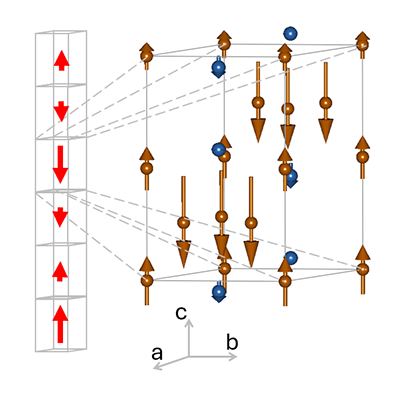
By the complementary combination of NMR and neutron diffraction measurements, and a symmetry analysis using the previously reported magnetization measurements, a negative-chirality q=0 magnetic structure is successfully identified as the ground state of CdCu3(OH)6(NO3)2H2O, the S=½ perfect kagome antiferromagnet. Detailed investigation of the internal fields leads the authors to suggest a spin-locked magnetic structure with <100> anisotropy, which is stabilized by the Dzyaloshinskii-Moriya interaction and the interactions slightly modified by the orientational order of the NO3 units.

Yoshihiko Ihara et al.
Phys. Rev. B 106, 024401 (2022)


Key image
EDITORS' SUGGESTION

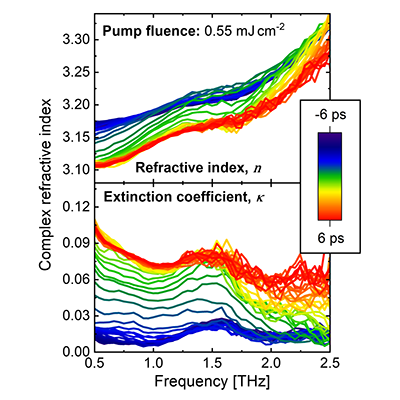
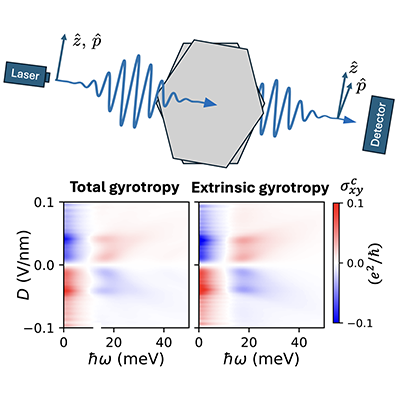
Nonequilibrium quasistationary spin disordered state in αRuCl3

The authors use optical excitation as a way to alter the magnetic free energy landscape and the resulting phase diagram of the frustrated honeycomb magnet α-RuCl3. They time-track experimentally the magneto-optical response from the α-RuCl3’s zigzag-ordered ground state after photoexcitation and they reproduce the observed dynamics within a Ginzburg-Landau model. A quasistationary spin disordered state is induced above a critical photoexcitation density, suggesting a new route to reach a nontrivial spin disordered state in Kitaev-like magnets such as α-RuCl3.

R. B. Versteeg et al.
Phys. Rev. B 105, 224428 (2022)


Key image
EDITORS' SUGGESTION

Probing the interlayer coupling in 2HNbS2 via soft x-ray angle-resolved photoemission spectroscopy

One secret to the charm of two-dimensional (2D) van der Waals materials is that their interlayer coupling lies in a sweet spot: weak enough to render the individual layers electronically quasi-2D, yet strong enough to produce distinct behavior upon stacking individual layers. Here, the authors utilize soft-x-ray angle-resolved photoemission spectroscopy to extract the interlayer hopping parameters in the typical transition metal dichalcogenide 2H-NbS2. Comparison with first-principles calculations reveals the influence of atomic distances and hybrid functionals on interlayer coupling.

D. Huang et al.
Phys. Rev. B 105, 245145 (2022)


Key image
EDITORS' SUGGESTION

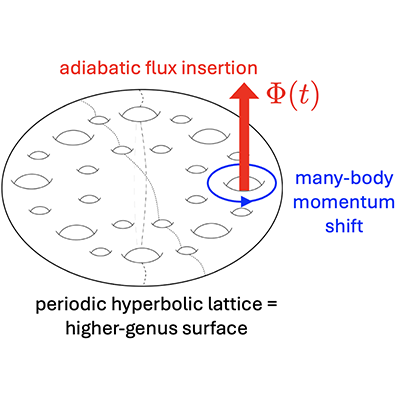
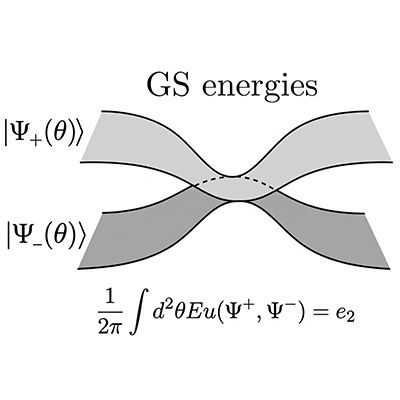
Classification of (2+1)D invertible fermionic topological phases with symmetry

Integer quantum Hall states and their generalization to topological insulators and superconductors are paradigmatic examples of invertible fermionic topological states of matter. Here, the authors develop a comprehensive characterization and classification of invertible fermionic topological phases of matter in two spatial dimensions for general symmetry groups. The results are nonperturbative and apply to strongly interacting systems. In particular, they extend previous classification results to account for the possible chiral nature of invertible phases.

Maissam Barkeshli, Yu-An Chen, Po-Shen Hsin, and Naren Manjunath
Phys. Rev. B 105, 235143 (2022)


Key image
EDITORS' SUGGESTION

Entanglement transitions from stochastic resetting of non-Hermitian quasiparticles

Entanglement is a key tool to classify quantum phases of matter in and out of equilibrium. Here, the authors introduce a phenomenological quasiparticle picture for entanglement dynamics in monitored systems evolving under the effect of quantum jumps. Within this picture, entanglement is carried by non-Hermitian quasiparticles, associated to the no-click limit of the measurement protocol, that propagate ballistically and are randomly reset with a rate given by their inverse lifetime. The authors show how this picture qualitatively reproduces the entanglement transition in the monitored Ising chain.

Xhek Turkeshi, Marcello Dalmonte, Rosario Fazio, and Marco Schirò
Phys. Rev. B 105, L241114 (2022)


Key image
EDITORS' SUGGESTION

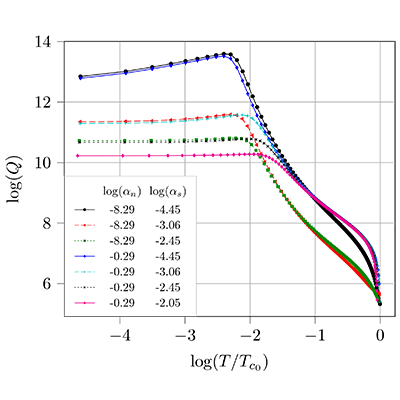
Renormalization group analysis of the finite two-dimensional XY model with fourfold anisotropy: Application to the magnetic susceptibility of a ferromagnetic ultrathin film

The topological phase transition introduced by Kosterlitz and Thouless has become a central concept in condensed matter physics. With the increasing relevance of topological phases to applications in spintronics, it is important to extend the description of the Kosterlitz-Thouless transition in an infinite, isotropic two-dimensional XY ferromagnet to experimentally realizable systems such as a finite, anisotropic ultrathin film with fourfold in-plane anisotropy. Using a renormalization group analysis, this description is used to calculate the magnetic susceptibility for comparison to experiment.

D. Venus
Phys. Rev. B 105, 235440 (2022)


Key image
EDITORS' SUGGESTION

Fluctuation-induced odd-frequency spin-triplet pairing in a disordered electron liquid

The authors mix fluctuations of different origin to obtain pairing in the odd-frequency spin-triplet channel. Such fluctuations are enhanced in disordered two-dimensional systems, and the pairing is predicted to be sufficient for the instability in the odd-frequency spin-triplet channel.

Vladimir A. Zyuzin and Alexander M. Finkel'stein
Phys. Rev. B 105, 214523 (2022)


Key image
EDITORS' SUGGESTION

Fluctuating spin-orbital texture of Rashba-split surface states in real and reciprocal space

Spin-orbit interaction in a crystal surface typically causes helical spin polarization, namely topological or Rashba states. The authors have noticed that the known cases of such surface spin polarization are limited to ideal models because of the symmetry operations in the surface atomic structure. Here, they reveal numerous hidden surface spin textures in a surface quasi-1D system, which vary from ferromagnetic to antiferromagnetic depending on the wave vector, with a small number of symmetry operations. This achievement suggests that versatile spin texture at the surface would be tailored by tuning the symmetry operations.

Takuto Nakamura et al.
Phys. Rev. B 105, 235141 (2022)


Key image
EDITORS' SUGGESTION

Conditional probability density functional theory

Conditional probability density functional theory (CP-DFT) determines the ground-state energy of a many-electron system by finding the conditional probability density from a parallelizable series of Kohn-Sham DFT calculations. By directly calculating conditional probability densities, the authors bypass the need for an approximate exchange-correlation (XC) energy functional. CP-DFT is formally exact, but approximate potentials are used in practice. We explore a suitable approximation that satisfies many presented exact constraints and even properly dissociates neutral hydrogen chains.

Ryan Pederson, Jielun Chen (陈捷伦), Steven R. White, and Kieron Burke
Phys. Rev. B 105, 245138 (2022)


Key image
EDITORS' SUGGESTION

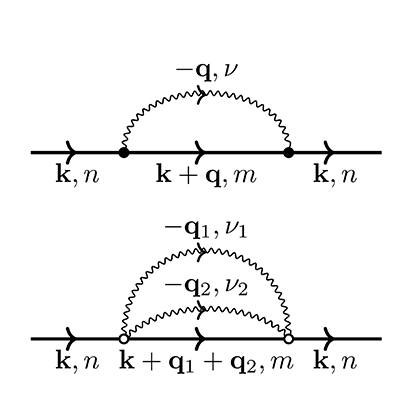
Improved estimator for numerical renormalization group calculations of the self-energy

The numerical renormalization group is the gold standard for solving quantum impurity models. To compute the self-energy, one routinely employs an equation of motion instead of inverting Dyson’s equation. Still, in challenging regimes, the results often suffer from artifacts. The author shows here that a new estimator, derived by a twofold application of the equation of motion, yields greatly improved results, as key aspects of the retarded self-energy require only the imaginary parts of auxiliary correlators and not their real parts obtained by a Kramers-Kronig transform.

Fabian B. Kugler
Phys. Rev. B 105, 245132 (2022)


Key image
EDITORS' SUGGESTION

Scattering of spin waves by a Bloch domain wall: Effect of the dipolar interaction

It is known that if the dipolar interaction is ignored or replaced by an effective magnetic anisotropy, the theoretical computations predict that a domain wall is transparent to spin waves. Taking into account the full complexity of this interaction, the authors show that the domain wall does indeed reflect spin waves. The scattering parameters are computed by treating the dipolar interaction perturbatively in the Born approximation, which is not straightforward due to the nonlocality of this interaction. A lateral shift of the scattered waves is also predicted.

Victor Laliena, Athanasios Athanasopoulos, and Javier Campo
Phys. Rev. B 105, 214429 (2022)


Key image
EDITORS' SUGGESTION

Unveiling the spin-singlet states of two electron-hole pair complexes using two-photon excitation in a GaAs/AlAs quantum dot

The ability to initialize excitonic states in the high-energy orbital levels of quantum dots provides additional degrees of freedom for all-optical spin-driving protocols. Here, the authors show that unconventional two-photon excitation can simultaneously photocreate two electron-hole pairs located on distinct orbital levels of a GaAs quantum dot. Tuning the laser energy allows the triplet and singlet spin states of the biexciton to be selectively addressed. The measured radiative cascades suggest the importance of many-body effects in these weakly confined dots.

S. Germanis et al.
Phys. Rev. B 105, 235430 (2022)


Key image
EDITORS' SUGGESTION

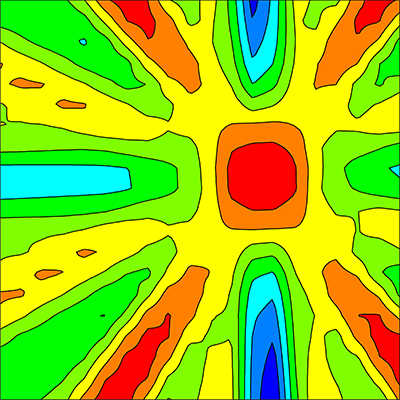
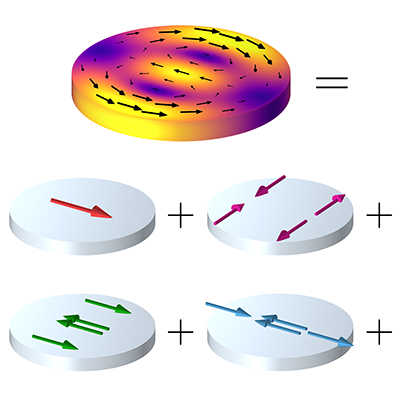
Bound states in the continuum in multipolar lattices

A general theory of bound states in the continuum (BICs) in multipolar lattices composed of Mie-resonant or plasmonic nanoparticles is developed. It is revealed that the BICs, which are usually very sensitive to parameters of the photonic structure, can be completely robust, remaining pinned to specific directions in k space. The developed approach sets a direct relation between the topological charge of BIC and the asymptotic behavior of its Q factor that is important for engineering the photonic structures supporting BICs.

Sergei Gladyshev et al.
Phys. Rev. B 105, L241301 (2022)


Key image
EDITORS' SUGGESTION

Band filling effects on the emergence of magnetic skyrmions: Pd/Fe and Pd/Co bilayers on Ir(111)

Structurally similar transition metal systems can exhibit very different magnetic properties. An instructive example is the widely studied Pd/Fe/Ir(111) multilayer, which shows a spin-spiral ground state, while Pd/Co/Ir(111) presents a ferromagnetic (single-domain) ground state. Here, the authors analyze the origin of this difference combining ab initio and atomistic spin-dynamics calculations, demonstrating that the distinct behaviors can be explained by a simple rigid-band-like model. This analysis highlights the possibility of tuning topological magnetic structures by alloying and/or external agents, e.g., electric fields.

I. P. Miranda, A. B. Klautau, A. Bergman, and H. M. Petrilli
Phys. Rev. B 105, 224413 (2022)


Key image
EDITORS' SUGGESTION

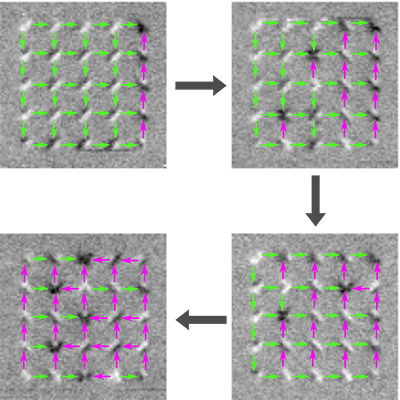
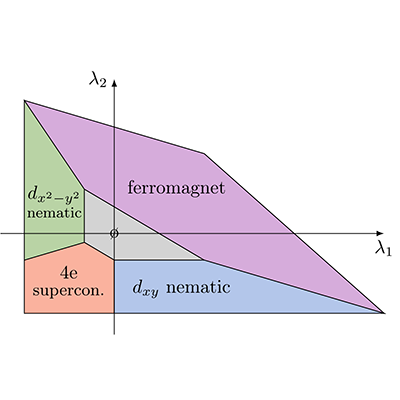
Beyond the freshman’s dream: Classical fractal spin liquids from matrix cellular automata in three-dimensional lattice models

The Newman-Moore model on the 2D triangular lattice is a classic example of a statistical mechanical model with immobile fractal excitations: fractons. These result in kinetic constraints leading to glassy behavior. Here, the authors generalize this construction to two 3D lattices, trillium and hyperhyperkagome. While these models exhibit a similar phenomenology, the authors show that the underlying fractons have a richer structure and are intimately connected to the matrix cellular automata that describe the manifold of ground states.

Sounak Biswas, Yves H. Kwan, and S. A. Parameswaran
Phys. Rev. B 105, 224410 (2022)

Current Issues

Vol. 106, Iss. 1-4 — July 2022

View Current Issues

Announcements

New PRX Lead Editor
May 13, 2022

APS has appointed Denis Bartolo, Professor of Physics at ENS de Lyon, France as the Lead Editor of Physical Review X (PRX). Professor Bartolo takes the helm following the journal’s previous Lead Editors Cristina Marchetti and Jean-Michel Raimond.

Now Online: First Published Articles from PRX Energy
April 7, 2022

APS is delighted to introduce the first published articles from PRX Energy, a fully open access and highly selective journal for the multidisciplinary energy science and technology research communities.

APS Announces Outstanding Referees for 2022
March 1, 2022

APS has selected 146 Outstanding Referees for 2022 who have demonstrated exceptional work in the assessment of manuscripts published in the Physical Review journals. A full list of the Outstanding Referees is available online.

Physical Review Journals Announce Inclusive Name Change Policy
September 17, 2021

The American Physical Society (APS) today released the details of its name change policy for the Physical Review journals. The policy is intended to make the world’s leading physics journals more inclusive and ensure authors retain ownership of prior work published under a different name.

Introducing PRX Energy
June 2, 2021

Opening for submissions later this year, PRX Energy is a new, highly selective open access journal from APS that will communicate and facilitate important advances in energy science and technology for the benefit of humanity. Article publication charges (APCs) will be waived for a limited time.

More Announcements

Job Openings

Lead Editor, Physical Review B
June 15, 2022

The American Physical Society is conducting an international search for a new Lead Editor of Physical Review B (PRB).

2021 Journal Citation Reports

2021 Journal Citation Reports

Trending in PRB

In-plane anisotropic charge dynamics in the layered polar Dirac semimetal BaMnSb2
H. Yoshizawa et al.
Phys. Rev. B 105, L241110 (2022)

Band filling effects on the emergence of magnetic skyrmions: Pd/Fe and Pd/Co bilayers on Ir(111)
I.P. Miranda, A.B. Klautau, A. Bergman, and H.M. Petrilli
Phys. Rev. B 105, 224413 (2022)

Conditional probability density functional theory
Ryan Pederson, Jielun Chen, Steven R. White, and Kieron Burke
Phys. Rev. B 105, 245138 (2022)

Bound states in the continuum in multipolar lattices
Sergei Gladyshev et al.
Phys. Rev. B 105, L241301 (2022)

Scattering of spin waves by a Bloch domain wall: Effect of the dipolar interaction
Victor Laliena, Athanasios Athanasopoulos, and Javier Campo
Phys. Rev. B 105, 214429 (2022)

Challenges to observation of many-body localization
Piotr Sierant and Jakub Zakrzewski
Phys. Rev. B 105, 224203 (2022)

Flat-band plasmons in twisted bilayer transition metal dichalcogenides
Xueheng Kuang, Zhen Zhan, and Shengjun Yuan
Phys. Rev. B 105, 245415 (2022)

Two-dimensional transition metal triborides: Monolayers with robust intrinsic magnetism and high spin stability
Xiaojing Yao et al.
Phys. Rev. B 105, 214421 (2022)

Floquet topological systems with flat bands: Edge modes, Berry curvature, and orbital magnetization
Ceren B. Dag and Aditi Mitra
Phys. Rev. B 105, 245136 (2022)

Modulation doping of the FeSe monolayer on SrTiO3
Fengmiao Li, Ilya Elfimov, and George A. Sawatzky
Phys. Rev. B 105, 214518 (2022)

Electronic states dressed by an out-of-plane supermodulation in the quasi-two-dimensional kagome superconductor CsV3Sb5
Yang Luo et al.
Phys. Rev. B 105, L241111 (2022)

Superconductive materials with MgB2-like structures from data-driven screening
Ze Yu et al.
Phys. Rev. B 105, 214517 (2022)

Weak electronic correlations in the kagome superconductor A_V3Sb5 (_A=K, Rb, Cs)
Min Liu, Zhiwei Wang, and Jin-Jian Zhou
Phys. Rev. B 105, 235130 (2022)

Observation of nontrivial spin-orbit torque in single-layer ferromagnetic metals
Qingwei Fu et al.
Phys. Rev. B 105, 224417 (2022)

Beyond the freshman’s dream: Classical fractal spin liquids from matrix cellular automata in three-dimensional lattice models
Sounak Biswas, Yves H. Kwan, and S.A. Parameswaran
Phys. Rev. B 105, 224410 (2022)

APS-Max Planck Gesellschaft Pilot Transformative Agreement

APS-MPG

Sign up to receive regular email alerts from Physical Review B

Log In

Cancel
×

Search


Article Lookup

Paste a citation or DOI

Enter a citation
×