



Voltage-driven breakdown of electronic order
Miguel M. Oliveira, Pedro Ribeiro, and Stefan Kirchner
Phys. Rev. B 114, 245101 (2026) - Published 1 October, 2026
Non-Hermitian topology driven by an identity term: An exactly solvable paradigm
Lingfang Li, Yating Wei, Yang Ruan, Gangzhou Wu, Jun Wang, Shihua Chen, Tong Lin, Ching Hua Lee, and Zhenhua Ni
Phys. Rev. B 114, 245102 (2026) - Published 2 October, 2026
Boundary-doublet spectroscopy from isolated subgap absorption in finite Su-Schrieffer-Heeger and Rice-Mele chains
Nazir A. Ganaie and M. A. Shah
Phys. Rev. B 114, 245103 (2026) - Published 5 October, 2026
Quantum phase diagram and topological magnetocaloric effect of the anisotropic Kitaev magnet under magnetic field along the [111] direction
Zai-Ning Wang, Bo-Wen Sun, Shi-Jie Luo, Xiang-Rong Shen, Nai-Chao Zheng, Qi Yuan, Bin Liu, Gang Su, Wei Li, and Han Li
Phys. Rev. B 114, 245104 (2026) - Published 5 October, 2026
No-go theorem for single time-reversal invariant symmetry-protected Dirac fermions in
Lei Gioia, Anton A. Burkov, and Taylor L. Hughes
Phys. Rev. B 114, 245105 (2026) - Published 5 October, 2026
Nonlinear electron-phonon interactions from first principles
Zhenbang Dai and Feliciano Giustino
Phys. Rev. B 114, 245106 (2026) - Published 5 October, 2026
The interacting electron-phonon problem has long been studied within the linear coupling approximation, which can break down in the strong-coupling limit. Here, the authors develop an theory that enables the calculation of the full nonlinear electron-phonon coupling matrix. With this development, the authors demonstrate the critical role of nonlinear couplings in electron-phonon physics by analyzing its impact on the small hole polaron in lithium fluoride.
Theory of two-dimensional Wigner crystals with defects: Interactions, melting transitions, and collective modes
Paweł Matus and Tobias Holder
Phys. Rev. B 114, 245107 (2026) - Published 6 October, 2026
Unbiased large- approach to competing vestigial orders of density-wave and superconducting instabilities
Grgur Palle and Rafael M. Fernandes
Phys. Rev. B 114, 245108 (2026) - Published 7 October, 2026
Vestigial orders are partially melted versions of ordered states stabilized by fluctuations of the order parameter. Observed in several quantum materials, their theoretical description has often relied on a large- approximation that suffers from ambiguities due to multiple interfering channels. Here, the authors uncover the structural reasons for the ambiguities and from them derive a large- prescription that removes the ambiguities, yielding unequivocal physical results. This prescription is then applied to multicomponent density wave and superconducting instabilities, where they find exotic vestigial phases describing spin-quadrupolar, charge-4 superconducting, and altermagnetic orders.
Spectroscopic signatures of emergent SO(5) symmetry at the deconfined critical point of the model
Shutao Liu, Yan Liu, Chengkang Zhou, Zhe Wang, Jie Lou, Changle Liu, Zheng Yan, and Yan Chen
Phys. Rev. B 114, 245109 (2026) - Published 7 October, 2026
Lieb-Schultz-Mattis constraints for hyperbolic lattices
G. Shankar and Joseph Maciejko
Phys. Rev. B 114, 245110 (2026) - Published 8 October, 2026
The Lieb-Schultz-Mattis (LSM) theorem powerfully constrains the low-energy behavior of quantum many-body systems. In spin systems with spin rotation and conventional (Euclidean) lattice translation symmetries, it forbids a unique, gapped, symmetric ground state at half-odd-integer spin per unit cell. Here, the authors generalize this theorem to hyperbolic lattices — synthetic structures that emulate negatively curved space. Unlike Euclidean lattice translations, hyperbolic translations are noncommutative. By adapting a flux-threading argument, the authors derive LSM constraints on gapped phases of hyperbolic quantum matter.
Disordered Su-Schrieffer-Heeger model
Michael Hilke
Phys. Rev. B 114, 245111 (2026) - Published 8 October, 2026
Transport through a magnetic nanoelectromechanical spin-valve device controlled by magnetic polarization
Jing Hu, Yi Ding, Szabolcs Kelemen, Xingyu Zhang, Yuguo Su, Yiying Yan, Elijah Omollo Ayieta, Slobodan Radošević, Georg Engelhardt, Gernot Schaller, and JunYan Luo
Phys. Rev. B 114, 245112 (2026) - Published 9 October, 2026
Emergent heavy-fermion behavior from and hybridization in the quadruple perovskite
Hiroaki Anzai, Yasuaki Kikuchi, Yuta Kato, Kyoichi Otsuki, Toshiaki Iwazumi, Yukimi Tanimoto, Hitoshi Sato, Masashi Arita, and Ikuya Yamada
Phys. Rev. B 114, 245113 (2026) - Published 13 October, 2026
Towards interpretability of neural quantum states
Fabian Döschl and Annabelle Bohrdt
Phys. Rev. B 114, 245114 (2026) - Published 13 October, 2026
Scanning tunneling microscopy study of the charge order landscape in
Jiakang Zhang, Xiangqi Liu, Shiyuan Wang, Ziyuan Chen, Zhiyuan Ma, Yuanji Li, Ruotong Yin, Jiashuo Gong, Mingzhe Li, Xiuhua Chen, Yanfeng Guo, Yilin Wang, Dong-Lai Feng, and Ya-Jun Yan
Phys. Rev. B 114, 245115 (2026) - Published 14 October, 2026
Monte Carlo sampling from a projected entangled-pair state in simulations of quantum annealing in the three-dimensional random Ising model
Jacek Dziarmaga
Phys. Rev. B 114, 245116 (2026) - Published 14 October, 2026
Imaginary-time Mpemba effect in the extended Bose-Hubbard model: Energy relaxation versus local observables
Zhen-Qi Guo and Ji-Guo Wang
Phys. Rev. B 114, 245117 (2026) - Published 14 October, 2026
Level statistics of the disordered Haldane-Shastry model with interaction
Vengatesan Ganapathy, Pranay Patil, and Ajit C. Balram
Phys. Rev. B 114, 245118 (2026) - Published 15 October, 2026
Imaging Van Hove singularity heterogeneity in overdoped graphene
Raymond Blackwell, Zengyi Du, Takuya Okugawa, Asish K. Kundu, Zebin Wu, Ilya Drozdov, Kazuhiro Fujita, Angel Rubio, Dante M. Kennes, and Abhay N. Pasupathy
Phys. Rev. B 114, 245119 (2026) - Published 15 October, 2026
Directional criticality and higher-order flatness: Designing Van Hove singularities in three dimensions
Hua-Yu Li, Hengxin Tan, Hao-Yu Zhu, Hong-Kuan Yuan, and Min-Quan Kuang
Phys. Rev. B 114, 245120 (2026) - Published 15 October, 2026
Mott insulating interface in cuprate-based bilayers
Maxime Dion, Guo-zhen Zhu, Guillaume Hardy, Gianluigi A. Botton, and Patrick Fournier
Phys. Rev. B 114, 245121 (2026) - Published 15 October, 2026
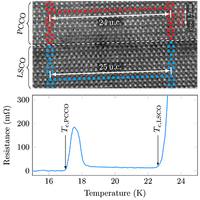
The - junction is at the heart of the first great technological revolution. Here, the authors fabricate and characterize such a junction made entirely out of cuprates superconductors thin films. They observe a charge transfer between -type PrCeCuO and -type LaSrCuO, from which a Mott insulating layer emerges at the atomically sharp interface. They first assess the quality of the structure through x-ray diffraction and scanning transmission electron microscopy and then they explore the nature of the insulating interface arising from strong electron correlations with various electrical transport experiments.
Emergence of charge density waves in the SU() Holstein model at half filling
Chunhan Feng, Linh Pham, George Batrouni, and Richard T. Scalettar
Phys. Rev. B 114, 245122 (2026) - Published 19 October, 2026
Origin of the absence of a charge density wave in the kagome metal : A rattling chain model–predicted -type charge density wave compound
Xizhi Li, Nour Maraytta, Xipeng Wang, Xinyi Peng, Zeyu Li, Dechao Cheng, Nan Xiong, Shilin Zhou, Qiaochu Wan, Mingquan He, Yisheng Chai, Xiaoyuan Zhou, Michael Merz, Aifeng Wang, and Hengxin Tan
Phys. Rev. B 114, 245123 (2026) - Published 19 October, 2026
Machine-learning disordered Hubbard model underlying semiconductor quantum dot based two-dimensional spin qubit arrays
Jacob R. Taylor and Sankar Das Sarma
Phys. Rev. B 114, 245124 (2026) - Published 19 October, 2026
Quasiparticle electronic structure and excitonic effects in Janus CrSO monolayers are investigated by many-body calculations within first principles
Zeeshan Abbas, Haiying Song, Wenlong Zhang, Danmin Liu, and Shibing Liu
Phys. Rev. B 114, 245125 (2026) - Published 19 October, 2026
Nonperturbative renormalization group for Ising-nematic criticality: A closed-form nonlocal ansatz
Hyeon Jung Kim, Kyoung-Min Kim, and Ki-Seok Kim
Phys. Rev. B 114, 245126 (2026) - Published 19 October, 2026
Theory of clusterization in orbitally degenerate transition-metal compounds driven by lattice instabilities
Soshun Ozaki, Kota Mitsumoto, and Chisa Hotta
Phys. Rev. B 114, 245127 (2026) - Published 20 October, 2026
Non-Hermitian Landau levels
Anton Montag and Tomoki Ozawa
Phys. Rev. B 114, 245128 (2026) - Published 20 October, 2026
Symmetry rules for cavity materials engineering with linearly polarized vacuum fields
Jingkai Quan, Chongxiao Fan, Benshu Fan, I-Te Lu, Dante M. Kennes, and Angel Rubio
Phys. Rev. B 114, 245129 (2026) - Published 22 October, 2026
Cavity vacuum fluctuations offer a promising route to modifying material properties without external driving, yet a general framework for predicting the resulting symmetry breaking is lacking. Here, the authors analyze the Pauli-Fierz Hamiltonian to establish symmetry rules for light-matter interactions with linearly polarized cavity modes, and classify their effects across all 32 crystallographic point groups. Quantum electrodynamical density functional theory calculations demonstrate these rules through cavity-induced band splitting and modified vibrational spectra, providing general guidelines for symmetry-guided cavity materials engineering.
Constructing bulk topological orders via layered gauging
Shang Liu
Phys. Rev. B 114, 245130 (2026) - Published 22 October, 2026