Browse by Subject

Quantum-Secure Multiparty Deep Learning

Kfir Sulimany, Sri Krishna Vadlamani, Ryan Hamerly, Prahlad Iyengar, and Dirk Englund

Phys. Rev. X 15, 041056 (2025) - Published 24 December, 2025

A quantum-secure deep learning protocol lets multiple parties harness AI without exposing proprietary data or models.

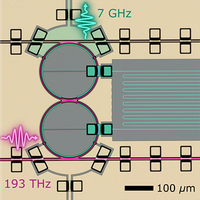
Bidirectional Microwave-Optical Conversion with an Integrated Soft-Ferroelectric Barium Titanate Transducer

Charles Möhl, Annina Riedhauser, Max Glantschnig, Daniele Caimi, Ute Drechsler, Antonis Olziersky, Deividas Sabonis, David I. Indolese, Thomas M. Karg, and Paul Seidler

Phys. Rev. X 15, 041044 (2025) - Published 8 December, 2025

A new on-chip microwave-to-optical converter built from soft-ferroelectric barium titanate achieves bidirectional signal conversion, offering a promising path toward long-range interconnects for superconducting quantum computers.

Time-Cost-Error Trade-Off Relation in Thermodynamics: The Third Law and Beyond

Tan Van Vu and Keiji Saito

Phys. Rev. X 15, 041029 (2025) - Published 13 November, 2025

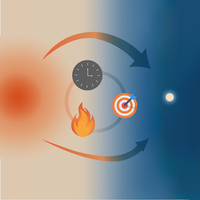
A universal trade-off links time, cost, and error in thermodynamic processes, showing that perfection requires infinite resources. This limit applies to both classical and quantum systems, guiding the design of efficient control and information processing.

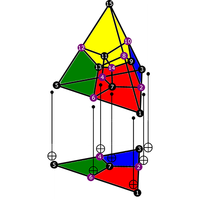
Letting the Tiger out of Its Cage: Bosonic Coding without Concatenation

Yijia Xu (许逸葭), Yixu Wang (王亦许), Christophe Vuillot, and Victor V. Albert

Phys. Rev. X 15, 041025 (2025) - Published 10 November, 2025

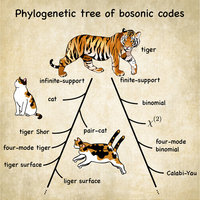
Tiger codes provide a unified framework for designing quantum error-correcting codes directly in harmonic oscillators, using integer-based homology to exploit their full structure and enable scalable quantum information processing.

Spin Squeezing with Itinerant Magnetic Dipoles

Alec Douglas, Vassilios Kaxiras, Lin Su, Michal Szurek, Vikram Singh, Ognjen Marković, and Markus Greiner

Phys. Rev. X 15, 041021 (2025) - Published 5 November, 2025

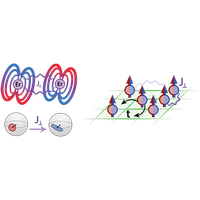
Quantum sensors can surpass their current limits by using entanglement. A method to create entangled states with fermionic erbium atoms reduces measurement noise fivefold while opening paths to advanced sensing and fundamental physics tests.

A Polynomial-Time Classical Algorithm for Noisy Quantum Circuits

Thomas Schuster, Chao Yin, Xun Gao, and Norman Y. Yao

Phys. Rev. X 15, 041018 (2025) - Published 3 November, 2025

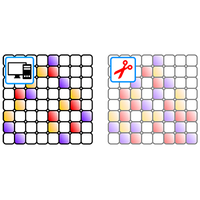
A new classical algorithm shows that noise restricts non-error-corrected quantum computational power more generally than previously recognized.

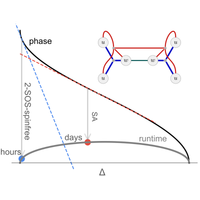
Fast Quantum Simulation of Electronic Structure by Spectral Amplification

Guang Hao Low, Robbie King, Dominic W. Berry, Qiushi Han, A. Eugene DePrince, III, Alec F. White, Ryan Babbush, Rolando D. Somma, and Nicholas C. Rubin

Phys. Rev. X 15, 041016 (2025) - Published 31 October, 2025

A new quantum algorithm framework reduces gate counts for ground-state energy estimation in molecular simulations by combining spectral amplification, sum-of-squares Hamiltonian representations, and integral compression.

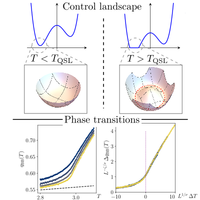
Toward a Theory of Phase Transitions in Quantum Control Landscapes

Nicolò Beato, Pranay Patil, and Marin Bukov

Phys. Rev. X 15, 041014 (2025) - Published 29 October, 2025

Analytical and numerical tools adapted from statistical physics reveal phase transitions in quantum control landscapes, explaining when new optimal strategies emerge and guiding the design of more efficient quantum technologies.

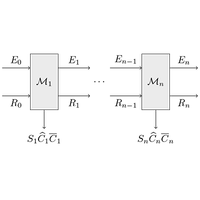
Generalized Rényi Entropy Accumulation Theorem and Generalized Quantum Probability Estimation

Amir Arqand, Thomas A. Hahn, and Ernest Y.-Z. Tan

Phys. Rev. X 15, 041013 (2025) - Published 28 October, 2025

A unified framework combining entropy accumulation and quantum probability estimation provides tight, practical bounds on certified randomness generation, paving the way for simpler and stronger security analyses in quantum cryptography.

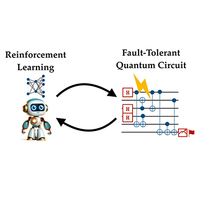
Quantum Circuit Discovery for Fault-Tolerant Logical State Preparation with Reinforcement Learning

Remmy Zen, Jan Olle, Luis Colmenarez, Matteo Puviani, Markus Müller, and Florian Marquardt

Phys. Rev. X 15, 041012 (2025) - Published 22 October, 2025

Using reinforcement learning to design fault-tolerant quantum circuits leads to efficient logical state preparation schemes with fewer gates and flag qubits than human-designed methods, advancing quantum error correction.

Clustering of Conditional Mutual Information and Quantum Markov Structure at Arbitrary Temperatures

Tomotaka Kuwahara

Phys. Rev. X 15, 041010 (2025) - Published 16 October, 2025

Quantum systems at equilibrium are more localized than previously thought when looked at through the lens of conditional mutual information, a key way of measuring three-part correlations.

Experimental Demonstration of High-Fidelity Logical Magic States from Code Switching

Lucas Daguerre, Robin Blume-Kohout, Natalie C. Brown, David Hayes, and Isaac H. Kim

Phys. Rev. X 15, 041008 (2025) - Published 14 October, 2025

A new trapped-ion experiment creates the most reliable “magic state” yet, protecting the state from environmental noise using minimal overhead and advancing practical quantum computing.

Heralded Entanglement of On-Demand Spin-Wave Solid-State Quantum Memories for Multiplexed Quantum Network Links

Jonathan Hänni, Alberto E. Rodríguez-Moldes, Félicien Appas, Soeren Wengerowsky, Dario Lago-Rivera, Markus Teller, Samuele Grandi, and Hugues de Riedmatten

Phys. Rev. X 15, 041003 (2025) - Published 3 October, 2025

Heralded entanglement between two solid-state quantum memories with on-demand retrieval and temporal multimodality demonstrates a crucial building block for scalable quantum repeaters and long-distance quantum networks.

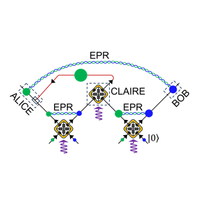
Teleportation and Entanglement Swapping of Continuous Quantum Variables of Microwave Radiation

Baleegh Abdo, William Shanks, Oblesh Jinka, J. R. Rozen, and Jason Orcutt

Phys. Rev. X 15, 031075 (2025) - Published 25 September, 2025

A superconducting Josephson mixer generates continuous-variable entanglement between microwave modes, enabling teleportation and entanglement swapping with fidelities beyond classical limits—key steps toward scalable quantum networks.

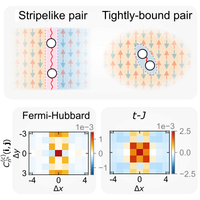
Two-Dopant Origin of Competing Stripe and Pair Formation in Hubbard and t−J Models

Tizian Blatz, Ulrich Schollwöck, Fabian Grusdt, and Annabelle Bohrdt

Phys. Rev. X 15, 031074 (2025) - Published 24 September, 2025

A single pair of charge carriers can reveal the competition between superconducting and insulating phases in the microscopic models describing high-temperature superconductors.

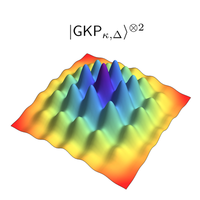
Complexity of Gottesman-Kitaev-Preskill States

Lukas Brenner, Libor Caha, Xavier Coiteux-Roy, and Robert Koenig

Phys. Rev. X 15, 031073 (2025) - Published 19 September, 2025

A proposed protocol efficiently prepares high-quality Gottesman-Kitaev-Preskill (GKP) quantum states with rigorous accuracy guarantees. Since GKP states are central to quantum error correction, this paves the way for more robust quantum computing.

Středa Formula for Floquet Systems: Topological Invariants and Quantized Anomalies from Cesàro Summation

Lucila Peralta Gavensky, Gonzalo Usaj, and Nathan Goldman

Phys. Rev. X 15, 031067 (2025) - Published 10 September, 2025

A nonequilibrium extension of the Středa formula provides a physical framework for the topological classification of Floquet systems, revealing universal quantized magnetic responses in driven settings.

Efficient Finite-Resource Formulation of Non-Abelian Lattice Gauge Theories beyond One Dimension

Pierpaolo Fontana, Marc Miranda-Riaza, and Alessio Celi

Phys. Rev. X 15, 031065 (2025) - Published 9 September, 2025

A new quantum-compatible method simplifies non-Abelian gauge theory simulations by compressing gauge field data, enabling accurate predictions across interaction strengths with limited quantum resources.

Quantum Effects in Gravity Beyond the Newton Potential from a Delocalized Quantum Source

Lin-Qing Chen and Flaminia Giacomini

Phys. Rev. X 15, 031063 (2025) - Published 4 September, 2025

New predictions from linearized quantum gravity show that delocalized sources and gravitational-field commutators could offer stronger evidence for future experiments that gravity is inherently quantum.

Efficient Preparation of Solvable Anyons with Adaptive Quantum Circuits

Yuanjie Ren, Nathanan Tantivasadakarn, and Dominic J. Williamson

Phys. Rev. X 15, 031060 (2025) - Published 29 August, 2025
Adaptive quantum circuits can efficiently generate and control solvable anyons—including complex non-Abelian types—offering a comprehensive, constant-time method for preparing topological phases on quantum devices.

Sign In to Your Journals Account

Filter

Filter

Article Lookup

Enter a citation