

- Open Access
Bidirectional Microwave-Optical Conversion with an Integrated Soft-Ferroelectric Barium Titanate Transducer
Phys. Rev. X 15, 041044 – Published 8 December, 2025
DOI: https://doi.org/10.1103/1gvf-w6lx
Abstract
Efficient, low-noise, and high-bandwidth transduction between optical and microwave photons is key to long-range quantum communication between distant superconducting quantum processors. Recent demonstrations of microwave-optical transduction using the broadband direct electro-optic (Pockels) effect in optical thin films made of AlN or have shown promise. To improve efficiency and added noise, materials with larger Pockels coefficients, such as the soft ferroelectrics or , are needed. However, these materials require adapted designs and fabrication approaches due to their nonlinear and, in some cases, hysteretic electro-optic response. Here, we engineer an on-chip, triply resonant transducer comprising low-loss -on- waveguides monolithically integrated with a superconducting microwave resonator made of Nb. We demonstrate bidirectional microwave-optical transduction and reach total off-chip efficiencies of using pulsed pumping. The device design permits in situ poling of the ferroelectric material without introducing excess microwave loss, exploiting superconducting air bridges fabricated using only subtractive patterning steps. In addition, we investigate optically induced heating, revealing fast thermalization and quasiparticle resilience of the microwave resonator. Our transducer concept and fabrication process are applicable to other materials with a large bias-induced Pockels effect like and pave the way for efficient, low-power quantum interconnects.
Physics Subject Headings (PhySH)
Popular Summary
Superconducting quantum computers promise breakthroughs in areas like drug discovery, materials science, and artificial intelligence, but connecting them over long distances is difficult because their processors must operate near absolute zero. One solution is to convert the microwave quantum signals in the superconducting electrical circuits to optical photons that can travel through fiber networks at room temperature. The problem is that conversion efficiency is limited by the weak nonlinear properties of the materials used to date. To address this, we build the first microwave-to-optical converter using a soft ferroelectric, a class of materials offering the potential for much stronger microwave-optical interaction.
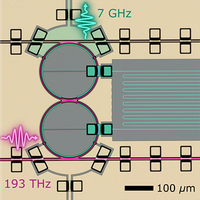
In our design, we integrate an optical resonator made of the soft ferroelectric barium titanate () with a superconducting microwave resonator to create an on-chip device capable of bidirectional, coherent conversion between microwave and optical signals. A key feature of our approach is a microwave circuit engineered to pole the ferroelectric and maximize electro-optic coupling, while maintaining high-quality microwave resonances. We also measure heating effects caused by absorption of optical photons, separating the contributions from the dielectric and the superconductor. Remarkably, we find that the heating does not reduce conversion efficiency.
These results show that soft-ferroelectric materials are attractive candidates for building efficient microwave-to-optical quantum interconnects. To outperform existing platforms, optimization of the material properties of , such as strain engineering, will be necessary. Nevertheless, the concepts developed are applicable to other soft ferroelectrics such as , and our work provides insight into the design of electro-optic transducers in general.
Article Text
References (70)
- National Academies of Sciences, Engineering, and Medicine, Quantum Computing: Progress and Prospects (National Academies Press, Washington, DC, 2019), 10.17226/25196.
- S. Bravyi, O. Dial, J. M. Gambetta, D. Gil, and Z. Nazario, The future of quantum computing with superconducting qubits, J. Appl. Phys. 132, 160902 (2022).
- S. Storz et al., Loophole-free Bell inequality violation with superconducting circuits, Nature (London) 617, 265 (2023).
- A. J. Stolk et al., Metropolitan-scale heralded entanglement of solid-state qubits, Sci. Adv. 10, eadp6442 (2024).
- J.-L. Liu et al., Creation of memory-memory entanglement in a metropolitan quantum network, Nature (London) 629, 579 (2024).
- J.-G. Ren et al., Ground-to-satellite quantum teleportation, Nature (London) 549, 70 (2017).
- Y. Huang, F. Salces–Carcoba, R. X. Adhikari, A. H. Safavi-Naeini, and L. Jiang, Vacuum beam guide for large scale quantum networks, Phys. Rev. Lett. 133, 020801 (2024).
- D. Lago-Rivera, S. Grandi, J. V. Rakonjac, A. Seri, and H. de Riedmatten, Telecom-heralded entanglement between multimode solid-state quantum memories, Nature (London) 594, 37 (2021).
- T. van Leent, M. Bock, F. Fertig, R. Garthoff, S. Eppelt, Y. Zhou, P. Malik, M. Seubert, T. Bauer, W. Rosenfeld, W. Zhang, C. Becher, and H. Weinfurter, Entangling single atoms over 33 km telecom fibre, Nature (London) 607, 69 (2022).
- C. M. Knaut, A. Suleymanzade, Y.-C. Wei, D. R. Assumpcao, P.-J. Stas, Y. Q. Huan, B. Machielse, E. N. Knall, M. Sutula, G. Baranes, N. Sinclair, C. De-Eknamkul, D. S. Levonian, M. K. Bhaskar, H. Park, M. Lončar, and M. D. Lukin, Entanglement of nanophotonic quantum memory nodes in a telecom network, Nature (London) 629, 573 (2024).
- H. J. Kimble, The quantum internet, Nature (London) 453, 1023 (2008).
- S. Wehner, D. Elkouss, and R. Hanson, Quantum internet: A vision for the road ahead, Science 362, eaam9288 (2018).
- Y. Chu and S. Gröblacher, A perspective on hybrid quantum opto- and electromechanical systems, Appl. Phys. Lett. 117, 150503 (2020).
- N. Lauk, N. Sinclair, S. Barzanjeh, J. P. Covey, M. Saffman, M. Spiropulu, and C. Simon, Perspectives on quantum transduction, Quantum Sci. Technol. 5, 020501 (2020).
- S. Krastanov, H. Raniwala, J. Holzgrafe, K. Jacobs, M. Lončar, M. J. Reagor, and D. R. Englund, Optically heralded entanglement of superconducting systems in quantum networks, Phys. Rev. Lett. 127, 040503 (2021).
- M. Mirhosseini, A. Sipahigil, M. Kalaee, and O. Painter, Superconducting qubit to optical photon transduction, Nature (London) 588, 599 (2020).
- S. Hönl, Y. Popoff, D. Caimi, A. Beccari, T. J. Kippenberg, and P. Seidler, Microwave-to-optical conversion with a gallium phosphide photonic crystal cavity, Nat. Commun. 13, 2065 (2022).
- W. Jiang, F. M. Mayor, S. Malik, R. Van Laer, T. P. McKenna, R. N. Patel, J. D. Witmer, and A. H. Safavi-Naeini, Optically heralded microwave photon addition, Nat. Phys. 19, 1423 (2023).
- M. J. Weaver, P. Duivestein, A. C. Bernasconi, S. Scharmer, M. Lemang, T. C. v. Thiel, F. Hijazi, B. Hensen, S. Gröblacher, and R. Stockill, An integrated microwave-to-optics interface for scalable quantum computing, Nat. Nanotechnol. 19, 166 (2024).
- S. Meesala, D. Lake, S. Wood, P. Chiappina, C. Zhong, A. D. Beyer, M. D. Shaw, L. Jiang, and O. Painter, Quantum entanglement between optical and microwave photonic qubits, Phys. Rev. X 14, 031055 (2024).
- H. Zhao, W. D. Chen, A. Kejriwal, and M. Mirhosseini, Quantum-enabled continuous microwave-to-optics frequency conversion, arXiv:2406.02704.
- L. Fan, C.-L. Zou, R. Cheng, X. Guo, X. Han, Z. Gong, S. Wang, and H. X. Tang, Superconducting cavity electro-optics: A platform for coherent photon conversion between superconducting and photonic circuits, Sci. Adv. 4, eaar4994 (2018).
- T. P. McKenna, J. D. Witmer, R. N. Patel, W. Jiang, R. Van Laer, P. Arrangoiz-Arriola, E. A. Wollack, J. F. Herrmann, and A. H. Safavi-Naeini, Cryogenic microwave-to-optical conversion using a triply resonant lithium-niobate-on-sapphire transducer, Optica 7, 1737 (2020).
- J. Holzgrafe, N. Sinclair, D. Zhu, A. Shams-Ansari, M. Colangelo, Y. Hu, M. Zhang, K. K. Berggren, and M. Lončar, Cavity electro-optics in thin-film lithium niobate for efficient microwave-to-optical transduction, Optica 7, 1714 (2020).
- H. K. Warner, J. Holzgrafe, B. Yankelevich, D. Barton, S. Poletto, C. J. Xin, N. Sinclair, D. Zhu, E. Sete, B. Langley, E. Batson, M. Colangelo, A. Shams-Ansari, G. Joe, K. K. Berggren, L. Jiang, M. Reagor, and M. Lončar, Coherent control of a superconducting qubit using light, Nat. Phys. 21, 831 (2025).
- R. Sahu, W. Hease, A. Rueda, G. Arnold, L. Qiu, and J. M. Fink, Quantum-enabled operation of a microwave-optical interface, Nat. Commun. 13, 1276 (2022).
- R. Sahu, L. Qiu, W. Hease, G. Arnold, Y. Minoguchi, P. Rabl, and J. M. Fink, Entangling microwaves with light, Science 380, 718 (2023).
- G. Arnold, T. Werner, R. Sahu, L. N. Kapoor, L. Qiu, and J. M. Fink, All-optical single-shot readout of a superconducting qubit, Nat. Phys. 21, 393 (2025).
- M. Shen, J. Xie, Y. Xu, S. Wang, R. Cheng, W. Fu, Y. Zhou, and H. X. Tang, Photonic link from single-flux-quantum circuits to room temperature, Nat. Photonics 18, 371 (2024).
- W. Fu, M. Xu, X. Liu, C.-L. Zou, C. Zhong, X. Han, M. Shen, Y. Xu, R. Cheng, S. Wang, L. Jiang, and H. X. Tang, Cavity electro-optic circuit for microwave-to-optical conversion in the quantum ground state, Phys. Rev. A 103, 053504 (2021).
- Y. Xu, A. A. Sayem, L. Fan, C.-L. Zou, S. Wang, R. Cheng, W. Fu, L. Yang, M. Xu, and H. X. Tang, Bidirectional interconversion of microwave and light with thin-film lithium niobate, Nat. Commun. 12, 4453 (2021).
- Y. Xu, W. Fu, Y. Zhou, M. Xu, M. Shen, A. A. Sayem, and H. X. Tang, Light-induced dynamic frequency shifting of microwave photons in a superconducting electro-optic converter, Phys. Rev. Appl. 18, 064045 (2022).
- X. Zhu, Y. Hu, S. Lu, H. K. Warner, X. Li, Y. Song, L. Magalhães, A. Shams-Ansari, A. Cordaro, N. Sinclair, and M. Lončar, Twenty-nine million intrinsic -factor monolithic microresonators on thin-film lithium niobate, Photonics Res. 12, A63 (2024).
- W. Hease, A. Rueda, R. Sahu, M. Wulf, G. Arnold, H. G. L. Schwefel, and J. M. Fink, Bidirectional electro-optic wavelength conversion in the quantum ground state, PRX Quantum 1, 020315 (2020).
- M. Tsang, Cavity quantum electro-optics, Phys. Rev. A 81, 063837 (2010).
- M. Tsang, Cavity quantum electro-optics. II. Input-output relations between traveling optical and microwave fields, Phys. Rev. A 84, 043845 (2011).
- F. Eltes, G. E. Villarreal-Garcia, D. Caimi, H. Siegwart, A. A. Gentile, A. Hart, P. Stark, G. D. Marshall, M. G. Thompson, J. Barreto, J. Fompeyrine, and S. Abel, An integrated optical modulator operating at cryogenic temperatures, Nat. Mater. 19, 1164 (2020).
- C. Anderson, G. Scuri, A. White, D. Lukin, E. Szakiel, J. Yang, K. Van Gasse, M. Guidry, W. Jiang, A. Safavi-Naeini, and J. Vuckovic, Quantum critical electro-optic materials for photonics, in CLEO 2023, Technical Digest Series (Optica Publishing Group, San Jose, CA, 2023), paper SF1E.5, 10.1364/CLEO_SI.2023.SF1E.5.
- G. A. Smolenskii, N. N. Krainik, N. P. Khuchua, V. V. Zhdanova, and I. E. Mylnikova, The Curie temperature of , Phys. Status Solidi (b) 13, 309 (1966).
- M. G. Harwood, P. Popper, and D. F. Rushman, Curie point of barium titanate, Nature (London) 160, 58 (1947).
- S. Abel, F. Eltes, J. E. Ortmann, A. Messner, P. Castera, T. Wagner, D. Urbonas, A. Rosa, A. M. Gutierrez, D. Tulli, P. Ma, B. Baeuerle, A. Josten, W. Heni, D. Caimi, L. Czornomaz, A. A. Demkov, J. Leuthold, P. Sanchis, and J. Fompeyrine, Large Pockels effect in micro- and nanostructured barium titanate integrated on silicon, Nat. Mater. 18, 42 (2019).
- K. A. Müller and H. Burkard, : An intrinsic quantum paraelectric below 4 K, Phys. Rev. B 19, 3593 (1979).
- Y. Fujii and T. Sakudo, Interferometric determination of the quadratic electro-optic coefficients in crystal, J. Appl. Phys. 41, 4118 (2003).
- K. D. Fredrickson, V. V. Vogler-Neuling, K. J. Kormondy, D. Caimi, F. Eltes, M. Sousa, J. Fompeyrine, S. Abel, and A. A. Demkov, Strain enhancement of the electro-optical response in films integrated on Si (001), Phys. Rev. B 98, 075136 (2018).
- H. Tian, J. Liu, A. Attanasio, A. Siddharth, T. Blésin, R. Ning Wang, A. Voloshin, G. Lihachev, J. Riemensberger, S. E. Kenning, Y. Tian, T. Han Chang, A. Bancora, V. Snigirev, V. Shadymov, T. J. Kippenberg, and S. A. Bhave, Piezoelectric actuation for integrated photonics, Adv. Opt. Photonics 16, 749 (2024).
- A. Ulrich, K. Brahim, A. Boelen, M. Debaets, C. Sun, Y. Huang, S. S. Saseendran, M. Baryshnikova, P. Favia, T. Nuytten, S. Sergeant, K. V. Gasse, B. Kuyken, K. D. Greve, C. Merckling, and C. Haffner, Engineering high Pockels coefficients in thin-film strontium titanate for cryogenic quantum electro-optic applications, arXiv:2502.14349.
- C. P. Anderson, G. Scuri, A. Chan, S. Eun, A. D. White, G. H. Ahn, C. Jilly, A. Safavi-Naeini, K. V. Gasse, L. Li, and J. Vučković, Quantum critical electro-optic and piezo-electric nonlinearities, arXiv:2502.15164.
- D. Davidovikj, N. Manca, H. S. J. Van der Zant, A. D. Caviglia, and G. A. Steele, Quantum paraelectricity probed by superconducting resonators, Phys. Rev. B 95, 214513 (2017).
- A. K. Hamze, M. Reynaud, J. Geler-Kremer, and A. A. Demkov, Design rules for strong electro-optic materials, npj Comput. Mater. 6, 130 (2020).
- R. Xu, J. Huang, E. S. Barnard, S. S. Hong, P. Singh, E. K. Wong, T. Jansen, V. Harbola, J. Xiao, B. Y. Wang, S. Crossley, D. Lu, S. Liu, and H. Y. Hwang, Strain-induced room-temperature ferroelectricity in membranes, Nat. Commun. 11, 3141 (2020).
- M. Xu, C. Li, Y. Xu, and H. X. Tang, Light-induced microwave noise in superconducting microwave-optical transducers, Phys. Rev. Appl. 21, 014022 (2024).
- M. Peruzzo, A. Trioni, F. Hassani, M. Zemlicka, and J. M. Fink, Surpassing the resistance quantum with a geometric superinductor, Phys. Rev. Appl. 14, 044055 (2020).
- R. Barends, H. L. Hortensius, T. Zijlstra, J. J. A. Baselmans, S. J. C. Yates, J. R. Gao, and T. M. Klapwijk, Contribution of dielectrics to frequency and noise of superconducting resonators, Appl. Phys. Lett. 92, 223502 (2008).
- K. D. Crowley et al., Disentangling losses in tantalum superconducting circuits, Phys. Rev. X 13, 041005 (2023).
- E. Zeuthen, A. Schliesser, A. S. Sørensen, and J. M. Taylor, Figures of merit for quantum transducers, Quantum Sci. Technol. 5, 034009 (2020).
- M. Xu, Y. Wu, W. Dai, and H. X. Tang, Radiatively cooled quantum microwave amplifiers, Appl. Phys. Lett. 125, 024001 (2024).
- H. Ren, M. H. Matheny, G. S. MacCabe, J. Luo, H. Pfeifer, M. Mirhosseini, and O. Painter, Two-dimensional optomechanical crystal cavity with high quantum cooperativity, Nat. Commun. 11, 3373 (2020).
- T. Paoletta and A. A. Demkov, Pockels effect in low-temperature rhombohedral , Phys. Rev. B 103, 014303 (2021).
- C. Möhl, C. Convertino, F. Eltes, and P. Seidler, Electro-optic frequency-comb generation in monolithically integrated, low-loss barium titanate waveguides, in CLEO 2022, Technical Digest Series (Optica Publishing Group, San Jose, CA, 2022), paper STu1C.2, 10.1364/CLEO_SI.2022.STu1C.2.
- A. Riedhauser, C. Möhl, J. Schading, D. Caimi, D. Indolese, T. Karg, and P. Seidler, Absorption loss and Kerr nonlinearity in barium titanate waveguides, APL Photonics 10, 016121 (2025).
- R. Riedinger, A. Wallucks, I. Marinković, C. Löschnauer, M. Aspelmeyer, S. Hong, and S. Gröblacher, Remote quantum entanglement between two micromechanical oscillators, Nature (London) 556, 473 (2018).
- C. Möhl et al.Data for Bidirectional microwave-optical conversion with an integrated soft-ferroelectric barium titanate transducer (2025), 10.5281/zenodo.17127145.
- S. Leble, Practical Electrodynamics with Advanced Applications (IOP Publishing Ltd, Bristol, UK, 2020), 10.1088/978-0-7503-2576-9.
- D. F. Walls and G. J. Milburn, Quantum Optics, 2nd ed. (Springer, Berlin Heidelberg, 2008), 10.1007/978-3-540-28574-8.
- Z. K. Minev, Z. Leghtas, S. O. Mundhada, L. Christakis, I. M. Pop, and M. H. Devoret, Energy-participation quantization of Josephson circuits, npj Quantum Inf. 7, 131 (2021).
- A. Li, T. Van Vaerenbergh, P. De Heyn, P. Bienstman, and W. Bogaerts, Backscattering in silicon microring resonators: A quantitative analysis, Laser Photonics Rev. 10, 420 (2016).
- M. Aspelmeyer, T. J. Kippenberg, and F. Marquardt, Cavity optomechanics, Rev. Mod. Phys. 86, 1391 (2014).
- A. P. Gregory, Q-factor measurement by using a Vector Network Analyser, Technical Report, National Physical Laboratory, 2022, 10.47120/npl.MAT58.
- J. Gao, The physics of superconducting microwave resonators, Ph.D. thesis, California Institute of Technology, 2008.
- J. Rairden and C. Neugebauer, Critical temperature of niobium and tantalum films, Proc. IEEE 52, 1234 (1964).

