

- Open Access
Spin Squeezing with Itinerant Magnetic Dipoles
Phys. Rev. X 15, 041021 – Published 5 November, 2025
DOI: https://doi.org/10.1103/shj7-9kb3
Abstract
Entanglement can improve the measurement precision of quantum sensors beyond the shot noise limit. Neutral atoms, the basis of some of the most precise and accurate optical clocks and interferometers, do not naturally exhibit the all-to-all interactions traditionally used to generate such entangled states. On the other hand, these systems exhibit exceedingly high degrees of experimental control over parameters such as temperature, spatial entropy, and itinerancy. In this work, we investigate spin squeezing in a highly coherent itinerant system of neutral atoms with magnetic dipole-dipole interactions. We achieve 7.1 dB of metrologically useful squeezing using finite-range spin-exchange interactions in an erbium quantum gas microscope, and we demonstrate that introducing atomic motion, realizing a dipolar model, protects the spin sector coherence at low fillings, significantly improving the achievable spin squeezing in a 2D dipolar system. This work’s protocol can be implemented with most neutral atoms, opening the door to quantum-enhanced metrology in other itinerant dipolar systems, such as molecules or optical lattice clocks, and serves as a novel method for studying itinerant quantum magnetism with long-range interactions.
Physics Subject Headings (PhySH)
Popular Summary
Quantum sensors such as atomic clocks and interferometers are already the most precise measurement devices in the world, but their performance can still be improved by using entanglement, a uniquely quantum effect that links particles in ways impossible for classical systems. The challenge is that neutral atoms, which form the basis of today’s best clocks, normally lack the right kind of interactions to generate entanglement. Our work shows how to overcome this limitation.
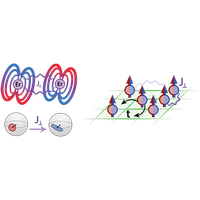
We use a quantum gas microscope with fermionic erbium atoms and take advantage of their natural magnetic dipole-dipole forces to create entangled states. This produces a state with a measurement variance about one-fifth that of any comparable classical ensemble. Surprisingly, we also find that letting the atoms move—by tunneling between sites in the optical lattice—helps preserve coherence and even enhances squeezing at low densities. What is usually thought of as noise instead becomes a useful resource when combined with long-range dipolar interactions.
Because our method relies only on ingredients available in many atomic and molecular systems, it can be broadly applied, from ultracold molecules to optical lattice clocks. This opens a practical path to quantum-enhanced metrology and new tests of fundamental physics. At the same time, it provides a platform for exploring new forms of quantum magnetism, where atomic motion and long-range interactions combine in unexpected ways.
Article Text
References (66)
- Edwin Pedrozo-Peñafiel, Simone Colombo, Chi Shu, Albert F. Adiyatullin, Zeyang Li, Enrique Mendez, Boris Braverman, Akio Kawasaki, Daisuke Akamatsu, Yanhong Xiao, and Vladan Vuletić, Entanglement on an optical atomic-clock transition, Nature (London) 588, 414 (2020).
- John M. Robinson, Maya Miklos, Yee Ming Tso, Colin J. Kennedy, Tobias Bothwell, Dhruv Kedar, James K. Thompson, and Jun Ye, Direct comparison of two spin-squeezed optical clock ensembles at the 10-17 level, Nat. Phys. 20, 208 (2024).
- Graham P. Greve, Chengyi Luo, Baochen Wu, and James K. Thompson, Entanglement-enhanced matter-wave interferometry in a high-finesse cavity, Nature (London) 610, 472 (2022).
- Wenxuan Jia, Victoria Xu, Kevin Kuns, Masayuki Nakano, Lisa Barsotti, Matthew Evans, Nergis Mavalvala, and members of the LIGO Scientific Collaboration, Squeezing the quantum noise of a gravitational-wave detector below the standard quantum limit, Science 385, 1318 (2024).
- M. Kitagawa and M. Ueda, Squeezed spin states, Phys. Rev. A 47, 5138 (1993).
- Jian Ma, Xiaoguang Wang, C. P. Sun, and Franco Nori, Quantum spin squeezing, Phys. Rep. 509, 89 (2011).
- D. J. Wineland, J. J. Bollinger, W. M. Itano, F. L. Moore, and D. J. Heinzen, Spin squeezing and reduced quantum noise in spectroscopy, Phys. Rev. A 46, R6797 (1992).
- C. L. Degen, F. Reinhard, and P. Cappellaro, Quantum sensing, Rev. Mod. Phys. 89, 035002 (2017).
- J. Appel, P. J. Windpassinger, D. Oblak, U. B. Hoff, N. Kjærgaard, and E. S. Polzik, Mesoscopic atomic entanglement for precision measurements beyond the standard quantum limit, Proc. Natl. Acad. Sci. U.S.A. 106, 10960 (2009).
- I. D. Leroux, M. H. Schleier-Smith, and V. Vuletić, Implementation of cavity squeezing of a collective atomic spin, Phys. Rev. Lett. 104, 073602 (2010).
- M. H. Schleier-Smith, I. D. Leroux, and V. Vuletić, States of an ensemble of two-level atoms with reduced quantum uncertainty, Phys. Rev. Lett. 104, 073604 (2010).
- Onur Hosten, Nils J. Engelsen, Rajiv Krishnakumar, and Mark A. Kasevich, Measurement noise 100 times lower than the quantum-projection limit using entangled atoms, Nature (London) 529, 505 (2016).
- K. C. Cox, G. P. Greve, J. M. Weiner, and J. K. Thompson, Deterministic squeezed states with collective measurements and feedback, Phys. Rev. Lett. 116, 093602 (2016).
- J. Estève, C. Gross, A. Weller, S. Giovanazzi, and M. K. Oberthaler, Squeezing and entanglement in a Bose–Einstein condensate, Nature (London) 455, 1216 (2008).
- Max F. Riedel, Pascal Böhi, Yun Li, Theodor W. Hänsch, Alice Sinatra, and Philipp Treutlein, Atom-chip-based generation of entanglement for quantum metrology, Nature (London) 464, 1170 (2010).
- C. Gross, T. Zibold, E. Nicklas, J. Estève, and M. K. Oberthaler, Nonlinear atom interferometer surpasses classical precision limit, Nature (London) 464, 1165 (2010).
- B. Lücke, M. Scherer, J. Kruse, L. Pezzé, F. Deuretzbacher, P. Hyllus, O. Topic, J. Peise, W. Ertmer, J. Arlt, L. Santos, A. Smerzi, and C. Klempt, Twin matter waves for interferometry beyond the classical limit, Science 334, 773 (2011).
- C. D. Hamley, C. S. Gerving, T. M. Hoang, E. M. Bookjans, and M. S. Chapman, Spin-nematic squeezed vacuum in a quantum gas, Nat. Phys. 8, 305 (2012).
- Marcin Płodzień, Maciej Kościelski, Emilia Witkowska, and Alice Sinatra, Producing and storing spin-squeezed states and Greenberger-Horne-Zeilinger states in a one-dimensional optical lattice, Phys. Rev. A 102, 013328 (2020).
- P. He, M. A Perlin, S. R Muleady, R. J. Lewis-Swan, R. B. Hutson, J. Ye, and A. M. Rey, Engineering spin squeezing in a 3D optical lattice with interacting spin-orbit-coupled fermions, Phys. Rev. Res. 1, 033075 (2019).
- T. Hernández Yanes, M. Płodzień, M. Mackoit Sinkevičienė, G. Žlabys, G. Juzeliūnas, and E. Witkowska, One- and two-axis squeezing via laser coupling in an atomic Fermi-Hubbard model, Phys. Rev. Lett. 129, 090403 (2022).
- Michael A. Perlin, Chunlei Qu, and Ana Maria Rey, Spin squeezing with short-range spin-exchange interactions, Phys. Rev. Lett. 125, 223401 (2020).
- L. I. R. Gil, R. Mukherjee, E. M. Bridge, M. P. A. Jones, and T. Pohl, Spin squeezing in a Rydberg lattice clock, Phys. Rev. Lett. 112, 103601 (2014).
- Michael Foss-Feig, Zhe-Xuan Gong, Alexey V. Gorshkov, and Charles W. Clark, Entanglement and spin-squeezing without infinite-range interactions, arXiv:1612.07805.
- Maxwell Block, Bingtian Ye, Brenden Roberts, Sabrina Chern, Weijie Wu, Zilin Wang, Lode Pollet, Emily J. Davis, Bertrand I. Halperin, and Norman Y. Yao, Scalable spin squeezing from finite-temperature easy-plane magnetism, Nat. Phys. 20, 1575 (2024).
- Lauriane Chomaz, Igor Ferrier-Barbut, Francesca Ferlaino, Bruno Laburthe-Tolra, Benjamin L. Lev, and Tilman Pfau, Dipolar physics: A review of experiments with magnetic quantum gases, Rep. Prog. Phys. 86, 026401 (2022).
- Simon L. Cornish, Michael R. Tarbutt, and Kaden R. A. Hazzard, Quantum computation and quantum simulation with ultracold molecules, Nat. Phys. 20, 730 (2024).
- Antoine Browaeys and Thierry Lahaye, Many-body physics with individually controlled Rydberg atoms, Nat. Phys. 16, 132 (2020).
- Gary Wolfowicz, F. Joseph Heremans, Christopher P. Anderson, Shun Kanai, Hosung Seo, Adam Gali, Giulia Galli, and David D. Awschalom, Quantum guidelines for solid-state spin defects, Nat. Rev. Mater. 6, 906 (2021).
- Guillaume Bornet, Gabriel Emperauger, Cheng Chen, Bingtian Ye, Maxwell Block, Marcus Bintz, Jamie A. Boyd, Daniel Barredo, Tommaso Comparin, Fabio Mezzacapo, Tommaso Roscilde, Thierry Lahaye, Norman Y. Yao, and Antoine Browaeys, Scalable spin squeezing in a dipolar Rydberg atom array, Nature (London) 621, 728 (2023).
- William J. Eckner, Nelson Darkwah Oppong, Alec Cao, Aaron W. Young, William R. Milner, John M. Robinson, Jun Ye, and Adam M. Kaufman, Realizing spin squeezing with Rydberg interactions in an optical clock, Nature (London) 621, 734 (2023).
- J. A. Hines, S. V. Rajagopal, G. L. Moreau, M. D. Wahrman, N. A. Lewis, O. Marković, and M. Schleier-Smith, Spin squeezing by Rydberg dressing in an array of atomic ensembles, Phys. Rev. Lett. 131, 063401 (2023).
- Johannes Franke, Sean R. Muleady, Raphael Kaubruegger, Florian Kranzl, Rainer Blatt, Ana Maria Rey, Manoj K. Joshi, and Christian F. Roos, Quantum-enhanced sensing on optical transitions through finite-range interactions, Nature (London) 621, 740 (2023).
- Y.-Q. Zou, B. Bakkali-Hassani, C. Maury, E. Le Cerf, S. Nascimbene, J. Dalibard, and J. Beugnon, Magnetic dipolar interaction between hyperfine clock states in a planar alkali Bose gas, Phys. Rev. Lett. 125, 233604 (2020).
- T. Comparin, F. Mezzacapo, M. Robert-de Saint-Vincent, and T. Roscilde, Scalable spin squeezing from spontaneous breaking of a continuous symmetry, Phys. Rev. Lett. 129, 113201 (2022).
- T. Bilitewski, L. De Marco, J.-R. Li, K. Matsuda, W. G. Tobias, G. Valtolina, J. Ye, and A. M. Rey, Dynamical generation of spin squeezing in ultracold dipolar molecules, Phys. Rev. Lett. 126, 113401 (2021).
- D. Wellnitz, M. Mamaev, T. Bilitewski, and A. M. Rey, Spin squeezing with itinerant dipoles: A case for shallow lattices, Phys. Rev. Res. 6, L012025 (2024).
- M. P. Kwasigroch and N. R. Cooper, Synchronization transition in dipole-coupled two-level systems with positional disorder, Phys. Rev. A 96, 053610 (2017).
- Tanausú Hernández Yanes, Artur Niezgoda, and Emilia Witkowska, Exploring spin squeezing in the Mott insulating regime: Role of anisotropy, inhomogeneity, and hole doping, Phys. Rev. B 109, 214310 (2024).
- Jun-Ru Li, Kyle Matsuda, Calder Miller, Annette N. Carroll, William G. Tobias, Jacob S. Higgins, and Jun Ye, Tunable itinerant spin dynamics with polar molecules, Nature (London) 614, 70 (2023).
- Y. K. Lee, H. Lin, and W. Ketterle, Spin dynamics dominated by resonant tunneling into molecular states, Phys. Rev. Lett. 131, 213001 (2023).
- Annette N. Carroll, Henrik Hirzler, Calder Miller, David Wellnitz, Sean R. Muleady, Junyu Lin, Krzysztof P. Zamarski, Reuben R. W. Wang, John L. Bohn, Ana Maria Rey, and Jun Ye, Observation of generalized spin dynamics with tunable dipolar interactions, Science 388, 381 (2025).
- Cheng Chen, Guillaume Bornet, Marcus Bintz, Gabriel Emperauger, Lucas Leclerc, Vincent S. Liu, Pascal Scholl, Daniel Barredo, Johannes Hauschild, Shubhayu Chatterjee, Michael Schuler, Andreas M. Läuchli, Michael P. Zaletel, Thierry Lahaye, Norman Y. Yao, and Antoine Browaeys, Continuous symmetry breaking in a two-dimensional Rydberg array, Nature (London) 616, 691 (2023).
- T. Comparin, F. Mezzacapo, and T. Roscilde, Multipartite entangled states in dipolar quantum simulators, Phys. Rev. Lett. 129, 150503 (2022).
- Lin Su, Alexander Douglas, Michal Szurek, Robin Groth, S. Furkan Ozturk, Aaron Krahn, Anne H. Hébert, Gregory A. Phelps, Sepehr Ebadi, Susannah Dickerson, Francesca Ferlaino, Ognjen Marković, and Markus Greiner, Dipolar quantum solids emerging in a Hubbard quantum simulator, Nature (London) 622, 724 (2023).
- Lin Su, Alexander Douglas, Michal Szurek, Anne H. Hébert, Aaron Krahn, Robin Groth, Gregory A. Phelps, Ognjen Marković, and Markus Greiner, Fast single atom imaging for optical lattice arrays, Nat. Commun. 16, 1017 (2025).
- J. Choi, H. Zhou, H. S. Knowles, R. Landig, S. Choi, and M. D. Lukin, Robust dynamic Hamiltonian engineering of many-body spin systems, Phys. Rev. X 10, 031002 (2020).
- T. Roscilde, T. Comparin, and F. Mezzacapo, Entangling dynamics from effective rotor–spin-wave separation in U(1)-symmetric quantum spin models, Phys. Rev. Lett. 131, 160403 (2023).
- Y. K. Lee, M. Block, H. Lin, V. Fedoseev, P. J. D. Crowley, N. Y. Yao, and W. Ketterle, Observation of spin squeezing with contact interactions in one- and three-dimensional easy-plane magnets, Phys. Rev. Lett. 135, 023402 (2025).
- Simone Colombo, Edwin Pedrozo-Peeñafiel, Albert F. Adiyatullin, Zeyang Li, Enrique Mendez, Chi Shu, and Vladan Vuletić, Time-reversal-based quantum metrology with many-body entangled states, Nat. Phys. 18, 925 (2022).
- Andrew D. Ludlow, Martin M. Boyd, Jun Ye, E. Peik, and P. O. Schmidt, Optical atomic clocks, Rev. Mod. Phys. 87, 637 (2015).
- Youssef Trifa and Tommaso Roscilde, Scalable spin squeezing in two-dimensional arrays of dipolar large- spins, Phys. Rev. Lett. 133, 083601 (2024).
- A. Kozlov, V. A. Dzuba, and V. V. Flambaum, Prospects of building optical atomic clocks using Er i or Er iii, Phys. Rev. A 88, 032509 (2013).
- A. Patscheider, B. Yang, G. Natale, D. Petter, L. Chomaz, M. J. Mark, G. Hovhannesyan, M. Lepers, and F. Ferlaino, Observation of a narrow inner-shell orbital transition in atomic erbium at 1299 nm, Phys. Rev. Res. 3, 033256 (2021).
- Vassilios Kaxiras, Data and Analysis Code for “Spin Squeezing with Itinerant Magnetic Dipoles”, 2025.
- Albert Frisch, Dipolar quantum gases of erbium, Ph.D. thesis, University of Innsbruck, Innsbruck, 2014.
- Gregory A. Phelps, Anne Hébert, Aaron Krahn, Susannah Dickerson, Furkan Öztürk, Sepehr Ebadi, Lin Su, and Markus Greiner, Sub-second production of a quantum degenerate gas, arXiv:2007.10807.
- K. Aikawa, A. Frisch, M. Mark, S. Baier, R. Grimm, and F. Ferlaino, Reaching Fermi degeneracy via universal dipolar scattering, Phys. Rev. Lett. 112, 010404 (2014).
- A. Patscheider, L. Chomaz, G. Natale, D. Petter, M. J. Mark, S. Baier, B. Yang, R. R. W. Wang, J. L. Bohn, and F. Ferlaino, Determination of the scattering length of erbium atoms, Phys. Rev. A 105, 063307 (2022).
- Albert Frisch, Michael Mark, Kiyotaka Aikawa, Francesca Ferlaino, John L. Bohn, Constantinos Makrides, Alexander Petrov, and Svetlana Kotochigova, Quantum chaos in ultracold collisions of gas-phase erbium atoms, Nature (London) 507, 475 (2014).
- P. B. Wigley, P. J. Everitt, A. van den Hengel, J. W. Bastian, M. A. Sooriyabandara, G. D. McDonald, K. S. Hardman, C. D. Quinlivan, P. Manju, C. C. N. Kuhn, I. R. Petersen, A. N. Luiten, J. J. Hope, N. P. Robins, and M. R. Hush, Fast machine-learning online optimization of ultra-cold-atom experiments, Sci. Rep. 6, 25890 (2016).
- A. Patscheider, B. Zhu, L. Chomaz, D. Petter, S. Baier, A.-M. Rey, F. Ferlaino, and M. J. Mark, Controlling dipolar exchange interactions in a dense three-dimensional array of large-spin fermions, Phys. Rev. Res. 2, 023050 (2020).
- J. Schachenmayer, A. Pikovski, and A. M. Rey, Many-body quantum spin dynamics with Monte Carlo trajectories on a discrete phase space, Phys. Rev. X 5, 011022 (2015).
- Philipp M. Preiss, Ruichao Ma, M. Eric Tai, Alexander Lukin, Matthew Rispoli, Philip Zupancic, Yoav Lahini, Rajibul Islam, and Markus Greiner, Strongly correlated quantum walks in optical lattices, Science 347, 1229 (2015).
- Shainen M. Davidson, Dries Sels, and Anatoli Polkovnikov, Semiclassical approach to dynamics of interacting fermions, Ann. Phys. (Amsterdam) 384, 128 (2017).
- S. Baier, D. Petter, J. H. Becher, A. Patscheider, G. Natale, L. Chomaz, M. J. Mark, and F. Ferlaino, Realization of a strongly interacting Fermi gas of dipolar atoms, Phys. Rev. Lett. 121, 093602 (2018).

