

- Open Access
Complexity of Gottesman-Kitaev-Preskill States
Phys. Rev. X 15, 031073 – Published 19 September, 2025
DOI: https://doi.org/10.1103/4ww5-4yww
Abstract
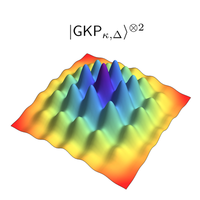
We initiate the study of state complexity for continuous-variable quantum systems. Concretely, we consider a setup with bosonic modes and auxiliary qubits, where available operations include Gaussian one- and two-mode operations and single- and two-qubit operations as well as qubit-controlled phase-space displacements. We define the (approximate) complexity of a bosonic state by the minimum size of a circuit that prepares an approximation to the state in trace distance. We propose a new circuit which prepares an approximate Gottesman-Kitaev-Preskill (GKP) state . Here, is the variance of the envelope, and is the variance of the individual peaks. We show that the circuit accepts with constant probability and—conditioned on acceptance—the output state is polynomially close in to the state . The size of our circuit is linear in . To our knowledge, this is the first protocol for GKP-state preparation with fidelity guarantees for the prepared state. We also show converse bounds, establishing that the linear circuit-size dependence of our construction is optimal. This fully characterizes the complexity of GKP states.
Physics Subject Headings (PhySH)
Popular Summary
Quantum information is highly fragile, and protecting it against noise is one of the central challenges in building practical quantum computers. A promising tool for this is the Gottesman-Kitaev-Preskill (GKP) state, a special kind of continuous-variable quantum state that is resilient to small errors in phase space. However, creating high-quality GKP states is notoriously difficult. They cannot be produced with simple optical operations, and the difficulty of preparing them grows rapidly with the degree of error protection one wants. In this work, we introduce a new and efficient protocol for preparing approximate GKP states using experimentally accessible interactions between quantum bits and oscillators.
With just two oscillators and a single qubit, we can prepare GKP states in a time that scales only logarithmically with the level of error protection, quantified by the squeezing parameter of the state. We also prove that this scaling is the best possible, meaning that no more efficient general method exists. Importantly, unlike previous approaches, our protocol comes with rigorous accuracy guarantees in the “trace norm” sense, which provides a strong mathematical measure of their reliability.
The fact that our states come with formal accuracy guarantees means they can safely replace ideal GKP states in any larger quantum information protocol, opening the door to modular designs for quantum error correction and computation. Looking forward, adapting our protocol to realistic experimental noise will be an important step toward creating robust and scalable quantum technologies based on bosonic error correction.
Article Text
References (40)
- D. Gottesman, A. Kitaev, and J. Preskill, Encoding a qubit in an oscillator, Phys. Rev. A 64, 012310 (2001).
- C. Vuillot, H. Asasi, Y. Wang, L. P. Pryadko, and B. M. Terhal, Quantum error correction with the toric Gottesman-Kitaev-Preskill code, Phys. Rev. A 99, 032344 (2019).
- L. Hänggli, M. Heinze, and R. König, Enhanced noise resilience of the surface–Gottesman-Kitaev-Preskill code via designed bias, Phys. Rev. A 102, 052408 (2020).
- K. Fukui, A. Tomita, A. Okamoto, and K. Fujii, High-threshold fault-tolerant quantum computation with analog quantum error correction, Phys. Rev. X 8, 021054 (2018).
- Kyungjoo Noh and Christopher Chamberland, Fault-tolerant bosonic quantum error correction with the surface–Gottesman-Kitaev-Preskill code, Phys. Rev. A 101, 012316 (2020).
- K. Noh, S. M. Girvin, and L. Jiang, Encoding an oscillator into many oscillators, Phys. Rev. Lett. 125, 080503 (2020).
- Nicolas C. Menicucci, Fault-tolerant measurement-based quantum computing with continuous-variable cluster states, Phys. Rev. Lett. 112, 120504 (2014).
- Ben Q. Baragiola, Giacomo Pantaleoni, Rafael N. Alexander, Angela Karanjai, and Nicolas C. Menicucci, All-Gaussian universality and fault tolerance with the Gottesman-Kitaev-Preskill code, Phys. Rev. Lett. 123, 200502 (2019).
- J. Wenger, M. Hafezi, F. Grosshans, R. Tualle-Brouri, and P. Grangier, Maximal violation of Bell inequalities using continuous-variable measurements, Phys. Rev. A 67, 012105 (2003).
- Jean Etesse, Rémi Blandino, Bhaskar Kanseri, and Rosa Tualle-Brouri, Proposal for a loophole-free violation of Bell’s inequalities with a set of single photons and homodyne measurements, New J. Phys. 16, 053001 (2014).
- Kasper Duivenvoorden, Barbara M. Terhal, and Daniel Weigand, Single-mode displacement sensor, Phys. Rev. A 95, 012305 (2017).
- Quntao Zhuang, John Preskill, and Liang Jiang, Distributed quantum sensing enhanced by continuous-variable error correction, New J. Phys. 22, 022001 (2020).
- B. Zhou, A. J. Brady, and Q. Zhuang, Enhancing distributed sensing with imperfect error correction, Phys. Rev. A 106, 012404 (2022).
- Lukas Brenner, Libor Caha, Xavier Coiteux-Roy, and Robert Koenig, Factoring an integer with three oscillators and a qubit, arXiv:2412.13164.
- Anthony J. Brady, Alec Eickbusch, Shraddha Singh, Jing Wu, and Quntao Zhuang, Advances in bosonic quantum error correction with Gottesman–Kitaev–Preskill codes: Theory, engineering and applications, Prog. Quantum Electron. 93, 100496 (2024).
- Barbara M. Terhal and Daniel J. Weigand, Encoding a qubit into a cavity mode in circuit QED using phase estimation, Phys. Rev. A 93, 012315 (2016).
- Yunong Shi, Christopher Chamberland, and Andrew Cross, Fault-tolerant preparation of approximate GKP states, New J. Phys. 21, 093007 (2019).
- Daniel J. Weigand and Barbara M. Terhal, Generating grid states from Schrödinger-cat states without postselection, Phys. Rev. A 97, 022341 (2018).
- Philippe Campagne-Ibarcq, Alec Eickbusch, Steven Touzard, Evan Zalys-Geller, Nicholas E. Frattini, Volodymyr V. Sivak, Philip Reinhold, Shruti Puri, Shyam Shankar, Robert J. Schoelkopf, Luigi Frunzio, Mazyar Mirrahimi, and Michel H. Devoret, Quantum error correction of a qubit encoded in grid states of an oscillator, Nature (London) 584, 368 (2020).
- S. Ganeshan and M. Levin, Formalism for the solution of quadratic Hamiltonians with large cosine terms, Phys. Rev. B 93, 075118 (2016).
- Benoît Douçot and Lev B. Ioffe, Physical implementation of protected qubits, Rep. Prog. Phys. 75, 072001 (2012).
- M. Rymarz, S. Bosco, A. Ciani, and D. P. DiVincenzo, Hardware-encoding grid states in a nonreciprocal superconducting circuit, Phys. Rev. X 11, 011032 (2021).
- J. Conrad, Twirling and Hamiltonian engineering via dynamical decoupling for Gottesman-Kitaev-Preskill quantum computing, Phys. Rev. A 103, 022404 (2021).
- Lev-Arcady Sellem, Alain Sarlette, Zaki Leghtas, Mazyar Mirrahimi, Pierre Rouchon, and Philippe Campagne-Ibarcq, A GKP qubit protected by dissipation in a high-impedance superconducting circuit driven by a microwave frequency comb, Phys. Rev. X 15, 011011 (2023).
- X. C. Kolesnikow, R. W. Bomantara, A. C. Doherty, and A. L. Grimsmo, Gottesman-Kitaev-Preskill state preparation using periodic driving, Phys. Rev. Lett. 132, 130605 (2024).
- Scott Aaronson, The complexity of quantum states and transformations: From quantum money to black holes, arXiv:1607.05256 [Electron. Colloquium Comput. Complex. (to be published)].
- Alec Eickbusch, Volodymyr Sivak, Andy Z. Ding, Salvatore S. Elder, Shantanu R. Jha, Jayameenakshi Venkatraman, Baptiste Royer, S. M. Girvin, Robert J. Schoelkopf, and Michel H. Devoret, Fast universal control of an oscillator with weak dispersive coupling to a qubit, Nat. Phys. 18, 1464 (2022).
- Maxime Boissonneault, Jay M. Gambetta, and Alexandre Blais, Dispersive regime of circuit QED: Photon-dependent qubit dephasing and relaxation rates, Phys. Rev. A 79, 013819 (2009).
- Yuan Liu, Shraddha Singh, Kevin C. Smith, Eleanor Crane, John M. Martyn, Alec Eickbusch, Alexander Schuckert, Richard D. Li, Jasmine Sinanan-Singh, Micheline B. Soley, Takahiro Tsunoda, Isaac L. Chuang, Nathan Wiebe, and Steven M. Girvin, Hybrid oscillator-qubit quantum processors: Instruction set architectures, abstract machine models, and applications, arXiv:2407.10381.
- Andreas Winter, Energy-constrained diamond norm with applications to the uniform continuity of continuous variable channel capacities, arXiv:1712.10267.
- Maksim E. Shirokov, On the energy-constrained diamond norm and its application in quantum information theory, Probl. Inf. Transm. 54, 20 (2018).
- Jacob Hastrup, Kimin Park, Jonatan Bohr Brask, Radim Filip, and Ulrik Lund Andersen, Measurement-free preparation of grid states, npj Quantum Inf. 7, 17 (2021).
- Leon H. Bohnmann, David F. Locher, Johannes Zeiher, and Markus Müller, Bosonic quantum error correction with neutral atoms in optical dipole traps, Phys. Rev. A 111, 022432 (2025).
- Christopher M. Dawson and Michael A. Nielsen, The Solovay-Kitaev algorithm, Quantum Inf. Comput. 6, 81 (2006).
- M. Reck, A. Zeilinger, H. J. Bernstein, and P. Bertani, Experimental realization of any discrete unitary operator, Phys. Rev. Lett. 73, 58 (1994).
- Arvind, Biswadeb Dutta, Narasimhaiengar Mukunda, and Rajiah Simon, The real symplectic groups in quantum mechanics and optics, Pramana 45, 471 (1995).
- Alexander S. Holevo, Quantum Systems, Channels, Information: A Mathematical Introduction (De Gruyter, Berlin, Boston, 2013).
- Roman Vershynin, High-Dimensional Probability: An Introduction with Applications in Data Science, Cambridge Series in Statistical and Probabilistic Mathematics (Cambridge University Press, Cambridge, England, 2018).
- Beatriz Dias and Robert Koenig, Classical simulation of non-Gaussian bosonic circuits, Phys. Rev. A 110, 042402 (2024).
- Antoni Zygmund, Trigonometric Series, 3rd ed., Cambridge Mathematical Library (Cambridge University Press, Cambridge, England, 2003).

