

- Open Access
Time-Cost-Error Trade-Off Relation in Thermodynamics: The Third Law and Beyond
Phys. Rev. X 15, 041029 – Published 13 November, 2025
DOI: https://doi.org/10.1103/l6b9-rg1j
Abstract
Elucidating fundamental limitations inherent in physical systems is a central subject in physics. For important thermodynamic operations such as information erasure, cooling, and copying, resources like time and energetic cost must be expended to achieve the desired outcome within a predetermined error margin. In the context of cooling, the unattainability principle of the third law of thermodynamics asserts that infinite “resources” are needed to reach absolute zero. However, the precise identification of relevant resources and how they jointly constrain achievable error remains unclear within the frameworks of stochastic and quantum thermodynamics. In this work, we introduce the concept of separated states, which consist of fully unoccupied and occupied states, and formulate the corresponding thermokinetic cost and error, thereby establishing a unifying framework for a broad class of thermodynamic operations. We then uncover a three-way trade-off relation between time, cost, and error for thermodynamic operations aimed at creating separated states, simply expressed as . This fundamental relation is applicable to diverse thermodynamic operations, including information erasure, cooling, and copying. It provides a profound quantification of the unattainability principle in the third law of thermodynamics in a general form. Building upon this relation, we explore the quantitative limitations governing cooling operations, the preparation of separated states, and a no-go theorem for exact classical copying. Furthermore, we extend these findings to the quantum regime, encompassing both Markovian and non-Markovian dynamics. Specifically, within Lindblad dynamics, we derive a similar three-way trade-off relation that quantifies the cost of achieving a pure state with a given error. The generalization to general quantum dynamics involving a system coupled to a finite bath implies that the dissipative cost becomes infinite as the quantum system is exactly cooled down to the ground state or perfectly reset to a pure state, thereby resolving an open question regarding the thermodynamic cost of information erasure.
Physics Subject Headings (PhySH)
Popular Summary
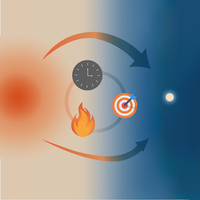
Perfection in physical processes always has a cost: Completely erasing a bit of information, cooling a system to absolute zero, or preparing a flawless state cannot be done without spending essential resources like time or energy. In this study, we show that three quantities in thermodynamic processes—time, cost, and error—are fundamentally linked. If we try to reduce error, at least one of the other quantities must increase. Our key result is that perfect accuracy requires infinite time or infinite cost, revealing a universal trade-off that sets strict limits on what any finite process can achieve.
We reach this result by focusing on what we call a “separated state,” in which all unwanted states are removed and only the desired one remains. These states appear in many settings, such as cooling a material, resetting a bit in a computer, or processing information in biological systems. By deriving a mathematical relation connecting time, cost, and error, we extend the third law of thermodynamics, which says that absolute zero cannot be reached in a finite process. Our framework applies to both classical and quantum systems, including those with limited environments or memory effects, and addresses long-standing questions about the thermodynamic cost of erasing information or preparing pure states.
These findings reveal fundamental limits on control and information processing and prohibit perfect copying of classical information within finite resources, connecting thermodynamics to ideas similar to the quantum no-cloning principle. Looking ahead, this trade-off can guide the design of efficient technologies such as quantum computers, biological networks, and nanoscale machines.
Article Text
References (120)
- G. Lan, P. Sartori, S. Neumann, V. Sourjik, and Y. Tu, The energy–speed–accuracy trade-off in sensory adaptation, Nat. Phys. 8, 422 (2012).
- A. Bérut, A. Arakelyan, A. Petrosyan, S. Ciliberto, R. Dillenschneider, and E. Lutz, Experimental verification of Landauer’s principle linking information and thermodynamics, Nature (London) 483, 187 (2012).
- Y. Jun, M. c. v. Gavrilov, and J. Bechhoefer, High-precision test of Landauer’s principle in a feedback trap, Phys. Rev. Lett. 113, 190601 (2014).
- J. Hong, B. Lambson, S. Dhuey, and J. Bokor, Experimental test of Landauer’s principle in single-bit operations on nanomagnetic memory bits, Sci. Adv. 2, e1501492 (2016).
- L. L. Yan, T. P. Xiong, K. Rehan, F. Zhou, D. F. Liang, L. Chen, J. Q. Zhang, W. L. Yang, Z. H. Ma, and M. Feng, Single-atom demonstration of the quantum Landauer principle, Phys. Rev. Lett. 120, 210601 (2018).
- S. Dago, J. Pereda, N. Barros, S. Ciliberto, and L. Bellon, Information and thermodynamics: Fast and precise approach to Landauer’s bound in an underdamped micromechanical oscillator, Phys. Rev. Lett. 126, 170601 (2021).
- M. Scandi, D. Barker, S. Lehmann, K. A. Dick, V. F. Maisi, and M. Perarnau-Llobet, Minimally dissipative information erasure in a quantum dot via thermodynamic length, Phys. Rev. Lett. 129, 270601 (2022).
- K. Sekimoto, Stochastic Energetics (Springer, Berlin, 2010), Vol. 799.
- U. Seifert, Stochastic thermodynamics, fluctuation theorems and molecular machines, Rep. Prog. Phys. 75, 126001 (2012).
- S. Vinjanampathy and J. Anders, Quantum thermodynamics, Contemp. Phys. 57, 545 (2016).
- J. Goold, M. Huber, A. Riera, L. del Rio, and P. Skrzypczyk, The role of quantum information in thermodynamics—a topical review, J. Phys. A 49, 143001 (2016).
- S. Deffner and S. Campbell, Quantum Thermodynamics (Morgan & Claypool Publishers, San Rafael, 2019).
- A. C. Barato and U. Seifert, Thermodynamic uncertainty relation for biomolecular processes, Phys. Rev. Lett. 114, 158101 (2015).
- T. R. Gingrich, J. M. Horowitz, N. Perunov, and J. L. England, Dissipation bounds all steady-state current fluctuations, Phys. Rev. Lett. 116, 120601 (2016).
- J. M. Horowitz and T. R. Gingrich, Proof of the finite-time thermodynamic uncertainty relation for steady-state currents, Phys. Rev. E 96, 020103(R) (2017).
- A. Dechant and S.-i. Sasa, Current fluctuations and transport efficiency for general Langevin systems, J. Stat. Mech. (2018) 063209.
- Y. Hasegawa and T. Van Vu, Fluctuation theorem uncertainty relation, Phys. Rev. Lett. 123, 110602 (2019).
- A. M. Timpanaro, G. Guarnieri, J. Goold, and G. T. Landi, Thermodynamic uncertainty relations from exchange fluctuation theorems, Phys. Rev. Lett. 123, 090604 (2019).
- T. Koyuk and U. Seifert, Thermodynamic uncertainty relation for time-dependent driving, Phys. Rev. Lett. 125, 260604 (2020).
- H. J. D. Miller, M. H. Mohammady, M. Perarnau-Llobet, and G. Guarnieri, Thermodynamic uncertainty relation in slowly driven quantum heat engines, Phys. Rev. Lett. 126, 210603 (2021).
- T. Van Vu and K. Saito, Thermodynamics of precision in Markovian open quantum dynamics, Phys. Rev. Lett. 128, 140602 (2022).
- J. M. Horowitz and T. R. Gingrich, Thermodynamic uncertainty relations constrain non-equilibrium fluctuations, Nat. Phys. 16, 15 (2020).
- P. Pietzonka and U. Seifert, Universal trade-off between power, efficiency, and constancy in steady-state heat engines, Phys. Rev. Lett. 120, 190602 (2018).
- D. Hartich and A. c. v. Godec, Thermodynamic uncertainty relation bounds the extent of anomalous diffusion, Phys. Rev. Lett. 127, 080601 (2021).
- J. Li, J. M. Horowitz, T. R. Gingrich, and N. Fakhri, Quantifying dissipation using fluctuating currents, Nat. Commun. 10, 1666 (2019).
- S. K. Manikandan, D. Gupta, and S. Krishnamurthy, Inferring entropy production from short experiments, Phys. Rev. Lett. 124, 120603 (2020).
- T. Van Vu, V. T. Vo, and Y. Hasegawa, Entropy production estimation with optimal current, Phys. Rev. E 101, 042138 (2020).
- S. Otsubo, S. Ito, A. Dechant, and T. Sagawa, Estimating entropy production by machine learning of short-time fluctuating currents, Phys. Rev. E 101, 062106 (2020).
- A. Dechant and S. I. Sasa, Improving thermodynamic bounds using correlations, Phys. Rev. X 11, 041061 (2021).
- E. Aurell, K. Gawȩdzki, C. Mejía-Monasterio, R. Mohayaee, and P. Muratore-Ginanneschi, Refined second law of thermodynamics for fast random processes, J. Stat. Phys. 147, 487 (2012).
- N. Shiraishi, K. Funo, and K. Saito, Speed limit for classical stochastic processes, Phys. Rev. Lett. 121, 070601 (2018).
- V. T. Vo, T. Van Vu, and Y. Hasegawa, Unified approach to classical speed limit and thermodynamic uncertainty relation, Phys. Rev. E 102, 062132 (2020).
- S. Ito and A. Dechant, Stochastic time evolution, information geometry, and the Cramér-Rao bound, Phys. Rev. X 10, 021056 (2020).
- T. Van Vu and Y. Hasegawa, Geometrical bounds of the irreversibility in Markovian systems, Phys. Rev. Lett. 126, 010601 (2021).
- K. Yoshimura and S. Ito, Thermodynamic uncertainty relation and thermodynamic speed limit in deterministic chemical reaction networks, Phys. Rev. Lett. 127, 160601 (2021).
- D. S. P. Salazar, Lower bound for entropy production rate in stochastic systems far from equilibrium, Phys. Rev. E 106, L032101 (2022).
- T. Van Vu and K. Saito, Topological speed limit, Phys. Rev. Lett. 130, 010402 (2023).
- E. Kwon, J.-M. Park, J. S. Lee, and Y. Baek, Unified hierarchical relationship between thermodynamic tradeoff relations, Phys. Rev. E 110, 044131 (2024).
- J.-C. Delvenne and G. Falasco, Thermokinetic relations, Phys. Rev. E 109, 014109 (2024).
- R. Landauer, Irreversibility and heat generation in the computing process, IBM J. Res. Dev. 5, 183 (1961).
- J. Goold, M. Paternostro, and K. Modi, Nonequilibrium quantum Landauer principle, Phys. Rev. Lett. 114, 060602 (2015).
- K. Proesmans, J. Ehrich, and J. Bechhoefer, Finite-time Landauer principle, Phys. Rev. Lett. 125, 100602 (2020).
- Y.-Z. Zhen, D. Egloff, K. Modi, and O. Dahlsten, Universal bound on energy cost of bit reset in finite time, Phys. Rev. Lett. 127, 190602 (2021).
- T. Van Vu and K. Saito, Finite-time quantum Landauer principle and quantum coherence, Phys. Rev. Lett. 128, 010602 (2022).
- J. S. Lee, S. Lee, H. Kwon, and H. Park, Speed limit for a highly irreversible process and tight finite-time Landauer’s bound, Phys. Rev. Lett. 129, 120603 (2022).
- T. Van Vu and K. Saito, Thermodynamic unification of optimal transport: Thermodynamic uncertainty relation, minimum dissipation, and thermodynamic speed limits, Phys. Rev. X 13, 011013 (2023).
- A. Rolandi, P. Abiuso, and M. Perarnau-Llobet, Collective advantages in finite-time thermodynamics, Phys. Rev. Lett. 131, 210401 (2023).
- G. Falasco and M. Esposito, Dissipation-time uncertainty relation, Phys. Rev. Lett. 125, 120604 (2020).
- I. Neri, Universal tradeoff relation between speed, uncertainty, and dissipation in nonequilibrium stationary states, SciPost Phys. 12, 139 (2022).
- S. B. Nicholson, L. P. García-Pintos, A. del Campo, and J. R. Green, Time-information uncertainty relations in thermodynamics, Nat. Phys. 16, 1211 (2020).
- L. P. García-Pintos, S. B. Nicholson, J. R. Green, A. del Campo, and A. V. Gorshkov, Unifying quantum and classical speed limits on observables, Phys. Rev. X 12, 011038 (2022).
- C. H. Bennett, The thermodynamics of computation—a review, Int. J. Theor. Phys. 21, 905 (1982).
- L. d. Rio, J. Åberg, R. Renner, O. Dahlsten, and V. Vedral, The thermodynamic meaning of negative entropy, Nature (London) 474, 61 (2011).
- R. Dillenschneider and E. Lutz, Memory erasure in small systems, Phys. Rev. Lett. 102, 210601 (2009).
- A. Munson, N. B. T. Kothakonda, J. Haferkamp, N. Yunger Halpern, J. Eisert, and P. Faist, Complexity-constrained quantum thermodynamics, PRX Quantum 6, 010346 (2025).
- L. J. Schulman, T. Mor, and Y. Weinstein, Physical limits of heat-bath algorithmic cooling, Phys. Rev. Lett. 94, 120501 (2005).
- J. Chan, T. P. M. Alegre, A. H. Safavi-Naeini, J. T. Hill, A. Krause, S. Gröblacher, M. Aspelmeyer, and O. Painter, Laser cooling of a nanomechanical oscillator into its quantum ground state, Nature (London) 478, 89 (2011).
- J. D. Teufel, T. Donner, D. Li, J. W. Harlow, M. S. Allman, K. Cicak, A. J. Sirois, J. D. Whittaker, K. W. Lehnert, and R. W. Simmonds, Sideband cooling of micromechanical motion to the quantum ground state, Nature (London) 475, 359 (2011).
- R. W. Peterson, T. P. Purdy, N. S. Kampel, R. W. Andrews, P.-L. Yu, K. W. Lehnert, and C. A. Regal, Laser cooling of a micromechanical membrane to the quantum backaction limit, Phys. Rev. Lett. 116, 063601 (2016).
- J. Guo, R. Norte, and S. Gröblacher, Feedback cooling of a room temperature mechanical oscillator close to its motional ground state, Phys. Rev. Lett. 123, 223602 (2019).
- R. R. Soldati, D. B. R. Dasari, J. Wrachtrup, and E. Lutz, Thermodynamics of a minimal algorithmic cooling refrigerator, Phys. Rev. Lett. 129, 030601 (2022).
- P. Taranto, P. Lipka-Bartosik, N. A. Rodríguez-Briones, M. Perarnau-Llobet, N. Friis, M. Huber, and P. Bakhshinezhad, Efficiently cooling quantum systems with finite resources: Insights from thermodynamic geometry, Phys. Rev. Lett. 134, 070401 (2025).
- J. J. Hopfield, Kinetic proofreading: A new mechanism for reducing errors in biosynthetic processes requiring high specificity, Proc. Natl. Acad. Sci. U.S.A. 71, 4135 (1974).
- C. H. Bennett, Dissipation-error tradeoff in proofreading, BioSystems 11, 85 (1979).
- P. Sartori and S. Pigolotti, Thermodynamics of error correction, Phys. Rev. X 5, 041039 (2015).
- C. Di Franco and M. Paternostro, A no-go result on the purification of quantum states, Sci. Rep. 3, 1387 (2013).
- L.-A. Wu, D. Segal, and P. Brumer, No-go theorem for ground state cooling given initial system-thermal bath factorization, Sci. Rep. 3, 1824 (2013).
- F. Ticozzi and L. Viola, Quantum resources for purification and cooling: fundamental limits and opportunities, Sci. Rep. 4, 5192 (2014).
- L. Masanes and J. Oppenheim, A general derivation and quantification of the third law of thermodynamics, Nat. Commun. 8, 14538 (2017).
- H. Wilming and R. Gallego, Third law of thermodynamics as a single inequality, Phys. Rev. X 7, 041033 (2017).
- J. Scharlau and M. P. Mueller, Quantum Horn’s lemma, finite heat baths, and the third law of thermodynamics, Quantum 2, 54 (2018).
- F. Clivaz, R. Silva, G. Haack, J. B. Brask, N. Brunner, and M. Huber, Unifying paradigms of quantum refrigeration: A universal and attainable bound on cooling, Phys. Rev. Lett. 123, 170605 (2019).
- A. Levy, R. Alicki, and R. Kosloff, Quantum refrigerators and the third law of thermodynamics, Phys. Rev. E 85, 061126 (2012).
- M. Kolář, D. Gelbwaser-Klimovsky, R. Alicki, and G. Kurizki, Quantum bath refrigeration towards absolute zero: Challenging the unattainability principle, Phys. Rev. Lett. 109, 090601 (2012).
- D. Reeb and M. M. Wolf, An improved Landauer principle with finite-size corrections, New J. Phys. 16, 103011 (2014).
- E. H. Lieb and D. W. Robinson, The finite group velocity of quantum spin systems, Commun. Math. Phys. 28, 251 (1972).
- G. T. Landi and M. Paternostro, Irreversible entropy production: From classical to quantum, Rev. Mod. Phys. 93, 035008 (2021).
- C. Maes, Frenesy: Time-symmetric dynamical activity in nonequilibria, Phys. Rep. 850, 1 (2020).
- J. P. Garrahan, Simple bounds on fluctuations and uncertainty relations for first-passage times of counting observables, Phys. Rev. E 95, 032134 (2017).
- I. Di Terlizzi and M. Baiesi, Kinetic uncertainty relation, J. Phys. A 52, 02LT03 (2019).
- Y. Hasegawa, Quantum thermodynamic uncertainty relation for continuous measurement, Phys. Rev. Lett. 125, 050601 (2020).
- V. T. Vo, T. Van Vu, and Y. Hasegawa, Unified thermodynamic-kinetic uncertainty relation, J. Phys. A 55, 405004 (2022).
is the solution of equation .
- T. Van Vu and Y. Hasegawa, Lower bound on irreversibility in thermal relaxation of open quantum systems, Phys. Rev. Lett. 127, 190601 (2021).
- B. Remlein and U. Seifert, Optimality of nonconservative driving for finite-time processes with discrete states, Phys. Rev. E 103, L050105 (2021).
- A. Dechant, Minimum entropy production, detailed balance and Wasserstein distance for continuous-time Markov processes, J. Phys. A 55, 094001 (2022).
- W. Nernst, Ueber die Berechnung chemischer Gleichgewichte aus thermischen Messungen, Nachr. Kgl. Ges. Wiss. Goett. 1906, 1 (1906).
- M. Planck, Vorlesungen über Thermodynamik, 3rd ed. (Verlag von Veit & Comp., Leipzig, 1911).
- A. E. Allahverdyan, K. V. Hovhannisyan, D. Janzing, and G. Mahler, Thermodynamic limits of dynamic cooling, Phys. Rev. E 84, 041109 (2011).
- R. Silva, G. Manzano, P. Skrzypczyk, and N. Brunner, Performance of autonomous quantum thermal machines: Hilbert space dimension as a thermodynamical resource, Phys. Rev. E 94, 032120 (2016).
- L. Buffoni, S. Gherardini, E. Zambrini Cruzeiro, and Y. Omar, Third law of thermodynamics and the scaling of quantum computers, Phys. Rev. Lett. 129, 150602 (2022).
- P. Taranto, F. Bakhshinezhad, A. Bluhm, R. Silva, N. Friis, M. P. E. Lock, G. Vitagliano, F. C. Binder, T. Debarba, E. Schwarzhans, F. Clivaz, and M. Huber, Landauer versus Nernst: What is the true cost of cooling a quantum system?, PRX Quantum 4, 010332 (2023).
- T. Hatano and S. I. Sasa, Steady-state thermodynamics of Langevin systems, Phys. Rev. Lett. 86, 3463 (2001).
- M. Esposito and C. Van den Broeck, Three detailed fluctuation theorems, Phys. Rev. Lett. 104, 090601 (2010).
Even though the error in the final probability distribution can be incorporated into the TSL, it still cannot establish the third law of thermodynamics.
- J. Casas-Vézquez and D. Jou, Temperature in non-equilibrium states: A review of open problems and current proposals, Rep. Prog. Phys. 66, 1937 (2003).
- P. Lipka-Bartosik, M. Perarnau-Llobet, and N. Brunner, Operational definition of the temperature of a quantum state, Phys. Rev. Lett. 130, 040401 (2023).
- A. Daffertshofer, A. R. Plastino, and A. Plastino, Classical no-cloning theorem, Phys. Rev. Lett. 88, 210601 (2002).
- D. Mulder, P. R. Wolde, and T. R. Ouldridge, Exploiting bias in optimal finite-time copying protocols, Phys. Rev. Res. 7, L012026 (2025).
- J. M. Horowitz and M. Esposito, Thermodynamics with continuous information flow, Phys. Rev. X 4, 031015 (2014).
A similar result can also be derived for general .
- V. Gorini, A. Kossakowski, and E. C. G. Sudarshan, Completely positive dynamical semigroups of N-level systems, J. Math. Phys. (N.Y.) 17, 821 (1976).
- G. Lindblad, On the generators of quantum dynamical semigroups, Commun. Math. Phys. 48, 119 (1976).
- J. M. Horowitz and J. M. R. Parrondo, Entropy production along nonequilibrium quantum jump trajectories, New J. Phys. 15, 085028 (2013).
- G. Manzano and R. Zambrini, Quantum thermodynamics under continuous monitoring: A general framework, AVS Quantum Sci. 4, 025302 (2022).
- T. Van Vu and K. Saito, Geometric characterization for cyclic heat engines far from equilibrium, Phys. Rev. A 109, 042209 (2024).
This follows directly from the inequality , where denotes the trace norm.
- M. Esposito, K. Lindenberg, and C. V. den Broeck, Entropy production as correlation between system and reservoir, New J. Phys. 12, 013013 (2010).
- A. J. Leggett, S. Chakravarty, A. T. Dorsey, M. P. A. Fisher, A. Garg, and W. Zwerger, Dynamics of the dissipative two-state system, Rev. Mod. Phys. 59, 1 (1987).
- H. J. D. Miller, G. Guarnieri, M. T. Mitchison, and J. Goold, Quantum fluctuations hinder finite-time information erasure near the Landauer limit, Phys. Rev. Lett. 125, 160602 (2020).
- B. Annby-Andersson, F. Bakhshinezhad, D. Bhattacharyya, G. De Sousa, C. Jarzynski, P. Samuelsson, and P. P. Potts, Quantum Fokker-Planck master equation for continuous feedback control, Phys. Rev. Lett. 129, 050401 (2022).
- D. Zhang, Y. Cao, Q. Ouyang, and Y. Tu, The energy cost and optimal design for synchronization of coupled molecular oscillators, Nat. Phys. 16, 95 (2019).
- R. Rao and M. Esposito, Nonequilibrium thermodynamics of chemical reaction networks: Wisdom from stochastic thermodynamics, Phys. Rev. X 6, 041064 (2016).
- S. Nakajima and H. Tajima, Speed-accuracy trade-off relations in quantum measurements and computations, arXiv:2405.15291.
- Y. Guryanova, N. Friis, and M. Huber, Ideal projective measurements have infinite resource costs, Quantum 4, 222 (2020).
- M. H. Mohammady and T. Miyadera, Quantum measurements constrained by the third law of thermodynamics, Phys. Rev. A 107, 022406 (2023).
- B. Cleuren, B. Rutten, and C. Van den Broeck, Cooling by heating: Refrigeration powered by photons, Phys. Rev. Lett. 108, 120603 (2012).
- R. Kosloff, Quantum thermodynamics: A dynamical viewpoint, Entropy 15, 2100 (2013).
- N. Shiraishi and K. Saito, Information-theoretical bound of the irreversibility in thermal relaxation processes, Phys. Rev. Lett. 123, 110603 (2019).
- A. Kolchinsky, A. Dechant, K. Yoshimura, and S. Ito, Information geometry of excess and housekeeping entropy production, arXiv:2206.14599.

