

- Open Access
Two-Dopant Origin of Competing Stripe and Pair Formation in Hubbard and Models
Phys. Rev. X 15, 031074 – Published 24 September, 2025
DOI: https://doi.org/10.1103/dpfl-12st
Abstract
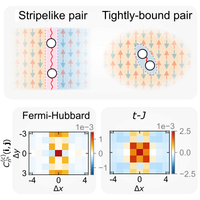
Understanding the physics of the two-dimensional Hubbard model is widely believed to be a key step in achieving a full understanding of high- cuprate superconductors. In recent years, progress has been made by large-scale numerical simulations at finite doping and, on the other hand, by microscopic theories able to capture the physics of individual charge carriers. In this work, we study single pairs of dopants in a cylindrical system using the density-matrix renormalization group algorithm. We identify two coexisting charge configurations that couple to the spin environment in different ways: a tightly bound configuration featuring (next-)nearest-neighbor pairs and a stripelike configuration of dopants on opposite sides of the cylinder, accompanied by a spin domain wall. Thus, we establish that the interplay between stripe order and uniform pairing, central to the models’ phases at finite doping, has its origin at the single-pair level. By interpolating between the Hubbard and the related model, we are able to quantitatively understand discrepancies in the pairing properties of the two models through the three-site hopping term usually omitted from the Hamiltonian. This term is closely related to a next-nearest-neighbor tunneling , which we observe to upset the balance between the competing stripe and pair states on the two-dopant level.
Physics Subject Headings (PhySH)
Popular Summary
High-temperature superconductors exhibit a complex competition between superconducting and insulating striped phases. Understanding this interplay is key to designing materials that conduct without resistance at practical temperatures. In our work, we discover that this competition can be observed at the scale of a single pair of charge carriers—challenging the long-held belief that many carriers are needed for such collective behaviors. This microscopic perspective marks a surprising and important step toward unraveling the mechanisms behind unconventional superconductivity.
We investigate this problem using advanced numerical simulations of mobile dopants moving in an antiferromagnetic background, a setting relevant to cuprate superconductors. By analyzing charge and magnetic correlations, we uncover two distinct types of charge pairing: one associated with uniform-density superconducting states and the other with insulating striped configurations. We find that these two types of pairs appear across the two most widely used theoretical models for the cuprates. This unifying insight helps resolve a major debate in the field over the nature of pairing in these materials.
Our results deepen our understanding of the building blocks of superconductivity and highlight a new direction for experimental investigation. In particular, we argue that quantum simulation platforms realizing the model are well positioned to directly observe these pairing effects in the lab. This opens the door to experimentally probing the microscopic roots of high-temperature superconductivity.
Article Text
References (58)
- J. G. Bednorz and K. A. Müller, Possible high superconductivity in the system, Z. Phys. B Condens. Matter 64, 189 (1986).
- M. A. Kastner, R. J. Birgeneau, G. Shirane, and Y. Endoh, Magnetic, transport, and optical properties of monolayer copper oxides, Rev. Mod. Phys. 70, 897 (1998).
- D. J. Scalapino, A common thread: The pairing interaction for unconventional superconductors, Rev. Mod. Phys. 84, 1383 (2012).
- Mingpu Qin, Chia-Min Chung, Hao Shi, Ettore Vitali, Claudius Hubig, Ulrich Schollwöck, Steven R. White, and Shiwei Zhang, Absence of superconductivity in the pure two-dimensional Hubbard model, Phys. Rev. X 10, 031016 (2020).
- Shengtao Jiang, Douglas J. Scalapino, and Steven R. White, Ground-state phase diagram of the model, Proc. Natl. Acad. Sci. U.S.A. 118, e2109978118 (2021).
- Yi-Fan Jiang, Thomas P. Devereaux, and Hong-Chen Jiang, Ground-state phase diagram and superconductivity of the doped Hubbard model on six-leg square cylinders, Phys. Rev. B 109, 085121 (2024).
- Xin Lu, Feng Chen, W. Zhu, D. N. Sheng, and Shou-Shu Gong, Emergent superconductivity and competing charge orders in hole-doped square-lattice model, Phys. Rev. Lett. 132, 066002 (2024).
- Yang Shen, Xiangjian Qian, and Mingpu Qin, The ground state of electron-doped model on cylinders, arXiv:2404.01979.
- Hao Xu, Chia-Min Chung, Mingpu Qin, Ulrich Schollwöck, Steven R. White, and Shiwei Zhang, Coexistence of superconductivity with partially filled stripes in the Hubbard model, Science 384, eadh7691 (2024).
- P. W. Anderson, The resonating valence bond state in and superconductivity, Science 235, 1196 (1987).
- F. C. Zhang and T. M. Rice, Effective Hamiltonian for the superconducting oxides, Phys. Rev. B 37, 3759 (1988).
- J. Hubbard, Electron correlations in narrow energy bands, Proc. R. Soc. A 276, 238 (1963).
- Shengtao Jiang, Douglas J. Scalapino, and Steven R. White, Pairing properties of the model, Phys. Rev. B 106, 174507 (2022).
- K. A. Chao, J. Spalek, and A. M. Oles, Kinetic exchange interaction in a narrow S-band, J. Phys. C 10, L271 (1977).
- K. A. Chao, J. Spałek, and A. M. Oleś, Canonical perturbation expansion of the Hubbard model, Phys. Rev. B 18, 3453 (1978).
- J. E. Hirsch, Attractive interaction and pairing in fermion systems with strong on-site repulsion, Phys. Rev. Lett. 54, 1317 (1985).
- B. Ammon, M. Troyer, and Hirokazu Tsunetsugu, Effect of the three-site hopping term on the model, Phys. Rev. B 52, 629 (1995).
- J. R. Coulthard, S. R. Clark, and D. Jaksch, Ground-state phase diagram of the one-dimensional model with pair hopping terms, Phys. Rev. B 98, 035116 (2018).
- V. I. Kuz’min, S. V. Nikolaev, and S. G. Ovchinnikov, Comparison of the electronic structure of the Hubbard and models within the cluster perturbation theory, Phys. Rev. B 90, 245104 (2014).
- Y. Wang, K. Wohlfeld, B. Moritz, C. J. Jia, M. van Veenendaal, K. Wu, C.-C. Chen, and T. P. Devereaux, Origin of strong dispersion in Hubbard insulators, Phys. Rev. B 92, 075119 (2015).
- Xin Lu, Jia-Xin Zhang, Shou-Shu Gong, D. N. Sheng, and Zheng-Yu Weng, Sign structure of the model and its physical consequences, Phys. Rev. B 110, 165127 (2024).
- Feng Chen, F. D. M. Haldane, and D. N. Sheng, D-wave and pair-density-wave superconductivity in the square-lattice model, Proc. Natl. Acad. Sci. U.S.A. 122, e2420963122 (2025).
- Immanuel Bloch, Jean Dalibard, and Sylvain Nascimbène, Quantum simulations with ultracold quantum gases, Nat. Phys. 8, 267 (2012).
- Christian Gross and Immanuel Bloch, Quantum simulations with ultracold atoms in optical lattices, Science 357, 995 (2017).
- Annabelle Bohrdt, Lukas Homeier, Christian Reinmoser, Eugene Demler, and Fabian Grusdt, Exploration of doped quantum magnets with ultracold atoms, Ann. Phys. (Amsterdam) 435, 168651 (2021), Special Issue on Philip W. Anderson.
- Christie S. Chiu, Geoffrey Ji, Annabelle Bohrdt, Muqing Xu, Michael Knap, Eugene Demler, Fabian Grusdt, Markus Greiner, and Daniel Greif, String patterns in the doped Hubbard model, Science 365, 251 (2019).
- Joannis Koepsell, Dominik Bourgund, Pimonpan Sompet, Sarah Hirthe, Annabelle Bohrdt, Yao Wang, Fabian Grusdt, Eugene Demler, Guillaume Salomon, Christian Gross, and Immanuel Bloch, Microscopic evolution of doped Mott insulators from polaronic metal to Fermi liquid, Science 374, 82 (2021).
- Geoffrey Ji, Muqing Xu, Lev Haldar Kendrick, Christie S. Chiu, Justus C. Brüggenjürgen, Daniel Greif, Annabelle Bohrdt, Fabian Grusdt, Eugene Demler, Martin Lebrat, and Markus Greiner, Coupling a mobile hole to an antiferromagnetic spin background: Transient dynamics of a magnetic polaron, Phys. Rev. X 11, 021022 (2021).
- Martin Lebrat, Muqing Xu, Lev Haldar Kendrick, Anant Kale, Youqi Gang, Pranav Seetharaman, Ivan Morera, Ehsan Khatami, Eugene Demler, and Markus Greiner, Observation of Nagaoka polarons in a Fermi–Hubbard quantum simulator, Nature (London) 629, 317 (2024).
- Max L. Prichard, Benjamin M. Spar, Ivan Morera, Eugene Demler, Zoe Z. Yan, and Waseem S. Bakr, Directly imaging spin polarons in a kinetically frustrated Hubbard system, Nature (London) 629, 323 (2024).
- Sarah Hirthe, Thomas Chalopin, Dominik Bourgund, Petar Bojović, Annabelle Bohrdt, Eugene Demler, Fabian Grusdt, Immanuel Bloch, and Timon A. Hilker, Magnetically mediated hole pairing in fermionic ladders of ultracold atoms, Nature (London) 613, 463 (2023).
- Dominik Bourgund, Thomas Chalopin, Petar Bojović, Henning Schlömer, Si Wang, Titus Franz, Sarah Hirthe, Annabelle Bohrdt, Fabian Grusdt, Immanuel Bloch, and Timon A. Hilker, Formation of individual stripes in a mixed-dimensional cold-atom Fermi–Hubbard system, Nature (London) 637, 57 (2025).
- Steven R. White, Density matrix formulation for quantum renormalization groups, Phys. Rev. Lett. 69, 2863 (1992).
- Steven R. White, Density-matrix algorithms for quantum renormalization groups, Phys. Rev. B 48, 10345 (1993).
- Assa Auerbach, Interacting Electrons and Quantum Magnetism, Graduate Texts in Contemporary Physics (Springer, New York, NY, 1994).
- Mark S. Hybertsen, Michael Schlüter, and Niels E. Christensen, Calculation of Coulomb-interaction parameters for using a constrained-density-functional approach, Phys. Rev. B 39, 9028 (1989).
- Elbio Dagotto, Correlated electrons in high-temperature superconductors, Rev. Mod. Phys. 66, 763 (1994).
- Anton Mazurenko, Christie S. Chiu, Geoffrey Ji, Maxwell F. Parsons, Márton Kanász-Nagy, Richard Schmidt, Fabian Grusdt, Eugene Demler, Daniel Greif, and Markus Greiner, A cold-atom Fermi–Hubbard antiferromagnet, Nature (London) 545, 462 (2017).
- Marcell Gall, Nicola Wurz, Jens Samland, Chun Fai Chan, and Michael Köhl, Competing magnetic orders in a bilayer Hubbard model with ultracold atoms, Nature (London) 589, 40 (2021).
- J. Spałek, M. Fidrysiak, M. Zegrodnik, and A. Biborski, Superconductivity in high- and related strongly correlated systems from variational perspective: Beyond mean field theory, Phys. Rep. 959, 1 (2022).
- Steven R. White and D. J. Scalapino, Hole and pair structures in the model, Phys. Rev. B 55, 6504 (1997).
- O. K. Andersen, A. I. Liechtenstein, O. Jepsen, and F. Paulsen, LDA energy bands, low-energy Hamiltonians, , , () and , J. Phys. Chem. Solids 56, 1573 (1995).
- Motoaki Hirayama, Youhei Yamaji, Takahiro Misawa, and Masatoshi Imada, Ab initio effective Hamiltonians for cuprate superconductors, Phys. Rev. B 98, 134501 (2018).
- John Sous, Yu He, and Steven A. Kivelson, Absence of a BCS-BEC crossover in the cuprate superconductors, npj Quantum Mater. 8, 1 (2023).
- Giuseppe Carleo and Matthias Troyer, Solving the quantum many-body problem with artificial neural networks, Science 355, 602 (2017).
- Pit Bermes, Annabelle Bohrdt, and Fabian Grusdt, Magnetic polarons beyond linear spin-wave theory: Mesons dressed by magnons, Phys. Rev. B 109, 205104 (2024).
- Annabelle Bohrdt, Christie S. Chiu, Geoffrey Ji, Muqing Xu, Daniel Greif, Markus Greiner, Eugene Demler, Fabian Grusdt, and Michael Knap, Classifying snapshots of the doped Hubbard model with machine learning, Nat. Phys. 15, 921 (2019).
- Lukas Homeier, Timothy J. Harris, Tizian Blatz, Sebastian Geier, Simon Hollerith, Ulrich Schollwöck, Fabian Grusdt, and Annabelle Bohrdt, Antiferromagnetic bosonic models and their quantum simulation in tweezer arrays, Phys. Rev. Lett. 132, 230401 (2024).
- Annette N. Carroll, Henrik Hirzler, Calder Miller, David Wellnitz, Sean R. Muleady, Junyu Lin, Krzysztof P. Zamarski, Reuben R. W. Wang, John L. Bohn, Ana Maria Rey, and Jun Ye, Observation of generalized spin dynamics with tunable dipolar interactions, Science 388, 381 (2025).
- https://github.com/TizianBlatz/pairing_structure_FH_tJ.
- Martin Boll, Timon A. Hilker, Guillaume Salomon, Ahmed Omran, Jacopo Nespolo, Lode Pollet, Immanuel Bloch, and Christian Gross, Spin- and density-resolved microscopy of antiferromagnetic correlations in Fermi-Hubbard chains, Science 353, 1257 (2016).
- Joannis Koepsell, Sarah Hirthe, Dominik Bourgund, Pimonpan Sompet, Jayadev Vijayan, Guillaume Salomon, Christian Gross, and Immanuel Bloch, Robust bilayer charge pumping for spin- and density-resolved quantum gas microscopy, Phys. Rev. Lett. 125, 010403 (2020).
- Thomas Hartke, Botond Oreg, Ningyuan Jia, and Martin Zwierlein, Doublon-hole correlations and fluctuation thermometry in a Fermi-Hubbard gas, Phys. Rev. Lett. 125, 113601 (2020).
- Julian Léonard, Sooshin Kim, Joyce Kwan, Perrin Segura, Fabian Grusdt, Cécile Repellin, Nathan Goldman, and Markus Greiner, Realization of a fractional quantum Hall state with ultracold atoms, Nature (London) 619, 495 (2023).
- Ulrich Schollwoeck, The density-matrix renormalization group in the age of matrix product states, Ann. Phys. (Amsterdam) 326, 96 (2011).
- C. Hubig, F. Lachenmaier, N.-O. Linden, T. Reinhard, L. Stenzel, A. Swoboda, M. Grundner, S. Mardazad, and S. Paeckel, The SyTen toolkit, www.syten.eu.
- Chia-Min Chung, Mingpu Qin, Shiwei Zhang, Ulrich Schollwöck, and Steven R. White, Plaquette versus ordinary -wave pairing in the -Hubbard model on a width-4 cylinder, Phys. Rev. B 102, 041106(R) (2020).
- Mingru Yang and Steven R. White, Time dependent variational principle with ancillary Krylov subspace, Phys. Rev. B 102, 094315 (2020).

