Browse by Subject

Supercurrent Spectroscopy of Andreev States

L. Bretheau, Ç. Ö. Girit, C. Urbina, D. Esteve, and H. Pothier

Phys. Rev. X 3, 041034 (2013) - Published 27 December, 2013

When two superconductors are connected through a weak link, discrete quasiparticle states localized at the link, called Andreev levels, are known to appear and leave their signatures in a “supercurrent” that flows through the link. Using microwave excitation and supercurrent measurements, scientists reveal the fundamental nature of the Andreev levels associated with a single-atom link.

Breaking of PT Symmetry in Bounded and Unbounded Scattering Systems

Philipp Ambichl, Konstantinos G. Makris, Li Ge, Yidong Chong, A. Douglas Stone, and Stefan Rotter

Phys. Rev. X 3, 041030 (2013) - Published 18 December, 2013

Coupling a light-amplifying gain material with a light-absorbing lossy material should, if their strengths are carefully balanced, result in a system with no net amplification or absorption. However, this overall symmetry can spontaneously break down at a specific value of gain-loss strength. Surprisingly, scientists find that this “symmetry-breaking” point is extremely robust to modifications of the system by its optical boundary conditions and explain why.

Creation, Storage, and On-Demand Release of Optical Quantum States with a Negative Wigner Function

Jun-ichi Yoshikawa, Kenzo Makino, Shintaro Kurata, Peter van Loock, and Akira Furusawa

Phys. Rev. X 3, 041028 (2013) - Published 13 December, 2013

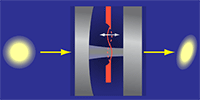
Nonclassical quantum states—those with no correspondence to classical states—can be characterized by a negative Wigner function and are vital to quantum-information processing. A new all-optical scheme achieves, for the first time, creation, storage, and on-demand release of highly nonclassical photonic states by using two coupled optical cavities, one for creation and storage, and the other for dynamical tuning of the release.

PtSi Clustering in Silicon Probed by Transport Spectroscopy

Massimo Mongillo, Panayotis Spathis, Georgios Katsaros, Silvano De Franceschi, Pascal Gentile, Riccardo Rurali, and Xavier Cartoixà

Phys. Rev. X 3, 041025 (2013) - Published 9 December, 2013

Metallic silicides interface with silicon in most microelectronic devices. But when the miniaturization of the devices takes their sizes down to the nanoscale, is the chemical and structural integrity of the interfacing materials maintained, and if not, how are the electronic properties of the device affected? Scientists investigate nanoscale transistors based on PtSi/Si/PtSi heterostructures and find that Pt diffuses into the silicon channel to form PtSi clusters that behave as metallic quantum dots in a semiconductor matrix.

Error Suppression and Error Correction in Adiabatic Quantum Computation: Techniques and Challenges

Kevin C. Young, Mohan Sarovar, and Robin Blume-Kohout

Phys. Rev. X 3, 041013 (2013) - Published 13 November, 2013

Adiabatic quantum computing (AQC) has intrinsic robustness to noise, but whether it’s fault-tolerant—robust to all forms of noise—has not been explored. While fault tolerance through error correction is theoretically achievable in standard quantum computing, scientists show that it may not be achievable in AQC.

Rotational Coherence Encoded in an “Air-Laser” Spectrum of Nitrogen Molecular Ions in an Intense Laser Field

Haisu Zhang, Chenrui Jing, Jinping Yao, Guihua Li, Bin Zeng, Wei Chu, Jielei Ni, Hongqiang Xie, Huailiang Xu, See Leang Chin, Kaoru Yamanouchi, Ya Cheng, and Zhizhan Xu

Phys. Rev. X 3, 041009 (2013) - Published 29 October, 2013

When exposed to intense infrared laser pulses of femtosecond duration, molecules such as N2, CO2, and H2O not only become ionized but can also produce lasers as a result of simultaneous population inversion. Scientists look deep into this “air lasing” phenomenon in N2 gas and uncover both quantum coherence in the rotational wave packets of the lasing molecular ions and its footprint in the air-laser spectrum.

Degree Distribution in Quantum Walks on Complex Networks

Mauro Faccin, Tomi Johnson, Jacob Biamonte, Sabre Kais, and Piotr Migdał

Phys. Rev. X 3, 041007 (2013) - Published 24 October, 2013

Google’s search engine algorithmically determines the relative importance of the world’s webpages by exploiting the physics of a classical random walker on the complex network of nodes (pages) and links (hyperlinks). What happens if the classical random walker is replaced by a quantum one? Researchers develop and investigate a simple model of a quantum walker on a complex network, uncovering interesting quantum-classical correspondence as well as fundamentally intriguing differences.

Frequency-Stabilized Source of Single Photons from a Solid-State Qubit

Jonathan H. Prechtel, Andreas V. Kuhlmann, Julien Houel, Lukas Greuter, Arne Ludwig, Dirk Reuter, Andreas D. Wieck, and Richard J. Warburton

Phys. Rev. X 3, 041006 (2013) - Published 23 October, 2013

Single-photon sources required for quantum communication and computation are commonly based on semiconductor quantum dots; however, charge fluctuations in the semiconductor lead to unwanted variations in the “color” (wavelength) of the emitted photons. Scientists use a hybrid system of a quantum dot and a constant-wavelength laser to measure and then cancel out fluctuations in the wavelength, generating a perfect stream of single photons of one color.

Quantum Amplification by Superradiant Emission of Radiation

Anatoly A. Svidzinsky, Luqi Yuan, and Marlan O. Scully

Phys. Rev. X 3, 041001 (2013) - Published 8 October, 2013

Light amplification in lasers usually relies on populating higher energy levels with more light emitters than lower energy levels. Scientists propose a new way of amplifying light without such population inversion, based on their discovery of resonant superradiant emission from an atomic ensemble interacting with a driving light field.

Entanglement Growth in Quench Dynamics with Variable Range Interactions

J. Schachenmayer, B. P. Lanyon, C. F. Roos, and A. J. Daley

Phys. Rev. X 3, 031015 (2013) - Published 13 September, 2013

Recent advances in quantum simulators allow the use of systems of trapped ions to create and simulate spin models with a controllable interaction range. Scientists report timely and counterintuitive theoretical findings about the temporal growth of quantum entanglement in a suddenly “quenched” quantum spin chain based on trapped ions.

All-Optical Switching and Router via the Direct Quantum Control of Coupling between Cavity Modes

Keyu Xia (夏可宇) and Jason Twamley

Phys. Rev. X 3, 031013 (2013) - Published 5 September, 2013

Classical optical communication and quantum information processing based on photonic networks require photonics signals to be switched on and off or routed via optical cavities and waveguides in the networks. Large-bandwidth and nearly perfect switching as well as low-loss, multiport routing remains challenging. A new proposal achieves these goals, relying on controlling the coupling between two neighboring cavities in a transmission path with a three-level atomic scatter of photons.

Strong Optomechanical Squeezing of Light

T. P. Purdy, P.-L. Yu, R. W. Peterson, N. S. Kampel, and C. A. Regal

Phys. Rev. X 3, 031012 (2013) - Published 3 September, 2013

New ways of making low-noise beams of light could lead to more sensitive optical interferometry measurements.

Deterministic Many-Resonator W Entanglement of Nearly Arbitrary Microwave States via Attractive Bose-Hubbard Simulation

A. A. Gangat, I. P. McCulloch, and G. J. Milburn

Phys. Rev. X 3, 031009 (2013) - Published 21 August, 2013

Recent advances in fabricating superconducting circuits have allowed large numbers of microwave resonators and superconducting qubits to be employed in such circuits, but shared quantum entanglement among the photonics states of the resonators has not been attempted. Theorists now present a proposal that uses superconducting circuits to simulate a particular many-body quantum model that until now has been experimentally inaccessible and to create a type of shared quantum entanglement with the simulation.

Security of Device-Independent Quantum Key Distribution in the Bounded-Quantum-Storage Model

S. Pironio, Ll. Masanes, A. Leverrier, and A. Acín

Phys. Rev. X 3, 031007 (2013) - Published 9 August, 2013

Current security proofs for device-independent quantum key distribution have significant limitations, such as very low noise tolerance, requiring the use of many devices, or applying to a given Bell inequality only. A new proof—with the only assumption that the eavesdropper does not have a long-term quantum memory—tolerates realistic noise levels, uses only two devices, and broadens the security certification to the test of any Bell inequality.

Device-Independent Quantum Key Distribution with Local Bell Test

Charles Ci Wen Lim, Christopher Portmann, Marco Tomamichel, Renato Renner, and Nicolas Gisin

Phys. Rev. X 3, 031006 (2013) - Published 30 July, 2013

Existing protocols for device-independent quantum key distribution solve the problem of inadvertently flawed devices, but still rely on two-party Bell tests across almost lossless quantum channels that are hard to realize over long distances. Now theorists propose a new device-independent protocol that allows Bell testing to be carried out by only one party, potentially enabling long-distance key distributions.

Adiabatic Quantum Transistors

Dave Bacon, Steven T. Flammia, and Gregory M. Crosswhite

Phys. Rev. X 3, 021015 (2013) - Published 14 June, 2013

Many conventional quantum information-processing proposals fix data spatially and use temporally sequenced operations to carry out a computation. Researchers now propose a different approach, relying on connected modular elements—quantum transistors—that could enable clock-controlled quantum information processing similar to present-day classical integrated circuits.

Persistent Control of a Superconducting Qubit by Stroboscopic Measurement Feedback

P. Campagne-Ibarcq, E. Flurin, N. Roch, D. Darson, P. Morfin, M. Mirrahimi, M. H. Devoret, F. Mallet, and B. Huard

Phys. Rev. X 3, 021008 (2013) - Published 29 May, 2013

In sensing-feedback control of a quantum system, optimizing the timing of the sensing measurements turns out to be a key to getting around the fundamental difficulty that a measurement can randomly change the system’s state. Achieving optimal timing by combining technical advances with conceptual physical insight, researchers demonstrate, for the first time, high-fidelity control of a superconducting qubit along time-dependent trajectories.

Experimental Implementation of a Kochen-Specker Set of Quantum Tests

Vincenzo D’Ambrosio, Isabelle Herbauts, Elias Amselem, Eleonora Nagali, Mohamed Bourennane, Fabio Sciarrino, and Adán Cabello

Phys. Rev. X 3, 011012 (2013) - Published 14 February, 2013

The Kochen-Specker theorem, which excludes noncontextual hidden-variable explanations for the counterintuitive puzzles of quantum mechanics, has been realized for the first time in two different single-photon experiments.

Symmetries and Collective Excitations in Large Superconducting Circuits

David G. Ferguson, A. A. Houck, and Jens Koch

Phys. Rev. X 3, 011003 (2013) - Published 17 January, 2013

Theoretical calculations describe the behavior of a large quantum circuit by taking advantage of certain symmetrical relationships between superconducting elements.

Cooling a Single Atom in an Optical Tweezer to Its Quantum Ground State

A. M. Kaufman, B. J. Lester, and C. A. Regal

Phys. Rev. X 2, 041014 (2012) - Published 29 November, 2012

Individual, neutral atoms trapped in optical tweezers have been cooled to their quantum ground state, raising hopes that they can be used to process quantum information.

Sign In to Your Journals Account

Filter

Filter

Article Lookup

Enter a citation