Browse by Subject

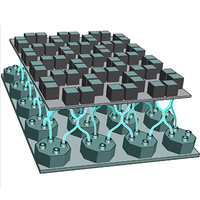
Realization of a Quantum Integer-Spin Chain with Controllable Interactions

C. Senko, P. Richerme, J. Smith, A. Lee, I. Cohen, A. Retzker, and C. Monroe

Phys. Rev. X 5, 021026 (2015) - Published 17 June, 2015

Ions with multiple quantum states are useful test beds for quantum magnetism and memory. Researchers use trapped 171Yb ions to control interactions among ions with three quantum states.

Nonreciprocal Photon Transmission and Amplification via Reservoir Engineering

A. Metelmann and A. A. Clerk

Phys. Rev. X 5, 021025 (2015) - Published 15 June, 2015

Nonreciprocal photonic systems allow for the unidirectional transmission and amplification of photons, which enables a host of applications. A new and general approach for realizing nonreciprocal interactions shows how they can be used to construct quantum-limited amplifiers and isolators.

Phase Locking a Clock Oscillator to a Coherent Atomic Ensemble

R. Kohlhaas, A. Bertoldi, E. Cantin, A. Aspect, A. Landragin, and P. Bouyer

Phys. Rev. X 5, 021011 (2015) - Published 27 April, 2015

Time measurements and navigation rely on atomic interferometers and atomic clocks. A new technique can improve the stability of such clocks by coupling a classical oscillator to an ensemble of atoms in a superposition state using repeated, coherence-preserving measurements.

Linear-Optical Generation of Eigenstates of the Two-Site XY Model

Stefanie Barz, Borivoje Dakić, Yannick Ole Lipp, Frank Verstraete, James D. Whitfield, and Philip Walther

Phys. Rev. X 5, 021010 (2015) - Published 24 April, 2015

Using quantum systems to simulate the behavior of other quantum systems is a step toward achieving revolutionary computing. Entangled photons are used to simulate the eigenstates of spin systems and how they change when the external magnetic field and spin-coupling are altered.

Spurious Harmonic Response of Multipulse Quantum Sensing Sequences

M. Loretz, J. M. Boss, T. Rosskopf, H. J. Mamin, D. Rugar, and C. L. Degen

Phys. Rev. X 5, 021009 (2015) - Published 22 April, 2015

Identifying atomic nuclei using magnetic spins is done in many fields of biology and chemistry. A new investigation shows that the presence of harmonic signals can make it difficult to accurately identify a heterogeneous group of atoms.

Wigner Function Negativity and Contextuality in Quantum Computation on Rebits

Nicolas Delfosse, Philippe Allard Guerin, Jacob Bian, and Robert Raussendorf

Phys. Rev. X 5, 021003 (2015) - Published 2 April, 2015

Quantum computation commonly relies on qubits, but rebits—states with real density matrices—can be used as well. Researchers show how the contextuality of two-level states is necessary for quantum computation.

Quantum Coherence, Time-Translation Symmetry, and Thermodynamics

Matteo Lostaglio, Kamil Korzekwa, David Jennings, and Terry Rudolph

Phys. Rev. X 5, 021001 (2015) - Published 1 April, 2015

Quantum mechanics and thermodynamics are fundamental fields of physics. Scientists show how the processing of quantum coherence is constrained by the laws of thermodynamics.

Transverse Spin and Momentum in Two-Wave Interference

Aleksandr Y. Bekshaev, Konstantin Y. Bliokh, and Franco Nori

Phys. Rev. X 5, 011039 (2015) - Published 30 March, 2015

Momentum and angular momentum are ubiquitous in wave physics. Calculations show that unusual transverse momentum and spin angular momentum, thus far only recorded in evanescent waves, can also be seen in interfering propagating waves, like laser beams.

Nonequilibrium Dynamical Mean-Field Theory for Bosonic Lattice Models

Hugo U. R. Strand, Martin Eckstein, and Philipp Werner

Phys. Rev. X 5, 011038 (2015) - Published 30 March, 2015

Ultracold atomic gases allow scientists to study the out-of-equilibrium dynamics of many-particle systems. A computationally tractable formalism is used to model systems of cold atoms trapped in an optical lattice.

Gauging Quantum States: From Global to Local Symmetries in Many-Body Systems

Jutho Haegeman, Karel Van Acoleyen, Norbert Schuch, J. Ignacio Cirac, and Frank Verstraete

Phys. Rev. X 5, 011024 (2015) - Published 27 February, 2015

Gauge fields, which appear in the standard model of physics, underpin a variety of fields, including condensed-matter physics. An alternative technique for studying gauge theories using a lattice with quantum degrees of freedom at its vertices is presented.

Many-Body Quantum Spin Dynamics with Monte Carlo Trajectories on a Discrete Phase Space

J. Schachenmayer, A. Pikovski, and A. M. Rey

Phys. Rev. X 5, 011022 (2015) - Published 25 February, 2015

Following the time evolution of a large and high-dimensional quantum system is often computationally intractable. A new semiclassical method of modeling quantum dynamics yields surprisingly good results for nonequilibrium dynamics.

Deterministic Writing and Control of the Dark Exciton Spin Using Single Short Optical Pulses

I. Schwartz, E. R. Schmidgall, L. Gantz, D. Cogan, E. Bordo, Y. Don, M. Zielinski, and D. Gershoni

Phys. Rev. X 5, 011009 (2015) - Published 30 January, 2015

Quantum information processing relies on controlling electronic and nuclear spins. Scientists experimentally demonstrate that the spins of a certain kind of optical excitation have relatively long coherence lifetimes and, furthermore, can be reliably controlled.

Ideal Negative Measurements in Quantum Walks Disprove Theories Based on Classical Trajectories

Carsten Robens, Wolfgang Alt, Dieter Meschede, Clive Emary, and Andrea Alberti

Phys. Rev. X 5, 011003 (2015) - Published 20 January, 2015

An atom’s walk in an optical lattice is used to test a key principle of quantum physics.

Atomic-Scale Nuclear Spin Imaging Using Quantum-Assisted Sensors in Diamond

A. Ajoy, U. Bissbort, M. D. Lukin, R. L. Walsworth, and P. Cappellaro

Phys. Rev. X 5, 011001 (2015) - Published 7 January, 2015

Manufacturing potent drugs requires knowledge of protein receptor sites. A novel strategy, combining the use of a quantum memory with quantum control, can boost the spatial resolution of magnetic-field sensors based on spin defects in diamond, thus achieving nanoscale magnetic imaging of biomolecules.

Long-time Behavior of Isolated Periodically Driven Interacting Lattice Systems

Luca D’Alessio and Marcos Rigol

Phys. Rev. X 4, 041048 (2014) - Published 19 December, 2014

The periodic input of energy into systems—driving—can have profound effects. Scientists studying driven interacting quantum systems find that a lattice model displays three different regimes as a function of driving period.

Freely Scalable Quantum Technologies Using Cells of 5-to-50 Qubits with Very Lossy and Noisy Photonic Links

Naomi H. Nickerson, Joseph F. Fitzsimons, and Simon C. Benjamin

Phys. Rev. X 4, 041041 (2014) - Published 9 December, 2014

Achieving quantum computation has been a long-standing goal of physicists and engineers. Researchers conduct numerical simulations of a quantum computer to show that a “clock speed” of kilohertz is possible with today’s systems.

Measurement-Free Topological Protection Using Dissipative Feedback

Keisuke Fujii, Makoto Negoro, Nobuyuki Imoto, and Masahiro Kitagawa

Phys. Rev. X 4, 041039 (2014) - Published 1 December, 2014

Quantum computing is susceptible to noise, which can require parallel measurements of many individual particles to correct. A new “measurement-free” scheme is proposed to protect quantum information in a topological way.

Entangled-Pair Transmission Improvement Using Distributed Phase-Sensitive Amplification

Anjali Agarwal, James M. Dailey, Paul Toliver, and Nicholas A. Peters

Phys. Rev. X 4, 041038 (2014) - Published 1 December, 2014

Quantum communications rely on transmitting quantum states, which are susceptible to transmission loss. Researchers have experimentally compensated for the transmission loss of two-qubit entangled states over a 5-km-long fiber configured as a distributed amplifier.

Synthetic Topological Qubits in Conventional Bilayer Quantum Hall Systems

Maissam Barkeshli and Xiao-Liang Qi

Phys. Rev. X 4, 041035 (2014) - Published 20 November, 2014

Topological qubits can process and store quantum information. A new theory proposes that topological qubits can be synthesized in experimentally well-established conventional bilayer fractional quantum Hall states.

Few-Electron Ultrastrong Light-Matter Coupling in a Quantum LC Circuit

Yanko Todorov and Carlo Sirtori

Phys. Rev. X 4, 041031 (2014) - Published 18 November, 2014

Future systems for quantum information processing will rely on coherent quantum phenomena, such as the coupling between light and matter. Using a quantum well within a capacitor to study how atomic physics and condensed matter physics are linked, researchers suggest a device architecture for semiconductor-based quantum processing.

Sign In to Your Journals Account

Filter

Filter

Article Lookup

Enter a citation