Recent Articles

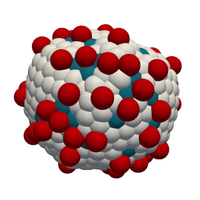
Cell Bulging and Extrusion in a Three-Dimensional Bubbly Vertex Model for Curved Epithelial Sheets

Oliver M. Drozdowski, Büşra Kocameşe-Tamgac𝚤, Kim E. Boonekamp, Michael Boutros, and Ulrich S. Schwarz

Phys. Rev. X 16, 021023 (2026) - Published 30 April, 2026

Cells at topological defects in curved epithelial sheets experience mechanical forces that facilitate extrusion.

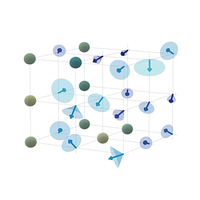
Dipolar Nematic State in Relaxor Ferroelectrics

Yuan-Jinsheng Liu, Tyler C. Sterling, and Shi Liu

Phys. Rev. X 16, 021022 (2026) - Published 29 April, 2026

A nematic ordering underpins the behavior of relaxor ferroelectrics.

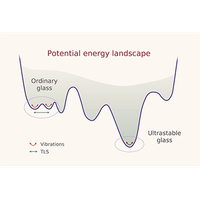
Effect of Glass Stability on the Low Frequency Vibrations of Vapor Deposited Glasses

I. Festi, E. Alfinelli, D. Bessas, F. Caporaletti, A. I. Chumakov, M. Moratalla, M. A. Ramos, M. Rodríguez-López, C. Rodríguez-Tinoco, J. Rodríguez-Viejo, and G. Baldi

Phys. Rev. X 16, 021021 (2026) - Published 28 April, 2026

An improved inelastic x-ray scattering technique helps clarify the connections between complex vibrations and the properties of glasses.

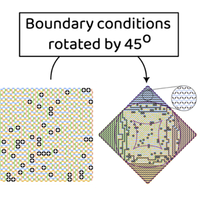
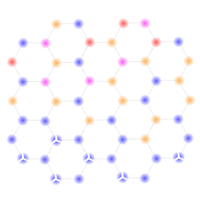
Breakdown of the Thermodynamic Limit in Quantum Spin and Dimer Models

Jeet Shah, Laura Shou, Jeremy Shuler, and Victor Galitski

Phys. Rev. X 16, 021020 (2026) - Published 27 April, 2026

Geometry-induced quantum phase separation in quantum dimer models demonstrates that domain shape can fundamentally alter macroscopic ground states, challenging traditional assumptions about the thermodynamic limit.

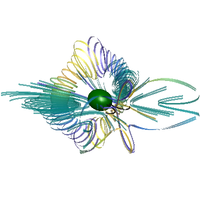
Seeing New Depths: Three-Dimensional Flow of a Free-Swimming Alga

Gregorius Pradipta, Wanho Lee, Van Tran, Kyle Welch, Santosh K. Sankar, Yongsam Kim, Satish Kumar, Xin Yong, Jiarong Hong, Sookkyung Lim, and Xiang Cheng

Phys. Rev. X 16, 021019 (2026) - Published 24 April, 2026

Experimental three-dimensional measurements of the flow field around a free-swimming microalga reveal that microscopic organisms generate unexpected low-Reynolds-number flow phenomena, expanding our understanding of microhydrodynamics with profound biological implications for microbial motility and physiology.

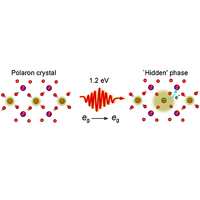
Excitations across the Equilibrium and Photoinduced “Hidden” States of Magnetoresistive Manganites

Shiyu Fan, Feng Jin, Taehun Kim, Umesh Kumar, Zixun Zhang, Vivek Bhartiya, Jiemin Li, Brandon Yalin, Yanhong Gu, Mingqiang Gu, Wen Hu, Claudio Mazzoli, G. Lawrence Carr, Osor S. Barišić, Andrey S. Mishchenko, Valentina Bisogni, Sobhit Singh, Wenbin Wu, and Jonathan Pelliciari

Phys. Rev. X 16, 021018 (2026) - Published 23 April, 2026

Ultrafast photoexcitation in La2/3Ca1/3MnO3 generates a long-lived hidden phase with unique polaronic and phononic excitations that do not exist under standard equilibrium conditions.

Prethermalization, Shadowing Breakdown, and the Absence of Trotterization Transition in Quantum Circuits

Marko Žnidarič

Phys. Rev. X 16, 021017 (2026) - Published 22 April, 2026

New research uses truncated propagators to show that shadowing time in many-body chaotic systems is finite. It also offers a method to calculate thermalization time, finding that the “Trotterization transition” is generically a finite-size effect.

Entropy of Strongly Correlated Electrons in a Partially Filled Landau Level

Alexandre Assouline, Taige Wang, Heun Mo Yoo, Ruihua Fan, Fangyuan Yang, Ruining Zhang, Takashi Taniguchi, Kenji Watanabe, Michael P. Zaletel, and Andrea F. Young

Phys. Rev. X 16, 021016 (2026) - Published 17 April, 2026

Entropy measurements in partially filled Landau levels reveal the successive freezing of spin and motional degrees of freedom, reaching sensitivities that constrain the isolation of topological entropy in non-Abelian quantum phases.

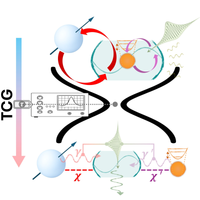
Model Order Reduction for Open Quantum Systems Based on Measurement-Adapted Time-Coarse Graining

Wentao Fan and Hakan E. Türeci

Phys. Rev. X 16, 021015 (2026) - Published 16 April, 2026

Researchers introduce measurement-adapted time-coarse graining, a model reduction technique that uses the time resolution of measurement channels to capture the observable dynamics of a complex quantum system.

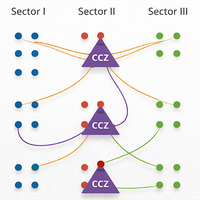
Magic Tricycles: Efficient Magic-State Generation with Finite Block-Length Quantum LDPC Codes

Varun Menon, J. Pablo Bonilla Ataides, Rohan Mehta, Andi Gu, Daniel Bochen Tan, and Mikhail D. Lukin

Phys. Rev. X 16, 021014 (2026) - Published 15 April, 2026

Quantum computing needs “magic states” for universality, but they are costly to make. New research introduces tricycle codes: high-rate QLDPC codes that can be used to generate CCZ magic states in constant depth with high noise resilience.

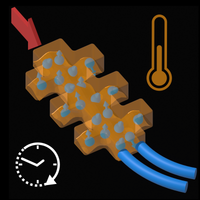
Heating Dynamics of Mesoscopic Electron Baths at High Magnetic Field

F. Zanichelli, A. Veillon, C. Piquard, A. Aassime, Y. Sato, A. Cavanna, Y. Jin, J. Folk, U. Gennser, A. Anthore, and F. Pierre

Phys. Rev. X 16, 021013 (2026) - Published 14 April, 2026

Time-resolved noise thermometry on mesoscopic metallic islands reveals a two-step thermalization process arising from the interplay between electronic quantum channels and nuclear spins.

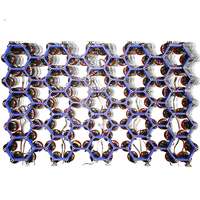
More is Less in Unpercolated Active Solids

Jack Binysh, Guido Baardink, Jonas Veenstra, Corentin Coulais, and Anton Souslov

Phys. Rev. X 16, 021012 (2026) - Published 13 April, 2026

By combining experiments with robotic metamaterials and theory, this work shows that increasing microscopic activity can counterintuitively cause a solid’s macroscale active response to vanish when active units are too sparse for the active forces to percolate through the structure.

Boosting the Thermoelectric Performance of α-MgAgSb through Phase-Transition-Induced Self-Doping

Kaiwei Guo, Tianyu Wang, Zhen Fan, Lunhua He, Fuhong Chen, Yi Wang, Qi Zhao, Jiawei Yang, Hangtian Zhu, Jun Li, Te-Huan Liu, and Huaizhou Zhao

Phys. Rev. X 16, 021011 (2026) - Published 10 April, 2026

A doping-free approach is able to boost thermoelectric performance, providing an attractive route for developing waste heat recovery technologies.

Subsurface Driven Size-Dependent Elasticity in Nanodiamond

Jiaqi Zhang, Chunmeng Liu, Xing Li, Dongyang Wang, Keke Zhao, Houlin Ji, Yoshifumi Oshima, Shaobo Cheng, and Chongxin Shan

Phys. Rev. X 16, 021010 (2026) - Published 10 April, 2026

Subsurface compliant regions in nanodiamond allow for an elastic response to strain, providing a method for engineering the mechanical properties of brittle materials like diamond.

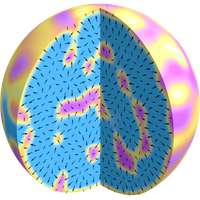
Active Hydrodynamic Theory of Euchromatin and Heterochromatin

S. Alex Rautu, Alexandra Zidovska, David Saintillan, and Michael J. Shelley

Phys. Rev. X 16, 021009 (2026) - Published 9 April, 2026

Researchers develop a theoretical framework that shows how mechanical forces and flows drive the spatial segregation and nucleus-wide patterning of chromatin in cells.

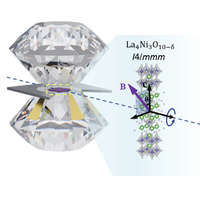
Nearly Isotropic Upper Critical Field in Pressurized Trilayer Nickelate La4Ni3O10−δ

Di Peng et al.

Phys. Rev. X 16, 021008 (2026) - Published 8 April, 2026

Angle-dependent magnetotransport measurements under extreme pressure reveal an isotropic upper critical field in trilayer nickelates driven by the compensation of distinct electronic orbitals.

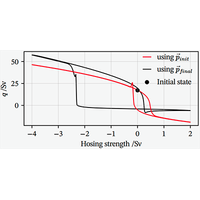
Targeted Calibration to Adjust Stability Biases in Complex Dynamical System Models

Daniel Pals, Sebastian Bathiany, Joel Kuettel, Richard A. Wood, and Niklas Boers

Phys. Rev. X 16, 021007 (2026) - Published 7 April, 2026

A method is introduced for systematic calibration of complex dynamical system models, targeted at adjusting system stability, with applications to climate models.

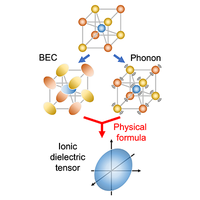
Physics-Based Factorized Machine Learning for Predicting Ionic Dielectric Tensors

Atsushi Takigawa, Shin Kiyohara, and Yu Kumagai

Phys. Rev. X 16, 021006 (2026) - Published 7 April, 2026

A machine-learning methodology helps screen thousands of candidate oxides to identify materials with excellent dielectric properties.

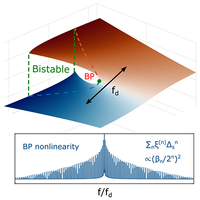
Ultralow-Power Microwave Frequency Comb at a Bistable Phase Transition

Hanfeng Wang, Kurt Jacobs, Dirk R. Englund, and Matthew E. Trusheim

Phys. Rev. X 16, 021005 (2026) - Published 6 April, 2026

Leveraging a bistable phase transition in a hybrid quantum system enables the generation of a microwave frequency comb with 193 spectral teeth at unprecedentedly low driving power.

Observation of Nonadiabatic Landau-Zener Tunneling among Floquet States

Yun Yen, Marcel Reutzel, Andi Li, Zehua Wang, Hrvoje Petek, and Michael Schüler

Phys. Rev. X 16, 021004 (2026) - Published 3 April, 2026

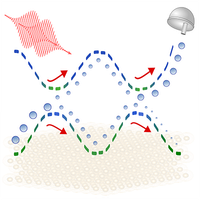
Spectroscopic data reveal copper electronic states transitioning to nonadiabatic Landau-Zener tunneling among Floquet states under intense light.

Sign In to Your Journals Account

Filter

Recent Issues

Vol. 16, Iss. 4
October - December 2026
Vol. 16, Iss. 3
July - September 2026
Vol. 16, Iss. 2
April - June 2026
Vol. 16, Iss. 1
January - March 2026
Category
Article Type

Filter

Article Lookup

Enter a citation