

- Open Access
Ultralow-Power Microwave Frequency Comb at a Bistable Phase Transition
Phys. Rev. X 16, 021005 – Published 6 April, 2026
DOI: https://doi.org/10.1103/59xl-zyxp
Abstract
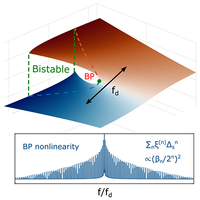
Nonlinear phenomena underpin a broad array of technologies, from electronic frequency mixers and harmonic generation to parametric amplification and optical frequency doubling. Conventional schemes for generating microwave frequency combs are constrained by intrinsic material or junction properties that require high driving powers. Here, we overcome these limitations via phase-transition physics. We show that a hybrid quantum system—composed of a solid-state spin ensemble and a nonlinear oscillator—exhibits a distinct bistable phase transition point (BP) where system response becomes both highly enhanced and nonlinear. The nonlinearity around the BP is higher order than other phase transitions, such as exceptional points, critically producing high-order frequency response which enhances nonlinear processes. Approaching the BP, we demonstrate a frequency comb with a record number of teeth at unprecedentedly low driving powers, surpassing previous results using magnonic systems and traditional diode-based approaches. These findings highlight the potential of hybrid quantum systems in advancing high-performance frequency manipulation.
Physics Subject Headings (PhySH)
Popular Summary
Generating strong nonlinear behavior for applications like frequency combs traditionally relies on intrinsic material properties that require relatively high driving powers. We demonstrate a low-power approach in a hybrid quantum system by coupling an ensemble of nitrogen-vacancy centers in diamond to a microwave oscillator near a bistable phase transition point. We observe that operating at this specific point yields an enhanced higher-order nonlinear response. This behavior allows us to generate a microwave frequency comb with 193 distinct spectral teeth using only of driving power, significantly lower than existing conventional platforms. Our findings provide a pathway for advancing low-power and high-precision technologies in quantum sensing, communications, and metrology.
Article Text
References (74)
- S. A. Diddams, K. Vahala, and T. Udem, Optical frequency combs: Coherently uniting the electromagnetic spectrum, Science 369, eaay3676 (2020).
- D. I. Herman, M. Walsh, M. K. Kreider, N. Lordi, E. J. Tsao, A. J. Lind, M. Heyrich, J. Combes, J. Genest, and S. A. Diddams, Squeezed dual-comb spectroscopy, Science 387, 653 (2025).
- V. Brasch, M. Geiselmann, T. Herr, G. Lihachev, M. H. Pfeiffer, M. L. Gorodetsky, and T. J. Kippenberg, Photonic chip-based optical frequency comb using soliton Cherenkov radiation, Science 351, 357 (2016).
- L. Chang, S. Liu, and J. E. Bowers, Integrated optical frequency comb technologies, Nat. Photonics 16, 95 (2022).
- S. Sun, B. Wang, K. Liu, M. W. Harrington, F. Tabatabaei, R. Liu, J. Wang, S. Hanifi, J. S. Morgan, M. Jahanbozorgi et al., Integrated optical frequency division for microwave and mmWave generation, Nature (London) 627, 540 (2024).
- A. L. Gaeta, M. Lipson, and T. J. Kippenberg, Photonic-chip-based frequency combs, Nat. Photonics 13, 158 (2019).
- J. S. Ochs, D. K. J. Boneß, G. Rastelli, M. Seitner, W. Belzig, M. I. Dykman, and E. M. Weig, Frequency comb from a single driven nonlinear nanomechanical mode, Phys. Rev. X 12, 041019 (2022).
- T.-Y. Chen, C.-P. Tsai, and W.-C. Li, Ultrasensitive sensing via internal resonance induced frequency combs in micromechanical resonators, J. Microelectromech. Syst. 34, 557 (2025).
- L. Colombo, H. M. Hussein, W. Gubinelli, R. Tetro, N. Casilli, A. Banfi, P. Simeoni, M. Rinaldi, and C. Cassella, A passive wireless quasi-harmonic strain sensor for eternal structural health monitoring, in 2024 IEEE Sensors, Kobe, Japan (IEEE, New York, 2024), pp. 1–4.
- P. Srivastava, P. P. Kumar, and C. V. Rao, Design and development of multi-frequency comb generator for space borne microwave active sensors, in Proceedings of the 2008 International Conference on Recent Advances in Microwave Theory and Applications, Jaipur, India (IEEE, New York, 2008), pp. 445–447.
- H. Wu, Z. Qian, H. Zhang, X. Xu, B. Xue, and J. Zhai, Precise underwater distance measurement by dual acoustic frequency combs, Ann. Phys. (Berlin) 531, 1900283 (2019).
- A. Greco, X. Ballu, F. Giazotto, and A. Crippa, Coherent microwave comb generation via the Josephson effect, arXiv:2503.13259.
- J. Guo, J. Xu, and C. Qian, Design of dual-mode frequency multiplier with Schottky diodes, IEEE Microwave Wireless Compon. Lett. 24, 554 (2014).
- L. Xiang, Y. Zhu, Q. Ding, Y. Luo, J. Sun, Z. Zeng, J. Zhang, X. Li, L. Jin, Y. Shangguan et al., A microwave comb generator based on AGaN/GaN heterostructure Schottky diodes nonlinear transmission line, Appl. Phys. Express 16, 074001 (2023).
- M. Saeed, A. Hamed, P. Palacios, B. Uzlu, Z. Wang, E. Baskent, and R. Negra, Voltage-tunable thin film graphene-diode-based microwave harmonic generator, IEEE Microwave Wireless Compon. Lett. 31, 733 (2021).
- R. K. Rai and N. Lohchaab, Higher order harmonic generation using capacitive nonlinearity of the step recovery diode, in Proceedings of the 2023 IEEE Microwaves, Antennas, and Propagation Conference (MAPCON), Ahmedabad, India (IEEE, New York, 2023), pp. 1–4.
- Q. Li, W. Jiang, Y. Xu, and F. Nian, Analysis and design of wide-band comb generator based on srd, in Proceedings of the 2012 International Conference on Microwave and Millimeter Wave Technology (ICMMT), Shenzhen, China (IEEE, New York, 2012), Vol. 1, pp. 1–3.
- T. Micallef, X. Gu, and K. Wu, Diode-based wideband harmonic generation for future nonlinear sensing applications, IEEE Trans. Microwave Theory Tech. 73, 6180 (2025).
- Z. Wang, H. Y. Yuan, Y. Cao, Z.-X. Li, R. A. Duine, and P. Yan, Magnonic frequency comb through nonlinear magnon-skyrmion scattering, Phys. Rev. Lett. 127, 037202 (2021).
- C. Zhao, Z. Yang, R. Peng, J. Yang, C. Li, and L. Zhou, Dissipative-coupling-induced transparency and high-order sidebands with Kerr nonlinearity in a cavity-magnonics system, Phys. Rev. Appl. 18, 044074 (2022).
- T. Hula, K. Schultheiss, F. J. T. Goncalves, L. Körber, M. Bejarano, M. Copus, L. Flacke, L. Liensberger, A. Buzdakov, A. Kákay et al., Spin-wave frequency combs, Appl. Phys. Lett. 121 (2022).
- J. W. Rao, B. Yao, C. Y. Wang, C. Zhang, T. Yu, and W. Lu, Unveiling a pump-induced magnon mode via its strong interaction with Walker modes, Phys. Rev. Lett. 130, 046705 (2023).
- G.-T. Xu, M. Zhang, Y. Wang, Z. Shen, G.-C. Guo, and C.-H. Dong, Magnonic frequency comb in the magnomechanical resonator, Phys. Rev. Lett. 131, 243601 (2023).
- Y.-S. Juan and F.-Y. Lin, Microwave-frequency-comb generation utilizing a semiconductor laser subject to optical pulse injection from an optoelectronic feedback laser, Opt. Lett. 34, 1636 (2009).
- A. Ganesan and A. Seshia, Resonance tracking in a micromechanical device using phononic frequency combs, Sci. Rep. 9, 9452 (2019).
- W. S. Wall, R. L. Kubena, Y.-K. Yook, J. Koehl, and R. J. Joyce, Phase noise transfer in high- quartz phononic frequency combs, in Proceedings of the 2020 IEEE International Ultrasonics Symposium (IUS), Las Vegas, NV, USA (IEEE, New York, 2020), pp. 1–4.
- M. H. De Jong, A. Ganesan, A. Cupertino, S. Gröblacher, and R. A. Norte, Mechanical overtone frequency combs, Nat. Commun. 14, 1458 (2023).
- A. Ganesan, C. Do, and A. Seshia, Frequency transitions in phononic four-wave mixing, Appl. Phys. Lett. 111 (2017).
- P. Song, J. Wu, S. Zang, E. Abdel-Rahman, L. Shao, and W. Zhang, Strong nonlinear mixing evolutions within phononic frequency combs, Commun. Nonlinear Sci. Numer. Simul. 138, 108233 (2024).
- H. Hodaei, A. U. Hassan, S. Wittek, H. Garcia-Gracia, R. El-Ganainy, D. N. Christodoulides, and M. Khajavikhan, Enhanced sensitivity at higher-order exceptional points, Nature (London) 548, 187 (2017).
- W. Chen, Ş. Kaya Özdemir, G. Zhao, J. Wiersig, and L. Yang, Exceptional points enhance sensing in an optical microcavity, Nature (London) 548, 192 (2017).
- X. Yin and X. Zhang, Unidirectional light propagation at exceptional points, Nat. Mater. 12, 175 (2013).
- Q. Song, M. Odeh, J. Zúñiga-Pérez, B. Kanté, and P. Genevet, Plasmonic topological metasurface by encircling an exceptional point, Science 373, 1133 (2021).
- J. Doppler, A. A. Mailybaev, J. Böhm, U. Kuhl, A. Girschik, F. Libisch, T. J. Milburn, P. Rabl, N. Moiseyev, and S. Rotter, Dynamically encircling an exceptional point for asymmetric mode switching, Nature (London) 537, 76 (2016).
- W. Liu, Y. Wu, C.-K. Duan, X. Rong, and J. Du, Dynamically encircling an exceptional point in a real quantum system, Phys. Rev. Lett. 126, 170506 (2021).
- A. Li, H. Wei, M. Cotrufo, W. Chen, S. Mann, X. Ni, B. Xu, J. Chen, J. Wang, S. Fan et al., Exceptional points and non-Hermitian photonics at the nanoscale, Nat. Nanotechnol. 18, 706 (2023).
- B. Peng, Ş. Özdemir, S. Rotter, H. Yilmaz, M. Liertzer, F. Monifi, C. Bender, F. Nori, and L. Yang, Loss-induced suppression and revival of lasing, Science 346, 328 (2014).
- B. Peng, Ş. K. Özdemir, M. Liertzer, W. Chen, J. Kramer, H. Y𝚤lmaz, J. Wiersig, S. Rotter, and L. Yang, Chiral modes and directional lasing at exceptional points, Proc. Natl. Acad. Sci. U.S.A. 113, 6845 (2016).
- H. Nasari, G. Lopez-Galmiche, H. E. Lopez-Aviles, A. Schumer, A. U. Hassan, Q. Zhong, S. Rotter, P. LiKamWa, D. N. Christodoulides, and M. Khajavikhan, Observation of chiral state transfer without encircling an exceptional point, Nature (London) 605, 256 (2022).
- F. Ding, Y. Deng, C. Meng, P. C. Thrane, and S. I. Bozhevolnyi, Electrically tunable topological phase transition in non-Hermitian optical mems metasurfaces, Sci. Adv. 10, eadl4661 (2024).
- Y.-P. Ruan, J.-S. Tang, Z. Li, H. Wu, W. Zhou, L. Xiao, J. Chen, S.-J. Ge, W. Hu, H. Zhang et al., Observation of loss-enhanced magneto-optical effect, Nat. Photonics 19, 109 (2025).
- J. Xu, Y. Mao, Z. Li, Y. Zuo, J. Zhang, B. Yang, W. Xu, N. Liu, Z. J. Deng, W. Chen et al., Single-cavity loss-enabled nanometrology, Nat. Nanotechnol. 19, 1472 (2024).
- Y.-H. Lai, Y.-K. Lu, M.-G. Suh, Z. Yuan, and K. Vahala, Observation of the exceptional-point-enhanced Sagnac effect, Nature (London) 576, 65 (2019).
- H.-K. Lau and A. A. Clerk, Fundamental limits and non-reciprocal approaches in non-Hermitian quantum sensing, Nat. Commun. 9, 4320 (2018).
- W. Langbein, No exceptional precision of exceptional-point sensors, Phys. Rev. A 98, 023805 (2018).
- R. Kononchuk, J. Cai, F. Ellis, R. Thevamaran, and T. Kottos, Exceptional-point-based accelerometers with enhanced signal-to-noise ratio, Nature (London) 607, 697 (2022).
- H. Loughlin and V. Sudhir, Exceptional-point sensors offer no fundamental signal-to-noise ratio enhancement, Phys. Rev. Lett. 132, 243601 (2024).
- C. Wang, J. Rao, Z. Chen, K. Zhao, L. Sun, B. Yao, T. Yu, Y.-P. Wang, and W. Lu, Enhancement of magnonic frequency combs by exceptional points, Nat. Phys. 20, 1139 (2024).
- H. Wang, Y.-H. Lai, Z. Yuan, M.-G. Suh, and K. Vahala, Petermann-factor sensitivity limit near an exceptional point in a Brillouin ring laser gyroscope, Nat. Commun. 11, 1610 (2020).
- J. Naikoo, R. W. Chhajlany, and J. Kołodyński, Multiparameter estimation perspective on non-Hermitian singularity-enhanced sensing, Phys. Rev. Lett. 131, 220801 (2023).
- C. Chen, L. Jin, and R.-B. Liu, Sensitivity of parameter estimation near the exceptional point of a non-Hermitian system, New J. Phys. 21, 083002 (2019).
- C. L. Degen, F. Reinhard, and P. Cappellaro, Quantum sensing, Rev. Mod. Phys. 89, 035002 (2017).
- J. F. Barry, J. M. Schloss, E. Bauch, M. J. Turner, C. A. Hart, L. M. Pham, and R. L. Walsworth, Sensitivity optimization for NV-diamond magnetometry, Rev. Mod. Phys. 92, 015004 (2020).
- H. Wang, M. E. Trusheim, L. Kim, H. Raniwala, and D. R. Englund, Field programmable spin arrays for scalable quantum repeaters, Nat. Commun. 14, 704 (2023).
- H. Wang, K. L. Tiwari, K. Jacobs, M. Judy, X. Zhang, D. R. Englund, and M. E. Trusheim, A spin-refrigerated cavity quantum electrodynamic sensor, Nat. Commun. 15, 10320 (2024).
- H. Wang, S. Wu, K. Jacobs, Y. Duan, D. R. Englund, and M. E. Trusheim, Cavity-enhanced solid-state nuclear spin gyroscope, Phys. Rev. Lett. 134, 183603 (2025).
- E. R. Eisenach, J. F. Barry, M. F. O’Keeffe, J. M. Schloss, M. H. Steinecker, D. R. Englund, and D. A. Braje, Cavity-enhanced microwave readout of a solid-state spin sensor, Nat. Commun. 12, 1357 (2021).
- Y. Zhang, Q. Wu, S.-L. Su, Q. Lou, C. Shan, and K. Mølmer, Cavity quantum electrodynamics effects with nitrogen vacancy center spins coupled to room temperature microwave resonators, Phys. Rev. Lett. 128, 253601 (2022).
- H. Wu, S. Mirkhanov, W. Ng, and M. Oxborrow, Bench-top cooling of a microwave mode using an optically pumped spin refrigerator, Phys. Rev. Lett. 127, 053604 (2021).
- H. Wang, K. Jacobs, D. Fahey, Y. Hu, D. R. Englund, and M. E. Trusheim, Exceptional sensitivity near the bistable transition point of a hybrid quantum system, Nat. Phys. (2026), 10.1038/s41567-026-03217-3.
- A. Suntharalingam, L. Fernández-Alcázar, R. Kononchuk, and T. Kottos, Noise resilient exceptional-point voltmeters enabled by oscillation quenching phenomena, Nat. Commun. 14, 5515 (2023).
- K. Bai, L. Fang, T.-R. Liu, J.-Z. Li, D. Wan, and M. Xiao, Nonlinearity-enabled higher-order exceptional singularities with ultra-enhanced signal-to-noise ratio, Natl. Sci. Rev. 10, nwac259 (2023).
- K. Bai, J.-Z. Li, T.-R. Liu, L. Fang, D. Wan, and M. Xiao, Nonlinear exceptional points with a complete basis in dynamics, Phys. Rev. Lett. 130, 266901 (2023).
- K. Bai, T.-R. Liu, L. Fang, J.-Z. Li, C. Lin, D. Wan, and M. Xiao, Observation of nonlinear exceptional points with a complete basis in dynamics, Phys. Rev. Lett. 132, 073802 (2024).
- S. Murali and P. Gupta, Overmodulation protection in fm transmitters, in Proceedings of the 2013 National Conference on Communications (NCC), New Delhi, India (IEEE, New York, 2013), pp. 1–5.
- J. F. Barry, R. A. Irion, M. H. Steinecker, D. K. Freeman, J. J. Kedziora, R. G. Wilcox, and D. A. Braje, Ferrimagnetic oscillator magnetometer, Phys. Rev. Appl. 19, 044044 (2023).
- J. Luo, Y. Geng, F. Rana, and G. D. Fuchs, Room temperature optically detected magnetic resonance of single spins in gan, Nat. Mater. 23, 512 (2024).
- T. Day, M. Isarov, W. J. Pappas, B. C. Johnson, H. Abe, T. Ohshima, D. R. McCamey, A. Laucht, and J. J. Pla, Room-temperature solid-state maser amplifier, Phys. Rev. X 14, 041066 (2024).
- A. Angerer, S. Putz, D. O. Krimer, T. Astner, M. Zens, R. Glattauer, K. Streltsov, W. J. Munro, K. Nemoto, S. Rotter, J. Schmiedmayer, and J. Majer, Ultralong relaxation times in bistable hybrid quantum systems, Sci. Adv. 3, e1701626 (2017).
- D. O. Krimer, M. Zens, and S. Rotter, Critical phenomena and nonlinear dynamics in a spin ensemble strongly coupled to a cavity. I. Semiclassical approach, Phys. Rev. A 100, 013855 (2019).
- M. Zens, D. O. Krimer, and S. Rotter, Critical phenomena and nonlinear dynamics in a spin ensemble strongly coupled to a cavity. II. Semiclassical-to-quantum boundary, Phys. Rev. A 100, 013856 (2019).
- H. Wang, K. Jacobs, D. R. Englund, and M. E. Trusheim, Data associated with “Ultralow-power microwave frequency comb at a bistable phase transition”, https://github.com/hanfengw/NVMFC (2026).
- M. Blaha, A. Johnson, A. Rauschenbeutel, and J. Volz, Beyond the Tavis-Cummings model: Revisiting cavity QED with ensembles of quantum emitters, Phys. Rev. A 105, 013719 (2022).
- M. O. Scully and M. S. Zubairy, Quantum Optics (Cambridge University Press, Cambridge, England, 1997).

