

- Featured in Physics
- Open Access
Breakdown of the Thermodynamic Limit in Quantum Spin and Dimer Models
Phys. Rev. X 16, 021020 – Published 27 April, 2026
DOI: https://doi.org/10.1103/ckrx-wbct
Abstract
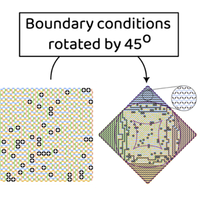
The thermodynamic limit is foundational to statistical mechanics, underlying our understanding of many-body phases. It assumes that, as the system size grows infinitely at fixed density of particles, unambiguous macroscopic phases emerge that are independent of the system’s boundary shape. We present explicit quantum spin and dimer Hamiltonians whose ground states violate this principle. Our construction relies on the previous mathematical work on classical dimers on the Aztec diamond and the square-octagon fortress, where geometry-dependent phase behaviors are observed in the infinite-size limit. We reverse engineer quantum spin Hamiltonians on the square and the square-octagon lattices whose ground states at the Rokhsar-Kivelson points are described by classical dimer coverings. On diamond-shaped domains, we find macroscopic boundary regions exhibiting distinct quantum phases from those on square-shaped domains. We study the nature of these phases by calculating the dimer-dimer and vison correlators and adapt Kasteleyn matrix based analytical and numerical methods for computing the vison correlator, which are significantly more efficient than standard Monte Carlo techniques. Our results show that the square-octagon lattice supports a single gapped short-range entangled phase, with exponentially decaying dimer correlators and a constant vison correlator. When the same model is considered on a diamond-shaped domain, two additional macroscopic regions emerge, with one near the corners and exhibiting staggered dimer order, and another exhibiting critical correlations.
Physics Subject Headings (PhySH)
 Viewpoint

When Boundaries Control the Bulk
An outwardly simple statistical model exhibits diverse equilibrium phases whose properties depend on geometry.
See more in Physics
Popular Summary
A foundational assumption in statistical mechanics is that of the thermodynamic limit, which implies that the boundary conditions do not affect macroscopic phases in the limit of infinite system size. We show that this assumption fails spectacularly in certain quantum spin and quantum dimer models where the geometry of the domain dictates the emergence of macroscopic regions which are in distinct phases. Our analysis of the square-octagon fortress domain reveals a ground state split into frozen ordered corners, an intermediate critical region, and a central short-range entangled phase. We used the vison correlator to diagnose these regions and found that it approaches a constant in the central phase, a result we also verified analytically for the infinite periodic limit. This implies vison condensation and the lack of a quantum spin liquid. By adapting a Kasteleyn matrix-based method, we achieved a significant increase in numerical efficiency and accuracy compared to standard Monte Carlo simulations. These results provide rigorous examples of geometry-induced quantum phase separation and offer new computational tools for investigating the complex phase diagrams of quantum dimer models.
Article Text
References (92)
- D. S. Rokhsar and S. A. Kivelson, Superconductivity and the quantum hard-core dimer gas, Phys. Rev. Lett. 61, 2376 (1988).
- N. Elkies, G. Kuperberg, M. Larsen, and J. Propp, Alternating-sign matrices and domino tilings Part I, Journal of Algebraic Combinatorics 1, 111 (1992).
- W. Jockusch, J. Propp, and P. Shor, Random domino tilings and the arctic circle theorem, arXiv:math/9801068.
- N. Elkies, G. Kuperberg, M. Larsen, and J. Propp, Alternating-sign matrices and domino tilings Part II, Journal of Algebraic Combinatorics 1, 219 (1992).
- R. Kenyon, Local statistics of lattice dimers, Ann. Inst. Henri Poincaré (B) Probab. Stat. 33, 591 (1997).
- H. Cohn, N. Elkies, and J. Propp, Local statistics for random domino tilings of the Aztec diamond, Duke Math. J. 85, 117 (1996).
- J. Propp, Generalized domino-shuffling, Theor. Comput. Sci. 303, 267 (2003).
- R. Kenyon, Lectures on dimers, in Statistical Mechanics, IAS/Park City Mathematics Series Vol. 16 (American Mathematical Society, Providence, RI, 2009), pp. 191–230.
- D. Cimasoni, The geometry of dimer models, Winter Braids Lect. Notes 1, 14 (2014).
- V. Gorin, Lectures on Random Lozenge Tilings, Cambridge Studies in Advanced Mathematics Vol. 193 (Cambridge University Press, Cambridge, England, 2021), pp. viii+250.
- I. Lyberg, V. Korepin, and J. Viti, Fluctuation of the phase boundary in the six-vertex model with domain wall boundary conditions: A Monte Carlo study, J. Phys. A 56, 495002 (2023).
- I. Lyberg, V. Korepin, and J. Viti, The density profile of the six-vertex model with domain wall boundary conditions, J. Stat. Mech. (2017) 053103.
- T. S. Tavares, G. A. P. Ribeiro, and V. E. Korepin, Influence of boundary conditions on bulk properties of six-vertex model, J. Phys. A 48, 454004 (2015).
- T. S. Tavares, G. A. P. Ribeiro, and V. E. Korepin, The entropy of the six-vertex model with a variety of different boundary conditions, J. Stat. Mech. (2015) P06016.
- G. A. P. Ribeiro and V. E. Korepin, Thermodynamic limit of the six-vertex model with reflecting end, J. Phys. A 48, 045205 (2015).
- A. Giuliani, V. Mastropietro, and F. L. Toninelli, Non-integrable dimers: Universal fluctuations of tilted height profiles, Commun. Math. Phys. 377, 1883 (2020).
- D. Yaremchuk, T. Hutak, V. Baliha, T. Krokhmalskii, O. Derzhko, J. Schnack, and J. Richter, Frustrated kagome-lattice bilayer quantum Heisenberg antiferromagnet, Phys. Rev. B 112, 024402 (2025).
- D. Bulmash and T. Iadecola, Braiding and gapped boundaries in fracton topological phases, Phys. Rev. B 99, 125132 (2019).
- W. Shirley, K. Slagle, Z. Wang, and X. Chen, Fracton models on general three-dimensional manifolds, Phys. Rev. X 8, 031051 (2018).
- S. Vijay, J. Haah, and L. Fu, Fracton topological order, generalized lattice gauge theory, and duality, Phys. Rev. B 94, 235157 (2016).
- P. W. Kasteleyn, The statistics of dimers on a lattice: I. The number of dimer arrangements on a quadratic lattice, Physica 27, 1209 (1961).
- H. N. Temperley and M. E. Fisher, Dimer problem in statistical mechanics-an exact result, Phil. Mag. 6, 1061 (1961).
- M. E. Fisher, Statistical mechanics of dimers on a plane lattice, Phys. Rev. 124, 1664 (1961).
- E. W. Montroll, R. B. Potts, and J. C. Ward, Correlations and spontaneous magnetization of the two-dimensional Ising model, J. Math. Phys. (N.Y.) 4, 308 (1963).
- L. Shou, J. Shah, M. Lerner-Brecher, A. Aggarwal, A. Borodin, and V. Galitski, Exactly solvable topological phase transition in a quantum dimer model, arXiv:2601.15377.
- R. Moessner and K. S. Raman, Quantum dimer models, in Introduction to Frustrated Magnetism: Materials, Experiments, Theory (Springer, Berlin, Heidelberg, 2011), pp. 437–479.
- L. Balents, M. P. A. Fisher, and S. M. Girvin, Fractionalization in an easy-axis Kagome antiferromagnet, Phys. Rev. B 65, 224412 (2002).
- L. Savary and L. Balents, Quantum spin liquids: A review, Rep. Prog. Phys. 80, 016502 (2017).
- T. Senthil and Matthew P. A. Fisher, gauge theory of electron fractionalization in strongly correlated systems, Phys. Rev. B 62, 7850 (2000).
- R. Moessner and S. L. Sondhi, Resonating Valence bond phase in the triangular lattice quantum dimer model, Phys. Rev. Lett. 86, 1881 (2001).
- P. Fendley, R. Moessner, and S. L. Sondhi, Classical dimers on the triangular lattice, Phys. Rev. B 66, 214513 (2002).
- G. Misguich, D. Serban, and V. Pasquier, Quantum dimer model on the Kagome lattice: Solvable dimer-liquid and Ising gauge theory, Phys. Rev. Lett. 89, 137202 (2002).
- M. Hermele, Matthew P. A. Fisher, and L. Balents, Pyrochlore photons: The spin liquid in a three-dimensional frustrated magnet, Phys. Rev. B 69, 064404 (2004).
- S. Chhita and B. Young, Coupling functions for domino tilings of Aztec diamonds, Adv. Math. 259, 173 (2014).
- S. Chhita, K. Johansson, and B. Young, Asymptotic domino statistics in the Aztec diamond, Ann. Appl. Probab. 25, 1232 (2015).
- S. Chhita and K. Johansson, Domino statistics of the two-periodic Aztec diamond, Adv. Math. 294, 37 (2016).
- P. Di Francesco and R. Soto-Garrido, Arctic curves of the octahedron equation, J. Phys. A 47, 285204 (2014).
- M. Duits and A. B. J. Kuijlaars, The two-periodic Aztec diamond and matrix valued orthogonal polynomials, J. Eur. Math. Soc. (JEMS) 23, 1075 (2021).
- T. Berggren and M. Duits, Correlation functions for determinantal processes defined by infinite block Toeplitz minors, Adv. Math. 356, 106766 (2019).
- T. Berggren and A. Borodin, Geometry of the doubly periodic Aztec dimer model, arXiv:2306.07482.
- C. Boutillier and B. Tilière, Fock’s dimer model on the Aztec diamond, arXiv:2405.20284.
- R. Kenyon, A. Okounkov, and S. Sheffield, Dimers and amoebae, Ann. Math. 163, 1019 (2006).
- R. Moessner, S. L. Sondhi, and E. Fradkin, Short-ranged resonating valence bond physics, quantum dimer models, and Ising gauge theories, Phys. Rev. B 65, 024504 (2001).
- G. Misguich and F. Mila, Quantum dimer model on the triangular lattice: Semiclassical and variational approaches to vison dispersion and condensation, Phys. Rev. B 77, 134421 (2008).
- A. Ioselevich, D. A. Ivanov, and M. V. Feigelman, Ground-state properties of the Rokhsar-Kivelson dimer model on the triangular lattice, Phys. Rev. B 66, 174405 (2002).
- J. Shah, G. Nambiar, A. V. Gorshkov, and V. Galitski, A quantum monomer-dimer model on Penrose tilings, arXiv:2503.15588.
- S. Balasubramanian, V. Galitski, and A. Vishwanath, Classical vertex model dualities in a family of two-dimensional frustrated quantum antiferromagnets, Phys. Rev. B 106, 195127 (2022).
- P. W. Kasteleyn, Dimer statistics and phase transitions, J. Math. Phys. (N.Y.) 4, 287 (1963).
- P. W. Kasteleyn, Graph theory and crystal physics, in Graph Theory and Theoretical Physics, edited by F. Harary (Academic Press, London, 1967), pp. 43–110.
- C. H. C. Little, An extension of Kasteleyn’s method of enumerating the 1-factors of planar graphs, in Combinatorial Mathematics (Proc. Second Australian Conference, Univ. Melbourne, Melbourne, 1973), Lecture Notes in Mathematics Vol. Vol. 403 (Springer, Berlin-New York, 1974), pp. 63–72.
- L. Lovász and M. D. Plummer, Matching Theory, North-Holland Mathematics Studies Vol. 121 (North-Holland Publishing Co., Amsterdam, 1986), pp. xxvii+544.
- J. Wildeboer, Z. Nussinov, and A. Seidel, Exact solution and correlations of a dimer model on the checkerboard lattice, Phys. Rev. B 102, 020401(R) (2020).
- T. Senthil and Matthew P. A. Fisher, Fractionalization in the cuprates: Detecting the topological order, Phys. Rev. Lett. 86, 292 (2001).
- T. Senthil and Matthew P. A. Fisher, Fractionalization, topological order, and cuprate superconductivity, Phys. Rev. B 63, 134521 (2001).
In terms of concepts from the mathematics literature, the vison correlator is related to a form of the height function modulo two.
- H. R. Lee and B. D. Saunders, Fraction free Gaussian elimination for sparse matrices, J. Symb. Comput. 19, 393 (1995).
- G. C. Nakos, P. R. Turner, and R. M. Williams, Fraction-free algorithms for linear and polynomial equations, ACM SIGSAM Bull. 31, 11 (1997).
- D. B. Wilson, Determinant algorithms for random planar structures, in Proceedings of the eighth annual ACM-SIAM symposium on Discrete algorithms, SODA’97 (ACM/SIAM, 1997), Vol. 97, pp. 258–267, 10.5555/314161.314264.
- P. J. Bhakta, Markov chains for weighted lattice structures, Ph.D. thesis, Georgia Institute of Technology, 2016.
- P. Bhakta and D. Randall, Sampling weighted perfect matchings on the square-octagon lattice, Theor. Comput. Sci. 699, 21 (2017).
- M. E. Fisher and J. Stephenson, Statistical mechanics of dimers on a plane lattice. II. Dimer correlations and monomers, Phys. Rev. 132, 1411 (1963).
- Z. Yan, Z. Zhou, O. F. Syljuåsen, J. Zhang, T. Yuan, J. Lou, and Y. Chen, Widely existing mixed phase structure of the quantum dimer model on a square lattice, Phys. Rev. B 103, 094421 (2021).
- D. Banerjee, M. Bögli, C. P. Hofmann, F.-J. Jiang, P. Widmer, and U.-J. Wiese, Finite-volume energy spectrum, fractionalized strings, and low-energy effective field theory for the quantum dimer model on the square lattice, Phys. Rev. B 94, 115120 (2016).
- H. Cohn, R. Kenyon, and J. Propp, A variational principle for domino tilings, J. Am. Math. Soc. 14, 297 (2001).
- H. Broer and F. Takens, Dynamical Systems and Chaos, Applied Mathematical Sciences Vol. 172 (Springer, New York, 2011), pp. xvi+313.
- F. Y. Wu, Dimers on two-dimensional lattices, Int. J. Mod. Phys. B 20, 5357 (2006).
- G. Szegö, On certain Hermitian forms associated with the Fourier series of a positive function, Comm. Sém. Math. Univ. Lund [Medd. Lunds Univ. Mat. Sem.] 228 (1952).
- H. Widom, Asymptotic behavior of block Toeplitz matrices and determinants, Adv. Math. 13, 284 (1974).
- A. Böttcher and B. Silbermann, Analysis of Toeplitz Operators (Springer-Verlag, Berlin, 1990), p. 512.
- A. Böttcher, The Onsager formula, the Fisher-Hartwig conjecture, and their influence on research into Toeplitz operators, J. Stat. Phys. 78, 575 (1995).
- E. Basor, J. Dubail, T. Emig, and R. Santachiara, Modified Szegö-Widom asymptotics for block Toeplitz matrices with zero modes, J. Stat. Phys. 174, 28 (2019).
- E. L. Basor and T. Ehrhardt, Asymptotics of block Toeplitz determinants and the classical dimer model, Commun. Math. Phys. 274, 427 (2007).
- W. P. Thurston, Conway’s tiling groups, Am. Math. Mon. 97, 757 (1990).
- R. Kenyon and A. Okounkov, Limit shapes and the complex Burgers equation, Acta Math. 199, 263 (2007).
- R. Kenyon, Height fluctuations in the honeycomb dimer model, Commun. Math. Phys. 281, 675 (2008).
- O. Schramm and S. Sheffield, Contour lines of the two-dimensional discrete Gaussian free field, Acta Math. 202, 21 (2009).
- J. Poulson, High-performance sampling of generic determinantal point processes, Phil. Trans. R. Soc. A 378, 20190059 (2020).
- O. F. Syljuåsen, Plaquette phase of the square-lattice quantum dimer model: Quantum Monte Carlo calculations, Phys. Rev. B 73, 245105 (2006).
- N. Shannon, O. Sikora, F. Pollmann, K. Penc, and P. Fulde, Quantum Ice: A quantum Monte Carlo study, Phys. Rev. Lett. 108, 067204 (2012).
- H. Cohn, M. Larsen, and J. Propp, The shape of a typical boxed plane partition, arXiv:math/9801059.
- G. Semeghini, H. Levine, A. Keesling, S. Ebadi, T. T. Wang, D. Bluvstein, R. Verresen, H. Pichler, M. Kalinowski, R. Samajdar, A. Omran, S. Sachdev, A. Vishwanath, M. Greiner, V. Vuletić, and M. D. Lukin, Probing topological spin liquids on a programmable quantum simulator, Science 374, 1242 (2021).
- R. Verresen, M. D. Lukin, and A. Vishwanath, Prediction of Toric code topological order from Rydberg blockade, Phys. Rev. X 11, 031005 (2021).
- Z. Zeng, G. Giudici, and H. Pichler, Quantum dimer models with Rydberg gadgets, Phys. Rev. Res. 7, L012006 (2025).
- J. Shah, G. Nambiar, A. V. Gorshkov, and V. Galitski, Quantum spin ice in three-dimensional Rydberg atom arrays, Phys. Rev. X 15, 011025 (2025).
- A. W. Glaetzle, M. Dalmonte, R. Nath, I. Rousochatzakis, R. Moessner, and P. Zoller, Quantum spin-ice and dimer models with Rydberg atoms, Phys. Rev. X 4, 041037 (2014).
- Z. Yan, R. Samajdar, Y.-C. Wang, S. Sachdev, and Z. Y. Meng, Triangular lattice quantum dimer model with variable dimer density, Nat. Commun. 13, 5799 (2022).
- D. A. Huse, W. Krauth, R. Moessner, and S. L. Sondhi, Coulomb and Liquid dimer models in three dimensions, Phys. Rev. Lett. 91, 167004 (2003).
- S. Balasubramanian, D. Bulmash, V. Galitski, and A. Vishwanath, Interplay of symmetry breaking and deconfinement in three-dimensional quantum vertex models, Phys. Rev. B 110, L180401 (2024).
- J. Shah, dimers-monte-carlo (2025), 10.5281/zenodo.18810499.
- L. Shou, dimers-kasteleyn (2025), GitHub repository, 10.5281/zenodo.19009789.
- R. L. Burden, J. D. Faires, and A. M. Burden, Numerical Analysis, 10th ed. (Cengage Learning, Boston, 2015).
- P. Di Francesco, -systems, networks and dimers, Commun. Math. Phys. 331, 1237 (2014).

