

- Open Access
Model Order Reduction for Open Quantum Systems Based on Measurement-Adapted Time-Coarse Graining
Phys. Rev. X 16, 021015 – Published 16 April, 2026
DOI: https://doi.org/10.1103/bysj-hjfl
Abstract
Model order reduction encompasses mathematical techniques aimed at reducing the complexity of mathematical models in simulations while retaining the essential characteristics and behaviors of the original model. This is particularly useful in the context of large-scale dynamical systems, which can be computationally expensive to analyze and simulate. Here, we present a model order reduction technique to reduce the time complexity of open quantum systems, grounded in the principle of measurement-adapted coarse graining. This method, governed by a coarse-graining timescale and the spectral band center of the measurement channel, organizes corrections to the lowest-order model which aligns with the rotating-wave approximation Hamiltonian in certain limits and rigorously justifies the resulting effective quantum master equation (EQME). The focus on calculating to a high degree of accuracy what can only be resolved by the measurement introduces a principled regularization procedure to address singularities and generates low-stiffness models suitable for efficient long-time integration. The closed-form EQME parameters greatly enhance interpretability, while the predicted EQME structure provides a foundation for deriving stochastic master equations under continuous measurement and for constructing efficient gray-box models for system identification and control. As a demonstration, we derive the fourth-order EQME for a challenging problem related to the dynamics of a superconducting qubit under high-power dispersive readout in the presence of a continuum of dissipative waveguide modes. This derivation shows that the lowest-order terms align with previous results, while higher-order corrections suggest new phenomena.
Physics Subject Headings (PhySH)
Popular Summary
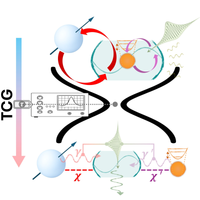
Efficiently modeling open quantum systems is a primary challenge in quantum science due to the complex multiscale dynamics that arise when nonlinear systems are driven by external sources. We introduce measurement-adapted time-coarse graining, a model order reduction technique that systematically derives effective quantum master equations based on the finite time resolution of a measurement apparatus. By organizing corrections through a coarse-graining timescale and the spectral band center of the measurement channel, we rigorously justify the resulting effective dynamics and provide closed-form formulas for superoperators at arbitrary orders. Our derivation for a superconducting qubit under high-power dispersive readout reveals new phenomena, such as measurement-induced spin energy jumps, that are not captured by standard rotating-wave approximations or effective Hamiltonian methods. This framework provides a self-consistent prescription for deriving stochastic master equations and low-stiffness models suitable for efficient system identification and control.
Article Text
Supplemental Material
References (76)
- Z. Leghtas, S. Touzard, I. M. Pop, A. Kou, B. Vlastakis, A. Petrenko, K. M. Sliwa, A. Narla, S. Shankar, M. J. Hatridge, M. Reagor, L. Frunzio, R. J. Schoelkopf, M. Mirrahimi, and M. H. Devoret, Confining the state of light to a quantum manifold by engineered two-photon loss, Science 347, 853 (2015).
- M. Reagor et al., Demonstration of universal parametric entangling gates on a multi-qubit lattice, Sci. Adv. 4, eaao3603 (2018).
- M. Villiers, W. C. Smith, A. Petrescu, A. Borgognoni, M. Delbecq, A. Sarlette, M. Mirrahimi, P. Campagne-Ibarcq, T. Kontos, and Z. Leghtas, Dynamically enhancing qubit-photon interactions with antisqueezing, PRX Quantum 5, 020306 (2024).
- X. L. He, Y. Lu, D. Q. Bao, H. Xue, W. B. Jiang, Z. Wang, A. F. Roudsari, P. Delsing, J. S. Tsai, and Z. R. Lin, Fast generation of Schrödinger cat states using a Kerr-tunable superconducting resonator, Nat. Commun. 14, 6358 (2023).
- M. Bukov, M. Kolodrubetz, and A. Polkovnikov, Schrieffer-Wolff transformation for periodically driven systems: Strongly correlated systems with artificial gauge fields, Phys. Rev. Lett. 116, 125301 (2016).
- M. Malekakhlagh, A. Petrescu, and H. E. Türeci, Lifetime renormalization of weakly anharmonic superconducting qubits. I. Role of number nonconserving terms, Phys. Rev. B 101, 134509 (2020).
- A. Petrescu, M. Malekakhlagh, and H. E. Türeci, Lifetime renormalization of driven weakly anharmonic superconducting qubits. II. The readout problem, Phys. Rev. B 101, 134510 (2020).
- R. Hanai, A. McDonald, and A. Clerk, Intrinsic mechanisms for drive-dependent purcell decay in superconducting quantum circuits, Phys. Rev. Res. 3, 043228 (2021).
- J. Venkatraman, X. Xiao, R. G. Cortiñas, A. Eickbusch, and M. H. Devoret, Static effective Hamiltonian of a rapidly driven nonlinear system, Phys. Rev. Lett. 129, 100601 (2022).
- A. Blais, A. L. Grimsmo, S. M. Girvin, and A. Wallraff, Circuit quantum electrodynamics, Rev. Mod. Phys. 93, 025005 (2021).
- L. Bello, W. Fan, A. Gandotra, and H. E. Türeci, Systematic time-coarse-graining for driven quantum systems, Phys. Rev. Appl. 23, 054042 (2025).
- A. Blais, R.-S. Huang, A. Wallraff, S. M. Girvin, and R. J. Schoelkopf, Cavity quantum electrodynamics for superconducting electrical circuits: An architecture for quantum computation, Phys. Rev. A 69, 062320 (2004).
- A. Wallraff, D. I. Schuster, A. Blais, L. Frunzio, R.-S. Huang, J. Majer, S. Kumar, S. M. Girvin, and R. J. Schoelkopf, Strong coupling of a single photon to a superconducting qubit using circuit quantum electrodynamics, Nature (London) 431, 162 (2004).
- M. Boissonneault, J. M. Gambetta, and A. Blais, Dispersive regime of circuit QED: Photon-dependent qubit dephasing and relaxation rates, Phys. Rev. A 79, 013819 (2009).
- D. Sank et al., Measurement-induced state transitions in a superconducting qubit: Beyond the rotating wave approximation, Phys. Rev. Lett. 117, 190503 (2016).
- R. Shillito, A. Petrescu, J. Cohen, J. Beall, M. Hauru, M. Ganahl, Adam G. Lewis, G. Vidal, and A. Blais, Dynamics of transmon ionization, Phys. Rev. Appl. 18, 034031 (2022).
- R. Lescanne, L. Verney, Q. Ficheux, M. H. Devoret, B. Huard, M. Mirrahimi, and Z. Leghtas, Escape of a driven quantum Josephson circuit into unconfined states, Phys. Rev. Appl. 11, 014030 (2019).
- J. Heinsoo, C. K. Andersen, A. Remm, S. Krinner, T. Walter, Y. Salathé, S. Gasparinetti, J.-C. Besse, A. Potočnik, A. Wallraff, and C. Eichler, Rapid high-fidelity multiplexed readout of superconducting qubits, Phys. Rev. Appl. 10, 034040 (2018).
- L. Chen et al., Transmon qubit readout fidelity at the threshold for quantum error correction without a quantum-limited amplifier, npj Quantum Inf. 9, 26 (2023).
- E. Ginossar, L. S. Bishop, D. I. Schuster, and S. M. Girvin, Protocol for high-fidelity readout in the photon-blockade regime of circuit QED, Phys. Rev. A 82, 022335 (2010).
- M. D. Reed, L. DiCarlo, B. R. Johnson, L. Sun, D. I. Schuster, L. Frunzio, and R. J. Schoelkopf, High-fidelity readout in circuit quantum electrodynamics using the Jaynes-Cummings nonlinearity, Phys. Rev. Lett. 105, 173601 (2010).
- H.-S. Yeo, S. Woo, J. Kim, Y. Kim, B. Choi, G. Choi, J. Choi, S. K. Lee, W. Song, and Y. Chong, High-fidelity multiplexed single-shot readout for transmon qubits with high-power measurement, IEEE Trans. Appl. Supercond. 33, 1 (2023).
- K. G. Wilson, Renormalization group and critical phenomena. I. Renormalization group and the Kadanoff scaling picture, Phys. Rev. B 4, 3174 (1971).
- K. G. Wilson, Renormalization group and critical phenomena. II. Phase-space cell analysis of critical behavior, Phys. Rev. B 4, 3184 (1971).
- K. G. Wilson, The renormalization group and critical phenomena, Rev. Mod. Phys. 55, 583 (1983).
- S. D. Głazek and K. G. Wilson, Renormalization of Hamiltonians, Phys. Rev. D 48, 5863 (1993).
- F. J. Wegner, Flow equations for Hamiltonians, Nucl. Phys. B, Proc. Suppl. 90, 141 (2000).
- S. Kehrein, The Flow Equation Approach to Many-Particle Systems (Springer, New York, 2006), Vol. 217.
- M. O. Scully and M. S. Zubairy, Quantum Optics (Cambridge University Press, Cambridge, England, 1997).
- Y.-Y. Zhang and Q.-H. Chen, Generalized rotating-wave approximation for the two-qubit quantum Rabi model, Phys. Rev. A 91, 013814 (2015).
- O. Gamel and Daniel F. V. James, Time-averaged quantum dynamics and the validity of the effective Hamiltonian model, Phys. Rev. A 82, 052106 (2010).
- C.-W. Lee, C. Noh, and J. Kim, Effective formalism for open-quantum-system dynamics: Time-coarse-graining approach, Phys. Rev. A 97, 012102 (2018).
- See Supplemental Material at http://link.aps.org/supplemental/10.1103/bysj-hjfl for details on additional derivations and numerical results.
- H. M. Wiseman and G. J. Milburn, Quantum Measurement and Control (Cambridge University Press, Cambridge, England, 2009).
- H. Carmichael, An Open Systems Approach to Quantum Optics, Lecture Notes in Physics Monographs Vol. 18 (Springer, Berlin, Heidelberg, 1993).
- H. M. Wiseman and G. J. Milburn, Quantum theory of field-quadrature measurements, Phys. Rev. A 47, 642 (1993).
- H. Mabuchi and H. M. Wiseman, Retroactive quantum jumps in a strongly coupled atom-field system, Phys. Rev. Lett. 81, 4620 (1998).
- C. Cohen-Tannoudji, Fluctuations in radiative processes, Phys. Scr. 1986, 19 (1986).
- Radiation considered as a reservoir: Master equation for the particles, in Atom—Photon Interactions (John Wiley & Sons, Ltd, New York, 1998), Chap. 4, pp. 257–351.
- J. D. Cresser and C. Facer, Coarse-graining in the derivation of Markovian master equations and its significance in quantum thermodynamics, arXiv:1710.09939.
- A. Youssry and H. I. Nurdin, Multi-axis control of a qubit in the presence of unknown non-Markovian quantum noise, Quantum Sci. Technol. 8, 015018 (2022).
- I. A. Luchnikov, S. V. Vintskevich, D. A. Grigoriev, and S. N. Filippov, Machine learning non-Markovian quantum dynamics, Phys. Rev. Lett. 124, 140502 (2020).
With the form of system-bath couplings in Eq. (9), the effective system-bath coupling coefficients produced by TCG are, in general, bandpass filtered around certain system operator frequencies, which apparently reduces the width of the spectral density function and thereby increases the bath correlation time . At first sight, this seems to suggest that the large- limit does not necessarily justify the Markov and secular approximations. However, we recognize that the increasing value of predicted by naive application of TCG essentially originates from taking into account some unrealistic Poincaré-recurrence-like phenomena in the bath, which are, in fact, prevented by other thermalizing mechanisms of the bath that are not included in the simplistic model presented here. Therefore, we make the physical assumption that the bath correlation time is always limited below some very small value as we increase the coarse-graining timescale .
- E. Genois, J. A. Gross, A. Di Paolo, N. J. Stevenson, G. Koolstra, A. Hashim, I. Siddiqi, and A. Blais, Quantum-tailored machine-learning characterization of a superconducting qubit, PRX Quantum 2, 040355 (2021).
- A. Youssry, Y. Yang, R. J. Chapman, B. Haylock, F. Lenzini, M. Lobino, and A. Peruzzo, Experimental graybox quantum system identification and control, npj Quantum Inf. 10, 9 (2024).
Here we refer to the continuously detected degrees of freedom as “photons”.
- P. Alsing and H. J. Carmichael, Spontaneous dressed-state polarization of a coupled atom and cavity mode, Quantum Opt. 3, 13 (1991).
- P. Warszawski and H. M. Wiseman, Quantum trajectories for realistic photodetection: I. General formalism, J. Opt. B 5, 1 (2002).
- H. M. Wiseman and J. M. Gambetta, Pure-state quantum trajectories for general non-Markovian systems do not exist, Phys. Rev. Lett. 101, 140401 (2008).
- S. K. Kehrein and A. Mielke, Theory of the Anderson impurity model: The Schrieffer–Wolff transformation reexamined, Ann. Phys. (N.Y.) 252, 1 (1996).
- P. Carbonaro, G. Compagno, and F. Persico, Canonical dressing of atoms by intense radiation fields, Phys. Lett. A 73, 97 (1979).
- C. F. Lo, K. L. Liu, K. M. Ng, and P. H. Yuen, Is there a spontaneous breaking of the parity symmetry of the Jaynes-Cummings model without the rotating-wave approximation?, Quantum Semiclassical Opt. 10, L63 (1998).
- D. Zueco, G. M. Reuther, S. Kohler, and P. Hänggi, Qubit-oscillator dynamics in the dispersive regime: Analytical theory beyond the rotating-wave approximation, Phys. Rev. A 80, 033846 (2009).
- F. Beaudoin, J. M. Gambetta, and A. Blais, Dissipation and ultrastrong coupling in circuit QED, Phys. Rev. A 84, 043832 (2011).
- S. Mundhada, S. Shankar, A. Narla, E. Zalys-Geller, S. Girvin, and M. Devoret, Dependence of transmon qubit relaxation rate on readout drive power, APS March Meeting (American Physical Society, Baltimore, Maryland, 2016), p. V48.
- Z. Minev, S. Mundhada, S. Shankar, P. Reinhold, R. Gutiérrez-Jáuregui, R. Schoelkopf, M. Mirrahimi, H. Carmichael, and M. Devoret, To catch and reverse a quantum jump mid-flight, Nature (London) 570, 200 (2019).
- C. R. Müller, C. Peuntinger, T. Dirmeier, I. Khan, U. Vogl, C. Marquardt, G. Leuchs, L. L. Sánchez-Soto, Y. S. Teo, Z. Hradil, and J. Řeháček, Evading vacuum noise: Wigner projections or Husimi samples?, Phys. Rev. Lett. 117, 070801 (2016).
- S. Stenholm, Simultaneous measurement of conjugate variables, Ann. Phys. (N.Y.) 218, 233 (1992).
- J. H. Shapiro, The quantum theory of optical communications, IEEE J. Sel. Top. Quantum Electron. 15, 1547 (2009).
- J. Gambetta, A. Blais, D. I. Schuster, A. Wallraff, L. Frunzio, J. Majer, M. H. Devoret, S. M. Girvin, and R. J. Schoelkopf, Qubit-photon interactions in a cavity: Measurement-induced dephasing and number splitting, Phys. Rev. A 74, 042318 (2006).
- H.-P. Breuer, E.-M. Laine, and J. Piilo, Measure for the degree of non-Markovian behavior of quantum processes in open systems, Phys. Rev. Lett. 103, 210401 (2009).
- N. Megier, D. Chruściński, J. Piilo, and W. T. Strunz, Eternal non-Markovianity: From random unitary to Markov chain realisations, Sci. Rep. 7, 6379 (2017).
- A. Rivas, S. F. Huelga, and M. B. Plenio, Entanglement and non-Markovianity of quantum evolutions, Phys. Rev. Lett. 105, 050403 (2010).
- U. Shrikant, R. Srikanth, and S. Banerjee, Non-Markovian dephasing and depolarizing channels, Phys. Rev. A 98, 032328 (2018).
- M. H. Muñoz Arias, C. Lledó, and A. Blais, Qubit readout enabled by qubit cloaking, Phys. Rev. Appl. 20, 054013 (2023).
- D. Gusenkova, M. Spiecker, R. Gebauer, M. Willsch, D. Willsch, F. Valenti, N. Karcher, L. Grünhaupt, I. Takmakov, P. Winkel, D. Rieger, A. V. Ustinov, N. Roch, W. Wernsdorfer, K. Michielsen, O. Sander, and I. M. Pop, Quantum nondemolition dispersive readout of a superconducting artificial atom using large photon numbers, Phys. Rev. Appl. 15, 064030 (2021).
- Y. Zhou, Z. Zhang, Z. Yin, S. Huai, X. Gu, X. Xu, J. Allcock, F. Liu, G. Xi, Q. Yu, H. Zhang, M. Zhang, H. Li, X. Song, Z. Wang, D. Zheng, S. An, Y. Zheng, and S. Zhang, Rapid and unconditional parametric reset protocol for tunable superconducting qubits, Nat. Commun. 12, 5924 (2021).
- T. Thorbeck, Z. Xiao, A. Kamal, and L. C. G. Govia, Readout-induced suppression and enhancement of superconducting qubit lifetimes, arXiv:2305.10508.
- C. Lledó, R. Dassonneville, A. Moulinas, J. Cohen, R. Shillito, A. Bienfait, B. Huard, and A. Blais, Cloaking a qubit in a cavity, Nat. Commun. 14, 6313 (2023).
- J. M. Martinis, Saving superconducting quantum processors from decay and correlated errors generated by gamma and cosmic rays, npj Quantum Inf. 7, 90 (2021).
- M. Malekakhlagh, A. Petrescu, and H. E. Türeci, Cutoff-free circuit quantum electrodynamics, Phys. Rev. Lett. 119, 073601 (2017).
- J. Cohen, A. Petrescu, R. Shillito, and A. Blais, Reminiscence of classical chaos in driven transmons, PRX Quantum 4, 020312 (2023).
- Z. Minev, Z. Leghtas, S. Mundhada, L. Christakis, I. Pop, and M. Devoret, Energy-participation quantization of Josephson circuits, npj Quantum Inf. 7, 131 (2021).
- J. Venkatraman, X. Xiao, R. Cortiñas, and M. H. Devoret, On the static effective Lindbladian of the squeezed Kerr oscillator, Phys. Rev. A 110, 042411 (2022).
- D. N. Pham, W. Fan, M. G. Scheer, and H. E. Türeci, Flux-based three-dimensional electrodynamic modeling approach to superconducting circuits and materials, Phys. Rev. A 107, 053704 (2023).
- L. Bello, W. Fan, A. Gandotra, and H. Türeci, GitHub, 2022, https://github.com/leonbello/quantumgraining.jl.

