

- Open Access
Physics-Based Factorized Machine Learning for Predicting Ionic Dielectric Tensors
Phys. Rev. X 16, 021006 – Published 7 April, 2026
DOI: https://doi.org/10.1103/28wr-w896
Abstract
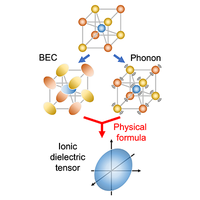
Considerable effort continues to be devoted to the exploration of next-generation high- materials that combine a high dielectric constant with a wide band gap. However, machine learning (ML)-based virtual screening has remained challenging, primarily due to the low accuracy in predicting the ionic contribution to the dielectric tensor, which dominates the dielectric performance of high- materials. We propose a joint ML model that predicts Born effective charges using an equivariant graph neural network, and phonon properties using a highly accurate pretrained ML potential. The ionic dielectric tensor is then computed analytically from these quantities. This approach significantly improves the accuracy of ionic contribution. Using the proposed model, we successfully identified 31 novel high- oxides from a screening pool of over 8000 candidates.
Physics Subject Headings (PhySH)
Popular Summary
Finding materials that can store electric energy efficiently is a key for the development of electronics. We used machine learning to discover materials that have both a high dielectric constant and a wide band gap. This combination is useful for making faster, smaller, and more stable devices. Our method first learns how atoms respond to electric fields (Born effective charges) and how they vibrate (phonons) instead of predicting everything at once. By combining these first results with simple physical equations, we accurately calculate how well a material can store energy. We screened more than 8000 oxide materials with this approach and identified 31 that should have excellent dielectric performance. Our physics-guided machine-learning model shows how combining scientific understanding with data opens exciting pathways for discovering advanced materials.
Article Text
Supplemental Material
References (151)
- R. P. Ortiz, A. Facchetti, and T. J. Marks, High- Organic, inorganic, and hybrid dielectrics for low-voltage organic field-effect transistors, Chem. Rev. 110, 205 (2010).
- B. Wang, W. Huang, L. Chi, M. Al-Hashimi, T. J. Marks, and A. Facchetti, High- gate dielectrics for emerging flexible and stretchable electronics, Chem. Rev. 118, 5690 (2018).
- A. I. Kingon, J.-P. Maria, and S. K. Streiffer, Alternative dielectrics to silicon dioxide for memory and logic devices, Nature (London) 406, 1032 (2000).
- G. D. Wilk, R. M. Wallace, and J. M. Anthony, High- gate dielectrics: Current status and materials properties considerations, J. Appl. Phys. 89, 5243 (2001).
- J. Robertson, High dielectric constant oxides, Eur. Phys. J. Appl. Phys. 28, 265 (2004).
- C. H. Ahn, K. M. Rabe, and J.-M. Triscone, Ferroelectricity at the nanoscale: Local polarization in oxide thin films and heterostructures, Science 303, 488 (2004).
- M. Esro, O. Kolosov, P. J. Jones, W. I. Milne, and G. Adamopoulos, Structural and electrical characterization of gate dielectrics deposited from solutions at moderate temperatures in air, ACS Appl. Mater. Interfaces 9, 529 (2017).
- K. Eisenbeiser et al., Field effect transistors with gate dielectric on , Appl. Phys. Lett. 76, 1324 (2000).
- O. Trithaveesak, J. Schubert, and Ch. Buchal, Ferroelectric properties of epitaxial thin films and heterostructures on different substrates, J. Appl. Phys. 98 (2005).
- D. G. Schlom, L. Chen, X. Pan, A. Schmehl, and M. A. Zurbuchen, A thin film approach to engineering functionality into oxides, J. Am. Ceram. Soc. 91, 2429 (2008).
- S. M. George, Atomic layer deposition: An overview, Chem. Rev. 110, 111 (2010).
- J. Robertson, High dielectric constant gate oxides for metal oxide transistors, Rep. Prog. Phys. 69, 327 (2006).
- M. Balog, M. Schieber, M. Michman, and S. Patai, Chemical vapor deposition and characterization of films from organo-hafnium compounds, Thin Solid Films 41, 247 (1977).
- K. Yim, Y. Yong, J. Lee, K. Lee, H.-H. Nahm, J. Yoo, C. Lee, C. Seong Hwang, and S. Han, Novel high- dielectrics for next-generation electronic devices screened by automated ab initio calculations, NPG Asia Mater. 7, e190 (2015).
- I. Petousis, D. Mrdjenovich, E. Ballouz, M. Liu, D. Winston, W. Chen, T. Graf, T. D. Schladt, K. A. Persson, and F. B. Prinz, High-throughput screening of inorganic compounds for the discovery of novel dielectric and optical materials, Sci. Data 4, 160134 (2017).
- A. Gopakumar, K. Pal, and C. Wolverton, Identification of high-dielectric constant compounds from statistical design, npj Comput. Mater. 8, 146 (2022).
- J. Riebesell, T. W. Surta, R. E. A. Goodall, M. W. Gaultois, and A. A. Lee, Discovery of high-performance dielectric materials with machine-learning-guided search, Cell Rep. Phys. Sci. 5, 102241 (2024).
- Z. Mao, W. Li, and J. Tan, Dielectric tensor prediction for inorganic materials using latent information from preferred potential, npj Comput. Mater. 10, 265 (2024).
- R. Ruff, P. Reiser, J. Stühmer, and P. Friederich, Connectivity optimized nested line graph networks for crystal structures, Digital Discovery 3, 594 (2024).
- S. S. Omee, S.-Y. Louis, N. Fu, L. Wei, S. Dey, R. Dong, Q. Li, and J. Hu, Scalable deeper graph neural networks for high-performance materials property prediction, Patterns 3, 100491 (2022).
- K. Choudhary and B. DeCost, Atomistic line graph neural network for improved materials property predictions, npj Comput. Mater. 7, 185 (2021).
- M. Gajdoš, K. Hummer, G. Kresse, J. Furthmüller, and F. Bechstedt, Linear optical properties in the projector-augmented wave methodology, Phys. Rev. B 73, 045112 (2006).
- A. Takahashi, Y. Kumagai, J. Miyamoto, Y. Mochizuki, and F. Oba, Machine learning models for predicting the dielectric constants of oxides based on high-throughput first-principles calculations, Phys. Rev. Mater. 4, 103801 (2020).
- Y. Hu et al., Accurate prediction of dielectric properties and bandgaps in materials with a machine learning approach, Appl. Phys. Lett. 125 (2024).
- Y. Shimano, A. Kutana, and R. Asahi, Machine learning and atomistic origin of high dielectric permittivity in oxides, Sci. Rep. 13 (2023).
- E. Kim, J. Kim, and K. Min, Prediction of dielectric constants of -type perovskites using machine learning and first-principles calculations, Phys. Chem. Chem. Phys. 24, 7050 (2022).
- K. Morita, D. W. Davies, K. T. Butler, and A. Walsh, Modeling the dielectric constants of crystals using machine learning, J. Chem. Phys. 153, 024503 (2020).
- Y. Lou and A. M. Ganose, Discovery of highly anisotropic dielectric crystals with equivariant graph neural networks, Faraday Discuss. 256, 255 (2024).
- K. T. Schütt, H. E. Sauceda, P. J. Kindermans, A. Tkatchenko, and K. R. Müller, SchNet—A deep learning architecture for molecules and materials, J. Chem. Phys. 148 (2018).
- X. Gonze and C. Lee, Dynamical matrices, Born effective charges, dielectric permittivity tensors, and interatomic force constants from density-functional perturbation theory, Phys. Rev. B 55, 10355 (1997).
- A. A. Maradudin, E. W. Montroll, and G. H. Weiss, Theory of Lattice Dynamics in the Harmonic Approximation, 2nd ed. (Academic Press, New York, 1971), Vol. 3.
- Ph. Ghosez, J.-P. Michenaud, and X. Gonze, Dynamical atomic charges: The case of compounds, Phys. Rev. B 58, 6224 (1998).
- R. Resta, Macroscopic polarization in crystalline dielectrics: the geometric phase approach, Rev. Mod. Phys. 66, 899 (1994).
- See Supplemental Material at http://link.aps.org/supplemental/10.1103/28wr-w896 for the distributions of the eigenvalues of the BEC tensors, and a systematic comparison of and dielectric-dependent hybrid functionals with experimental band-gap data, the prediction accuracies for dielectric constants, detailed information on the 31 identified high- oxides and the nine oxides included in the training dataset, which includes Refs. [35–42].
- J. M. Ziman, Electrons and Phonons (Oxford University Press, Oxford, U.K., 2001).
- S. H. Wemple, Polarization fluctuations and the optical-absorption edge in , Phys. Rev. B 2, 2679 (1970).
- M. Balog, M. Schieber, M. Michman, and S. Patai, The chemical vapour deposition and characterization of films from organometallic compounds, Thin Solid Films 47, 109 (1977).
- S. Maj, Energy gap and density in polymorphs, Phys. Chem. Miner. 15, 271 (1988).
- M. Batzill and U. Diebold, The surface and materials science of tin oxide, Prog. Surf. Sci. 79, 47 (2005).
- Y. Hinuma, Y. Kumagai, I. Tanaka, and F. Oba, Effects of composition, crystal structure, and surface orientation on band alignment of divalent metal oxides: A first-principles study, Phys. Rev. Mater. 2, 124603 (2018).
- Y. Hinuma, T. Gake, and F. Oba, Band alignment at surfaces and heterointerfaces of , , , and related group-III oxide polymorphs: A first-principles study, Phys. Rev. Mater. 3, 084605 (2019).
- A. Merchant, S. Batzner, S. S. Schoenholz, M. Aykol, G. Cheon, and E. D. Cubuk, Scaling deep learning for materials discovery, Nature (London) 624, 80 (2023).
- S. Batzner, A. Musaelian, L. Sun, M. Geiger, J. P. Mailoa, M. Kornbluth, N. Molinari, T. E. Smidt, and B. Kozinsky, E(3)-equivariant graph neural networks for data-efficient and accurate interatomic potentials, Nat. Commun. 13, 2453 (2022).
- N. Thomas, T. Smidt, S. Kearnes, L. Yang, L. Li, K. Kohlhoff, and P. Riley, Tensor field networks: Rotation- and translation-equivariant neural networks for 3D point clouds, arXiv:1802.08219.
- K. He, X. Zhang, S. Ren, and J. Sun, Deep residual learning for image recognition, in 2016 IEEE Conference on Computer Vision and Pattern Recognition (CVPR) (IEEE, Amsterdam, 2016), pp. 770–778.
- Y. Kumagai, N. Tsunoda, A. Takahashi, and F. Oba, Insights into oxygen vacancies from high-throughput first-principles calculations, Phys. Rev. Mater. 5, 123803 (2021).
- S. Falletta, A. Cepellotti, A. Johansson, C. W. Tan, M. L. Descoteaux, A. Musaelian, C. J. Owen, and B. Kozinsky, Unified differentiable learning of electric response, Nat. Commun. 16, 4031 (2025).
- B. Schmiedmayer and G. Kresse, Derivative learning of tensorial quantities—predicting finite temperature infrared spectra from first principles, J. Chem. Phys. 161 (2024).
- K. Shimizu, R. Otsuka, M. Hara, E. Minamitani, and S. Watanabe, Prediction of Born effective charges using neural network to study ion migration under electric fields: applications to crystalline and amorphous , Sci. Technol. Adv. Mater. 3, 2253135 (2023).
- A. Kutana, K. Shimizu, S. Watanabe, and R. Asahi, Representing Born effective charges with equivariant graph convolutional neural networks, Sci. Rep. 15, 16719 (2025).
- Max. Born and Kun. Huang, Dynamical Theory of Crystal Lattices (Clarendon Press, Oxford, 1998).
- X. Fu, B. M. Wood, L. Barroso-Luque, D. S. Levine, M. Gao, M. Dzamba, and C. L. Zitnick, Learning smooth and expressive interatomic potentials for physical property prediction, arXiv:2502.12147.
- B. Rhodes, S. Vandenhaute, V. Šimkus, J. Gin, J. Godwin, T. Duignan, and M. Neumann, Orb-v3: atomistic simulation at scale, arXiv:2504.06231.
- I. Batatia et al., A foundation model for atomistic materials chemistry, arXiv:2401.00096.
- J. Kim, J. Kim, J. Kim, J. Lee, Y. Park, Y. Kang, and S. Han, Data-efficient multifidelity training for high-fidelity machine learning interatomic potentials, J. Am. Chem. Soc. 147, 1042 (2025).
- A. Loew, D. Sun, H.-C. Wang, S. Botti, and M. A. L. Marques, Universal machine learning interatomic potentials are ready for phonons, npj Comput. Mater. 11, 178 (2025).
- Y. Park, J. Kim, S. Hwang, and S. Han, Scalable parallel algorithm for graph neural network interatomic potentials in molecular dynamics simulations, J. Chem. Theory Comput. 20, 4857 (2024).
- J. Riebesell, R. E. A. Goodall, P. Benner, Y. Chiang, B. Deng, G. Ceder, M. Asta, A. A. Lee, A. Jain, and K. A. Persson, A framework to evaluate machine learning crystal stability predictions, Nat. Mach. Intell. 7, 836 (2025).
- J. P. Perdew, K. Burke, and M. Ernzerhof, Generalized gradient approximation made simple, Phys. Rev. Lett. 77, 3865 (1996).
- J. P. Perdew, A. Ruzsinszky, G. I. Csonka, O. A. Vydrov, G. E. Scuseria, L. A. Constantin, X. Zhou, and K. Burke, Restoring the density-gradient expansion for exchange in solids and surfaces, Phys. Rev. Lett. 100, 136406 (2008).
- A. Jain et al., Commentary: The materials project: A materials genome approach to accelerating materials innovation, APL Mater. 1, 011002 (2013).
- J. H. Skone, M. Govoni, and G. Galli, Self-consistent hybrid functional for condensed systems, Phys. Rev. B 89, 195112 (2014).
- P. B. Jamieson and S. C. Abrahams, Re-examination of the crystal structure of ferroelectric tetragonal bronze-type , Acta Crystallogr. Sect. B 24, 984 (1968).
- R. Someya, Y. J. Shan, and K. Tezuka, Crystal structure and dielectric properties of tungsten bronze ceramics, J. Ceram. Soc. Jpn. 131, 236 (2023).
- Y. Yuan, X. M. Chen, and Y. J. Wu, Diffused ferroelectrics of and with filled tungsten-bronze structure, J. Appl. Phys. 98 (2005).
- G. L. Roberts, R. J. Cava, W. F. Peck, and J. J. Krajewski, Dielectric properties of barium titanium niobates, J. Mater. Res. 12, 526 (1997).
- Y. Itoh, S. Miyazawa, T. Yamada, and H. Iwasaki, Dielectric property of single crystal, Jpn. J. Appl. Phys. 9, 157 (1970).
- K. Praveena and K. B. R. Varma, Ferroelectric and optical properties of ceramics potential for memory applications, J. Mater. Sci. Mater. Electron. 25, 3103 (2014).
- K. E. Johnston, C. C. Tang, J. E. Parker, K. S. Knight, P. Lightfoot, and S. E. Ashbrook, The polar phase of : A combined study by powder diffraction, solid-state nmr, and first-principles calculations, J. Am. Chem. Soc. 132, 8732 (2010).
- H. Xu, Y. Su, M. Lou Balmer, and A. Navrotsky, A new series of oxygen-deficient perovskites in the system: Synthesis, crystal chemistry, and energetics, Chem. Mater. 15, 1872 (2003).
- A. C. Sakowski-Cowley, K. Łukaszewicz, and H. D. Megaw, The structure of sodium niobate at room temperature, and the problem of reliability in pseudosymmetric structures, Acta Crystallogr. Sect. B 25, 851 (1969).
- S. K. Mishra, N. Choudhury, S. L. Chaplot, P. S. R. Krishna, and R. Mittal, Competing antiferroelectric and ferroelectric interactions in : Neutron diffraction and theoretical studies, Phys. Rev. B 76, 024110 (2007).
- D. O. Mishchuk, O. I. V’yunov, O. V. Ovchar, and A. G. Belous, Structural and dielectric properties of solid solutions of sodium niobate in lanthanum and neodymium niobates, Inorg. Mater. (USSR) 40, 1324 (2004).
- Y. J. Shan, H. Mori, R. Wang, W. Luan, H. Imoto, Mitsuruitoh, and T. Nakamura, Powder X-ray diffraction study of ferroelectric phase transition in perovskite oxide , Ferroelectrics 259, 85 (2001).
- R. Caracas and R. E. Cohen, Prediction of a new phase transition in at high pressures, Geophys. Res. Lett. 32, 1 (2005).
- B. J. Kennedy, Q. Zhou, and M. Avdeev, The ferroelectric phase of : A powder neutron diffraction study, J. Solid State Chem. 184, 2987 (2011).
- S. Sasaki, C. T. Prewitt, J. D. Bass, and W. A. Schulze, Orthorhombic perovskite and : structure and space group, Acta Crystallogr. Sect. C 43, 1668 (1987).
- H. F. Kay and J. L. Miles, The structure of cadmium titanate and sodium tantalate, Acta Crystallogr. 10, 213 (1957).
- T. Sugai and M. Wada, Single crystal growth and some properties of and , Jpn. J. Appl. Phys. 18, 1709 (1979).
- A. Garbout, N. Kallel- Kchaou, and M. Férid, Relationship between the structural characteristics and photoluminescent properties of ( and ) pyrochlores, J. Lumin. 169, 359 (2016).
- L. Kong, Z. Zhang, M. de los Reyes, I. Karatchevtseva, G. R. Lumpkin, G. Triani, and R. D. Aughterson, Soft chemical synthesis and structural characterization of , Ceram. Int. 41, 5309 (2015).
- F. Matteucci, G. Cruciani, M. Dondi, G. Baldi, and A. Barzanti, Crystal structural and optical properties of Cr-doped and pyrochlores, Acta Mater. 55, 2229 (2007).
- O. Knop, F. Brisse, and L. Castelliz, Pyrochlores. V. Thermoanalytic, x-ray, neutron, infrared, and dielectric studies of titanates, Can. J. Chem. 47, 971 (1969).
- B. J. Sun, Q. L. Liu, J. K. Liang, J. B. Li, L. N. Ji, J. Y. Zhang, Y. H. Liu, and G. H. Rao, Subsolidus phase relations in the ternary system , J. Alloys Compd. 455, 265 (2008).
- M. Glerup, O. F. Nielsen, and F. W. Poulsen, The structural transformation from the pyrochlore structure, , to the fluorite structure, , studied by raman spectroscopy and defect chemistry modeling, J. Solid State Chem. 160, 25 (2001).
- J. M. Farmer, L. A. Boatner, B. C. Chakoumakos, M.-H. Du, M. J. Lance, C. J. Rawn, and J. C. Bryan, Structural and crystal chemical properties of rare-earth titanate pyrochlores, J. Alloys Compd. 605, 63 (2014).
- T. Ting-ting, W. Li-xi, and Z. Qi-tu, Study on the composite and properties of microwave dielectric ceramics, J. Alloys Compd. 486, 606 (2009).
- B. Muktha, M. H. Priya, G. Madras, and T. N. Guru Row, Synthesis, structure, and photocatalysis in a new structural variant of the Aurivillius phase: (, ), J. Phys. Chem. B 109, 11442 (2005).
- M. Bharathy, A. H. Fox, S. J. Mugavero, and H.-C. zur Loye, Crystal growth of inter-lanthanide (, Ho–Lu) perovskites from hydroxide fluxes, Solid State Sci. 11, 651 (2009).
- E. A. Zhurova, Y. Ivanov, V. Zavodnik, and V. Tsirelson, Electron density and atomic displacements in , Acta Crystallogr. Sect. B 56, 594 (2000).
- A. Tkach, P. M. Vilarinho, and A. Almeida, Role of initial potassium excess on the properties of potassium tantalate ceramics, J. Eur. Ceram. Soc. 31, 2303 (2011).
- O. Aktas, S. Crossley, M. A. Carpenter, and E. K. H. Salje, Polar correlations and defect-induced ferroelectricity in cryogenic , Phys. Rev. B 90, 165309 (2014).
- Y. Wu, Synthesis of nanoparticles for photocatalytic applications, Highlights Sci. Eng. Technol. 116, 9 (2024).
- W. Jauch and A. Palmer, Anomalous zero-point motion in : Results from -ray diffraction, Phys. Rev. B 60, 2961 (1999).
- S. Keshri, L. Joshi, and S. S. Rajput, Studies on composites using two-phase model, J. Alloys Compd. 509, 5796 (2011).
- S. A. Howard, J. K. Yau, and H. U. Anderson, Structural characteristics of as a function of oxygen partial pressure at , J. Appl. Phys. 65, 1492 (1989).
- Yu. A. Abramov, V. G. Tsirelson, V. E. Zavodnik, S. A. Ivanov, and I. D. Brown, The chemical bond, and atomic displacements in from x-ray diffraction analysis, Acta Crystallogr. Sect. B 51, 942 (1995).
- J. M. Kiat and T. Roisnel, Rietveld analysis of strontium titanate in the Müller state, J. Phys. Condens. Matter 8, 3471 (1996).
- L. Fang, W. Dong, F. Zheng, and M. Shen, Effects of Gd substitution on microstructures and low temperature dielectric relaxation behaviors of ceramics, J. Appl. Phys. 112 (2012).
- J. Brous, I. Fankuchen, and E. Banks, Rare earth titanates with a perovskite structure, Acta Crystallogr. 6, 67 (1953).
- M. Schmidbauer, A. Kwasniewski, and J. Schwarzkopf, High-precision absolute lattice parameter determination of , and single crystals, Acta Crystallogr. Sect. B 68, 8 (2012).
- S. Parida, S. K. Rout, V. Subramanian, P. K. Barhai, N. Gupta, and V. R. Gupta, Structural, microwave dielectric properties and dielectric resonator antenna studies of ceramics, J. Alloys Compd. 528, 126 (2012).
- R. H. Mitchell, A. R. Chakhmouradian, and P. M. Woodward, Crystal chemistry of perovskite-type compounds in the tausonite-loparite series, , Phys. Chem. Miner. 27, 583 (2000).
- J. Hutton and R. J. Nelmes, High-resolution studies of cubic perovskites by elastic neutron diffraction. II. , , and , J. Phys. C 14, 1713 (1981).
- K. Tsuda and M. Tanaka, Refinement of crystal structure parameters using convergent-beam electron diffraction: the low-temperature phase of , Acta Crystallogr. Sect. A 51, 7 (1995).
- Z. Yang, D. Lee, J. Yue, J. Gabel, T.-L. Lee, R. D. James, S. A. Chambers, and B. Jalan, Epitaxial films with dielectric constants exceeding 25,000, Proc. Natl. Acad. Sci. U.S.A. 119 (2022).
- M. Ahtee and L. Unonius, The structure of by x-ray powder diffraction, Acta Crystallogr. A 33, 150 (1977).
- M. Ahtee and C. N. W. Darlington, Structures of by neutron powder diffraction, Acta Crystallogr. Sect. B 36, 1007 (1980).
- S. W. Arulnesan, P. Kayser, B. J. Kennedy, and K. S. Knight, The impact of room temperature polymorphism in K doped on structural phase transition behaviour, J. Solid State Chem. 238, 109 (2016).
- B. J. Kennedy, A. K. Prodjosantoso, and C. J. Howard, Powder neutron diffraction study of the high temperature phase transitions in , J. Phys. Condens. Matter 11, 6319 (1999).
- V. Shanker, S. L. Samal, G. K. Pradhan, C. Narayana, and A. K. Ganguli, Nanocrystalline and : Rietveld studies, Raman spectroscopy and dielectric properties, Solid State Sci. 11, 562 (2009).
- F. Brisse, D. J. Stewart, V. Seidl, and O. Knop, Pyrochlores. VIII. Studies of some 2–5 pyrochlores and related compounds and minerals, Can. J. Chem. 50, 3648 (1972).
- K. Łukaszewicz, A. Pietraszko, J. Stepień-Damm, and N. N. Kolpakova, Temperature dependence of the crystal structure and dynamic disorder of cadmium in cadmium pyroniobates [ and ], Mater. Res. Bull. 29, 987 (1994).
- S. N. Al-Refaie and S. A. Alboon, On the analysis of dielectric dispersion, Phys. Procedia 25, 15 (2012).
- N. Takani and H. Yamane, Structure analysis of () solid solutions, Powder Diffr. 29, 254 (2014).
- X. Liu and RobertC. Liebermann, X-ray powder diffraction study of perovskite at high temperatures, Phys. Chem. Miner. 20 (1993).
- M. Yashima and R. Ali, Structural phase transition and octahedral tilting in the calcium titanate perovskite , Solid State Ionics 180, 120 (2009).
- A. Chandra and D. Pandey, Evolution of crystallographic phases in the system : A Rietveld study, J. Mater. Res. 18, 407 (2003).
- M. Tsubota, F. Iga, K. Uchihira, T. Nakano, S. Kura, T. Takabatake, S. Kodama, H. Nakao, and Y. Murakami, Coupling between orbital and lattice degrees of freedom in (): A resonant X-ray scattering study, J. Phys. Soc. Jpn. 74, 3259 (2005).
- K. S. Knight, Structural and thermoelastic properties of perovskite between 7K and 400K, J. Alloys Compd. 509, 6337 (2011).
- R. C. S. Costa, A. D. S. Bruno Costa, F. N. A. Freire, M. R. P. Santos, J. S. Almeida, R. S. T. M. Sohn, J. M. Sasaki, and A. S. B. Sombra, Structural properties of (CNLTO) and ( (CNFTO), Bi (CNBTO)), modified dielectric ceramics for microwave applications, Physica (Amsterdam) 404B, 1409 (2009).
- S. Yoon et al., Improved photoluminescence and afterglow of : by ammonia treatment, Opt. Mater. Express 3, 248 (2013).
- V. Vashook, L. Vasylechko, M. Knapp, H. Ullmann, and U. Guth, Lanthanum doped calcium titanates: synthesis, crystal structure, thermal expansion and transport properties, J. Alloys Compd. 354, 13 (2003).
- R. Ali and M. Yashima, Space group and crystal structure of the perovskite from 296 to 1720 K, J. Solid State Chem. 178, 2867 (2005).
- K. S. Knight, Parameterization of the crystal structures of centrosymmetric zone-boundary-tilted perovskites: An analysis in terms of symmetry-adapted basis-vectors of the cubic aristotype phase, Can. Mineral. 47, 381 (2009).
- A. R. Chakhmouradian and R. H. Mitchell, A structural study of the perovskite series , J. Solid State Chem. 138, 272 (1998).
- R. H. Buttner and E. N. Maslen, Electron difference density and structural parameters in , Acta Crystallogr. Sect. B 48, 644 (1992).
- V. Vashook, D. Nitsche, L. Vasylechko, J. Rebello, J. Zosel, and U. Guth, Solid state synthesis, structure and transport properties of compositions in the system, J. Alloys Compd. 485, 73 (2009).
- L. H. Oliveira, A. P. de Moura, T. M. Mazzo, M. A. Ramírez, L. S. Cavalcante, S. G. Antonio, W. Avansi, V. R. Mastelaro, E. Longo, and J. A. Varela, Structural refinement and photoluminescence properties of irregular cube-like microcrystals synthesized by the microwave–hydrothermal method, Mater. Chem. Phys. 136, 130 (2012).
- H. Yang, Y. Ohishi, K. Kurosaki, H. Muta, and S. Yamanaka, Thermomechanical properties of calcium series perovskite-type oxides, J. Alloys Compd. 504, 201 (2010).
- H. F. Kay and P. C. Bailey, Structure and properties of , Acta Crystallogr. 10, 219 (1957).
- H. Y. Zhou, X. Q. Liu, X. L. Zhu, and X. M. Chen, linear dielectric ceramics with greatly enhanced dielectric strength and energy storage density, J. Am. Ceram. Soc. 101, 1999 (2018).
- J. E. F. S. Rodrigues, P. J. Castro, P. S. Pizani, W. R. Correr, and A. C. Hernandes, Structural ordering and dielectric properties of -based microwave ceramics, Ceram. Int. 42, 18087 (2016).
- J. E. Rodrigues, D. M. Bezerra, and A. C. Hernandes, Ordering effect on the electrical properties of stoichiometric -based perovskite ceramics, Ceram. Int. 43, 14015 (2017).
- A. P. Gorshkov, N. S. Volkova, D. G. Fukina, S. B. Levichev, and L. A. Istomin, Impurity defect absorption and photochromic effect in , J. Solid State Chem. 298, 122099 (2021).
- S. Coh et al., Si-compatible candidates for high- dielectrics with the Pbnm perovskite structure, Phys. Rev. B 82, 064101 (2010).
- N. A. Spaldin, A beginner’s guide to the modern theory of polarization, J. Solid State Chem. 195, 2 (2012).
- M. A. Ghebouli, B. Ghebouli, A. Bouhemadou, M. Fatmi, and K. Bouamama, Structural, electronic, optical and thermodynamic properties of , and alloys, J. Alloys Compd. 509, 1440 (2011).
- I. Errea, M. Calandra, and F. Mauri, First-principles theory of anharmonicity and the inverse isotope effect in superconducting palladium-hydride compounds, Phys. Rev. Lett. 111, 177002 (2013).
- M. Sharma, R. Resta, and R. Car, Intermolecular dynamical charge fluctuations in water: A signature of the H-bond network, Phys. Rev. Lett. 95, 187401 (2005).
- A. Togo, First-principles phonon calculations with phonopy and phono3py, J. Phys. Soc. Jpn. 92, 012001 (2023).
- K. T. Schütt, F. Arbabzadah, S. Chmiela, K. R. Müller, and A. Tkatchenko, Quantum-chemical insights from deep tensor neural networks, Nat. Commun. 8, 13890 (2017).
- M. Geiger and T. Smidt, e3nn: Euclidean neural networks, arXiv:2207.09453.
- T. Xie and J. C. Grossman, Crystal graph convolutional neural networks for an accurate and interpretable prediction of material properties, Phys. Rev. Lett. 120, 145301 (2018).
- S. Elfwing, E. Uchibe, and K. Doya, Sigmoid-weighted linear units for neural network function approximation in reinforcement learning, Neural Netw. 107, 3 (2018).
- D. P. Kingma and J. Ba, Adam: A method for stochastic optimization, arXiv:1412.6980.
- P. E. Blöchl, Projector augmented-wave method, Phys. Rev. B 50, 17953 (1994).
- G. Kresse and J. Furthmüller, Efficient iterative schemes for ab initio total-energy calculations using a plane-wave basis set, Phys. Rev. B 54, 11169 (1996).
- https://github.com/kumagai-group/high-k_oxides_screening.
- C. Chen, W. Ye, Y. Zuo, C. Zheng, and S. P. Ong, Graph networks as a universal machine learning framework for molecules and crystals, Chem. Mater. 31, 3564 (2019).
- D. C. Wallace, Thermodynamics of Crystals, Dover ed. (Dover Publications, New York, 1998).

