

- Open Access
Dipolar Nematic State in Relaxor Ferroelectrics
Phys. Rev. X 16, 021022 – Published 29 April, 2026
DOI: https://doi.org/10.1103/1p6v-lgv7
Abstract
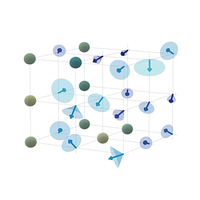
Relaxor ferroelectrics exhibit exceptional dielectric and electromechanical properties, yet their microscopic origins remain elusive due to the interplay of hierarchical polar structures and chemical complexity. While models based on polar nanoregions or nanodomains offer valuable phenomenological insights, they often lack the first-principles predictive capability necessary for quantitatively describing functional properties such as piezoelectric coefficients. Here, we use large-scale molecular dynamics simulations, enabled by a universal first-principles-based machine-learning interatomic potential, to investigate atomic-scale polar dynamics in canonical Pb-, Bi-, and Ba-based relaxors. Across all systems, we uncover a universal dipolar nematic state, characterized by long-range orientational order of local polarizations without local alignment, challenging conventional polar-cluster-based paradigms. We introduce a universal order parameter, derived from the skewness of the distributions of the local polarization autocorrelation functions, that captures the thermal evolution of both lead-based and lead-free systems within a single master curve. This nematic order, and its robust structural memory under electric field cycling, underpins key relaxor phenomena, including diffuse phase transition, frequency-dependent dielectric dispersion, and reversible giant piezoelectricity. Our findings establish a unified microscopic framework for relaxors and present a broadly applicable statistical approach to understanding complex disordered materials.
Physics Subject Headings (PhySH)
Popular Summary
Ferroelectric materials change polarization in response to an electric field, with relaxor ferroelectrics being a specific class that is particularly useful for a range of technologies. We discovered a universal organizing principle that governs relaxor ferroelectrics, while also providing a powerful methodological example of how deep neural network-based universal interatomic potentials can uncover fundamental mechanisms across broad chemical spaces. We find a dipolar nematic state, characterized by long-range orientational order without local polar alignment, which marks a fundamental shift from the decades-old paradigm of polar nanoregions and nanodomains for explaining relaxor ferroelectrics. This establishes a unified framework for understanding these complex systems with diverse chemical compositions. Our framework provides a foundational basis for rational design of these functional materials, important for an array of applications from advanced energy technologies to sensing and diagnostics.
Article Text
Supplemental Material
References (61)
- S.-E. Park and T. R. Shrout, Ultrahigh strain and piezoelectric behavior in relaxor based ferroelectric single crystals, J. Appl. Phys. 82, 1804 (1997).
- S. Pandya, J. Wilbur, J. Kim, R. Gao, A. Dasgupta, C. Dames, and L. W. Martin, Pyroelectric energy conversion with large energy and power density in relaxor ferroelectric thin films, Nat. Mater. 17, 432 (2018).
- Z. Kutnjak, J. Petzelt, and R. Blinc, The giant electromechanical response in ferroelectric relaxors as a critical phenomenon, Nature (London) 441, 956 (2006).
- F. Li, B. Wang, X. Gao, D. Damjanovic, L.-Q. Chen, and S. Zhang, Ferroelectric materials toward next-generation electromechanical technologies, Science 389, eadn4926 (2025).
- F. Li, M. J. Cabral, B. Xu, Z. Cheng, E. C. Dickey, J. M. LeBeau, J. Wang, J. Luo, S. Taylor, W. Hackenberger, L. Bellaiche, Z. Xu, L.-Q. Chen, T. R. Shrout, and S. Zhang, Giant piezoelectricity of Sm-doped single crystals, Science 364, 264 (2019).
- T. Rojac, Piezoelectric response of disordered lead-based relaxor ferroelectrics, Commun. Mater. 4, 12 (2023).
- G. Burns and B. Scott, Index of refraction in ‘dirty’ displacive ferroelectrics, Solid State Commun. 13, 423 (1973).
- G. Burns and F. Dacol, Glassy polarization behavior in ferroelectric compounds and , Solid State Commun. 48, 853 (1983).
- H. Takenaka, I. Grinberg, S. Liu, and A. M. Rappe, Slush-like polar structures in single-crystal relaxors, Nature (London) 546, 391 (2017).
- J. Kim, A. Kumar, Y. Qi, H. Takenaka, P. J. Ryan, D. Meyers, J.-W. Kim, A. Fernandez, Z. Tian, A. M. Rappe, J. M. LeBeau, and L. W. Martin, Coupled polarization and nanodomain evolution underpins large electromechanical responses in relaxors, Nat. Phys. 18, 1502 (2022).
- V. Westphal, W. Kleemann, and M. D. Glinchuk, Diffuse phase transitions and random-field-induced domain states of the “relaxor” ferroelectric , Phys. Rev. Lett. 68, 847 (1992).
- D. Phelan, C. Stock, J. A. Rodriguez-Rivera, S. Chi, J. Leão, X. Long, Y. Xie, A. A. Bokov, Z.-G. Ye, P. Ganesh, and P. M. Gehring, Role of random electric fields in relaxors, Proc. Natl. Acad. Sci. U.S.A. 111, 1754 (2014).
- H. Fu and R. E. Cohen, Polarization rotation mechanism for ultrahigh electromechanical response in single-crystal piezoelectrics, Nature (London) 403, 281 (2000).
- B. Noheda, Structure and high-piezoelectricity in lead oxide solid solutions, Curr. Opin. Solid State Mater. Sci. 6, 27 (2002).
- Y. M. Jin, Y. U. Wang, A. G. Khachaturyan, J. F. Li, and D. Viehland, Adaptive ferroelectric states in systems with low domain wall energy: Tetragonal microdomains, J. Appl. Phys. 94, 3629 (2003).
- Y. M. Jin, Y. U. Wang, A. G. Khachaturyan, J. F. Li, and D. Viehland, Conformal miniaturization of domains with low domain-wall energy: Monoclinic ferroelectric states near the morphotropic phase boundaries, Phys. Rev. Lett. 91, 197601 (2003).
- J. Wu, J. Yang, Y.-J. Liu, D. Zhang, Y. Yang, Y. Zhang, L. Zhang, and S. Liu, Universal interatomic potential for perovskite oxides, Phys. Rev. B 108, L180104 (2023).
- F. Li, S. Zhang, T. Yang, Z. Xu, N. Zhang, G. Liu, J. Wang, J. Wang, Z. Cheng, Z.-G. Ye, J. Luo, T. R. Shrout, and L.-Q. Chen, The origin of ultrahigh piezoelectricity in relaxor-ferroelectric solid solution crystals, Nat. Commun. 7, 13807 (2016).
- M. Eremenko, V. Krayzman, A. Bosak, H. Y. Playford, K. W. Chapman, J. C. Woicik, B. Ravel, and I. Levin, Local atomic order and hierarchical polar nanoregions in a classical relaxor ferroelectric, Nat. Commun. 10, 2728 (2019).
- A. Kumar, J. N. Baker, P. C. Bowes, M. J. Cabral, S. Zhang, E. C. Dickey, D. L. Irving, and J. M. LeBeau, Atomic-resolution electron microscopy of nanoscale local structure in lead-based relaxor ferroelectrics, Nat. Mater. 20, 62 (2020).
- J. Kim, Y. Qi, A. Kumar, Y.-L. Tang, M. Xu, H. Takenaka, M. Zhu, Z. Tian, R. Ramesh, J. M. LeBeau, A. M. Rappe, and L. W. Martin, Size-driven phase evolution in ultrathin relaxor films, Nat. Nanotechnol. 20, 478 (2025).
- S. Zhang, J. Luo, W. Hackenberger, and T. R. Shrout, Characterization of ferroelectric crystal with enhanced phase transition temperatures, J. Appl. Phys. 104, 064106 (2008).
- X. Liu, S. Zhang, J. Luo, T. R. Shrout, and W. Cao, Complete set of material constants of single crystal with morphotropic phase boundary composition, J. Appl. Phys. 106, 074112 (2009).
- Q. Li, S. Danilkin, G. Deng, Z. Li, R. L. Withers, Z. Xu, and Y. Liu, Soft phonon modes and diffuse scattering in relaxor ferroelectrics, J. Mater. 4, 345 (2018).
- A. Bosak, D. Chernyshov, S. Vakhrushev, and M. Krisch, Diffuse scattering in relaxor ferroelectrics: True three-dimensional mapping, experimental artefacts and modelling, Acta Crystallogr. Sect. A 68, 117 (2011).
- M. J. Krogstad, P. M. Gehring, S. Rosenkranz, R. Osborn, F. Ye, Y. Liu, J. P. C. Ruff, W. Chen, J. M. Wozniak, H. Luo, O. Chmaissem, Z.-G. Ye, and D. Phelan, The relation of local order to material properties in relaxor ferroelectrics, Nat. Mater. 17, 718 (2018).
- See Supplemental Material at http://link.aps.org/supplemental/10.1103/1p6v-lgv7 for diffuse scattering from MD simulations, Born effective charge calculations, and ensemble polarization sphere, which includes Refs. [28–32].
- P. M. Gehring, S.-E. Park, and G. Shirane, Soft phonon anomalies in the relaxor ferroelectric , Phys. Rev. Lett. 84, 5216 (2000).
- P. M. Gehring, S.-E. Park, and G. Shirane, Dynamical effects of the nanometer-sized polarized domains in , Phys. Rev. B 63, 224109 (2001).
- G. Kresse and J. Furthmüller, Efficient iterative schemes for ab initio total-energy calculations using a plane-wave basis set, Phys. Rev. B 54, 11169 (1996).
- G. Kresse and J. Furthmüller, Efficiency of ab-initio total energy calculations for metals and semiconductors using a plane-wave basis set, Comput. Mater. Sci. 6, 15 (1996).
- J. P. Perdew, A. Ruzsinszky, G. I. Csonka, O. A. Vydrov, G. E. Scuseria, L. A. Constantin, X. Zhou, and K. Burke, Restoring the density-gradient expansion for exchange in solids and surfaces, Phys. Rev. Lett. 100, 136406 (2008).
- Y. Chetverikov, A. Naberezhnov, S. Vakhrushev, B. Dorner, and A. Ivanov, Inelastic and critical neutron scattering in the ergodic phase of the relaxor ferroelectric , Appl. Phys. A 74, s989 (2002).
- G. Xu, G. Shirane, J. R. D. Copley, and P. M. Gehring, Neutron elastic diffuse scattering study of , Phys. Rev. B 69, 064112 (2004).
- F.-H. Gong, Y.-T. Chen, K.-M. Luo, H.-L. Ge, T. Wang, Y.-L. Tang, J.-Q. Liu, Y.-J. Wang, Y.-L. Zhu, and X.-L. Ma, Decoupling the compositional fluctuation theory and polar nanoregions in relaxor ferroelectric films, Phys. Rev. Lett. 136, 046801 (2026).
- I.-C. Khoo, Liquid Crystals (John Wiley & Sons, New York, 2022).
- V. V. Shvartsman and D. C. Lupascu, Lead-free relaxor ferroelectrics, J. Am. Ceram. Soc. 95, 1 (2011).
- X. Zhou, G. Xue, H. Luo, C. R. Bowen, and D. Zhang, Phase structure and properties of sodium bismuth titanate lead-free piezoelectric ceramics, Prog. Mater. Sci. 122, 100836 (2021).
- K. Sakata and Y. Masuda, Ferroelectric and antiferroelectric properties of solid solution ceramics, Ferroelectrics 7, 347 (1974).
- Y. Hiruma, H. Nagata, and T. Takenaka, Thermal depoling process and piezoelectric properties of bismuth sodium titanate ceramics, J. Appl. Phys. 105, 084112 (2009).
- B. N. Rao, R. Datta, S. S. Chandrashekaran, D. K. Mishra, V. Sathe, A. Senyshyn, and R. Ranjan, Local structural disorder and its influence on the average global structure and polar properties in , Phys. Rev. B 88, 224103 (2013).
- I. P. Pronin, P. P. Syrnikov, V. A. Isupov, V. M. Egorov, and N. V. Zaitseva, Peculiarities of phase transitions in sodium-bismuth titanate, Ferroelectrics 25, 395 (1980).
- T. Takenaka, K.-i. M. Kei-ichi Maruyama, and K. S. Koichiro Sakata, system for lead-free piezoelectric ceramics, Jpn. J. Appl. Phys. 30, 2236 (1991).
- C.-S. Tu, I. G. Siny, and V. H. Schmidt, Sequence of dielectric anomalies and high-temperature relaxation behavior in , Phys. Rev. B 49, 11550 (1994).
- J. Suchanicz, K. Roleder, A. Kania, and J. Hańaderek, Electrostrictive strain and pyroeffect in the region of phase coexistence in , Ferroelectrics 77, 107 (1988).
- J. Suchanicz and J. Kwapulinski, X-ray diffraction study of the phase transitions in , Ferroelectrics 165, 249 (1995).
- B. N. Rao, A. N. Fitch, and R. Ranjan, Ferroelectric-ferroelectric phase coexistence in , Phys. Rev. B 87, 060102(R) (2013).
- D. Zhang, H. Bi, F.-Z. Dai, W. Jiang, X. Liu, L. Zhang, and H. Wang, Pretraining of attention-based deep learning potential model for molecular simulation, npj Comput. Mater. 10, 94 (2024).
- Y. Zhang, H. Wang, W. Chen, J. Zeng, L. Zhang, H. Wang, and W. E, DP-GEN: A concurrent learning platform for the generation of reliable deep learning based potential energy models, Comput. Phys. Commun. 253, 107206 (2020).
- J. Wu, J. Yang, L. Ma, L. Zhang, and S. Liu, Modular development of deep potential for complex solid solutions, Phys. Rev. B 107, 144102 (2023).
- S. Plimpton, Fast parallel algorithms for short-range molecular synamics, J. Comput. Phys. 117, 1 (1995).
- https://github.com/MoseyQAQ/ferrodispcalc.
- S. Liu and R. E. Cohen, Origin of stationary domain wall enhanced ferroelectric susceptibility, Phys. Rev. B 95, 094102 (2017).
- S. Boresch, P. Höchtl, and O. Steinhauser, Studying the dielectric properties of a protein solution by computer simulation, J. Phys. Chem. B 104, 8743 (2000).
- I. Ponomareva, L. Bellaiche, and R. Resta, Dielectric anomalies in ferroelectric nanostructures, Phys. Rev. Lett. 99, 227601 (2007).
- I. Ponomareva, L. Bellaiche, and R. Resta, Relation between dielectric responses and polarization fluctuations in ferroelectric nanostructures, Phys. Rev. B 76, 235403 (2007).
- I. Ponomareva, L. Bellaiche, T. Ostapchuk, J. Hlinka, and J. Petzelt, Terahertz dielectric response of cubic , Phys. Rev. B 77, 012102 (2008).
- G. L. Squires, Introduction to the Theory of Thermal Neutron Scattering, 3rd ed. (Cambridge University Press, Cambridge, England, 2012), 10.1017/CBO9781139107808.
- N. J. Weadock, T. C. Sterling, J. A. Vigil, A. Gold-Parker, I. C. Smith, B. Ahammed, M. J. Krogstad, F. Ye, D. Voneshen, P. M. Gehring et al., The nature of dynamic local order in and , Joule 7, 1051 (2023).
- V. F. Sears, Neutron scattering lengths and cross sections, Neutron News 3, 26 (1992).
- T. C. Sterling, pynamic-structure-factor (2023), https://github.com/tyst3273/pynamic-structure-factor.

