Browse by Subject

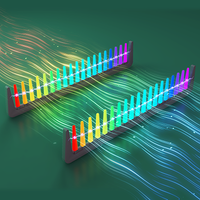
Characterization of Drive-Induced Unwanted State Transitions in Superconducting Circuits

W. Dai, S. Hazra, D. K. Weiss, P. D. Kurilovich, T. Connolly, H. K. Babla, S. Singh, V. R. Joshi, A. Z. Ding, P. D. Parakh, J. Venkatraman, X. Xiao, L. Frunzio, and M. H. Devoret

Phys. Rev. X 16, 011011 (2026) - Published 15 January, 2026

A systematic framework is developed to identify and categorize three distinct mechanisms of drive-induced unwanted state transitions in superconducting circuits, enabling predictable mitigation of errors to advance high-fidelity quantum operations.

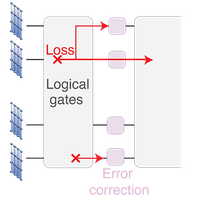
Leveraging Qubit Loss Detection in Fault-Tolerant Quantum Algorithms

Gefen Baranes, Madelyn Cain, J. Pablo Bonilla Ataides, Dolev Bluvstein, Josiah Sinclair, Vladan Vuletić, Hengyun Zhou, and Mikhail D. Lukin

Phys. Rev. X 16, 011002 (2026) - Published 2 January, 2026

Many quantum algorithms naturally detect and tolerate qubit loss. Combining them with a delayed-erasure decoding method that corrects missing qubits offers a simpler path toward scalable, fault-tolerant quantum computing.

Quantum-Secure Multiparty Deep Learning

Kfir Sulimany, Sri Krishna Vadlamani, Ryan Hamerly, Prahlad Iyengar, and Dirk Englund

Phys. Rev. X 15, 041056 (2025) - Published 24 December, 2025

A quantum-secure deep learning protocol lets multiple parties harness AI without exposing proprietary data or models.

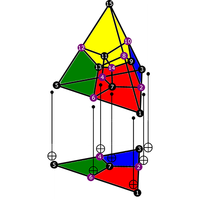
Rigorous Lower Bound on Dynamical Exponents in Gapless Frustration-Free Systems

Rintaro Masaoka, Tomohiro Soejima (副島智大), and Haruki Watanabe

Phys. Rev. X 15, 041050 (2025) - Published 16 December, 2025

A universal lower bound for the dynamical exponent in frustration-free systems is proven, showing that these systems can not host emergent Lorentz invariance.

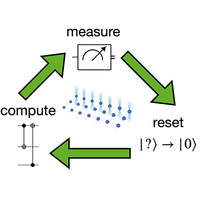
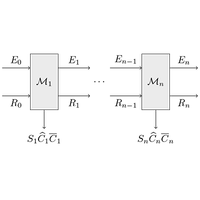
Repeated Ancilla Reuse for Logical Computation on a Neutral Atom Quantum Computer

J. A. Muniz et al.

Phys. Rev. X 15, 041040 (2025) - Published 4 December, 2025

A neutral-atom quantum computing system that can repeatedly measure, reuse, and replace ancilla qubits without disrupting others enables longer computations and advances scalable, fault-tolerant operation.

Splitting and Connecting Singlets in Atomic Quantum Circuits

Zijie Zhu, Yann Kiefer, Samuel Jele, Marius Gächter, Giacomo Bisson, Konrad Viebahn, and Tilman Esslinger

Phys. Rev. X 15, 041032 (2025) - Published 18 November, 2025

Neutral-atom qubits in optical lattices can be linked over long distances using topological pumping, robustly moving entangled atoms in their own “quantum lanes” to enable scalable, programmable quantum circuits.

Letting the Tiger out of Its Cage: Bosonic Coding without Concatenation

Yijia Xu (许逸葭), Yixu Wang (王亦许), Christophe Vuillot, and Victor V. Albert

Phys. Rev. X 15, 041025 (2025) - Published 10 November, 2025

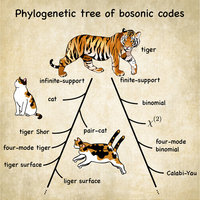
Tiger codes provide a unified framework for designing quantum error-correcting codes directly in harmonic oscillators, using integer-based homology to exploit their full structure and enable scalable quantum information processing.

Universality Classes for Purification in Nonunitary Quantum Processes

Andrea De Luca, Chunxiao Liu, Adam Nahum, and Tianci Zhou

Phys. Rev. X 15, 041024 (2025) - Published 7 November, 2025

Rare measurements in quantum systems cause a slow purification process. Mapping this process to a 1D dilute gas reveals a universal scaling law for how entropy and uncertainty decrease over time.

Demonstration of Two-Dimensional Connectivity for a Scalable Error-Corrected Ion-Trap Quantum Processor Architecture

M. Valentini, M. W. van Mourik, F. Butt, J. Wahl, M. Dietl, M. Pfeifer, F. Anmasser, Y. Colombe, C. Rössler, P. C. Holz, R. Blatt, A. Bermudez, M. Müller, T. Monz, and P. Schindler

Phys. Rev. X 15, 041023 (2025) - Published 6 November, 2025

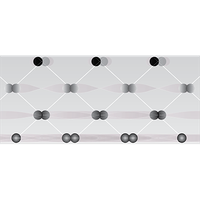
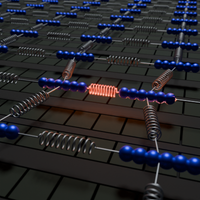
A two-dimensional trapped-ion architecture called the quantum spring array offers a novel method for hosting a large quantum computer.

Spin Squeezing with Itinerant Magnetic Dipoles

Alec Douglas, Vassilios Kaxiras, Lin Su, Michal Szurek, Vikram Singh, Ognjen Marković, and Markus Greiner

Phys. Rev. X 15, 041021 (2025) - Published 5 November, 2025

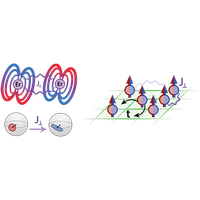
Quantum sensors can surpass their current limits by using entanglement. A method to create entangled states with fermionic erbium atoms reduces measurement noise fivefold while opening paths to advanced sensing and fundamental physics tests.

A Polynomial-Time Classical Algorithm for Noisy Quantum Circuits

Thomas Schuster, Chao Yin, Xun Gao, and Norman Y. Yao

Phys. Rev. X 15, 041018 (2025) - Published 3 November, 2025

A new classical algorithm shows that noise restricts non-error-corrected quantum computational power more generally than previously recognized.

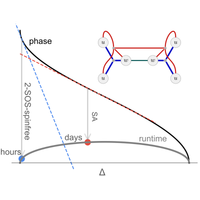
Fast Quantum Simulation of Electronic Structure by Spectral Amplification

Guang Hao Low, Robbie King, Dominic W. Berry, Qiushi Han, A. Eugene DePrince, III, Alec F. White, Ryan Babbush, Rolando D. Somma, and Nicholas C. Rubin

Phys. Rev. X 15, 041016 (2025) - Published 31 October, 2025

A new quantum algorithm framework reduces gate counts for ground-state energy estimation in molecular simulations by combining spectral amplification, sum-of-squares Hamiltonian representations, and integral compression.

Generalized Rényi Entropy Accumulation Theorem and Generalized Quantum Probability Estimation

Amir Arqand, Thomas A. Hahn, and Ernest Y.-Z. Tan

Phys. Rev. X 15, 041013 (2025) - Published 28 October, 2025

A unified framework combining entropy accumulation and quantum probability estimation provides tight, practical bounds on certified randomness generation, paving the way for simpler and stronger security analyses in quantum cryptography.

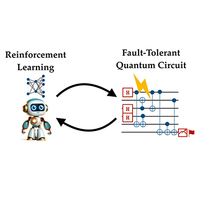
Quantum Circuit Discovery for Fault-Tolerant Logical State Preparation with Reinforcement Learning

Remmy Zen, Jan Olle, Luis Colmenarez, Matteo Puviani, Markus Müller, and Florian Marquardt

Phys. Rev. X 15, 041012 (2025) - Published 22 October, 2025

Using reinforcement learning to design fault-tolerant quantum circuits leads to efficient logical state preparation schemes with fewer gates and flag qubits than human-designed methods, advancing quantum error correction.

Clustering of Conditional Mutual Information and Quantum Markov Structure at Arbitrary Temperatures

Tomotaka Kuwahara

Phys. Rev. X 15, 041010 (2025) - Published 16 October, 2025

Quantum systems at equilibrium are more localized than previously thought when looked at through the lens of conditional mutual information, a key way of measuring three-part correlations.

Entangled Dual-Comb Spectroscopy

Abdulkarim Hariri, Shuai Liu, Haowei Shi, Quntao Zhuang, Xudong Fan, and Zheshen Zhang

Phys. Rev. X 15, 041009 (2025) - Published 15 October, 2025

Entangled dual-comb spectroscopy combines a classical comb with an entangled quantum comb to suppress photon noise, achieving faster, more precise measurements than classical methods and enabling advanced sensing and metrology applications.

Experimental Demonstration of High-Fidelity Logical Magic States from Code Switching

Lucas Daguerre, Robin Blume-Kohout, Natalie C. Brown, David Hayes, and Isaac H. Kim

Phys. Rev. X 15, 041008 (2025) - Published 14 October, 2025

A new trapped-ion experiment creates the most reliable “magic state” yet, protecting the state from environmental noise using minimal overhead and advancing practical quantum computing.

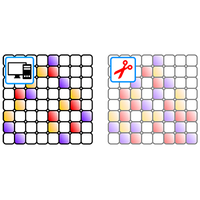
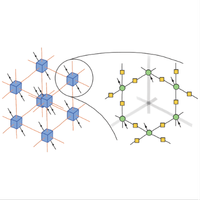
Tensor Networks for Noninvertible Symmetries in 3+1D and Beyond

Pranay Gorantla, Shu-Heng Shao, and Nathanan Tantivasadakarn

Phys. Rev. X 15, 041006 (2025) - Published 8 October, 2025

Relying on tensor networks and ZX-calculus, a visual framework for studying noninvertible symmetries in quantum systems reveals how these novel transformations constrain ground states and reshape our understanding of dualities.

Heralded Entanglement of On-Demand Spin-Wave Solid-State Quantum Memories for Multiplexed Quantum Network Links

Jonathan Hänni, Alberto E. Rodríguez-Moldes, Félicien Appas, Soeren Wengerowsky, Dario Lago-Rivera, Markus Teller, Samuele Grandi, and Hugues de Riedmatten

Phys. Rev. X 15, 041003 (2025) - Published 3 October, 2025

Heralded entanglement between two solid-state quantum memories with on-demand retrieval and temporal multimodality demonstrates a crucial building block for scalable quantum repeaters and long-distance quantum networks.

Sensing and Control of Single Trapped Electrons above 1 K

K. E. Castoria, N. R. Beysengulov, G. Koolstra, H. Byeon, E. O. Glen, M. Sammon, S. A. Lyon, J. Pollanen, and D. G. Rees

Phys. Rev. X 15, 041002 (2025) - Published 2 October, 2025

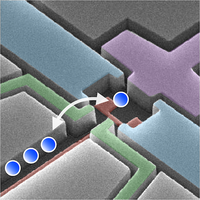
A microchannel quantum dot integrated with a superconducting resonator allows for the precision trapping and detection of single electrons on superfluid helium above 1 K, demonstrating control in conditions suited for scalable quantum processors.

Sign In to Your Journals Account

Filter

Filter

Article Lookup

Enter a citation