

- Open Access
Demonstration of Two-Dimensional Connectivity for a Scalable Error-Corrected Ion-Trap Quantum Processor Architecture
Phys. Rev. X 15, 041023 – Published 6 November, 2025
DOI: https://doi.org/10.1103/b9s1-6r44
Abstract
A major hurdle for building a large-scale quantum computer is increasing the number of qubits while maintaining connectivity between them. In trapped-ion devices, this connectivity can be achieved by moving subregisters consisting of a few ions across the processor. Here, we focus on an architecture, which we refer to as the quantum spring array (QSA), that is based on a rectangular two-dimensional lattice of linear strings of ions. Connectivity between adjacent ion strings can be controlled by adjusting their separation. This requires control of trapping potentials along two directions, one along the axis of the ion string and one radial to it. In this work, we investigate key elements of the QSA architecture along both directions: We show that the coupling rate between neighboring lattice sites increases with the number of ions per site and the motion of the coupled system can be resilient to electrical noise, both being key requisites for fast and high-fidelity quantum gate operations. The coherence of the coupling is assessed and an entangling gate between qubits stored in radially separated trapping regions is demonstrated. Moreover, we demonstrate control over radio-frequency signals to adjust the radial separation, and thus the coupling rate, between strings. We further present constructions for the implementation of parallelized, transversal gate operations, and map the QSA architecture to code primitives for fault-tolerant quantum error correction, providing a step towards a quantum processor architecture that is optimized for large-scale operation.
Physics Subject Headings (PhySH)
Popular Summary
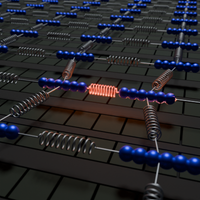
Quantum computers hold the potential to solve problems that are far beyond the reach of even the fastest classical supercomputers. Among the various hardware platforms, trapped ions have emerged as one of the most promising technologies, successfully demonstrating small- to medium-scale quantum processors. However, scaling up these systems has been challenging: In existing trap architectures, which are one dimensional, dividing a large group of ions into smaller subregisters introduces significant complexity when the subregisters need to interact. To overcome this, we introduce a 2D ion-trap architecture called the quantum spring array, which arranges ion subregisters in a lattice to reduce this communication overhead.
In our work, we demonstrate the key components required for such a 2D trapped-ion quantum computer. We show that ions can be reliably transported along both directions of the lattice, and we characterize how ions in different subregisters interact. Using this interaction, we successfully create and verify entanglement—a quantum link essential for computation—between two distinct subregisters through universal quantum operations.
These results show that our architecture can maintain high control and low error rates while offering a promising path toward large quantum computers. The next steps will focus on improving the efficiency of ion transport and entangling operations, as well as integrating optical and electronic control components directly into the trapping structure.
Article Text
References (92)
- D. Kielpinski, C. Monroe, and D. J. Wineland, Architecture for a large-scale ion-trap quantum computer, Nature (London) 417, 709 (2002).
- J. M. Pino, J. M. Dreiling, C. Figgatt, J. P. Gaebler, S. A. Moses, M. S. Allman, C. H. Baldwin, M. Foss-Feig, D. Hayes, K. Mayer, C. Ryan-Anderson, and B. Neyenhuis, Demonstration of the trapped-ion quantum CCD computer architecture, Nature (London) 592, 209 (2021).
- M. Palmero, S. Martínez-Garaot, U. G. Poschinger, A. Ruschhaupt, and J. G. Muga, Fast separation of two trapped ions, New J. Phys. 17, 093031 (2015).
- H. Kaufmann, T. Ruster, C. T. Schmiegelow, F. Schmidt-Kaler, and U. G. Poschinger, Dynamics and control of fast ion crystal splitting in segmented Paul traps, New J. Phys. 16, 073012 (2014).
- M. W. van Mourik, E. A. Martinez, L. Gerster, P. Hrmo, T. Monz, P. Schindler, and R. Blatt, Coherent rotations of qubits within a surface ion-trap quantum computer, Phys. Rev. A 102, 022611 (2020).
- H. Kaufmann, T. Ruster, C. T. Schmiegelow, M. A. Luda, V. Kaushal, J. Schulz, D. von Lindenfels, F. Schmidt-Kaler, and U. G. Poschinger, Fast ion swapping for quantum-information processing, Phys. Rev. A 95, 052319 (2017).
- K. Wright, J. M. Amini, D. L. Faircloth, C. Volin, S. Charles Doret, H. Hayden, C. S. Pai, D. W. Landgren, D. Denison, T. Killian, R. E. Slusher, and A. W. Harter, Reliable transport through a microfabricated X-junction surface-electrode ion trap, New J. Phys. 15, 033004 (2013).
- G. Shu, G. Vittorini, A. Buikema, C. S. Nichols, C. Volin, D. Stick, and K. R. Brown, Heating rates and ion-motion control in a -junction surface-electrode trap, Phys. Rev. A 89, 062308 (2014).
- W. C. Burton, B. Estey, I. M. Hoffman, A. R. Perry, C. Volin, and G. Price, Transport of multispecies ion crystals through a junction in a radio-frequency Paul trap, Phys. Rev. Lett. 130, 173202 (2023).
- J. H. Wesenberg, Ideal intersections for radio-frequency trap networks, Phys. Rev. A 79, 013416 (2009).
- S. A. Moses et al., A race-track trapped-ion quantum processor, Phys. Rev. X 13, 041052 (2023).
- P. C. Holz, S. Auchter, G. Stocker, M. Valentini, K. Lakhmanskiy, C. Rössler, P. Stampfer, S. Sgouridis, E. Aschauer, Y. Colombe, and R. Blatt, 2d linear trap array for quantum information processing, Adv. Quantum Technol. 3, 2000031 (2020).
- S. Jain, J. Alonso, M. Grau, and J. P. Home, Scalable arrays of micro-Penning traps for quantum computing and simulation, Phys. Rev. X 10, 031027 (2020).
- M. Mielenz, H. Kalis, M. Wittemer, F. Hakelberg, U. Warring, R. Schmied, M. Blain, P. Maunz, D. L. Moehring, D. Leibfried, and T. Schaetz, Arrays of individually controlled ions suitable for two-dimensional quantum simulations, Nat. Commun. 7, ncomms11839 (2016).
- D. Palani, F. Hasse, P. Kiefer, F. Boeckling, J.-P. Schroeder, U. Warring, and T. Schaetz, High-fidelity transport of trapped-ion qubits in a multilayer array, Phys. Rev. A 107, L050601 (2023).
- R. Schmied, J. H. Wesenberg, and D. Leibfried, Optimal surface-electrode trap lattices for quantum simulation with trapped ions, Phys. Rev. Lett. 102, 233002 (2009).
- F. Hakelberg, P. Kiefer, M. Wittemer, U. Warring, and T. Schaetz, Interference in a prototype of a two-dimensional ion trap array quantum simulator, Phys. Rev. Lett. 123, 100504 (2019).
- M. Harlander, R. Lechner, M. Brownnutt, R. Blatt, and W. Hänsel, Trapped-ion antennae for the transmission of quantum information, Nature (London) 471, 200 (2011).
- K. R. Brown, C. Ospelkaus, Y. Colombe, A. C. Wilson, D. Leibfried, and D. J. Wineland, Coupled quantized mechanical oscillators, Nature (London) 471, 196 (2011).
- A. C. Wilson, Y. Colombe, K. R. Brown, E. Knill, D. Leibfried, and D. J. Wineland, Tunable spin-spin interactions and entanglement of ions in separate potential wells, Nature (London) 512, 57 (2014).
- R. Blatt and D. Wineland, Entangled states of trapped atomic ions, Nature (London) 453, 1008 (2008).
- C. Monroe and J. Kim, Scaling the ion trap quantum processor, Science 339, 1164 (2013).
- D. J. Berkeland, J. D. Miller, J. C. Bergquist, W. M. Itano, and D. J. Wineland, Minimization of ion micromotion in a Paul trap, J. Appl. Phys. 83, 5025 (1998).
- R. G. DeVoe, J. Hoffnagle, and R. G. Brewer, Role of laser damping in trapped ion crystals, Phys. Rev. A 39, 4362 (1989).
- M. Brownnutt, M. Kumph, P. Rabl, and R. Blatt, Ion-trap measurements of electric-field noise near surfaces, Rev. Mod. Phys. 87, 1419 (2015).
- D. T. C. Allcock, L. Guidoni, T. P. Harty, C. J. Ballance, M. G. Blain, A. M. Steane, and D. M. Lucas, Reduction of heating rate in a microfabricated ion trap by pulsed-laser cleaning, New J. Phys. 13, 123023 (2011).
- R. Dubessy, T. Coudreau, and L. Guidoni, Electric field noise above surfaces: A model for heating-rate scaling law in ion traps, Phys. Rev. A 80, 031402(R) (2009).
- Q. A. Turchette, D. Kielpinski, B. E. King, D. Leibfried, D. M. Meekhof, C. J. Myatt, M. A. Rowe, C. A. Sackett, C. S. Wood, W. M. Itano, C. Monroe, and D. J. Wineland, Heating of trapped ions from the quantum ground state, Phys. Rev. A 61, 063418 (2000).
- M. Teller, D. A. Fioretto, P. C. Holz, P. Schindler, V. Messerer, K. Schüppert, Y. Zou, R. Blatt, J. Chiaverini, J. Sage, and T. E. Northup, Heating of a trapped ion induced by dielectric materials, Phys. Rev. Lett. 126, 230505 (2021).
- D. Kalincev, L. S. Dreissen, A. P. Kulosa, C. H. Yeh, H. A. Fürst, and T. E. Mehlstaubler, Motional heating of spatially extended ion crystals, Quantum Sci. Technol. 6, 034003 (2021).
- J. Welzel, A. Bautista-Salvador, C. Abarbanel, V. Wineman-Fisher, C. Wunderlich, R. Folman, and F. Schmidt-Kaler, Designing spin-spin interactions with one and two dimensional ion crystals in planar micro traps, Eur. Phys. J. D 65, 285 (2011).
- U. Tanaka, K. Suzuki, Y. Ibaraki, and S. Urabe, Design of a surface electrode trap for parallel ion strings, J. Phys. B 47, 035301 (2014).
- U. Tanaka, M. Nakamura, K. Hayasaka, A. Bautista-Salvador, C. Ospelkaus, and T. E. Mehlstäubler, Creation of double-well potentials in a surface-electrode trap towards a nanofriction model emulator, Quantum Sci. Technol. 6, 024010 (2021).
- W. M. Itano, J. C. Bergquist, J. J. Bollinger, J. M. Gilligan, D. J. Heinzen, F. L. Moore, M. G. Raizen, and D. J. Wineland, Quantum projection noise: Population fluctuations in two-level systems, Phys. Rev. A 47, 3554 (1993).
- P. O. Schmidt, T. Rosenband, C. Langer, W. M. Itano, J. C. Bergquist, and D. J. Wineland, Spectroscopy using quantum logic, Science 309, 749 (2005).
- F. Wolf, Y. Wan, J. C. Heip, F. Gebert, C. Shi, and P. O. Schmidt, Non-destructive state detection for quantum logic spectroscopy of molecular ions, Nature (London) 530, 457 (2016).
- M. Guggemos, M. Guevara-Bertsch, D. Heinrich, O. A. Herrera-Sancho, Y. Colombe, R. Blatt, and C. F. Roos, Frequency measurement of the transition of via quantum logic spectroscopy with , New J. Phys. 21, 103003 (2019).
- A. Sørensen and K. Mølmer, Quantum computation with ions in thermal motion, Phys. Rev. Lett. 82, 1971 (1999).
- A. R. Milne, C. L. Edmunds, C. Hempel, F. Roy, S. Mavadia, and M. J. Biercuk, Phase-modulated entangling gates robust to static and time-varying errors, Phys. Rev. Appl. 13, 024022 (2020).
- T. Choi, S. Debnath, T. A. Manning, C. Figgatt, Z.-X. Gong, L.-M. Duan, and C. Monroe, Optimal quantum control of multimode couplings between trapped ion qubits for scalable entanglement, Phys. Rev. Lett. 112, 190502 (2014).
- T. J. Green and M. J. Biercuk, Phase-modulated decoupling and error suppression in qubit-oscillator systems, Phys. Rev. Lett. 114, 120502 (2015).
- Y. Lu, S. Zhang, K. Zhang, W. Chen, Y. Shen, J. Zhang, J.-N. Zhang, and K. Kim, Global entangling gates on arbitrary ion qubits, Nature (London) 572, 363 (2019).
- K. A. Landsman, Y. Wu, P. H. Leung, D. Zhu, N. M. Linke, K. R. Brown, L. Duan, and C. Monroe, Two-qubit entangling gates within arbitrarily long chains of trapped ions, Phys. Rev. A 100, 022332 (2019).
- C. A. Sackett, D. Kielpinski, B. E. King, C. Langer, V. Meyer, C. J. Myatt, M. Rowe, Q. A. Turchette, W. M. Itano, D. J. Wineland, and C. Monroe, Experimental entanglement of four particles, Nature (London) 404, 256 (2000).
- D. F. V. James, Quantum dynamics of cold trapped ions with application to quantum computation, Appl. Phys. B 66, 181 (1998).
- M. Knoop, in Physics with Trapped Charged Particles (Imperial College Press, London, 2014), pp. 25–42.
- E. Knill, R. Laflamme, and W. H. Zurek, Resilient quantum computation, Science 279, 342 (1998).
- P. Aliferis, D. Gottesman, and J. Preskill, Quantum accuracy threshold for concatenated distance-3 codes, Quantum Inf. Comput. 6, 97 (2006).
- D. Gottesman, Stabilizer codes and quantum error correction, Ph.D. thesis, California Institute of Technology, 1997.
- B. M. Terhal, Quantum error correction for quantum memories, Rev. Mod. Phys. 87, 307 (2015).
- A. Bermudez, J. Almeida, F. Schmidt-Kaler, A. Retzker, and M. B. Plenio, Frustrated quantum spin models with cold Coulomb crystals, Phys. Rev. Lett. 107, 207209 (2011).
- A. Bermudez, J. Almeida, K. Ott, H. Kaufmann, S. Ulm, U. Poschinger, F. Schmidt-Kaler, A. Retzker, and M. Plenio, Quantum magnetism of spin-ladder compounds with trapped-ion crystals, New J. Phys. 14, 093042 (2012).
- D. Leibfried, B. DeMarco, V. Meyer, D. Lucas, M. Barrett, J. Britton, W. M. Itano, B. Jelenković, C. Langer, T. Rosenband, and D. J. Wineland, Experimental demonstration of a robust, high-fidelity geometric two ion-qubit phase gate, Nature (London) 422, 412 (2003).
- C. J. Ballance, T. P. Harty, N. M. Linke, M. A. Sepiol, and D. M. Lucas, High-fidelity quantum logic gates using trapped-ion hyperfine qubits, Phys. Rev. Lett. 117, 060504 (2016).
- B. C. Sawyer and K. R. Brown, Wavelength-insensitive, multispecies entangling gate for group-2 atomic ions, Phys. Rev. A 103, 022427 (2021).
- C. H. Baldwin, B. J. Bjork, M. Foss-Feig, J. P. Gaebler, D. Hayes, M. G. Kokish, C. Langer, J. A. Sedlacek, D. Stack, and G. Vittorini, High-fidelity light-shift gate for clock-state qubits, Phys. Rev. A 103, 012603 (2021).
- C. R. Clark, H. N. Tinkey, B. C. Sawyer, A. M. Meier, K. A. Burkhardt, C. M. Seck, C. M. Shappert, N. D. Guise, C. E. Volin, S. D. Fallek, H. T. Hayden, W. G. Rellergert, and K. R. Brown, High-fidelity Bell-state preparation with optical qubits, Phys. Rev. Lett. 127, 130505 (2021).
- G.-D. Lin, S.-L. Zhu, R. Islam, K. Kim, M.-S. Chang, S. Korenblit, C. Monroe, and L.-M. Duan, Large-scale quantum computation in an anharmonic linear ion trap, Europhys. Lett. 86, 60004 (2009).
- K. Khodjasteh and D. A. Lidar, Fault-tolerant quantum dynamical decoupling, Phys. Rev. Lett. 95, 180501 (2005).
- G. S. Uhrig, Concatenated control sequences based on optimized dynamic decoupling, Phys. Rev. Lett. 102, 120502 (2009).
- M. August and X. Ni, Using recurrent neural networks to optimize dynamical decoupling for quantum memory, Phys. Rev. A 95, 012335 (2017).
- Nicolas Andre da Costa Morazotti, A. H. da Silva, G. Audi, F. F. Fanchini, and R. J. Napolitano, Optimized continuous dynamical decoupling via differential geometry and machine learning, Phys. Rev. A 110, 042601 (2024).
- I. Pogorelov, T. Feldker, C. D. Marciniak, L. Postler, G. Jacob, O. Krieglsteiner, V. Podlesnic, M. Meth, V. Negnevitsky, M. Stadler, B. Höfer, C. Wächter, K. Lakhmanskiy, R. Blatt, P. Schindler, and T. Monz, Compact ion-trap quantum computing demonstrator, PRX Quantum 2, 020343 (2021).
- L. Postler, F. Butt, I. Pogorelov, C. D. Marciniak, S. Heußen, R. Blatt, P. Schindler, M. Rispler, M. Müller, and T. Monz, Demonstration of fault-tolerant Steane quantum error correction, PRX Quantum 5, 030326 (2024).
- L. Postler and S. Heußen, I. Pogorelov, M. Rispler, T. Feldker, M. Meth, C. D. Marciniak, R. Stricker, M. Ringbauer, R. Blatt, P. Schindler, M. Müller, and T. Monz, Demonstration of fault-tolerant universal quantum gate operations, Nature (London) 605, 675 (2022).
- C. Ryan-Anderson et al., Implementing fault-tolerant entangling gates on the five-qubit code and the color code, arXiv:2208.01863.
- D. Bluvstein et al., Logical quantum processor based on reconfigurable atom arrays, Nature (London) 626, 58 (2023).
- A. M. Steane, Active stabilization, quantum computation, and quantum state synthesis, Phys. Rev. Lett. 78, 2252 (1997).
- C. Chamberland, New methods in quantum error correction and fault-tolerant quantum computing, Ph.D. thesis, University of Waterloo, 2018.
- S. Huang, K. R. Brown, and M. Cetina, Comparing Shor and Steane error correction using the Bacon-Shor code, Sci. Adv. 10, eadp2008 (2024).
- M. Cain, C. Zhao, H. Zhou, N. Meister, J. P. B. Ataides, A. Jaffe, D. Bluvstein, and M. D. Lukin, Correlated decoding of logical algorithms with transversal gates, Phys. Rev. Lett. 133, 240602 (2024).
- N. Lacroix et al., Scaling and logic in the colour code on a superconducting quantum processor, Nature (London) 645, 614 (2025).
- P. Sales Rodriguez et al., Experimental demonstration of logical magic state distillation, Nature (London) 645, 620 (2025).
- C. Ryan-Anderson, N. Brown, C. Baldwin, J. Dreiling, C. Foltz, J. Gaebler, T. Gatterman, N. Hewitt, C. Holliman, C. Horst et al., High-fidelity teleportation of a logical qubit using transversal gates and lattice surgery, Science 385, 1327 (2024).
- B. Criger and B. Terhal, Noise thresholds for the [4,2,2]-concatenated toric code, Quantum Inf. Comput. 16, 1261 (2016).
- T. Jochym-O’Connor and R. Laflamme, Using concatenated quantum codes for universal fault-tolerant quantum gates, Phys. Rev. Lett. 112, 010505 (2014).
- C. Chamberland, T. Jochym-O’Connor, and R. Laflamme, Thresholds for universal concatenated quantum codes, Phys. Rev. Lett. 117, 010501 (2016).
- C. Chamberland, T. Jochym-O’Connor, and R. Laflamme, Overhead analysis of universal concatenated quantum codes, Phys. Rev. A 95, 022313 (2017).
- A. Y. Kitaev, Quantum computations: Algorithms and error correction, Russ. Math. Surv. 52, 1191 (1997).
- P. Aliferis and J. Preskill, Fault-tolerant quantum computation against biased noise, Phys. Rev. A 78, 052331 (2008).
- A. K. Pal, P. Schindler, A. Erhard, Á. Rivas, M.-A. Martin-Delgado, R. Blatt, T. Monz, and M. Müller, Relaxation times do not capture logical qubit dynamics, Quantum 6, 632 (2022).
- H. Bombin and M. A. Martin-Delgado, Topological quantum distillation, Phys. Rev. Lett. 97, 180501 (2006).
- D. Nigg, M. Müller, E. A. Martinez, P. Schindler, M. Hennrich, T. Monz, M. A. Martin-Delgado, and R. Blatt, Quantum computations on a topologically encoded qubit, Science 345, 302 (2014).
- H. Goto, Minimizing resource overheads for fault-tolerant preparation of encoded states of the Steane code, Sci. Rep. 6, 19578 (2016).
- C. Chamberland and A. W. Cross, Fault-tolerant magic state preparation with flag qubits, Quantum 3, 143 (2019).
- D. Gottesman, Fault-tolerant quantum computation with constant overhead, Quantum Inf. Comput. 14, 1338 (2014), https://dl.acm.org/doi/10.5555/2685179.2685184.
- N. P. Breuckmann and J. N. Eberhardt, Quantum low-density parity-check codes, PRX Quantum 2, 040101 (2021).
- A. Strikis and L. Berent, Quantum low-density parity-check codes for modular architectures, PRX Quantum 4, 020321 (2023).
- N. Berthusen, D. Devulapalli, E. Schoute, A. M. Childs, M. J. Gullans, A. V. Gorshkov, and D. Gottesman, Toward a 2D local implementation of quantum low-density parity-check codes, PRX Quantum 6, 010306 (2025).
- A. Sørensen and K. Mølmer, Entanglement and quantum computation with ions in thermal motion, Phys. Rev. A 62, 022311 (2000).
- M. Kang, Y. Wang, C. Fang, B. Zhang, O. Khosravani, J. Kim, and K. R. Brown, Designing filter functions of frequency-modulated pulses for high-fidelity two-qubit gates in ion chains, Phys. Rev. Appl. 19, 014014 (2023).
- F. Mintert and C. Wunderlich, Ion-trap quantum logic using long-wavelength radiation, Phys. Rev. Lett. 87, 257904 (2001).

