Browse by Subject

Passive Quantum Error Correction of Photon Loss at Breakeven

Shruti Shirol, Sean van Geldern, Hanzhe Xi, and Chen Wang

Phys. Rev. X 16, 021042 (2026) - Published 22 May, 2026

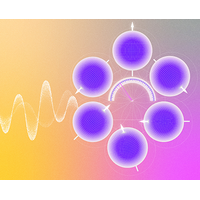
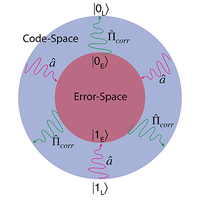
Researchers achieve passive quantum error correction at the “breakeven” point. Using continuous drives instead of active measurements, they extended a qubit’s lifetime past its physical limits.

High-Rate Discrete-Modulated Continuous-Variable Quantum Key Distribution with Composable Security

Mingze Wu, Yan Pan, Junhui Li, Heng Wang, Lu Fan, Yun Shao, Yang Li, Wei Huang, Song Yu, Bingjie Xu, and Yichen Zhang

Phys. Rev. X 16, 021039 (2026) - Published 20 May, 2026

Researchers achieve a high secret key rate for quantum communication over fiber optics. By combining advanced signal modulation with new security analysis tools, they have made highly secure, high-speed quantum networks closer to practical implementation.

Beyond Stellar Rank: Control Parameters for Scalable Optical Non-Gaussian State Generation

Fumiya Hanamura, Kan Takase, Hironari Nagayoshi, Ryuhoh Ide, Warit Asavanant, Kosuke Fukui, Petr Marek, Radim Filip, and Akira Furusawa

Phys. Rev. X 16, 021034 (2026) - Published 13 May, 2026

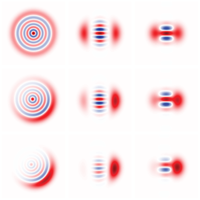
Researchers have introduced new non-Gaussian control parameters that allow for the systematic optimization of quantum light sources. This breakthrough can increase the success rate of generating essential quantum states by orders of magnitude.

Probing Excited-State Dynamics of Transmon Ionization

Zihao Wang, Benjamin D’Anjou, Philippe Gigon, Alexandre Blais, and Machiel S. Blok

Phys. Rev. X 16, 021033 (2026) - Published 12 May, 2026

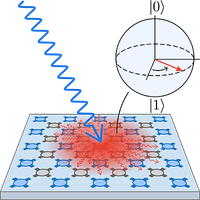
Researchers probe “transmon ionization,” revealing how qubits escape their computational states into highly excited states via multiphoton resonances. Understanding these Landau-Zener transitions is an important step toward developing better readout schemes.

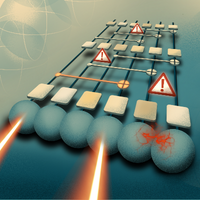
Scaling Laws of Quantum Information Lifetime in Monitored Quantum Dynamics

Bingzhi Zhang, Fangjun Hu, Runzhe Mo, Tianyang Chen, Hakan E. Türeci, and Quntao Zhuang

Phys. Rev. X 16, 021027 (2026) - Published 6 May, 2026

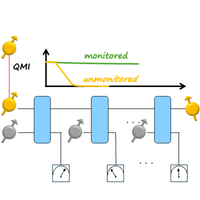
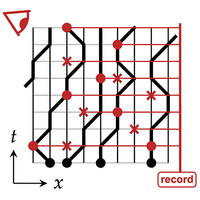
Researchers have discovered that recording data from midcircuit measurements can preserve quantum information for an exponentially long time. This finding offers a strategy to preserve fragile data and improve the performance of near-term quantum computers and algorithms.

Correlated Phase Error Bursts in a Gap-Engineered Superconducting Qubit Array

Vladislav D. Kurilovich, Gabrielle Roberts, Leigh S. Martin, Matt McEwen, Alec Eickbusch, Lara Faoro, Lev B. Ioffe, Juan Atalaya, Alexander Bilmes, John Mark Kreikebaum, Andreas Bengtsson, Paul Klimov, Matthew Neeley, Wojciech Mruczkiewicz, Kevin Miao, Igor L. Aleiner, Julian Kelly, Yu Chen, Kevin Satzinger, and Alex Opremcak

Phys. Rev. X 16, 021025 (2026) - Published 4 May, 2026

Ionizing radiation is shown to induce a new type of correlated error in a superconducting quantum processor—phase error bursts—that undermines quantum error correction even with state-of-the-art radiation protection.

Magic Tricycles: Efficient Magic-State Generation with Finite Block-Length Quantum LDPC Codes

Varun Menon, J. Pablo Bonilla Ataides, Rohan Mehta, Andi Gu, Daniel Bochen Tan, and Mikhail D. Lukin

Phys. Rev. X 16, 021014 (2026) - Published 15 April, 2026

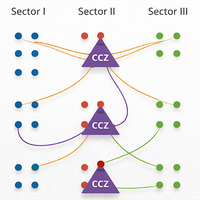
Quantum computing needs “magic states” for universality, but they are costly to make. New research introduces tricycle codes: high-rate QLDPC codes that can be used to generate CCZ magic states in constant depth with high noise resilience.

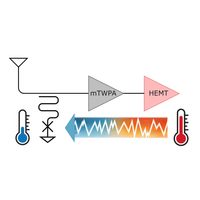
Traveling-Wave Parametric Amplifier with Passive Reverse Isolation

C. S. Kow and M. T. Bell

Phys. Rev. X 16, 021003 (2026) - Published 3 April, 2026

By integrating passive reverse isolation into a multistage architecture, a new traveling-wave parametric amplifier with near-quantum-limited performance protects sensitive qubits from thermal backaction, enabling a scalable isolator-free readout architecture for superconducting quantum computers.

Harnessing Quantum Backaction for Time-Series Processing

Giacomo Franceschetto, Marcin Płodzień, Maciej Lewenstein, Antonio Acín, and Pere Mujal

Phys. Rev. X 16, 021002 (2026) - Published 2 April, 2026

Tuning the strength of indirect measurements in quantum reservoir computing is shown to enhance memory and performance for processing time-series data, providing a way to turn quantum backaction into a resource.

Continuous Variable Measurement-Device-Independent Quantum Certification

B. L. Larsen, A. A. E. Hajomer, P. Abiuso, S. Izumi, T. Gehring, J. S. Neergaard-Nielsen, A. Acín, and U. L. Andersen

Phys. Rev. X 16, 011070 (2026) - Published 30 March, 2026

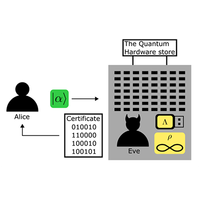
Researchers demonstrate a measurement-device-independent certification for continuous-variable systems. By using coherent states, they show that entanglement and memory can be verified even with untrusted hardware.

Scalable Photonic Quantum Interconnect Platform

Daniel Riedel, Teodoro Graziosi, Zhuoxian Wang, Chawina De-Eknamkul, Alex Abulnaga, Jonathan Dietz, Andrea Mucchietto, Michael Haas, Madison Sutula, Pierre Barral, Matteo Pompili, Mouktik Raha, Carsten Robens, Jeonghoon Ha, Denis Sukachev, David Levonian, Mihir Bhaskar, Matthew Markham, and Bartholomeus Machielse

Phys. Rev. X 16, 011063 (2026) - Published 24 March, 2026

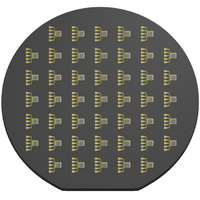
A wafer-scale platform integrating high-quality diamond membranes with functionalized silicon substrates enables the parallel fabrication of quantum memory arrays with near-unity yield, paving the way for the mass production of modular quantum interconnects.

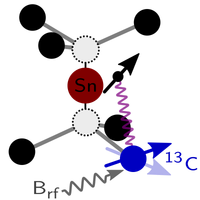
High-Fidelity Control of a C13 Nuclear Spin Coupled to a Tin-Vacancy Center in Diamond

Jeremias Resch, Ioannis Karapatzakis, Mohamed Elshorbagy, Marcel Schrodin, Philipp Fuchs, Philipp Graßhoff, Luis Kussi, Christoph Sürgers, Cyril Popov, Christoph Becher, Wolfgang Wernsdorfer, and David Hunger

Phys. Rev. X 16, 011060 (2026) - Published 19 March, 2026

High-fidelity control of a 13C nuclear spin coupled to a tin-vacancy center yields coherence times exceeding 1.35 s using a superconducting waveguide, highlighting the potential of the tin-vacancy center as a coherent spin-photon interface for future quantum network applications.

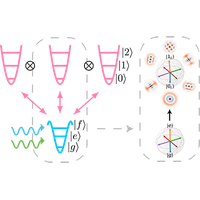
Fast Sideband Control of a Multimode Cavity Memory with Weak Dispersive Coupling to a Transmon

Jordan Huang, Thomas J. DiNapoli, Gavin Rockwood, Ming Yuan, Prathyankara Narasimhan, Eesh Gupta, Mustafa Bal, Francesco Crisa, Sabrina Garattoni, Yao Lu, Liang Jiang, and Srivatsan Chakram

Phys. Rev. X 16, 011058 (2026) - Published 17 March, 2026

Researchers use fast “sideband control” to swap quantum information between a processor and a superconducting-cavity memory far faster than traditional dispersive methods, even when the two are only weakly coupled. This enables robust encoding gates and reliable quantum storage in high-quality superconducting cavities.

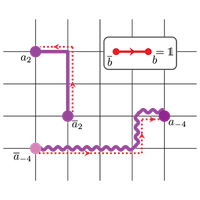
Topological Stabilizer Models on Continuous Variables

Julio C. Magdalena de la Fuente, Tyler D. Ellison, Meng Cheng, and Dominic J. Williamson

Phys. Rev. X 16, 011054 (2026) - Published 11 March, 2026

Researchers develop topological stabilizer codes that leverage infinite-dimensional local degrees of freedom. These codes realize quantum phases with universal properties that go beyond discrete variable stabilizer codes.

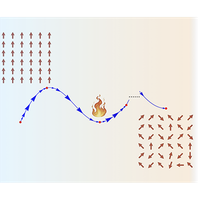
Floquet Thermalization via Instantons near Dynamical Freezing

Rohit Mukherjee, Haoyu Guo, and Debanjan Chowdhury

Phys. Rev. X 16, 011041 (2026) - Published 27 February, 2026

Researchers use flow renormalization to reveal that rare, sudden events called instantons puncture frozen states blocking the dynamics in periodically driven systems, triggering slow thermalization.

Stabilizer Rényi Entropy and Conformal Field Theory

Masahiro Hoshino, Masaki Oshikawa, and Yuto Ashida

Phys. Rev. X 16, 011037 (2026) - Published 25 February, 2026

Conformal field theory is used to uncover universal behaviors in nonstabilizerness. Like entanglement, this resource is governed by fundamental numbers such as the g factor.

Characterizing Physical and Logical Errors in a Transversal CNOT Gate via Cycle Error Reconstruction

Nicholas Fazio, Robert Freund, Debankan Sannamoth, Alex Steiner, Christian D. Marciniak, Manuel Rispler, Robin Harper, Thomas Monz, Joseph Emerson, and Stephen D. Bartlett

Phys. Rev. X 16, 011030 (2026) - Published 20 February, 2026

A scalable benchmarking framework using cycle error reconstruction is demonstrated to precisely identify and predict physical errors in a 14-qubit transversal ᴄɴᴏᴛ, enabling a clearer path to fault-tolerant quantum computing.

Reshaping the Quantum Arrow of Time

Luis Pedro García-Pintos, Yi-Kai Liu, and Alexey V. Gorshkov

Phys. Rev. X 16, 011028 (2026) - Published 19 February, 2026

A quantum control Hamiltonian is developed that can blur or even reverse the perceived arrow of time in monitored systems, enabling new ways to emulate backward-in-time dynamics and extract energy to power measurement-driven engines.

Monitored Fluctuating Hydrodynamics

Sarang Gopalakrishnan, Ewan McCulloch, and Romain Vasseur

Phys. Rev. X 16, 011024 (2026) - Published 12 February, 2026

A monitored fluctuating hydrodynamics framework is introduced to study what can be learned about classical many-body dynamics from partial data. It is found that classical stochastic processes undergo phase transitions in learnability, mirroring striking effects in quantum systems.

Powering Quantum Computation with Quantum Batteries

Yaniv Kurman, Kieran Hymas, Arkady Fedorov, William J. Munro, and James Quach

Phys. Rev. X 16, 011016 (2026) - Published 26 January, 2026

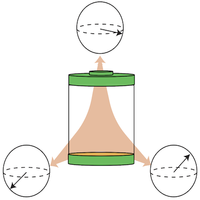
A framework is introduced to power universal quantum computation with internal quantum batteries, reducing heat load and wiring overhead to potentially increase qubit density fourfold.

Sign In to Your Journals Account

Filter

Filter

Article Lookup

Enter a citation