

- Open Access
Passive Quantum Error Correction of Photon Loss at Breakeven
Phys. Rev. X 16, 021042 – Published 22 May, 2026
DOI: https://doi.org/10.1103/nvbm-97vs
Abstract
Physical qubits in a quantum computer are often represented by superposition states of single particles or excitations. Decay of the excitation itself is a fundamental error channel that is difficult to overcome via external drive or control techniques. Quantum error correcting codes, which encode information in superpositions involving multiple excitations, provide a path to preserve information beyond the capacity of individual excitations, but typically require exquisite active operations on the system. Here, we demonstrate a steady-state driven-dissipative quantum system, composed of a superconducting cavity and a transmon ancilla, that preserves a logical qubit beyond the photon-lifetime limit by about 5% using a binomial encoding. This realization of continuous quantum error correction at the breakeven point highlights the quantitative competitiveness of passive correction strategies, while circumventing some demanding hardware requirements of its active counterparts.
Physics Subject Headings (PhySH)
Popular Summary
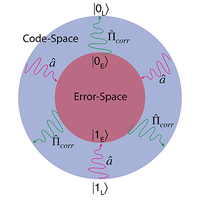
Overcoming the stochastic loss of elementary excitations, such as photon decay, is a fundamental requirement for building reliable quantum memories. We demonstrate a steady-state driven dissipative system that protects a logical qubit against single-photon loss using a binomial bosonic encoding. By engineering a continuous parity-recovery process via a three-level superconducting transmon ancilla, we achieve autonomous quantum error correction without the need for active measurement-based feedback. Our results show a logical coherence time which exceeds the intrinsic lifetime of individual photons, marking the first instance of continuous correction reaching the breakeven point. This approach provides a hardware-efficient alternative to active correction strategies by eliminating technically demanding high-fidelity readout and fast control requirements. Such passive stabilization techniques offer a competitive pathway for scaling quantum processors while extending information storage beyond the limits of physical hardware.
Article Text
References (59)
- N. Timoney, I. Baumgart, M. Johanning, A. Varón, A. Retzker, and C. Wunderlich, Quantum gates and memory using microwave-dressed states, Nature (London) 476, 185 (2011).
- X. Xu, Z. Wang, C. Duan, P. Huang, P. Wang, Y. Wang, N. Xu, X. Kong, F. Shi, X. Rong, and J. Du, Coherence-protected quantum gate by continuous dynamical decoupling in diamond, Phys. Rev. Lett. 109, 070502 (2012).
- Z. Leghtas, S. Touzard, I. M. Pop, A. Kou, B. Vlastakis, A. Petrenko, K. M. Sliwa, A. Narla, S. Shankar, M. J. Hatridge, M. Reagor, L. Frunzio, R. J. Schoelkopf, M. Mirrahimi, and M. H. Devoret, Confining the state of light to a quantum manifold by engineered two-photon loss, Science 347, 853 (2015).
- A. Grimm, N. E. Frattini, S. Puri, S. O. Mundhada, S. Touzard, M. Mirrahimi, S. M. Girvin, S. Shankar, and M. H. Devoret, Stabilization and operation of a Kerr-cat qubit, Nature (London) 584, 205 (2020).
- A. Laucht, R. Kalra, S. Simmons, J. P. Dehollain, J. T. Muhonen, F. A. Mohiyaddin, S. Freer, F. E. Hudson, K. M. Itoh, D. N. Jamieson et al., A dressed spin qubit in silicon, Nat. Nanotechnol. 12, 61 (2017).
- E. Paladino, Y. M. Galperin, G. Falci, and B. L. Altshuler, noise: Implications for solid-state quantum information, Rev. Mod. Phys. 86, 361 (2014).
- L. Viola and E. Knill, Robust dynamical decoupling of quantum systems with bounded controls, Phys. Rev. Lett. 90, 037901 (2003).
- F. Yan, S. Gustavsson, J. Bylander, X. Jin, F. Yoshihara, D. G. Cory, Y. Nakamura, T. P. Orlando, and W. D. Oliver, Rotating-frame relaxation as a noise spectrum analyser of a superconducting qubit under drive, Nat. Commun. 4, 2337 (2013).
- Z. Huang, P. S. Mundada, A. Gyenis, D. I. Schuster, A. A. Houck, and J. Koch, Engineering dynamical sweet spots to protect superconducting qubits from noise, Phys. Rev. Appl. 15, 034065 (2021).
- L. B. Nguyen, Y. Kim, A. Hashim, N. Goss, B. Marinelli, B. Bhandari, D. Das, R. K. Naik, J. M. Kreikebaum, A. N. Jordan et al., Programmable Heisenberg interactions between Floquet qubits, Nat. Phys. 20, 240 (2024).
- A. Hajr, B. Qing, K. Wang, G. Koolstra, Z. Pedramrazi, Z. Kang, L. Chen, L. B. Nguyen, C. Jünger, N. Goss et al., High-coherence Kerr-Cat qubit in 2D architecture, Phys. Rev. X 14, 041049 (2024).
- U. Réglade et al., Quantum control of a cat qubit with bit-flip times exceeding ten seconds, Nature (London) 629, 778 (2024).
- N. E. Frattini, R. G. Cortiñas, J. Venkatraman, X. Xiao, Q. Su, C. U. Lei, B. J. Chapman, V. R. Joshi, S. M. Girvin, R. J. Schoelkopf, S. Puri, and M. H. Devoret, Observation of pairwise level degeneracies and the quantum regime of the Arrhenius law in a double-well parametric oscillator, Phys. Rev. X 14, 031040 (2024).
- Y. Li, Q. Mei, Q.-X. Jie, W. Cai, Y. Li, Z. Liu, Z.-J. Chen, Z. Xie, X. Cheng, X. Zhao et al., Beating the break-even point with autonomous quantum error correction, arXiv:2504.16746.
- K. DeBry, N. Meister, A. V. Martinez, C. D. Bruzewicz, X. Shi, D. Reens, R. McConnell, I. L. Chuang, and J. Chiaverini, Error correction of a logical qubit encoded in a single atomic ion, arXiv:2503.13908.
- R. Acharya, D. A. Abanin, L. Aghababaie-Beni, I. Aleiner, T. I. Andersen, M. Ansmann, F. Arute, K. Arya, A. Asfaw, N. Astrakhantsev et al., Quantum error correction below the surface code threshold, Nature (London) 638, 920 (2024).
- S. Krinner, N. Lacroix, A. Remm, A. Di Paolo, E. Genois, C. Leroux, C. Hellings, S. Lazar, F. Swiadek, J. Herrmann et al., Realizing repeated quantum error correction in a distance-three surface code, Nature (London) 605, 669 (2022).
- H. Putterman, K. Noh, C. T. Hann, G. S. MacCabe, S. Aghaeimeibodi, R. N. Patel, M. Lee, W. M. Jones, H. Moradinejad, R. Rodriguez et al., Hardware-efficient quantum error correction via concatenated bosonic qubits, Nature (London) 638, 927 (2025).
- P. Campagne-Ibarcq, A. Eickbusch, S. Touzard, E. Zalys-Geller, N. E. Frattini, V. V. Sivak, P. Reinhold, S. Puri, S. Shankar, R. J. Schoelkopf et al., Quantum error correction of a qubit encoded in grid states of an oscillator, Nature (London) 584, 368 (2020).
- L. Hu, Y. Ma, W. Cai, X. Mu, Y. Xu, W. Wang, Y. Wu, H. Wang, Y. Song, C.-L. Zou et al., Quantum error correction and universal gate set operation on a binomial bosonic logical qubit, Nat. Phys. 15, 503 (2019).
- N. Ofek, A. Petrenko, R. Heeres, P. Reinhold, Z. Leghtas, B. Vlastakis, Y. Liu, L. Frunzio, S. M. Girvin, L. Jiang et al., Extending the lifetime of a quantum bit with error correction in superconducting circuits, Nature (London) 536, 441 (2016).
- V. V. Sivak, A. Eickbusch, B. Royer, S. Singh, I. Tsioutsios, S. Ganjam, A. Miano, B. Brock, A. Ding, L. Frunzio et al., Real-time quantum error correction beyond break-even, Nature (London) 616, 50 (2023).
- B. L. Brock, S. Singh, A. Eickbusch, V. V. Sivak, A. Z. Ding, L. Frunzio, S. M. Girvin, and M. H. Devoret, Quantum error correction of qudits beyond break-even, Nature (London) 641, 612 (2025).
- Z. Ni, S. Li, X. Deng, Y. Cai, L. Zhang, W. Wang, Z.-B. Yang, H. Yu, F. Yan, S. Liu et al., Beating the break-even point with a discrete-variable-encoded logical qubit, Nature (London) 616, 56 (2023).
- O. Oreshkov, in Quantum Error Correction, edited by D. A. Lidar and T. A. Brun (Cambridge University Press, Cambridge, England, 2013) Chap. 8, pp. 237–264.
- C. Ahn, A. C. Doherty, and A. J. Landahl, Continuous quantum error correction via quantum feedback control, Phys. Rev. A 65, 042301 (2002).
- J. Cohen and M. Mirrahimi, Dissipation-induced continuous quantum error correction for superconducting circuits, Phys. Rev. A 90, 062344 (2014).
- V. V. Albert, S. O. Mundhada, A. Grimm, S. Touzard, M. H. Devoret, and L. Jiang, Pair-cat codes: Autonomous error-correction with low-order nonlinearity, Quantum Sci. Technol. 4, 035007 (2019).
- Q. Xu, G. Zheng, Y.-X. Wang, P. Zoller, A. A. Clerk, and L. Jiang, Autonomous quantum error correction and fault-tolerant quantum computation with squeezed cat qubits, npj Quantum Inf. 9, 78 (2023).
- E. Kapit, Hardware-efficient and fully autonomous quantum error correction in superconducting circuits, Phys. Rev. Lett. 116, 150501 (2016).
- J. M. Gertler, B. Baker, J. Li, S. Shirol, J. Koch, and C. Wang, Protecting a bosonic qubit with autonomous quantum error correction, Nature (London) 590, 243 (2021).
- Z. Li, T. Roy, D. Rodríguez Pérez, K.-H. Lee, E. Kapit, and D. I. Schuster, Autonomous error correction of a single logical qubit using two transmons, Nat. Commun. 15, 1681 (2024).
- W. P. Livingston, M. S. Blok, E. Flurin, J. Dressel, A. N. Jordan, and I. Siddiqi, Experimental demonstration of continuous quantum error correction, Nat. Commun. 13, 2307 (2022).
- D. Lachance-Quirion, M.-A. Lemonde, J. O. Simoneau, L. St-Jean, P. Lemieux, S. Turcotte, W. Wright, A. Lacroix, J. Fréchette-Viens, R. Shillito et al., Autonomous quantum error correction of Gottesman-Kitaev-Preskill states, Phys. Rev. Lett. 132, 150607 (2024).
- B. De Neeve, T.-L. Nguyen, T. Behrle, and J. P. Home, Error correction of a logical grid state qubit by dissipative pumping, Nat. Phys. 18, 296 (2022).
- L. Sun, Y. Xu, Y. Zhou, Z. Hua, W. Wang, J. Zhou, Z. jie Chen, L. Z. de Paula, Q.-X. Jie, G. Xue, H. Yu, W. Cai, C.-L. Zou, and L. Sun, Extending coherence time beyond break-even point using only drives and dissipation, arXiv:2509.22191.
- Z. Ni, L. Hu, Y. Cai, L. Zhang, J. Mai, X. Deng, P. Zheng, S. Liu, S.-B. Zheng, Y. Xu, and D. Yu, Autonomous quantum error correction beyond break-even and its metrological application, arXiv:2509.26042.
- A. L. Grimsmo, J. Combes, and B. Q. Baragiola, Quantum computing with rotation-symmetric bosonic codes, Phys. Rev. X 10, 011058 (2020).
- M. Mirrahimi, Z. Leghtas, V. V. Albert, S. Touzard, R. J. Schoelkopf, L. Jiang, and M. H. Devoret, Dynamically protected cat-qubits: A new paradigm for universal quantum computation, New J. Phys. 16, 045014 (2014).
- A. Vanselow, B. Beauseigneur, L. Lattier, M. Villiers, A. Denis, P. Morfin, Z. Leghtas, and P. Campagne-Ibarcq, Dissipating quartets of excitations in a superconducting circuit, arXiv:2501.05960.
- C. Axline, M. Reagor, R. Heeres, P. Reinhold, C. Wang, K. Shain, W. Pfaff, Y. Chu, L. Frunzio, and R. J. Schoelkopf, An architecture for integrating planar and 3D cQED devices, Appl. Phys. Lett. 109, 042601 (2016).
- M. Kudra, M. Jirlow, M. Kervinen, A. M. Eriksson, F. Quijandría, P. Delsing, T. Abad, and S. Gasparinetti, Experimental realization of deterministic and selective photon addition in a bosonic mode assisted by an ancillary qubit, Quantum Sci. Technol. 10, 045037 (2025).
- J. Huang, T. J. DiNapoli, G. Rockwood, M. Yuan, P. Narasimhan, E. Gupta, M. Bal, F. Crisa, S. Garattoni, Y. Lu et al., Fast sideband control of a weakly coupled multimode bosonic memory, arXiv:2503.10623.
- R. W. Heeres, P. Reinhold, N. Ofek, L. Frunzio, L. Jiang, M. H. Devoret, and R. J. Schoelkopf, Implementing a universal gate set on a logical qubit encoded in an oscillator, Nat. Commun. 8, 94 (2017).
- W. Dai, S. Hazra, D. K. Weiss, P. D. Kurilovich, T. Connolly, H. K. Babla, S. Singh, V. R. Joshi, A. Z. Ding, P. D. Parakh, J. Venkatraman, X. Xiao, L. Frunzio, and M. H. Devoret, Characterization of drive-induced unwanted state transitions in superconducting circuits, Phys. Rev. X 16, 011011 (2026).
- M. Xia, C. Lledó, M. Capocci, J. Repicky, B. D’Anjou, I. Mondragon-Shem, R. Kaufman, J. Koch, A. Blais, and M. Hatridge, Exceeding the parametric drive strength threshold in nonlinear circuits, arXiv:2506.03456.
- M. F. Dumas, B. Groleau-Paré, A. McDonald, M. H. Muñoz Arias, C. Lledó, B. D’Anjou, and A. Blais, Measurement-induced transmon ionization, Phys. Rev. X 14, 041023 (2024).
- Y. Ma, Y. Xu, X. Mu, W. Cai, L. Hu, W. Wang, X. Pan, H. Wang, Y. P. Song, C.-L. Zou, and L. Sun, Error-transparent operations on a logical qubit protected by quantum error correction, Nat. Phys. 16, 827 (2020).
- P. Reinhold, S. Rosenblum, W.-L. Ma, L. Frunzio, L. Jiang, and R. J. Schoelkopf, Error-corrected gates on an encoded qubit, Nat. Phys. 16, 822 (2020).
- B. J. Brown, D. Loss, J. K. Pachos, C. N. Self, and J. R. Wootton, Quantum memories at finite temperature, Rev. Mod. Phys. 88, 045005 (2016).
- S. Shirol, 10.5281/zenodo.19190491 (2026).
- T. Connolly, P. D. Kurilovich, S. Diamond, H. Nho, Charlotte G. L. Bøttcher, L. I. Glazman, V. Fatemi, and M. H. Devoret, Coexistence of nonequilibrium density and equilibrium energy distribution of quasiparticles in a superconducting qubit, Phys. Rev. Lett. 132, 217001 (2024).
- Q-CTRL, Boulder Opal (2025), https://q-ctrl.com/boulder-opal.
- X. Y. Jin, A. Kamal, A. P. Sears, T. Gudmundsen, D. Hover, J. Miloshi, R. Slattery, F. Yan, J. Yoder, T. P. Orlando, S. Gustavsson, and W. D. Oliver, Thermal and residual excited-state population in a 3D transmon qubit, Phys. Rev. Lett. 114, 240501 (2015).
- K. Geerlings, Z. Leghtas, I. M. Pop, S. Shankar, L. Frunzio, R. J. Schoelkopf, M. Mirrahimi, and M. H. Devoret, Demonstrating a driven reset protocol for a superconducting qubit, Phys. Rev. Lett. 110, 120501 (2013).
- F. Reiter and A. S. Sørensen, Effective operator formalism for open quantum systems, Phys. Rev. A 85, 032111 (2012).
- J. M. Gertler, S. van Geldern, S. Shirol, L. Jiang, and C. Wang, Experimental realization and characterization of stabilized pair-coherent states, PRX Quantum 4, 020319 (2023).
- F. Valadares, N.-N. Huang, K. T. N. Chu, A. Dorogov, W. Chua, L. Kong, P. Song, and Y. Y. Gao, On-demand transposition across light-matter interaction regimes in bosonic cQED, Nat. Commun. 15, 5816 (2024).
- S. Rosenblum, P. Reinhold, M. Mirrahimi, L. Jiang, L. Frunzio, and R. Schoelkopf, A fault-tolerant detection of a quantum error, Science 361, 266 (2018).

