

- Featured in Physics
- Open Access
Correlated Phase Error Bursts in a Gap-Engineered Superconducting Qubit Array
Phys. Rev. X 16, 021025 – Published 4 May, 2026
DOI: https://doi.org/10.1103/1bl4-b2f7
Abstract
One of the roadblocks toward the implementation of a fault-tolerant superconducting quantum processor is impacts of ionizing radiation with the qubit substrate. Such impacts temporarily elevate the density of quasiparticles (QPs) across the device, leading to correlated qubit error bursts. The most damaging errors, errors, stem from QP tunneling across the qubit Josephson junctions (JJs). Recently, we demonstrated [M. McEwen, K. Miao, et al., Phys. Rev. Lett. 133, 240601 (2024)] that this type of error can be strongly suppressed by engineering the profile of superconducting gap at the JJs in a way that prevents QP tunneling. In this work, we identify a new type of impact-induced correlated error that persists in the presence of gap engineering. We observe that impacts shift the frequencies of the affected qubits, and thus lead to correlated phase errors. The frequency shifts are systematically negative, reach values up to 3 MHz, and last for . We provide evidence that the shifts originate from QP-qubit interactions in the JJ region. Further, we demonstrate that the shift-induced phase errors can be detrimental to the performance of quantum error correction protocols.
Physics Subject Headings (PhySH)
 Viewpoint

Quantum Error Correction Faces Another Hurdle
Newly identified correlated errors in superconducting qubits could limit the performance of error-correction schemes needed for a practical quantum computer.
See more in Physics
Popular Summary
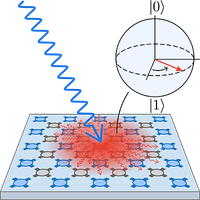
Ionizing radiation is a long-standing nemesis of superconducting quantum processors. Impacts of high-energy radiation break electron pairs responsible for superconductivity, causing a large number of qubits to fail simultaneously. Such correlated error bursts are particularly dangerous because they overwhelm standard quantum error correction protocols. Until recently, the most damaging bursts involved qubits relaxing their energy into a bath of unpaired electrons. A hardware modification, known as “gap engineering,” successfully suppressed this burst type. However, did this modification solve the radiation problem completely? In this work, we experimentally discover a type of correlated error that persists even in gap-engineered processors, namely, phase error bursts. These bursts result from the shifts in the qubit frequencies that inevitably occur when superconducting electron pairs are broken. Our findings show that the realization of a fault-tolerant quantum computer will require developing new mitigation strategies to suppress the residual phase errors.
Article Text
Supplemental Material
References (74)
- A. G. Fowler, M. Mariantoni, J. M. Martinis, and A. N. Cleland, Surface codes: Towards practical large-scale quantum computation, Phys. Rev. A 86, 032324 (2012).
- A. P. Vepsäläinen et al., Impact of ionizing radiation on superconducting qubit coherence, Nature (London) 584, 551 (2020).
- C. D. Wilen et al., Correlated charge noise and relaxation errors in superconducting qubits, Nature (London) 594, 369 (2021).
- L. Cardani et al., Reducing the impact of radioactivity on quantum circuits in a deep-underground facility, Nat. Commun. 12, 2733 (2021).
- J. M. Martinis, Saving superconducting quantum processors from decay and correlated errors generated by gamma and cosmic rays, npj Quantum Inf. 7, 1 (2021).
- M. McEwen et al., Resolving catastrophic error bursts from cosmic rays in large arrays of superconducting qubits, Nat. Phys. 18, 107 (2022).
- X. Li et al., Cosmic-ray-induced correlated errors in superconducting qubit array, Nat. Commun. 16, 4677 (2025).
- F. Valenti et al., The spatial correlation of radiation-induced errors in superconducting devices decays over a millimeter, arXiv:2505.04902.
- C. P. Larson et al., Quasiparticle poisoning of superconducting qubits with active gamma irradiation, arXiv:2503.07354.
- H. Nho, T. Connolly, P. D. Kurilovich, S. Diamond, C. G. L. Bøttcher, L. I. Glazman, and M. H. Devoret, Recovery dynamics of a gap-engineered transmon after a quasiparticle burst, Phys. Rev. Lett. 136, 050601 (2026).
- M. Lenander et al., Measurement of energy decay in superconducting qubits from nonequilibrium quasiparticles, Phys. Rev. B 84, 024501 (2011).
- G. Catelani, R. J. Schoelkopf, M. H. Devoret, and L. I. Glazman, Relaxation and frequency shifts induced by quasiparticles in superconducting qubits, Phys. Rev. B 84, 064517 (2011).
- G. Catelani et al., Quasiparticle relaxation of superconducting qubits in the presence of flux, Phys. Rev. Lett. 106, 077002 (2011).
- D. Ristè et al., Millisecond charge-parity fluctuations and induced decoherence in a superconducting transmon qubit, Nat. Commun. 4, 1913 (2013).
- K. Serniak et al., Hot nonequilibrium quasiparticles in transmon qubits, Phys. Rev. Lett. 121, 157701 (2018).
- K. Serniak et al., Direct dispersive monitoring of charge parity in offset-charge-sensitive transmons, Phys. Rev. Appl. 12, 014052 (2019).
- S. Diamond et al., Distinguishing parity-switching mechanisms in a superconducting qubit, PRX Quantum 3, 040304 (2022).
- R. Acharya et al. (Google Quantum AI), Suppressing quantum errors by scaling a surface code logical qubit, Nature (London) 614, 676 (2023).
- S. Krinner et al., Realizing repeated quantum error correction in a distance-three surface code, Nature (London) 605, 669 (2022).
- R. Acharya et al. (Google Quantum AI), Quantum error correction below the surface code threshold, Nature (London) 638, 920 (2024).
- Z. Chen et al., Exponential suppression of bit or phase errors with cyclic error correction, Nature (London) 595, 383 (2021).
- L. Sun et al., Measurements of quasiparticle tunneling dynamics in a band-gap-engineered transmon qubit, Phys. Rev. Lett. 108, 230509 (2012).
- C. Wang et al., Measurement and control of quasiparticle dynamics in a superconducting qubit, Nat. Commun. 5, 5836 (2014).
- K. Kalashnikov et al., Bifluxon: Fluxon-parity-protected superconducting qubit, PRX Quantum 1, 010307 (2020).
- G. Marchegiani, L. Amico, and G. Catelani, Quasiparticles in superconducting qubits with asymmetric junctions, PRX Quantum 3, 040338 (2022).
- P. Kamenov, T. DiNapoli, M. Gershenson, and S. Chakram, Suppression of quasiparticle poisoning in transmon qubits by gap engineering, arXiv:2309.02655.
- T. Connolly et al., Coexistence of nonequilibrium density and equilibrium energy distribution of quasiparticles in a superconducting qubit, Phys. Rev. Lett. 132, 217001 (2024).
- P. M. Harrington et al., Synchronous detection of cosmic rays and correlated errors in superconducting qubit arrays, Nat. Commun. 16, 6428 (2025).
- G. Marchegiani and G. Catelani, Nonequilibrium regimes for quasiparticles in superconducting qubits with gap-asymmetric junctions, Commun. Phys. 8, 120 (2025).
- M. Kishmar et al., Quasiparticle-induced decoherence of a driven superconducting qubit, arXiv:2505.00769.
- M. McEwen et al., Resisting high-energy impact events through gap engineering in superconducting qubit arrays, Phys. Rev. Lett. 133, 240601 (2024).
- R.-P. Riwar et al., Normal-metal quasiparticle traps for superconducting qubits, Phys. Rev. B 94, 104516 (2016).
- R.-P. Riwar and G. Catelani, Efficient quasiparticle traps with low dissipation through gap engineering, Phys. Rev. B 100, 144514 (2019).
- F. Henriques et al., Phonon traps reduce the quasiparticle density in superconducting circuits, Appl. Phys. Lett. 115, 212601 (2019).
- V. Iaia et al., Phonon downconversion to suppress correlated errors in superconducting qubits, Nat. Commun. 13, 6425 (2022).
- E. Yelton et al., Modeling phonon-mediated quasiparticle poisoning in superconducting qubit arrays, Phys. Rev. B 110, 024519 (2024).
We note that only the largest of these bursts will give rise to errors in a high distance repetition code. This is why logical errors in Ref. [20] have a smaller rate.
- See Supplemental Material at http://link.aps.org/supplemental/10.1103/1bl4-b2f7 for additional examples of bursts in , , and measurements, additional data on qubit frequency shifts during the bursts, and additional examples of error bursts in the interleaved experiment with the X-basis and Z-basis repetition code.
We include the measurement to collect additional statistics on the qubit relaxation errors; this measurement is not used in the frequency shift analysis.
In order to improve the fit precision, we allow to vary in a narrow interval around the measured peak value of .
- L. I. Glazman and G. Catelani, Bogoliubov quasiparticles in superconducting qubits, SciPost Phys. Lect. Notes 31, 1 (2021), 10.21468/SciPostPhysLectNotes.31.
- J. Kelly et al., State preservation by repetitive error detection in a superconducting quantum circuit, Nature (London) 519, 66 (2015).
An inconsequential difference in the present experiment from the experiment of Sec. 3 is that we use Hadamard gates instead of gates in .
When flux tuning the qubits in this experiment, we keep all of the calibrations (e.g., frequencies of the microwave pulses) fixed at their parameters before the shift.
- D. M. Debroy, M. McEwen, C. Gidney, N. Shutty, and A. Zalcman, LUCI in the surface code with dropouts, Quantum 9, 1936 (2025).
- C. Leroux, S. F. Lin, P. Bienias, K. R. Sankar, A. Benhemou, A. Kubica, and J. K. Iverson, Snakes and ladders: Adapting the surface code to defects, PRX Quantum 6, 040302 (2025).
- A. Eickbusch et al., Demonstrating dynamic surface codes, Nat. Phys. 21, 1994 (2025).
- D. S. Antonenko, P. D. Kurilovich, F. J. Matute-Cañadas, and L. I. Glazman, Effect of quasiparticles on the parameters of a gap-engineered transmon, Phys. Rev. B 113, 054504 (2026).
- J. W. Fowler et al., Spectroscopic measurements and models of energy deposition in the substrate of quantum circuits by natural ionizing radiation, PRX Quantum 5, 040323 (2024).
- P. V. Klimov, J. Kelly, J. M. Martinis, and H. Neven, The snake optimizer for learning quantum processor control parameters, arXiv:2006.04594.
- P. V. Klimov et al., Optimizing quantum gates towards the scale of logical qubits, Nat. Commun. 15, 2442 (2024).
- A. Bengtsson et al., Model-based optimization of superconducting qubit readout, Phys. Rev. Lett. 132, 100603 (2024).
- E. Jeffrey et al., Fast accurate state measurement with superconducting qubits, Phys. Rev. Lett. 112, 190504 (2014).
- M. McEwen et al., Removing leakage-induced correlated errors in superconducting quantum error correction, Nat. Commun. 12, 1761 (2021).
- K. C. Miao et al., Overcoming leakage in quantum error correction, Nat. Phys. 19, 1780 (2023).
- F. Motzoi, J. M. Gambetta, P. Rebentrost, and F. K. Wilhelm, Simple pulses for elimination of leakage in weakly nonlinear qubits, Phys. Rev. Lett. 103, 110501 (2009).
- J. M. Chow et al., Optimized driving of superconducting artificial atoms for improved single-qubit gates, Phys. Rev. A 82, 040305 (2010).
- Z. Chen et al., Measuring and suppressing quantum state leakage in a superconducting qubit, Phys. Rev. Lett. 116, 020501 (2016).
We note that the actual shape of the burst deviates from an exponential one, cf. Appendix pp6-s2. Nevertheless, we use an exponential template to extract the burst duration due to its simplicity.
- Y. Savich, L. Glazman, and A. Kamenev, Quasiparticle relaxation in superconducting nanostructures, Phys. Rev. B 96, 104510 (2017).
- D. Gall, Electron mean free path in elemental metals, J. Appl. Phys. 119, 085101 (2016).
Contribution of longitudinal phonons to electron relaxation rate is suppressed with respect to transverse phonons contribution by a factor [63]. Here, and are the speeds of transverse and longitudinal waves, respectively. In aluminum, .
- M. Y. Reizer and A. V. Sergeyev, Electron-phonon interaction in impure metals and superconductors, Sov. Phys. JETP 63, 616 (1986), https://jetp.ras.ru/cgi-bin/dn/e_063_03_0616.pdf.
- A. Schmid, Electron-phonon interaction in an impure metal, Z. Phys. 259, 421 (1973).
- A. Sergeev and V. Mitin, Electron-phonon interaction in disordered conductors: Static and vibrating scattering potentials, Phys. Rev. B 61, 6041 (2000).
- V. I. Yudson and V. E. Kravtsov, Electron kinetics in isolated mesoscopic rings driven out of equilibrium, Phys. Rev. B 67, 155310 (2003).
- G. Catelani and D. M. Basko, Non-equilibrium quasiparticles in superconducting circuits: Photons vs. phonons, SciPost Phys. 6, 013 (2019).
- V. Ambegaokar and A. Baratoff, Tunneling between superconductors, Phys. Rev. Lett. 10, 486 (1963).
This assumption is justified by the fact that the high-gap junction lead is strongly coupled to the low-gap qubit pad; see Fig. 1(b) of Ref. [31]. The latter acts as a reservoir imposing its distribution function onto the high-gap segment.
This form of the Ambegaokar-Baratoff relation is valid for [68].
- J. L. J. Hodges, The significance probability of the Smirnov two-sample test, Arkiv Mat. 3, 469 (1958).
We refer to DQLR gate [55] as to a two-qubit operation because in it the leakage state of a data qubit is transferred to a neighboring measure qubit.
There is a subtlety in evaluating for the injection experiment coming from the fact that we implement frequency shifts as fixed flux offsets. Indeed, during the two-qubit gates, we move qubits in frequency [74]; this changes the qubits’ sensitivity to flux offsets. As a result, the frequency shift “perceived” by the qubit during the two-qubit gate differs from its nominal value by, on average, 28%. We include this effect in our modeling by adjusting accordingly.
- B. Foxen et al., Demonstrating a continuous set of two-qubit gates for near-term quantum algorithms, Phys. Rev. Lett. 125, 120504 (2020).

