Browse by Subject

Teleportation and Entanglement Swapping of Continuous Quantum Variables of Microwave Radiation

Baleegh Abdo, William Shanks, Oblesh Jinka, J. R. Rozen, and Jason Orcutt

Phys. Rev. X 15, 031075 (2025) - Published 25 September, 2025

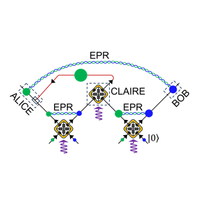
A superconducting Josephson mixer generates continuous-variable entanglement between microwave modes, enabling teleportation and entanglement swapping with fidelities beyond classical limits—key steps toward scalable quantum networks.

Complexity of Gottesman-Kitaev-Preskill States

Lukas Brenner, Libor Caha, Xavier Coiteux-Roy, and Robert Koenig

Phys. Rev. X 15, 031073 (2025) - Published 19 September, 2025

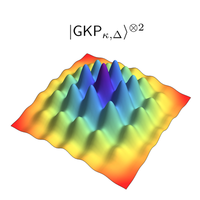
A proposed protocol efficiently prepares high-quality Gottesman-Kitaev-Preskill (GKP) quantum states with rigorous accuracy guarantees. Since GKP states are central to quantum error correction, this paves the way for more robust quantum computing.

Anticoncentration in Clifford Circuits and Beyond: From Random Tensor Networks to Pseudomagic States

Beatrice Magni, Alexios Christopoulos, Andrea De Luca, and Xhek Turkeshi

Phys. Rev. X 15, 031071 (2025) - Published 15 September, 2025

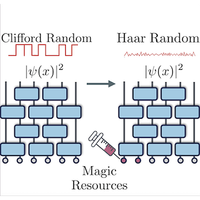
An analysis of how evenly quantum states spread out in Clifford circuits and tensor networks provides new insights for quantum sampling, benchmarking, and computational quantum advantage.

Experimentally Probing Entropy Reduction via Iterative Quantum Information Transfer

Toshihiro Yada, Pieter-Jan Stas, Aziza Suleymanzade, Erik N. Knall, Nobuyuki Yoshioka, Takahiro Sagawa, and Mikhail D. Lukin

Phys. Rev. X 15, 031054 (2025) - Published 26 August, 2025

Tracking real-time feedback on a spin qubit reveals how quantum information flow sets thermodynamic limits and shows that feedback with memory enables enhanced control performance compared to memoryless methods.

Dynamical α-Rényi Entropies of Local Hamiltonians Grow at Most Linearly in Time

Daniele Toniolo and Sougato Bose

Phys. Rev. X 15, 031046 (2025) - Published 19 August, 2025

Linking the Lieb-Robinson bound to entanglement growth shows that faster information spread yields greater entanglement, providing a way to estimate computational complexity via measurable quantities.

Operating Semiconductor Qubits without Individual Barrier Gates

Alexander S. Ivlev, Damien R. Crielaard, Marcel Meyer, William I. L. Lawrie, Nico W. Hendrickx, Amir Sammak, Yuta Matsumoto, Lieven M. K. Vandersypen, Giordano Scappucci, Corentin Déprez, and Menno Veldhorst

Phys. Rev. X 15, 031042 (2025) - Published 14 August, 2025

A new method for controlling spin qubits in quantum dots reduces wiring complexity by tuning qubit energy levels instead of individual barriers, enabling scalable architectures without sacrificing performance.

On the Quantum Mechanics of Entropic Forces

Daniel Carney, Manthos Karydas, Thilo Scharnhorst, Roshni Singh, and Jacob M. Taylor

Phys. Rev. X 15, 031038 (2025) - Published 11 August, 2025

A detailed quantum model of how gravity might emerge from microscopic spacetime constituents, like spacetime “molecules,” offers testable predictions that distinguish it from particle-based gravity and paves the way for experimental probes.

Geometric Floquet Theory

Paul M. Schindler and Marin Bukov

Phys. Rev. X 15, 031037 (2025) - Published 8 August, 2025

A new geometric reformulation of Floquet theory introduces a way to uniquely define ground energies for Floquet states, enabling clearer classification of nonequilibrium phases and improved simulation of driven quantum systems.

Demonstration of Measurement-Enhanced State Preparation and Erasure Conversion in a Molecular Tweezer Array

Connor M. Holland, Yukai Lu, Samuel J. Li, Callum L. Welsh, and Lawrence W. Cheuk

Phys. Rev. X 15, 031018 (2025) - Published 16 July, 2025

Programmable arrays of trapped molecules offer a powerful platform for quantum science. New error-mitigation strategies detect and mitigate state preparation and leakage errors by encoding faults in bright, easily detectable molecular states.

Massively Multiplexed Nanoscale Magnetometry with Diamond Quantum Sensors

Kai-Hung Cheng, Zeeshawn Kazi, Jared Rovny, Bichen Zhang, Lila S. Nassar, Jeff D. Thompson, and Nathalie P. de Leon

Phys. Rev. X 15, 031014 (2025) - Published 14 July, 2025

Two independent groups optimize diamond-based quantum sensing by using more than 100 such sensors in parallel.

Experimental Signatures of Hilbert-Space Ergodicity: Universal Bitstring Distributions and Applications in Noise Learning

Adam L. Shaw, Daniel K. Mark, Joonhee Choi, Ran Finkelstein, Pascal Scholl, Soonwon Choi, and Manuel Endres

Phys. Rev. X 15, 031001 (2025) - Published 1 July, 2025

An analog quantum simulator shows that while local parts of a quantum system appear thermalized, global properties exhibit persistent, universal fluctuations—offering new insight into quantum thermalization.

Efficient Control of a Transmon Qudit Using Effective Spin-7/2 Rotations

Elizabeth Champion, Zihao Wang, Rayleigh W. Parker, and Machiel S. Blok

Phys. Rev. X 15, 021096 (2025) - Published 18 June, 2025

A superconducting quantum processor uses transmon qudits with up to eight levels, achieving 98.9% control fidelity via simultaneous spinlike transitions and demonstrating high-performance quantum Fourier transforms.

Flat-Band (De)localization Emulated with a Superconducting Qubit Array

Ilan T. Rosen, Sarah Muschinske, Cora N. Barrett, David A. Rower, Rabindra Das, David K. Kim, Bethany M. Niedzielski, Meghan Schuldt, Kyle Serniak, Mollie E. Schwartz, Jonilyn L. Yoder, Jeffrey A. Grover, and William D. Oliver

Phys. Rev. X 15, 021091 (2025) - Published 16 June, 2025

Quantum computers can emulate electronic materials when qubit interactions are tuned to mimic electron flow. This approach reveals how disorder and interactions affect conductivity in flat-band materials.

How Much Entanglement Is Needed for Topological Codes and Mixed States with Anomalous Symmetry?

Zhi Li, Dongjin Lee, and Beni Yoshida

Phys. Rev. X 15, 021090 (2025) - Published 11 June, 2025

Topological phases require quantum entanglement that scales extensively with system size. This long-range entanglement is essential for supporting emergent particles, anomalous symmetries, and robust quantum error correction.

Fault-Tolerant Logical Measurements via Homological Measurement

Benjamin Ide, Manoj G. Gowda, Priya J. Nadkarni, and Guillaume Dauphinais

Phys. Rev. X 15, 021088 (2025) - Published 10 June, 2025

A new framework, homological measurement, enables fault-tolerant logical operations across a broad class of quantum error-correction codes known as CSS codes.

Demonstration of Algorithmic Quantum Speedup for an Abelian Hidden Subgroup Problem

Phattharaporn Singkanipa, Victor Kasatkin, Zeyuan Zhou, Gregory Quiroz, and Daniel A. Lidar

Phys. Rev. X 15, 021082 (2025) - Published 5 June, 2025

IBM’s 127-qubit processor solves an adapted version of Simon’s problem with exponential quantum speedup, making significant progress toward demonstrating algorithmic quantum advantage on real hardware.

Fast, Robust, and Laser-Free Universal Entangling Gates for Trapped-Ion Quantum Computing

Markus Nünnerich, Daniel Cohen, Patrick Barthel, Patrick H. Huber, Dorna Niroomand, Alex Retzker, and Christof Wunderlich

Phys. Rev. X 15, 021079 (2025) - Published 3 June, 2025

A new radio-frequency-driven gate is an order of magnitude faster than previous ones in static magnetic gradients and has a simplified design suitable for large-scale applications in different quantum computing platforms.

Emergent Holographic Forces from Tensor Networks and Criticality

Rahul Sahay, Mikhail D. Lukin, and Jordan Cotler

Phys. Rev. X 15, 021078 (2025) - Published 3 June, 2025

A simplified quantum gravity model, which can be simulated using current quantum technologies, replicates key features of Einstein’s gravity, offering insights into the quantum nature of spacetime and paving the way for experimental exploration.

Quartic Quantum Speedups for Planted Inference

Alexander Schmidhuber, Ryan O’Donnell, Robin Kothari, and Ryan Babbush

Phys. Rev. X 15, 021077 (2025) - Published 2 June, 2025

A new quantum algorithm solves planted inference problems with a quartic speedup and exponentially less memory than classical methods, offering practical gains even when considering quantum error correction.

High-Rate Measurement-Device-Independent Quantum Communication without Optical Reference Light

Shan-Feng Shao, Lai Zhou, Jinping Lin, Mariella Minder, Chengfang Ge, Yuan-Mei Xie, Ao Shen, Zhengyu Yan, Hua-Lei Yin, and Zhiliang Yuan

Phys. Rev. X 15, 021066 (2025) - Published 23 May, 2025
A cost-effective quantum key distribution system achieves record key rates over 100 to 400 km using measurement-device-independent quantum key distribution and a novel postmeasurement laser drift compensation—without complex hardware.

Sign In to Your Journals Account

Filter

Filter

Article Lookup

Enter a citation