

- Open Access
Anticoncentration in Clifford Circuits and Beyond: From Random Tensor Networks to Pseudomagic States
Phys. Rev. X 15, 031071 – Published 15 September, 2025
DOI: https://doi.org/10.1103/p8dn-glcw
Abstract
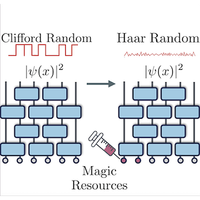
Anticoncentration describes how an ensemble of quantum states spreads over the allowed Hilbert space, leading to statistically uniform output probability distributions. In this work, we investigate the anticoncentration of random Clifford circuits toward the overlap distribution of random stabilizer states. Using exact analytical techniques and extensive numerical simulations based on Clifford replica tensor networks, we demonstrate that random Clifford circuits fully anticoncentrate in logarithmic circuit depth; namely, higher-order moments of the overlap distribution converge to those of random stabilizer states. Moreover, we investigate the effect of introducing a controlled number of non-Clifford (magic) resources into Clifford circuits. We show that inserting a polylogarithmic in qudit number of states is sufficient to drive the overlap distribution toward the Porter-Thomas statistics, effectively recovering full quantum randomness. In short, this fact presents doped tensor networks and shallow Clifford circuits as pseudomagic quantum states. Our results clarify the interplay between Clifford dynamics, magic-state injection, and quantum complexity, with implications for quantum circuit sampling, many-body quantum physics, and the benchmarking of quantum computational advantage.
Physics Subject Headings (PhySH)
Popular Summary
A central question in quantum computing is how quantum circuits generate randomness, since this property underlies complexity, chaos, and the potential for computational advantage. A key concept is anticoncentration, which measures how evenly a quantum state spreads across all possible outcomes. In this work, we study anticoncentration in Clifford circuits and tensor networks, which play a central role in error correction and fault-tolerant quantum computation.
We calculate the overlap distribution for random stabilizer states, giving a precise description of how Clifford circuits anticoncentrate. Our analysis shows that Clifford tensor networks whose bond dimension grows like some power of the system fully anticoncentrate, as do Clifford circuits with only logarithmic depth. We then go beyond Clifford dynamics by introducing non-Clifford, or “magic,” resources. By adding only a logarithmic number of special quantum states known as states, we find that circuits transition to fully chaotic behavior.
These results reveal the fine balance between Clifford operations, which are structured and efficiently simulable, and non-Clifford resources, which push circuits into the regime of quantum complexity. Understanding this transition informs strategies for quantum sampling, provides new tools for benchmarking devices, and points to resource requirements for true quantum advantage.
Article Text
References (120)
- J. Preskill, Quantum computing in the NISQ era and beyond, Quantum 2, 79 (2018).
- M. P. Fisher, V. Khemani, A. Nahum, and S. Vijay, Random quantum circuits, Annu. Rev. Condens. Matter Phys. 14, 335 (2023).
- A. Bouland, B. Fefferman, C. Nirkhe, and U. Vazirani, On the complexity and verification of quantum random circuit sampling, Nat. Phys. 15, 159 (2018).
- S. Boixo, S. V. Isakov, V. N. Smelyanskiy, R. Babbush, N. Ding, Z. Jiang, M. J. Bremner, J. M. Martinis, and H. Neven, Characterizing quantum supremacy in near-term devices, Nat. Phys. 14, 595 (2018).
- A. M. Dalzell, N. Hunter-Jones, and F. G. S. L. Brandão, Random quantum circuits anticoncentrate in log depth, PRX Quantum 3, 010333 (2022).
- D. Hangleiter, J. Bermejo-Vega, M. Schwarz, and J. Eisert, Anticoncentration theorems for schemes showing a quantum speedup, Quantum 2, 65 (2018).
- G. Lami, J. De Nardis, and X. Turkeshi, Anticoncentration and state design of random tensor networks, Phys. Rev. Lett. 134, 010401 (2025).
- X. Turkeshi and P. Sierant, Hilbert space delocalization under random unitary circuits, Entropy 26, 471 (2024).
- A. Christopoulos, A. Chan, and A. D. Luca, Universal distributions of overlaps from unitary dynamics in generic quantum many-body systems, arXiv:2404.10057.
- D. J. Luitz, F. Alet, and N. Laflorencie, Universal behavior beyond multifractality in quantum many-body systems, Phys. Rev. Lett. 112, 057203 (2014).
- N. Macé, F. Alet, and N. Laflorencie, Multifractal scalings across the many-body localization transition, Phys. Rev. Lett. 123, 180601 (2019).
- P. Sierant and X. Turkeshi, Universal behavior beyond multifractality of wave functions at measurement-induced phase transitions, Phys. Rev. Lett. 128, 130605 (2022).
- P. W. Claeys and G. De Tomasi, Fock-space delocalization and the emergence of the Porter-Thomas distribution from dual-unitary dynamics, Phys. Rev. Lett. 134, 050405 (2025).
- H.-Y. Huang, R. Kueng, and J. Preskill, Predicting many properties of a quantum system from very few measurements, Nat. Phys. 16, 1050 (2020).
- C. Bertoni, J. Haferkamp, M. Hinsche, M. Ioannou, J. Eisert, and H. Pashayan, Shallow shadows: Expectation estimation using low-depth random Clifford circuits, Phys. Rev. Lett. 133, 020602 (2024).
- M. Arienzo, M. Heinrich, I. Roth, and M. Kliesch, Closed-form analytic expressions for shadow estimation with brickwork circuits, Quantum Inf. Comput. 23, 961 (2023).
- M. Ippoliti, Y. Li, T. Rakovszky, and V. Khemani, Operator relaxation and the optimal depth of classical shadows, Phys. Rev. Lett. 130, 230403 (2023).
- R. Cioli, E. Ercolessi, M. Ippoliti, X. Turkeshi, and L. Piroli, Approximate inverse measurement channel for shallow shadows, Quantum 9, 1698 (2025).
- F. Arute, K. Arya et al., Quantum supremacy using a programmable superconducting processor, Nature (London) 574, 505 (2019).
- D. Hangleiter and J. Eisert, Computational advantage of quantum random sampling, Rev. Mod. Phys. 95, 035001 (2023).
- A. Morvan, B. Villalonga et al., Phase transitions in random circuit sampling, Nature (London) 634, 328 (2024).
- B. Ware, A. Deshpande, D. Hangleiter, P. Niroula, B. Fefferman, A. V. Gorshkov, and M. J. Gullans, A sharp phase transition in linear cross-entropy benchmarking, arXiv:2305.04954.
- A. Nahum, J. Ruhman, S. Vijay, and J. Haah, Quantum entanglement growth under random unitary dynamics, Phys. Rev. X 7, 031016 (2017).
- A. Nahum, S. Vijay, and J. Haah, Operator spreading in random unitary circuits, Phys. Rev. X 8, 021014 (2018).
- C. W. von Keyserlingk, T. Rakovszky, F. Pollmann, and S. L. Sondhi, Operator hydrodynamics, otocs, and entanglement growth in systems without conservation laws, Phys. Rev. X 8, 021013 (2018).
- C. E. Porter and R. G. Thomas, Fluctuations of nuclear reaction widths, Phys. Rev. 104, 483 (1956).
- T. Schuster, J. Haferkamp, and H.-Y. Huang, Random unitaries in extremely low depth, Science 389, 92 (2025).
- B. Fefferman, S. Ghosh, and W. Zhan, Anti-concentration for the unitary haar measure and applications to random quantum circuits, arXiv:2407.19561.
- E. Tirrito, X. Turkeshi, and P. Sierant, Anticoncentration and magic spreading under ergodic quantum dynamics, arXiv:2412.10229.
- M. Collura, J. D. Nardis, V. Alba, and G. Lami, The quantum magic of fermionic Gaussian states, arXiv:2412.05367.
- D. Gottesman, Theory of fault-tolerant quantum computation, Phys. Rev. A 57, 127 (1998).
- D. Gottesman, Stabilizer codes and quantum error correction, arXiv:quant-ph/9705052.
- M. A. Nielsen and I. L. Chuang, Quantum Computation and Quantum Information (Cambridge University Press, Cambridge; New York, 2010).
- S. Aaronson and D. Gottesman, Improved simulation of stabilizer circuits, Phys. Rev. A 70, 052328 (2004).
- C. Gidney, Stim: A fast stabilizer circuit simulator, Quantum 5, 497 (2021).
- S. Bravyi, D. Browne, P. Calpin, E. Campbell, D. Gosset, and M. Howard, Simulation of quantum circuits by low-rank stabilizer decompositions, Quantum 3, 181 (2019).
- A. Rocchetto, Stabiliser states are efficiently pac-learnable, Quantum Inf. Comput. 18, 541 (2018).
- A. Montanaro, Learning stabilizer states by Bell sampling, arXiv:1707.04012.
- H. Zhu, R. Kueng, M. Grassl, and D. Gross, The Clifford group fails gracefully to be a unitary 4-design, arXiv:1609.08172.
- D. Gross, S. Nezami, and M. Walter, Schur–Weyl duality for the Clifford group with applications: Property testing, a robust Hudson theorem, and de Finetti representations, Commun. Math. Phys. 385, 1325 (2021).
- S. Bravyi and A. Kitaev, Universal quantum computation with ideal Clifford gates and noisy ancillas, Phys. Rev. A 71, 022316 (2005).
- Z.-W. Liu and A. Winter, Many-body quantum magic, PRX Quantum 3, 020333 (2022).
- E. Chitambar and G. Gour, Quantum resource theories, Rev. Mod. Phys. 91, 025001 (2019).
- A. Gu, L. Leone, S. Ghosh, J. Eisert, S. F. Yelin, and Y. Quek, Pseudomagic quantum states, Phys. Rev. Lett. 132, 210602 (2024).
- A. Jamiołkowski, Linear transformations which preserve trace and positive semidefiniteness of operators, Rep. Math. Phys. 3, 275 (1972).
- V. Kac and P. Cheung, Quantum Calculus (Springer, New York, 2002).
Explicitly , where vary with the considered geometry and . To simplify notation, and assuming this dependence on geometry is understood, we will use the shorthand .
- P. Braccia, P. Bermejo, L. Cincio, and M. Cerezo, Computing exact moments of local random quantum circuits via tensor networks, Quantum Mach. Intell. 6, 54 (2024).
- L. Bittel, J. Eisert, L. Leone, A. A. Mele, and S. F. E. Oliviero, A complete theory of the Clifford commutant, arXiv:2504.12263.
- X. Turkeshi, E. Tirrito, and P. Sierant, Magic spreading in random quantum circuits, Nat. Commun. 16, 2575 (2025).
- B. Collins and P. Śniady, Integration with respect to the Haar measure on unitary, orthogonal and symplectic group, Commun. Math. Phys. 264, 773 (2006).
- A. A. Mele, Introduction to Haar measure tools in quantum information: A beginner’s tutorial, Quantum 8, 1340 (2024).
- F. Montealegre-Mora and D. Gross, Rank-deficient representations in the theta correspondence over finite fields arise from quantum codes, Represent. Theor. 25, 193 (2021).
- S. Nezami and M. Walter, Multipartite entanglement in stabilizer tensor networks, Phys. Rev. Lett. 125, 241602 (2020).
- I. Roth, R. Kueng, S. Kimmel, Y.-K. Liu, D. Gross, J. Eisert, and M. Kliesch, Recovering quantum gates from few average gate fidelities, Phys. Rev. Lett. 121, 170502 (2018).
- J. Haferkamp, F. Montealegre-Mora, M. Heinrich, J. Eisert, D. Gross, and I. Roth, Efficient unitary designs with a system-size independent number of non-Clifford gates, Commun. Math. Phys. 397, 995 (2022).
- X. Turkeshi, M. Schirò, and P. Sierant, Measuring nonstabilizerness via multifractal flatness, Phys. Rev. A 108, 042408 (2023).
- D. J. Luitz, N. Laflorencie, and F. Alet, Participation spectroscopy and entanglement Hamiltonian of quantum spin models, J. Stat. Mech. (2014) P08007.
- Y. Liu, P. Sierant, P. Stornati, M. Lewenstein, and M. Płodzień, Quantum algorithms for inverse participation ratio estimation in multiqubit and multiqudit systems, Phys. Rev. A 111, 052614 (2025).
- A. Bäcker, M. Haque, and I. M. Khaymovich, Multifractal dimensions for random matrices, chaotic quantum maps, and many-body systems, Phys. Rev. E 100, 032117 (2019).
- T. Zhou and A. Nahum, Entanglement membrane in chaotic many-body systems, Phys. Rev. X 10, 031066 (2020).
- T. Zhou and A. Nahum, Emergent statistical mechanics of entanglement in random unitary circuits, Phys. Rev. B 99, 174205 (2019).
Performing a change of variable, we can express the overlap distribution in terms of the overlap ; the result is an exponential with a polylog in the exponent.
- P. Sierant, M. Schirò, M. Lewenstein, and X. Turkeshi, Entanglement growth and minimal membranes in () random unitary circuits, Phys. Rev. Lett. 131, 230403 (2023).
- S. Garnerone, T. R. de Oliveira, and P. Zanardi, Typicality in random matrix product states, Phys. Rev. A 81, 032336 (2010).
- S. Garnerone, T. R. de Oliveira, S. Haas, and P. Zanardi, Statistical properties of random matrix product states, Phys. Rev. A 82, 052312 (2010).
- J. Haferkamp, C. Bertoni, I. Roth, and J. Eisert, Emergent statistical mechanics from properties of disordered random matrix product states, PRX Quantum 2, 040308 (2021).
- D. Haag, F. Baccari, and G. Styliaris, Typical correlation length of sequentially generated tensor network states, PRX Quantum 4, 030330 (2023).
- G. Lami, T. Haug, and J. De Nardis, Quantum state designs with Clifford-enhanced matrix product states, PRX Quantum 6, 010345 (2025).
- Y. Li, R. Vasseur, M. P. A. Fisher, and A. W. W. Ludwig, Statistical mechanics model for Clifford random tensor networks and monitored quantum circuits, Phys. Rev. B 109, 174307 (2024).
- U. Schollwöck, The density-matrix renormalization group in the age of matrix product states, Ann. Phys. (Amsterdam) 326, 96 (2011).
- M. Fishman, S. R. White, and E. M. Stoudenmire, The ITensor Software Library for Tensor Network Calculations, SciPost Phys. Codebases 4 (2022).
- R. Orús, A practical introduction to tensor networks: Matrix product states and projected entangled pair states, Ann. Phys. (Amsterdam) 349, 117 (2014).
This circuit is specified by Eq. (5) with for .
- S. Shivam, A. De Luca, D. A. Huse, and A. Chan, Many-body quantum chaos and emergence of Ginibre ensemble, Phys. Rev. Lett. 130, 140403 (2023).
- A. Chan, S. Shivam, D. A. Huse, and A. De Luca, Many-body quantum chaos and space-time translational invariance, Nat. Commun. 13, 7484 (2022).
- A. De Luca, C. Liu, A. Nahum, and T. Zhou, Universality classes for purification in nonunitary quantum processes, arXiv:2312.17744.
- R. Kueng and D. Gross, Qubit stabilizer states are complex projective 3-designs, arXiv:1510.02767.
- Z. Webb, The Clifford group forms a unitary 3-design, Quantum Inf. Comput. 16, 1379 (2016.
We have checked, but do not present here, that the analogous results hold for other values of . The interested reader can access our complete datasets and code in Ref. [120].
- S. Bravyi and D. Maslov, Hadamard-free circuits expose the structure of the Clifford group, IEEE Trans. Inf. Theory 67, 4546 (2021).
This follows from the fact that individual rows and columns of the Clifford gate exhibit the same statistical properties akin to Haar-random gates.
These operators are not all independent; they can be rewritten in their irreducible representation, further simplifying the computations. This reduces the dimension of the commutant—and consequently, the size of the Gram and Weingarten matrices—from eight to seven for qutrits () and 12 to 11 for qupents ().
- M. Heinrich and D. Gross, Robustness of magic and symmetries of the stabiliser polytope, Quantum 3, 132 (2019).
- G. Lami and M. Collura, Nonstabilizerness via perfect Pauli sampling of matrix product states, Phys. Rev. Lett. 131, 180401 (2023).
- X. Turkeshi, A. Dymarsky, and P. Sierant, Pauli spectrum and nonstabilizerness of typical quantum many-body states, Phys. Rev. B 111, 054301 (2025).
- L. Leone, S. F. E. Oliviero, and A. Hamma, Stabilizer Rényi entropy, Phys. Rev. Lett. 128, 050402 (2022).
- L. Piroli, G. Styliaris, and J. I. Cirac, Quantum circuits assisted by local operations and classical communication: Transformations and phases of matter, Phys. Rev. Lett. 127, 220503 (2021).
- L. Leone, S. F. E. Oliviero, Y. Zhou, and A. Hamma, Quantum chaos is quantum, Quantum 5, 453 (2021).
- L. Leone, S. F. E. Oliviero, and A. Hamma, Learning t-doped stabilizer states, Quantum 8, 1361 (2024).
- G. Lami and M. Collura, Unveiling the stabilizer group of a matrix product state, Phys. Rev. Lett. 133, 010602 (2024).
- T. Haug, L. Aolita, and M. Kim, Probing quantum complexity via universal saturation of stabilizer entropies, Quantum 9, 1801 (2025).
- B. Magni and X. Turkeshi, Quantum complexity and chaos in many-qudit doped Clifford circuits, arXiv:2506.02127.
- N.-H. Chia, C.-Y. Lai, and H.-H. Lin, Efficient learning of -doped stabilizer states with single-copy measurements, Quantum 8, 1250 (2024).
- M. Bejan, C. McLauchlan, and B. Béri, Dynamical magic transitions in monitored Clifford + t circuits, PRX Quantum 5, 030332 (2024).
- D. Szombathy, A. Valli, C. P. Moca, L. Farkas, and G. Zaránd, Independent stabilizer Rényi entropy and entanglement fluctuations in random unitary circuits, arXiv:2501.11489.
- D. Szombathy, A. Valli, C. P. Moca, J. Asbóth, L. Farkas, T. Rakovszky, and G. Zaránd, Spectral properties versus magic generation in -doped random Clifford circuits, arXiv:2412.15912.
- P. Niroula, C. D. White, Q. Wang, S. Johri, D. Zhu, C. Monroe, C. Noel, and M. J. Gullans, Phase transition in magic with random quantum circuits, Nat. Phys. 20, 1786 (2024).
- X. Turkeshi, Coherent errors make magic, Nat. Phys. 20, 1696 (2024).
- G. E. Fux, E. Tirrito, M. Dalmonte, and R. Fazio, Entanglement—nonstabilizerness separation in hybrid quantum circuits, Phys. Rev. Res. 6, L042030 (2024).
- E. Tirrito, P. S. Tarabunga, G. Lami, T. Chanda, L. Leone, S. F. E. Oliviero, M. Dalmonte, M. Collura, and A. Hamma, Quantifying nonstabilizerness through entanglement spectrum flatness, Phys. Rev. A 109, L040401 (2024).
- M. Hinsche, M. Ioannou, A. Nietner, J. Haferkamp, Y. Quek, D. Hangleiter, J.-P. Seifert, J. Eisert, and R. Sweke, One gate makes distribution learning hard, Phys. Rev. Lett. 130, 240602 (2023).
- S. Zhou, Z.-C. Yang, A. Hamma, and C. Chamon, Single T gate in a Clifford circuit drives transition to universal entanglement spectrum statistics, SciPost Phys. 9, 087 (2020).
- N. Dowling, K. Modi, and G. A. L. White, Bridging entanglement and magic resources through operator space, arXiv:2501.18679.
- G. E. Fux, B. Béri, R. Fazio, and E. Tirrito, Disentangling unitary dynamics with classically simulable quantum circuits, arXiv:2410.09001.
- A. C. Nakhl, B. Harper, M. West, N. Dowling, M. Sevior, T. Quella, and M. Usman, Stabilizer tensor networks with magic state injection, Phys. Rev. Lett. 134, 190602 (2025).
Similar tests and results were corroborated for other choices of and , and are not reported for presentation purposes.
- Z. Cheng, X. Feng, and M. Ippoliti, Pseudoentanglement from tensor networks, Phys. Rev. Lett. 135, 020403 (2025).
- X. Feng and M. Ippoliti, Dynamics of pseudoentanglement, J. High Energy Phys. 02 (2025) 128.
- S. Grewal, V. Iyer, W. Kretschmer, and D. Liang, Low-stabilizer-complexity quantum states are not pseudorandom, arXiv:2209.14530.
- T. Haug, K. Bharti, and D. E. Koh, Pseudorandom unitaries are neither real nor sparse nor noise-robust, Quantum 9, 1759 (2025).
We have checked but have not reported that similar results hold for and qudits, and for qubits () and .
- L. Grevink, J. Haferkamp, M. Heinrich, J. Helsen, M. Hinsche, T. Schuster, and Z. Zimborás, Will it glue? on short-depth designs beyond the unitary group, arXiv:2506.23925.
- B. Magni, A. De Luca, and X. Turkeshi (to be published).
- A. Chan, A. De Luca, and J. T. Chalker, Solution of a minimal model for many-body quantum chaos, Phys. Rev. X 8, 041019 (2018).
- A. Sauliere, B. Magni, G. Lami, X. Turkeshi, and J. D. Nardis, Universality in the anticoncentration of chaotic quantum circuits, arXiv:2503.00119.
- P. Sierant, M. Schirò, M. Lewenstein, and X. Turkeshi, Entanglement growth and minimal membranes in () random unitary circuits, Phys. Rev. Lett. 131, 230403 (2023).
- B. Fefferman, S. Ghosh, M. Gullans, K. Kuroiwa, and K. Sharma, Effect of nonunital noise on random-circuit sampling, PRX Quantum 5, 030317 (2024).
- S.-K. Jian, G. Bentsen, and B. Swingle, Linear growth of circuit complexity from Brownian dynamics, J. High Energy Phys. 08 (2023) 190.
- B. Magni and X. Turkeshi, Anticoncentration in Clifford circuits and beyond: From random tensor networks to pseudo-magic states, Zenodo v2, 2025, 10.5281/zenodo.14973579.

