Browse by Subject

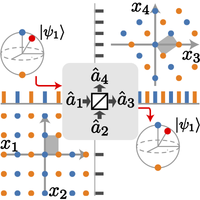
Fast and Parallelizable Logical Computation with Homological Product Codes

Qian Xu, Hengyun Zhou, Guo Zheng, Dolev Bluvstein, J. Pablo Bonilla Ataides, Mikhail D. Lukin, and Liang Jiang

Phys. Rev. X 15, 021065 (2025) - Published 22 May, 2025

New tools for qLDPC error-correction codes enable fast, parallel logical operations with low qubit overhead, enabling efficient, fault-tolerant quantum computing on existing platforms.

Locally Purified Density Operators for Symmetry-Protected Topological Phases in Mixed States

Yuchen Guo, Jian-Hao Zhang, Hao-Ran Zhang, Shuo Yang, and Zhen Bi

Phys. Rev. X 15, 021060 (2025) - Published 20 May, 2025

A new framework reveals symmetry-protected topological phases that exist only in open, noisy quantum systems, offering key insights for identifying and engineering robust quantum states in realistic environments.

Measurement-Induced Entanglement and Complexity in Random Constant-Depth 2D Quantum Circuits

Max McGinley, Wen Wei Ho, and Daniel Malz

Phys. Rev. X 15, 021059 (2025) - Published 19 May, 2025

Even shallow 2D quantum circuits can generate long-range entanglement during measurement, making them classically hard to simulate—not due to depth, but due to hidden complexity from measurements.

Practical Quantum Advantage on Partially Fault-Tolerant Quantum Computer

Riki Toshio, Yutaro Akahoshi, Jun Fujisaki, Hirotaka Oshima, Shintaro Sato, and Keisuke Fujii

Phys. Rev. X 15, 021057 (2025) - Published 16 May, 2025

A new framework shows how to achieve practical quantum advantage using early fault-tolerant quantum computing devices equipped with only tens of thousands of qubits.

Reply to “Comment on ‘Consistent Quantization of Nearly Singular Superconducting Circuits’”

David P. DiVincenzo and Martin Rymarz

Phys. Rev. X 15, 028002 (2025) - Published 15 May, 2025

Comment on “Consistent Quantization of Nearly Singular Superconducting Circuits”

I. L. Egusquiza and A. Parra-Rodriguez

Phys. Rev. X 15, 028001 (2025) - Published 15 May, 2025

Computational Power of Random Quantum Circuits in Arbitrary Geometries

M. DeCross et al.

Phys. Rev. X 15, 021052 (2025) - Published 13 May, 2025

A 56-qubit trapped-ion quantum computer achieves high fidelity in random circuit sampling, outperforming classical supercomputers and making important progress toward practical quantum computational advantage.

Unifying Non-Markovian Characterization with an Efficient and Self-Consistent Framework

G. A. L. White, P. Jurcevic, C. D. Hill, and K. Modi

Phys. Rev. X 15, 021047 (2025) - Published 9 May, 2025

A general framework models and counters the complex, time- and space-correlated noise that disrupts quantum computing performance. This relies on tensor networks to boost accuracy and efficiency of estimation.

Experimental Mode-Pairing Quantum Key Distribution Surpassing the Repeaterless Bound

Likang Zhang, Wei Li, Jiawei Pan, Yichen Lu, Wenwen Li, Zheng-Ping Li, Yizhi Huang, Xiongfeng Ma, Feihu Xu, and Jian-Wei Pan

Phys. Rev. X 15, 021037 (2025) - Published 2 May, 2025

Researchers have shown that they can distribute quantum keys under realistic conditions using commercial lasers.

Modular Autonomous Virtualization System for Two-Dimensional Semiconductor Quantum Dot Arrays

Anantha S. Rao, Donovan Buterakos, Barnaby van Straaten, Valentin John, Cécile X. Yu, Stefan D. Oosterhout, Lucas Stehouwer, Giordano Scappucci, Menno Veldhorst, Francesco Borsoi, and Justyna P. Zwolak

Phys. Rev. X 15, 021034 (2025) - Published 30 April, 2025

Machine learning automates the control of a large and highly connected array of semiconductor quantum dots.

Probing Many-Body Bell Correlation Depth with Superconducting Qubits

Ke Wang et al.

Phys. Rev. X 15, 021024 (2025) - Published 22 April, 2025

A demonstration of Bell-operator correlations in a 73-qubit quantum processor provides a benchmark for studying quantum nonlocality in complex systems that goes beyond standard measurements of entanglement.

Unitary k-Designs from Random Number-Conserving Quantum Circuits

Sumner N. Hearth, Michael O. Flynn, Anushya Chandran, and Chris R. Laumann

Phys. Rev. X 15, 021022 (2025) - Published 21 April, 2025

Symmetry-constrained random quantum circuits generate randomness more slowly than unconstrained ones, following a diffusive process. This finding reveals how conservation laws can impact quantum simulation and computation.

Accuracy Guarantees and Quantum Advantage in Analog Open Quantum Simulation with and without Noise

Vikram Kashyap, Georgios Styliaris, Sara Mouradian, J. Ignacio Cirac, and Rahul Trivedi

Phys. Rev. X 15, 021017 (2025) - Published 16 April, 2025

Quantum simulators can efficiently solve dissipative many-body problems that are intractable for classical computers, even with noise, thus establishing a robust quantum advantage for studying open quantum systems.

Classification of Joint Quantum Measurements Based on Entanglement Cost of Localization

Jef Pauwels, Alejandro Pozas-Kerstjens, Flavio Del Santo, and Nicolas Gisin

Phys. Rev. X 15, 021013 (2025) - Published 14 April, 2025

A powerful framework allows scientists to understand and classify joint quantum measurements—procedures essential for many quantum technologies.

Control of Solid-State Nuclear Spin Qubits Using an Electron Spin-1/2

Hans K. C. Beukers, Christopher Waas, Matteo Pasini, Hendrik B. van Ommen, Zarije Ademi, Mariagrazia Iuliano, Nina Codreanu, Julia M. Brevoord, Tim Turan, Tim H. Taminiau, and Ronald Hanson

Phys. Rev. X 15, 021011 (2025) - Published 11 April, 2025

Improved methods for using electron spins to sense and control nuclear spins could benefit many quantum technologies.

Synthetic High Angular Momentum Spin Dynamics in a Microwave Oscillator

Saswata Roy, Alen Senanian, Christopher S. Wang, Owen C. Wetherbee, Luojia Zhang, B. Cole, C. P. Larson, E. Yelton, Kartikeya Arora, Peter L. McMahon, B. L. T. Plourde, Baptiste Royer, and Valla Fatemi

Phys. Rev. X 15, 021009 (2025) - Published 8 April, 2025

A new control scheme simplifies quantum harmonic oscillator manipulation, linking control parameters to quantum behavior. It enables spin-like behavior for novel quantum information processing.

Passive Environment-Assisted Quantum Communication with GKP States

Zhaoyou Wang and Liang Jiang

Phys. Rev. X 15, 021003 (2025) - Published 3 April, 2025

Specially structured quantum states enable direct quantum communication through highly lossy channels, overcoming conventional limits. This approach could enhance quantum networks and transduction efficiency.

Exact Quantization of Nonreciprocal Quasilumped Electrical Networks

A. Parra-Rodriguez and I. L. Egusquiza

Phys. Rev. X 15, 011072 (2025) - Published 28 March, 2025

A geometric framework combined with functional analysis expands classical electrical theory to model complex superconducting and nonreciprocal quantum networks, enabling scalable quantum processors.

Spin-Photon Entanglement of a Single Er3+ Ion in the Telecom Band

Mehmet T. Uysal, Łukasz Dusanowski, Haitong Xu, Sebastian P. Horvath, Salim Ourari, Robert J. Cava, Nathalie P. de Leon, and Jeff D. Thompson

Phys. Rev. X 15, 011071 (2025) - Published 26 March, 2025

Experiments with erbium ions show that they can be used to create entangled photons in the telecom band—an important step in building quantum repeaters.

Preserving Phase Coherence and Linearity in Cat Qubits with Exponential Bit-Flip Suppression

Harald Putterman, Kyungjoo Noh, Rishi N. Patel, Gregory A. Peairs, Gregory S. MacCabe, Menyoung Lee, Shahriar Aghaeimeibodi, Connor T. Hann, Ignace Jarrige, Guillaume Marcaud, Yuan He, Hesam Moradinejad, John Clai Owens, Thomas Scaffidi, Patricio Arrangoiz-Arriola, Joe Iverson, Harry Levine, Fernando G. S. L. Brandão, Matthew H. Matheny, and Oskar Painter

Phys. Rev. X 15, 011070 (2025) - Published 25 March, 2025

Stabilizing cat qubits via two-photon dissipative stabilization extends bit-flip lifetimes without introducing undesired loss or nonlinearity, an advancement that could aid in scalable quantum error correction and fault-tolerant computing.

Sign In to Your Journals Account

Filter

Filter

Article Lookup

Enter a citation