

- Open Access
Powering Quantum Computation with Quantum Batteries
Phys. Rev. X 16, 011016 – Published 26 January, 2026
DOI: https://doi.org/10.1103/l39v-jwwz
Abstract
Executing quantum logic in cryogenic quantum computers requires a continuous energy supply from room-temperature control electronics. This dependence on external energy sources creates scalability limitations due to control channel density and heat dissipation. Here, we propose quantum batteries (QBs) as intrinsic quantum energy sources for quantum computation, enabling the thermodynamic limit of zero dissipation for unitary gates. Unlike classical power sources, QBs maintain quantum coherence with their load—a property that, while theoretically studied, remains unexploited in practical quantum technologies. We demonstrate that initializing a bosonic QB in a Fock state can supply the energy required for arbitrary unitary gates regardless of the circuit’s depth, via the recycling of precharged energy. Crucially, allowing QB-qubit entanglement during computation lowers the QB’s initial energy requirements below established energy-fidelity bounds. This scheme facilitates a universal gate set controlled by a single parameter per qubit: its resonant frequency. The relative detuning of each qubit from the QB’s resonant frequency qualitatively gives rise to two gate types: off resonance and around resonance. The former facilitates dispersive gates that allow multiqubit parity probing while the latter enables energy exchange between the QB and the qubits, driving both population transfer and entanglement generation. This mechanism utilizes the all-to-all connectivity of the shared-resonator architecture to go beyond the standard single- and two-qubit native gates of current platforms with multiqubit gate timescales of few , where is the qubit-resonator coupling. The resultant speedup also includes superextensive gates between symmetric Dicke states, characteristic of QB systems. Using a QB eliminates the need for individual drive lines, significantly reducing wiring overhead and potentially quadrupling the number of qubits that can be integrated within cryogenic systems, thereby offering a scalable architecture for quantum computing.
Physics Subject Headings (PhySH)
Popular Summary
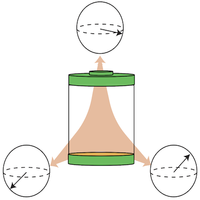
Scalability in cryogenic quantum computers is currently limited by the need for individual external drive lines, which increase control channel density and introduce significant heat dissipation. We propose utilizing quantum batteries (QBs) as intrinsic, shared energy sources that maintain quantum coherence with their load, enabling arbitrary unitary gates with nearly zero dissipation. By precharging a bosonic QB into a Fock state and allowing energy recycling within a closed qubit-battery entangled system, we demonstrate a universal gate set controlled solely by qubit resonance detuning. This architecture eliminates the need for dedicated microwave drive lines per qubit, significantly reducing wiring overhead and heat load while resulting in up to fourfold increase in qubit capacity per refrigerator. Our framework moves quantum computation toward the thermodynamic limit of efficiency, providing a concrete and scalable pathway for next-generation quantum processors.
Article Text
References (67)
- R. Alicki and M. Fannes, Entanglement boost for extractable work from ensembles of quantum batteries, Phys. Rev. E 87, 042123 (2013).
- F. Campaioli, S. Gherardini, J. Q. Quach, M. Polini, and G. M. Andolina, Colloquium: Quantum batteries, Rev. Mod. Phys. 96, 031001 (2024).
- F. Campaioli, F. A. Pollock, F. C. Binder, L. Céleri, J. Goold, S. Vinjanampathy, and K. Modi, Enhancing the charging power of quantum batteries, Phys. Rev. Lett. 118, 150601 (2017).
- D. Ferraro, M. Campisi, G. M. Andolina, V. Pellegrini, and M. Polini, High-power collective charging of a solid-state quantum battery, Phys. Rev. Lett. 120, 117702 (2018).
- S. Julià-Farré, T. Salamon, A. Riera, M. N. Bera, and M. Lewenstein, Bounds on the capacity and power of quantum batteries, Phys. Rev. Res. 2, 023113 (2020).
- J. Q. Quach, G. Cerullo, and T. Virgili, Quantum batteries: The future of energy storage?, Joule 7, 2195 (2023).
- G. M. Andolina, M. Keck, A. Mari, M. Campisi, V. Giovannetti, and M. Polini, Extractable work, the role of correlations, and asymptotic freedom in quantum batteries, Phys. Rev. Lett. 122, 047702 (2019).
- R. Grazi, D. Sacco Shaikh, M. Sassetti, N. Traverso Ziani, and D. Ferraro, Controlling energy storage crossing quantum phase transitions in an integrable spin quantum battery, Phys. Rev. Lett. 133, 197001 (2024).
- T. P. Le, J. Levinsen, K. Modi, M. M. Parish, and F. A. Pollock, Spin-chain model of a many-body quantum battery, Phys. Rev. A 97, 022106 (2018).
- D. Rossini, G. M. Andolina, D. Rosa, M. Carrega, and M. Polini, Quantum advantage in the charging process of Sachdev-ye-Kitaev batteries, Phys. Rev. Lett. 125, 236402 (2020).
- L. Razzoli, G. Gemme, I. Khomchenko, M. Sassetti, H. Ouerdane, D. Ferraro, and G. Benenti, Cyclic solid-state quantum battery: Thermodynamic characterization and quantum hardware simulation, Quantum Sci. Technol. 10, 015064 (2025).
- B. Ahmadi, P. Mazurek, P. Horodecki, and S. Barzanjeh, Nonreciprocal quantum batteries, Phys. Rev. Lett. 132, 210402 (2024).
- R. H. Dicke, Coherence in spontaneous radiation processes, Phys. Rev. 93, 99 (1954).
- J. Q. Quach, K. E. McGhee, L. Ganzer, D. M. Rouse, B. W. Lovett, E. M. Gauger, J. Keeling, G. Cerullo, D. G. Lidzey, and T. Virgili, Superabsorption in an organic microcavity: Toward a quantum battery, Sci. Adv. 8, eabk3160 (2022).
- K. Hymas, J. B. Muir, D. Tibben, J. van Embden, T. Hirai, C. J. Dunn, D. E. Gómez, J. A. Hutchison, T. A. Smith, and J. Q. Quach, Experimental demonstration of a scalable room-temperature quantum battery, arXiv:2501.16541.
- C.-K. Hu, J. Qiu, P. J. Souza, J. Yuan, Y. Zhou, L. Zhang, J. Chu, X. Pan, L. Hu, J. Li et al., Optimal charging of a superconducting quantum battery, Quantum Sci. Technol. 7, 045018 (2022).
- G. Gemme, M. Grossi, D. Ferraro, S. Vallecorsa, and M. Sassetti, IBM quantum platforms: A quantum battery perspective, Batteries 8, 43 (2022).
- F.-Q. Dou and F.-M. Yang, Superconducting transmon qubit-resonator quantum battery, Phys. Rev. A 107, 023725 (2023).
- J. Joshi and T. S. Mahesh, Experimental investigation of a quantum battery using star-topology nmr spin systems, Phys. Rev. A 106, 042601 (2022).
- N. Friis and M. Huber, Precision and work fluctuations in Gaussian battery charging, Quantum 2, 61 (2018).
- R. R. Rodriguez, B. Ahmadi, P. Mazurek, S. Barzanjeh, R. Alicki, and P. Horodecki, Catalysis in charging quantum batteries, Phys. Rev. A 107, 042419 (2023).
- A. Auffèves, Quantum technologies need a quantum energy initiative, PRX Quantum 3, 020101 (2022).
- P. Faist, F. Dupuis, J. Oppenheim, and R. Renner, The minimal work cost of information processing, Nat. Commun. 6, 7669 (2015).
- G. Chiribella, Y. Yang, and R. Renner, Fundamental energy requirement of reversible quantum operations, Phys. Rev. X 11, 021014 (2021).
- R. Castellano, V. Cavina, M. Perarnau-Llobet, P. Sekatski, and V. Giovannetti, Exact requirements for battery-assisted qubit gates, arXiv:2506.11855.
- M. Tavis and F. W. Cummings, Exact solution for an n-molecule—radiation-field Hamiltonian, Phys. Rev. 170, 379 (1968).
- S. Jandura, V. Srivastava, L. Pecorari, G. K. Brennen, and G. Pupillo, Nonlocal multiqubit quantum gates via a driven cavity, Phys. Rev. A 110, 062610 (2024).
- M. Renger, J. Verjauw, N. Wurz, A. Hosseinkhani, C. Ockeloen-Korppi, W. Liu, A. Rath, M. J. Thapa, F. Vigneau, E. Wybo et al., A superconducting qubit-resonator quantum processor with effective all-to-all connectivity, arXiv:2503.10903.
- J. Ikonen, J. Salmilehto, and M. Möttönen, Energy-efficient quantum computing, npj Quantum Inf. 3, 17 (2017).
- J. Gea-Banacloche, Minimum energy requirements for quantum computation, Phys. Rev. Lett. 89, 217901 (2002).
- R. Shankar, Principles of Quantum Mechanics (Springer Science & Business Media, New York, 2012).
- P. Bertet, C. J. P. M. Harmans, and J. E. Mooij, Parametric coupling for superconducting qubits, Phys. Rev. B 73, 064512 (2006).
- C. M. Dawson and M. A. Nielsen, The Solovay-Kitaev algorithm, arXiv:quant-ph/0505030.
- K. Mølmer and A. Sørensen, Multiparticle entanglement of hot trapped ions, Phys. Rev. Lett. 82, 1835 (1999).
- C. Song et al., 10-qubit entanglement and parallel logic operations with a superconducting circuit, Phys. Rev. Lett. 119, 180511 (2017).
- C. Song et al., Generation of multicomponent atomic Schrödinger cat states of up to 20 qubits, Science 365, 574 (2019).
- S. M. Young, N. T. Jacobson, and J. R. Petta, Optimal control of a cavity-mediated iswap gate between silicon spin qubits, Phys. Rev. Appl. 18, 064082 (2022).
- J. Dijkema, X. Xue, P. Harvey-Collard, M. Rimbach-Russ, S. L. de Snoo, G. Zheng, A. Sammak, G. Scappucci, and L. M. Vandersypen, Cavity-mediated ISWAP oscillations between distant spins, Nat. Phys. 21, 168 (2025).
- A. Sørensen and K. Mølmer, Quantum computation with ions in thermal motion, Phys. Rev. Lett. 82, 1971 (1999).
- G. Gemme, G. M. Andolina, F. M. D. Pellegrino, M. Sassetti, and D. Ferraro, Off-resonant Dicke quantum battery: Charging by virtual photons, Batteries 9, 197 (2023).
- S.-B. Zheng, One-step synthesis of multiatom Greenberger-Horne-Zeilinger states, Phys. Rev. Lett. 87, 230404 (2001).
- C. D. Bruzewicz, J. Chiaverini, R. McConnell, and J. M. Sage, Trapped-ion quantum computing: Progress and challenges, Appl. Phys. Rev. 6, 021314 (2019).
- P. Krantz, M. Kjaergaard, F. Yan, T. P. Orlando, S. Gustavsson, and W. D. Oliver, A quantum engineer’s guide to superconducting qubits, Appl. Phys. Rev. 6, 021318 (2019).
- J. A. Mlynek, A. A. Abdumalikov, C. Eichler, and A. Wallraff, Observation of Dicke superradiance for two artificial atoms in a cavity with high decay rate, Nat. Commun. 5, 5186 (2014).
- Z. Wang, H. Li, W. Feng, X. Song, C. Song, W. Liu, Q. Guo, X. Zhang, H. Dong, D. Zheng et al., Controllable switching between superradiant and subradiant states in a 10-qubit superconducting circuit, Phys. Rev. Lett. 124, 013601 (2020).
- H. Wang, M. Hofheinz, M. Ansmann, R. C. Bialczak, E. Lucero, M. Neeley, A. D. O’connell, D. Sank, J. Wenner, A. N. Cleland, and J. M. Martinis, Measurement of the decay of Fock states in a superconducting quantum circuit, Phys. Rev. Lett. 101, 240401 (2008).
- X. Deng, S. Li, Z.-J. Chen, Z. Ni, Y. Cai, J. Mai, L. Zhang, P. Zheng, H. Yu, C.-L. Zou et al., Quantum-enhanced metrology with large Fock states, Nat. Phys., 20, 1874 (2024).
- J. Gea-Banacloche and M. Ozawa, Minimum-energy pulses for quantum logic cannot be shared, Phys. Rev. A 74, 060301(R) (2006).
- V. V. Sivak, A. Eickbusch, B. Royer, S. Singh, I. Tsioutsios, S. Ganjam, A. Miano, B. Brock, A. Ding, L. Frunzio et al., Real-time quantum error correction beyond break-even, Nature (London) 616, 50 (2023).
- M. Tuokkola, Y. Sunada, H. Kivijärvi, J. Albanese, L. Grönberg, J.-P. Kaikkonen, V. Vesterinen, J. Govenius, and M. Möttönen, Methods to achieve near-millisecond energy relaxation and dephasing times for a superconducting transmon qubit, Nat. Commun. 16, 5421 (2025).
- M. Hofheinz, E. Weig, M. Ansmann, R. C. Bialczak, E. Lucero, M. Neeley, A. O’connell, H. Wang, J. M. Martinis, and A. Cleland, Generation of Fock states in a superconducting quantum circuit, Nature (London) 454, 310 (2008).
- C. Y. Zhang and J. Jing, Generating Fock-state superpositions from coherent states by selective measurement, Phys. Rev. A 110, 042421 (2024).
- M. A. Rol, L. Ciorciaro, F. K. Malinowski, B. M. Tarasinski, R. E. Sagastizabal, C. C. Bultink, Y. Salathe, N. Haandbæk, J. Sedivy, and L. DiCarlo, Time-domain characterization and correction of on-chip distortion of control pulses in a quantum processor, Appl. Phys. Lett. 116, 054001 (2020).
- Quantum error correction below the surface code threshold, Nature (London) 638, 920 (2025).
- S. Krinner, S. Storz, P. Kurpiers, P. Magnard, J. Heinsoo, R. Keller, J. Luetolf, C. Eichler, and A. Wallraff, Engineering cryogenic setups for 100-qubit scale superconducting circuit systems, Eur. Phys. J. Quantum Technol. 6, 2 (2019).
- S. S. Pratapsi, L. Buffoni, and S. Gherardini, Competition of decoherence and quantum speed limits for quantum-gate fidelity in the Jaynes-Cummings model, Phys. Rev. Res. 6, 023296 (2024).
- M. J. Martin, C. Hughes, G. Moreno, E. B. Jones, D. Sickinger, S. Narumanchi, and R. Grout, Energy use in quantum data centers: Scaling the impact of computer architecture, qubit performance, size, and thermal parameters, IEEE Trans. Sustainable Comput. 7, 864 (2022).
- F. Góis, M. Pezzutto, and Y. Omar, Towards energetic quantum advantage in trapped-ion quantum computation, arXiv:2404.11572.
- M. Fellous-Asiani, J. H. Chai, Y. Thonnart, H. K. Ng, R. S. Whitney, and A. Auffèves, Optimizing resource efficiencies for scalable full-stack quantum computers, PRX Quantum 4, 040319 (2023).
- E. Parker and M. J. Vermeer, Estimating the energy requirements to operate a cryptanalytically relevant quantum computer, arXiv:2304.14344.
- A. Paler and R. Basmadjian, Energy cost of quantum circuit optimisation: Predicting that optimising Shor’s algorithm circuit uses 1 GWh, ACM Trans. Quantum Comput. 3, 1 (2022).
- F. Lecocq, F. Quinlan, K. Cicak, J. Aumentado, S. Diddams, and J. Teufel, Control and readout of a superconducting qubit using a photonic link, Nature (London) 591, 575 (2021).
- P. Zhao, K. Linghu, Z. Li, P. Xu, R. Wang, G. Xue, Y. Jin, and H. Yu, Quantum crosstalk analysis for simultaneous gate operations on superconducting qubits, PRX Quantum 3, 020301 (2022).
- S. Pauka, K. Das, R. Kalra, A. Moini, Y. Yang, M. Trainer, A. Bousquet, C. Cantaloube, N. Dick, G. Gardner et al., A cryogenic CMOS chip for generating control signals for multiple qubits, National electronics review 4, 64 (2021).
- P. J. Liebermann and F. K. Wilhelm, Optimal qubit control using single-flux quantum pulses, Phys. Rev. Appl. 6, 024022 (2016).
- A. Opremcak, C. H. Liu, C. Wilen, K. Okubo, B. G. Christensen, D. Sank, T. C. White, A. Vainsencher, M. Giustina, A. Megrant, B. Burkett, B. L. T. Plourde, and R. Mcdermott, High-fidelity measurement of a superconducting qubit using an on-chip microwave photon counter, Phys. Rev. X 11, 011027 (2021).
- Yaniv Kurman, Dataset associated with, “Powering Quantum Computation with Quantum Batteries”, 10.6084/m9.figshare.29442464.v1 (2025) (accessed: 2025-07-01).

