

- Open Access
Continuous Variable Measurement-Device-Independent Quantum Certification
Phys. Rev. X 16, 011070 – Published 30 March, 2026
DOI: https://doi.org/10.1103/g92b-2kwg
Abstract
Secure and reliable certification of quantum resources is a fundamental challenge in the advancement of next-generation quantum technologies, particularly as devices become more complex and integrated into practical applications, where parts of the system may be untrusted or inaccessible by users. Addressing this challenge requires certification methods that rely on minimal assumptions and limited trust while still faithfully and reliably verifying the quantum resources in question. For infinite-dimensional bosonic systems, existing certification methods rely on fully trusted and well-calibrated measurement systems, leaving significant security vulnerabilities open. In this work, we present the first experimental demonstration of measurement-device-independent (MDI) certification schemes for infinite-dimensional bosonic systems, where the certification process is conducted using entirely untrusted measurement devices and assuming only the trusted preparation of coherent states. Specifically, we implement schemes for the MDI certification of continuous-variable (CV) entanglement and the operation of an elementary optical CV quantum memory. We leverage techniques of Bayesian metrology and exploit the practicality and accessibility of Gaussian quantum optics to achieve secure and efficient certification. These results demonstrate the potential of the MDI framework to enhance trust in quantum technologies with applications in quantum communication and quantum computing.
Physics Subject Headings (PhySH)
Popular Summary
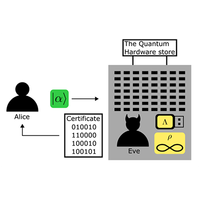
Reliably certifying quantum devices is a significant challenge when components are untrusted or inaccessible to the user. We present an experimental demonstration of measurement-device-independent certification for infinite-dimensional bosonic systems by verifying continuous-variable entanglement and an optical quantum memory. Our approach uses trusted preparations of coherent states while treating all measurement devices as entirely untrusted black boxes. We show entanglement in the form of a two-mode squeezed vacuum state and an optical memory in the form of a fiber spool. These results prove that secure certification is possible with minimal assumptions, offering a practical framework for validating complex hardware from external service providers.
Article Text
References (53)
- J. Eisert, D. Hangleiter, N. Walk, I. Roth, D. Markham, R. Parekh, U. Chabaud, and E. Kashefi, Quantum certification and benchmarking, Nat. Rev. Phys. 2, 382 (2020).
- M. Kliesch and I. Roth, Theory of quantum system certification, PRX Quantum 2, 010201 (2021).
- A. I. Lvovsky and M. G. Raymer, Continuous-variable optical quantum-state tomography, Rev. Mod. Phys. 81, 299 (2009).
- J.-D. Bancal, N. Gisin, Y.-C. Liang, and S. Pironio, Device-independent witnesses of genuine multipartite entanglement, Phys. Rev. Lett. 106, 250404 (2011).
- F. Baccari, D. Cavalcanti, P. Wittek, and A. Acín, Efficient device-independent entanglement detection for multipartite systems, Phys. Rev. X 7, 021042 (2017).
- J. Bowles, I. Šupić, D. Cavalcanti, and A. Acín, Device-independent entanglement certification of all entangled states, Phys. Rev. Lett. 121, 180503 (2018).
- N. Brunner, D. Cavalcanti, S. Pironio, V. Scarani, and S. Wehner, Bell nonlocality, Rev. Mod. Phys. 86, 419 (2014).
- I. Šupić and J. Bowles, Self-testing of quantum systems: A review, Quantum 4, 337 (2020).
- F. Buscemi, All entangled quantum states are nonlocal, Phys. Rev. Lett. 108, 200401 (2012).
- C. Branciard, D. Rosset, Y.-C. Liang, and N. Gisin, Measurement-device-independent entanglement witnesses for all entangled quantum states, Phys. Rev. Lett. 110, 060405 (2013).
- M. Nawareg, S. Muhammad, E. Amselem, and M. Bourennane, Experimental measurement-device-independent entanglement detection, Sci. Rep. 5, 8048 (2015).
- P. Xu, X. Yuan, L.-K. Chen, H. Lu, X.-C. Yao, X. Ma, Y.-A. Chen, and J.-W. Pan, Implementation of a measurement-device-independent entanglement witness, Phys. Rev. Lett. 112, 140506 (2014).
- S. Kocsis, M. J. W. Hall, A. J. Bennet, D. J. Saunders, and G. J. Pryde, Experimental measurement-device-independent verification of quantum steering, Nat. Commun. 6, 5886 (2015).
- Y. Guo, S. Cheng, X. Hu, B.-H. Liu, E.-M. Huang, Y.-F. Huang, C.-F. Li, G.-C. Guo, and E. G. Cavalcanti, Experimental measurement-device-independent quantum steering and randomness generation beyond qubits, Phys. Rev. Lett. 123, 170402 (2019).
- Y.-Y. Zhao, H.-Y. Ku, S.-L. Chen, H.-B. Chen, F. Nori, G.-Y. Xiang, C.-F. Li, G.-C. Guo, and Y.-N. Chen, Experimental demonstration of measurement-device-independent measure of quantum steering, npj Quantum Inf. 6, 77 (2020).
- M. F. Pusey, Verifying the quantumness of a channel with an untrusted device, J. Opt. Soc. Am. B 32, A56 (2015).
- D. Rosset, F. Buscemi, and Y.-C. Liang, Resource theory of quantum memories and their faithful verification with minimal assumptions, Phys. Rev. X 8, 021033 (2018).
- Y. Mao, Y.-Z. Zhen, H. Liu, M. Zou, Q.-J. Tang, S.-J. Zhang, J. Wang, H. Liang, W. Zhang, H. Li, L. You, Z. Wang, L. Li, N.-L. Liu, K. Chen, T.-Y. Chen, and J.-W. Pan, Experimentally verified approach to nonentanglement-breaking channel certification, Phys. Rev. Lett. 124, 010502 (2020).
- F. Graffitti, A. Pickston, P. Barrow, M. Proietti, D. Kundys, D. Rosset, M. Ringbauer, and A. Fedrizzi, Measurement-device-independent verification of quantum channels, Phys. Rev. Lett. 124, 010503 (2020).
- Y. Yu, P.-F. Sun, Y.-Z. Zhang, B. Bai, Y.-Q. Fang, X.-Y. Luo, Z.-Y. An, J. Li, J. Zhang, F. Xu, X.-H. Bao, and J.-W. Pan, Measurement-device-independent verification of a quantum memory, Phys. Rev. Lett. 127, 160502 (2021).
- S. Pirandola, C. Ottaviani, G. Spedalieri, C. Weedbrook, S. L. Braunstein, S. Lloyd, T. Gehring, C. S. Jacobsen, and U. L. Andersen, High-rate measurement-device-independent quantum cryptography, Nat. Photonics 9, 397 (2015).
- C. Weedbrook, S. Pirandola, R. García-Patrón, N. J. Cerf, T. C. Ralph, J. H. Shapiro, and S. Lloyd, Gaussian quantum information, Rev. Mod. Phys. 84, 621 (2012).
- M. Tse, H. Yu, N. Kijbunchoo, A. Fernandez-Galiana, P. Dupej, L. Barsotti, C. Blair, D. Brown, S. Dwyer, A. Effler et al., Quantum-enhanced Advanced LIGO detectors in the era of gravitational-wave astronomy, Phys. Rev. Lett. 123, 231107 (2019).
- R. B. de Andrade, H. Kerdoncuff, K. Berg-Sørensen, T. Gehring, M. Lassen, and U. L. Andersen, Quantum-enhanced continuous-wave stimulated raman scattering spectroscopy, Optica 7, 470 (2020).
- Y. Zhang, Y. Bian, Z. Li, S. Yu, and H. Guo, Continuous-variable quantum key distribution system: Past, present, and future, Appl. Phys. Rev. 11, 011318 (2024).
- H.-S. Zhong, H. Wang, Y.-H. Deng, M.-C. Chen, L.-C. Peng, Y.-H. Luo, J. Qin, D. Wu, X. Ding, Y. Hu et al., Quantum computational advantage using photons, Science 370, 1460 (2020).
- L. S. Madsen, F. Laudenbach, M. F. Askarani, F. Rortais, T. Vincent, J. F. Bulmer, F. M. Miatto, L. Neuhaus, L. G. Helt, M. J. Collins et al., Quantum computational advantage with a programmable photonic processor, Nature (London) 606, 75 (2022).
- P. Abiuso, S. Bäuml, D. Cavalcanti, and A. Acín, Measurement-device-independent entanglement detection for continuous-variable systems, Phys. Rev. Lett. 126, 190502 (2021).
- P. Abiuso, Verification of continuous-variable quantum memories, Quantum Sci. Technol. 9, 01LT02 (2023).
- L.-M. Duan, G. Giedke, J. I. Cirac, and P. Zoller, Inseparability criterion for continuous variable systems, Phys. Rev. Lett. 84, 2722 (2000).
- R. Simon, Peres-Horodecki separability criterion for continuous variable systems, Phys. Rev. Lett. 84, 2726 (2000).
- M. Horodecki, P. W. Shor, and M. B. Ruskai, Entanglement breaking channels, Rev. Math. Phys. 15, 629 (2003).
That is, entanglement breaking (EB) channels are of the form [32] , where represents a measurement operator with outcome , and the corresponding quantum state prepared. It follows that an entanglement breaking memory (transmission line) would only need to store (send) the classical data in order to simulate at arbitrary distance in time (space).
- H. Yuen and M. Lax, Multiple-parameter quantum estimation and measurement of nonselfadjoint observables, IEEE Trans. Inf. Theory 19, 740 (1973).
- A. S. Holevo, Probabilistic and Statistical Aspects of Quantum Theory (Springer Science & Business Media, New York, 2011), Vol. 1.
- M. G. Genoni, M. G. A. Paris, G. Adesso, H. Nha, P. L. Knight, and M. S. Kim, Optimal estimation of joint parameters in phase space, Phys. Rev. A 87, 012107 (2013).
- S. L. Braunstein, C. A. Fuchs, and H. J. Kimble, Criteria for continuous-variable quantum teleportation, J. Mod. Opt. 47, 267 (2000).
- D. Cavalcanti, P. Skrzypczyk, and I. Šupić, All entangled states can demonstrate nonclassical teleportation, Phys. Rev. Lett. 119, 110501 (2017).
While the verification procedure does not rely on trusting the measurement device, the calibration of the coherent states does require a trusted measurement device. This is a limitation of measurement-device-independent protocols compared to fully device independent protocols. However, MDI protocols can still be useful as the calibration of the coherent state generation can be performed in a trusted setting and subsequently used in untrusted settings.
- A. Verma, O. Solodovnikova, J. S. Neergaard-Nielsen, and U. L. Andersen, Detecting non-Gaussian entanglement beyond Gaussian criteria, arXiv:2512.17681.
The causal separation can be taken as a reasonable experimental assumption, or it can be guaranteed via the requirement of the local measurements being space-like separated.
- L. Neuhaus, M. Croquette, R. Metzdorff, S. Chua, P.-E. Jacquet, A. Journeaux, A. Heidmann, T. Briant, T. Jacqmin, P.-F. Cohadon, and S. Deléglise, Python Red Pitaya Lockbox (pyrpl): An open source software package for digital feedback control in quantum optics experiments, Rev. Sci. Instrum. 95, 033003 (2024).
- R. W. Drever, J. L. Hall, F. V. Kowalski, J. Hough, G. Ford, A. Munley, and H. Ward, Laser phase and frequency stabilization using an optical resonator, Appl. Phys. B 31, 97 (1983).
- A. A. Hajomer, U. L. Andersen, and T. Gehring, High-rate continuous-variable measurement device-independent quantum key distribution with finite-size security, arXiv:2303.01611.
- R. Demkowicz-Dobrzański, M. Jarzyna, and J. Kołodyński, Quantum limits in optical interferometry, Prog. Opt. 60, 345 (2015).
- S. Morelli, A. Usui, E. Agudelo, and N. Friis, Bayesian parameter estimation using Gaussian states and measurements, Quantum Sci. Technol. 6, 025018 (2021).
- C. M. Caves, C. A. Fuchs, and R. Schack, Unknown quantum states: The quantum de Finetti representation, J. Math. Phys. (N.Y.) 43, 4537 (2002).
- R. Renner and J. I. Cirac, de finetti representation theorem for infinite-dimensional quantum systems and applications to quantum cryptography, Phys. Rev. Lett. 102, 110504 (2009).
- A. Leverrier, Security of continuous-variable quantum key distribution via a Gaussian de Finetti reduction, Phys. Rev. Lett. 118, 200501 (2017).
- F. Dupuis, O. Fawzi, and R. Renner, Entropy accumulation, Commun. Math. Phys. 379, 867 (2020).
- T. Metger, O. Fawzi, D. Sutter, and R. Renner, Generalised entropy accumulation, Commun. Math. Phys. 405, 261 (2024)..
- A. E. Domínguez, W. E. O. Larcher, and C. N. Kozameh, Fundamental residual amplitude modulation in electro-optic modulators, arXiv:1710.10719.
- I. Suleiman, J. A. H. Nielsen, X. Guo, N. Jain, J. Neergaard-Nielsen, T. Gehring, and U. L. Andersen, 40 km fiber transmission of squeezed light measured with a real local oscillator, Quantum Sci. Technol. 7, 045003 (2022).

