

- Featured in Physics
- Open Access
Repeated Ancilla Reuse for Logical Computation on a Neutral Atom Quantum Computer
Phys. Rev. X 15, 041040 – Published 4 December, 2025
DOI: https://doi.org/10.1103/v7ny-fg31
Abstract
Quantum processors based on neutral atoms trapped in arrays of optical tweezers have appealing properties, including relatively easy qubit number scaling and the ability to engineer arbitrary gate connectivity with atom movement. However, these platforms are inherently prone to atom loss, and the ability to replace lost atoms during a quantum computation is an important but previously elusive capability. Here, we demonstrate the ability to measure and reinitialize, and if necessary replace, a subset of atoms while maintaining coherence in other atoms. This allows us to perform logical circuits that include single- and two-qubit gates as well as repeated midcircuit measurement while compensating for atom loss. We highlight this capability by performing up to 41 rounds of syndrome extraction in a repetition code, and combine midcircuit measurement and atom replacement with real-time conditional branching to demonstrate heralded state preparation of a logically encoded Bell state. Finally, we demonstrate the ability to replenish atoms in a tweezer array from an atomic beam while maintaining coherence of existing atoms—a key step toward execution of logical computations that last longer than the lifetime of an atom in the system.
Physics Subject Headings (PhySH)
 synopsis

Quantum Computer Recycles Its Atomic Qubits
Researchers have developed a protocol for resetting and reloading atoms that are inevitably lost during quantum computations.
See more in Physics
Popular Summary
Neutral atoms are a promising platform for quantum computing because they are identical, can be precisely manipulated with lasers, and interact in highly controllable ways. Arrays of these atoms, held in tightly focused laser beams known as optical tweezers, have enabled demonstrations of logical quantum bits that spread information across several atoms to detect and correct errors. However, a key limitation has been that the ancillary qubits used to check for errors can be heated or lost during measurements. This restricts how long computations can run. In this study, we overcome that challenge by repeatedly measuring and reusing ancilla qubits within quantum circuits while selectively replacing those that are lost, marking a major step toward sustained quantum computation.
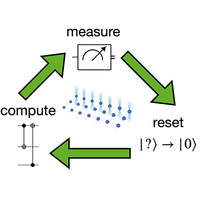
We achieve this using a system that integrates atom trapping, measurement, and reloading in a continuous loop. When a trapped atom disappears during a computation, we identify the loss and replace it from a nearby atomic reservoir without disturbing the surrounding qubits. We also perform repeated ancilla measurements to confirm the correct preparation of logical states and demonstrate continuous reloading from a steady atomic source—all while preserving the quantum states of the atoms already in the array. This approach allows the same ancilla qubits to participate in many cycles of error detection and correction.
By enabling the reuse and replenishment of ancilla qubits, we remove a major barrier to scaling up neutral-atom quantum computers. These capabilities make it possible to perform longer and more complex quantum computations and open the door to fault-tolerant logical operations that can outlast any individual qubit.
Article Text
References (37)
- P. W. Shor, Scheme for reducing decoherence in quantum computer memory, Phys. Rev. A 52, R2493 (1995).
- E. Knill and R. Laflamme, Theory of quantum error-correcting codes, Phys. Rev. A 55, 900 (1997).
- T. M. Graham, L. Phuttitarn, R. Chinnarasu, Y. Song, C. Poole, K. Jooya, J. Scott, A. Scott, P. Eichler, and M. Saffman, Midcircuit measurements on a single-species neutral alkali atom quantum processor, Phys. Rev. X 13, 041051 (2023).
- E. Deist, Y.-H. Lu, J. Ho, M. K. Pasha, J. Zeiher, Z. Yan, and D. M. Stamper-Kurn, Mid-circuit cavity measurement in a neutral atom array, Phys. Rev. Lett. 129, 203602 (2022).
- K. Singh, C. Bradley, S. Anand, V. Ramesh, R. White, and H. Bernien, Mid-circuit correction of correlated phase errors using an array of spectator qubits, Science 380, 1265 (2023).
- M. A. Norcia et al., Midcircuit qubit measurement and rearrangement in a atomic array, Phys. Rev. X 13, 041034 (2023).
- J. W. Lis, A. Senoo, W. F. McGrew, F. Rönchen, A. Jenkins, and A. M. Kaufman, Midcircuit operations using the omg architecture in neutral atom arrays, Phys. Rev. X 13, 041035 (2023).
- D. Bluvstein, S. J. Evered, A. A. Geim, S. H. Li, H. Zhou, T. Manovitz et al., Logical quantum processor based on reconfigurable atom arrays, Nature (London) 626, 58 (2024).
- R. Finkelstein, R. B.-S. Tsai, X. Sun, P. Scholl, S. Direkci, T. Gefen, J. Choi, A. L. Shaw, and M. Endres, Universal quantum operations and ancilla-based read-out for tweezer clocks, Nature (London) 634, 321 (2024).
- B. W. Reichardt, A. Paetznick, D. Aasen, I. Basov, J. M. Bello-Rivas et al., Logical computation demonstrated with a neutral atom quantum processor, arXiv:2411.11822.
- M. N. H. Chow, V. Buchemmavari, S. Omanakuttan, B. J. Little, S. Pandey, I. H. Deutsch, and Y.-Y. Jau, Circuit-based leakage-to-erasure conversion in a neutral-atom quantum processor, PRX Quantum 5, 040343 (2024).
- H. Perrin, S. Jandura, and G. Pupillo, Quantum error correction resilient against atom loss, Quantum 9, 1884 (2025).
- M. A. Norcia, H. Kim, W. B. Cairncross, M. Stone, A. Ryou, M. Jaffe, M. O. Brown et al., Iterative assembly of atom arrays with cavity-enhanced optical lattices, PRX Quantum 5, 030316 (2024).
- W. Huie, L. Li, N. Chen, X. Hu, Z. Jia, Won Kyu Calvin Sun, and J. P. Covey, Repetitive readout and real-time control of nuclear spin qubits in atoms, PRX Quantum 4, 030337 (2023).
- Y. Wu, S. Kolkowitz, S. Puri, and J. D. Thompson, Erasure conversion for fault-tolerant quantum computing in alkaline earth Rydberg atom arrays, Nat. Commun. 13, 4657 (2022).
- J. A. Muniz, M. Stone, D. T. Stack, M. Jaffe, J. M. Kindem et al., High-fidelity universal gates in the ground-state nuclear-spin qubit, PRX Quantum 6, 020334 (2025).
- K. Barnes, P. Battaglino, B. J. Bloom, K. Cassella, R. Coxe, N. Crisosto, J. P. King, S. S. Kondov, K. Kotru, S. C. Larsen et al., Assembly and coherent control of a register of nuclear spin qubits, Nat. Commun. 13, 2779 (2022).
- T. O. Höhn, E. Staub, G. Brochier, N. Darkwah Oppong, and M. Aidelsburger, State-dependent potentials for the and clock states of neutral ytterbium atoms, Phys. Rev. A 108, 053325 (2023).
- A. Jenkins, J. W. Lis, A. Senoo, W. F. McGrew, and A. M. Kaufman, Ytterbium nuclear-spin qubits in an optical tweezer array, Phys. Rev. X 12, 021027 (2022).
- Z. Chen, K. J. Satzinger et al., Exponential suppression of bit or phase errors with cyclic error correction, Nature (London) 595, 383 (2021).
- S. J. Evered, D. Bluvstein, M. Kalinowski, S. Ebadi, T. Manovitz, H. Zhou, S. H. Li, A. A. Geim, T. T. Wang, N. Maskara, H. Levine, G. Semeghini, M. Greiner, V. Vuletić, and M. D. Lukin, High-fidelity parallel entangling gates on a neutral-atom quantum computer, Nature (London) 622, 268 (2023).
- D. Cruz, R. Fournier, F. Gremion, A. Jeannerot, K. Komagata, T. Tosic, J. Thiesbrummel, C. L. Chan, N. Macris, M.-A. Dupertuis et al., Efficient quantum algorithms for GHZ and W states, and implementation on the IBM quantum computer, Adv. Quantum Technol. 2, 1900015 (2019).
- S. A. Moses, C. H. Baldwin, M. S. Allman et al., A race-track trapped-ion quantum processor, Phys. Rev. X 13, 041052 (2023).
- O. Higgott and C. Gidney, Sparse blossom: Correcting a million errors per core second with minimum-weight matching, Quantum 9, 1600 (2025).
- A. G. Fowler, D. Sank, J. Kelly, R. Barends, and J. M. Martinis, Scalable extraction of error models from the output of error detection circuits, arXiv:1405.1454.
- N. Schlosser, G. Reymond, I. Protsenko, and P. Grangier, Sub-Poissonian loading of single atoms in a microscopic dipole trap, Nature (London) 411, 1024 (2001).
- J. Lee, J. H. Lee, J. Noh, and J. Mun, Core-shell magneto-optical trap for alkaline-earth-metal-like atoms, Phys. Rev. A 91, 053405 (2015).
- L. Li, X. Hu, Z. Jia, W. Huie, W. K. C. Sun, Aakash, Y. Dong, N. Hiri-O-Tuppa, and J. P. Covey, Parallelized telecom quantum networking with an ytterbium-171 atom array, Nat. Phys. (2025), 10.1038/s41567-025-03022-4.
- S. Wimperis, Broadband, narrowband, and passband composite pulses for use in advanced NMR experiments, J. Magn. Reson., Ser. A 109, 221 (1994).
- H. Bombin, D. Litinski, N. Nickerson, F. Pastawski, and S. Roberts, Unifying flavors of fault tolerance with the ZX calculus, Quantum 8, 1379 (2024).
- C. Gidney, stim: A fast stabilizer circuit simulator, Quantum 5, 497 (2021).
- G. Baranes, M. Cain, J. Ataides, D. Bluvstein, J. Sinclair, V. Vuletic, H. Zhou, and M. D. Lukin, Leveraging atom loss errors in fault tolerant quantum algorithms, arXiv:2502.20558.
- D. Deutsch, A. Ekert, R. Jozsa, C. Macchiavello, S. Popescu, and A. Sanpera, Quantum privacy amplification and the security of quantum cryptography over noisy channels, Phys. Rev. Lett. 77, 2818 (1996).
- L. Vaidman, L. Goldenberg, and S. Wiesner, Error prevention scheme with four particles, Phys. Rev. A 54, R1745 (1996).
- M. Grassl, T. Beth, and T. Pellizzari, Codes for the quantum erasure channel, Phys. Rev. A 56, 33 (1997).
- N. M. Linke, M. Gutierrez, K. A. Landsman, C. Figgatt, S. Debnath, K. R. Brown, and C. Monroe, Fault-tolerant quantum error detection, Sci. Adv. 3, e1701074 (2017).
- D. Gottesman, Theory of fault-tolerant quantum computation, Phys. Rev. A 57, 127 (1998).

