




Metric-induced edge-dominated spectra in hyperbolic trusses
Kailun Wang, Jingming Chen, Yue Shen, Muyang Han, Xiang Li, Zhen Gao, and Ying Wu
Phys. Rev. B 114, L200101 (2026) - Published 30 October, 2026

Mungo Frost et al.
Phys. Rev. B 114, 204101 (2026) - Published 1 October, 2026
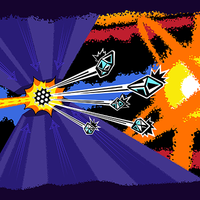
Under extreme conditions hydrocarbons are known to demix, forming diamond and a hydrogen-rich phase. Here, the authors probe the timescale of this process as a function of pressure and composition. Various hydrocarbon samples were compressed to between 20 and 80 GPa in diamond anvil cells prior to serial x-ray free electron laser heating and time-resolved diffraction. They find that carbon-rich precursors form diamond in 10s of microseconds over the whole pressure range, while hydrogen rich ones take longer. [Image credit: Greg Stewart/SLAC National Accelerator Laboratory]
Gusthavo M. S. Brizolla, Stepan S. Tsirkin, Yaroslav Zhumagulov, and Jaroslav Fabian
Phys. Rev. B 114, 204424 (2026) - Published 22 October, 2026
Spin–orbit torque (SOT) enables electrical magnetization control in spintronic devices. Here, the authors calculate SOT in monolayer FeGeTe and FeGaTe, van der Waals ferromagnets with perpendicular magnetic anisotropy and no reliance on heavy atoms for strong spin–orbit coupling. Horizontal mirror symmetry forbids conventional in-plane spin accumulation for out-of-plane magnetization, while tilting the magnetization enables a strongly angle-dependent response. Combining density functional theory, Wannier interpolation, and Kubo formalism, they map the torque across the magnetization sphere. They reveal hidden torques on mirror-related Fe atoms up to 30 times the net torque, whose cancellation could be lifted through van der Waals engineering.
Amanuel M. Berhane, Susan N. Coppersmith, Emma E. Mitchell, and Timothy L. Duty
Phys. Rev. B 114, 204503 (2026) - Published 5 October, 2026
Disorder strongly modifies the collective electronic state of one-dimensional Josephson junction arrays. However, identifying types of disorder and understanding their link to collective behavior remain challenging. Here, the authors find three classes of fabrication-induced structural disorder and investigate their effects on critical-voltage scaling of arrays in the insulating state. While the scaling remains remarkably robust against some fabrication-induced variations, arrays containing nanoscale gaps exhibit significantly different behavior, demonstrating that the nature of disorder influences the collective state of the system.
Gustav Romare, Daniel Shaffer, Alex Levchenko, Edwin Huang, and Ilya Esterlis
Phys. Rev. B 114, 204506 (2026) - Published 19 October, 2026
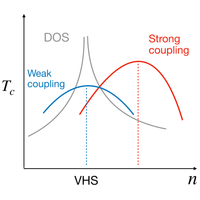
Using determinant quantum Monte Carlo simulations, the authors compute here the superconducting transition temperature of the two-dimensional attractive Hubbard model near ordinary and higher-order Van Hove singularities. Contrary to conventional wisdom, the authors find that the maximal in the model occurs away from the Van Hove singularities, when the system is in the intermediate coupling regime.
Matthew Houtput, Ingvar Zappacosta, William Wenborn, Serghei Klimin, Samuel Poncé, Jacques Tempere, and Cesare Franchini
Phys. Rev. B 114, L200301 (2026) - Published 8 October, 2026
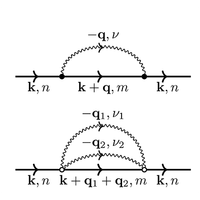
The carrier mobility in many materials is dominated by scattering of the carriers with phonons. It is often calculated using only linear, one-electron–one-phonon interaction. Here, the authors present a first-principles calculation of the mobility including the nonlinear, long-range electron-phonon interaction, for the representative halide perovskite CsPbI. It is shown that the temperature dependence of the carrier mobility decreases by about 10% due to the one-electron–two-phonon interaction, which is attributed to the strong anharmonicity and low phonon frequencies present in halide perovskites.
Khalil Zakeri, Arthur Ernst, and Christopher Hins
Phys. Rev. B 114, L200405 (2026) - Published 27 October, 2026
Long celebrated in graphene, Dirac physics inspires the search for similar phenomena in magnonic systems. Here, the authors experimentally demonstrate that magnons in an epitaxial Co bilayer on Ru(0001) exhibit Dirac properties near the Brillouin zone corner. Remarkably, the substrate does not destroy the essential physics; despite breaking sublattice symmetry and opening a gap, local valley topology remains intact. Beyond opening possibilities for discovering Dirac magnons in other ultrathin 3 magnetic films, these findings hold promise for on-chip magnonic applications.
Shunpei Yamaguchi, Nae Sasaki, Shintaro Adachi, Keiichi Harada, Yuki Teramoto, Shintaro Matsuda, Tomohiro Usui, Takenori Fujii, Takashi Noji, Itsuhiro Kakeya, Haruka Taniguchi, Michiaki Matsukawa, Atsushi Miyake, Hajime Ishikawa, Koichi Kindo, and Takao Watanabe
Phys. Rev. B 114, L200501 (2026) - Published 14 October, 2026
Elucidating the origin of the pseudogap remains a central challenge in copper oxide high‑ superconductors. By investigating the magnetotransport properties of Bi‑2212 and Bi‑2223 single crystals, the authors demonstrate here that the pseudogap and superconducting fluctuations are distinct phenomena. Their results strongly suggest that the pseudogap arises from preformed Cooper pairing in the BCS–BEC crossover regime, imposing stringent constraints on theoretical descriptions of high‑ cuprates beyond the conventional BCS paradigm.
Kailun Wang, Jingming Chen, Yue Shen, Muyang Han, Xiang Li, Zhen Gao, and Ying Wu
Phys. Rev. B 114, L200101 (2026) - Published 30 October, 2026
Matthew Houtput, Ingvar Zappacosta, William Wenborn, Serghei Klimin, Samuel Poncé, Jacques Tempere, and Cesare Franchini
Phys. Rev. B 114, L200301 (2026) - Published 8 October, 2026
The carrier mobility in many materials is dominated by scattering of the carriers with phonons. It is often calculated using only linear, one-electron–one-phonon interaction. Here, the authors present a first-principles calculation of the mobility including the nonlinear, long-range electron-phonon interaction, for the representative halide perovskite CsPbI. It is shown that the temperature dependence of the carrier mobility decreases by about 10% due to the one-electron–two-phonon interaction, which is attributed to the strong anharmonicity and low phonon frequencies present in halide perovskites.
Naafis Ahnaf Shahed, Himanshu Mavani, Zhonglin He, Kai Huang, Mohamed Elekhtiar, and Evgeny Y. Tsymbal
Phys. Rev. B 114, L200401 (2026) - Published 7 October, 2026
Dinesh Wagle, Anish Rai, and M. Benjamin Jungfleisch
Phys. Rev. B 114, L200402 (2026) - Published 9 October, 2026
Koki Mizuno
Phys. Rev. B 114, L200403 (2026) - Published 19 October, 2026
Andrei Shumilin, Diego López-Alcalá, Nassima Benchtaber, Alberto M. Ruiz, and José J. Baldoví
Phys. Rev. B 114, L200404 (2026) - Published 19 October, 2026
Khalil Zakeri, Arthur Ernst, and Christopher Hins
Phys. Rev. B 114, L200405 (2026) - Published 27 October, 2026
Long celebrated in graphene, Dirac physics inspires the search for similar phenomena in magnonic systems. Here, the authors experimentally demonstrate that magnons in an epitaxial Co bilayer on Ru(0001) exhibit Dirac properties near the Brillouin zone corner. Remarkably, the substrate does not destroy the essential physics; despite breaking sublattice symmetry and opening a gap, local valley topology remains intact. Beyond opening possibilities for discovering Dirac magnons in other ultrathin 3 magnetic films, these findings hold promise for on-chip magnonic applications.
Yongzhang Shi, Chi Zhang, Zhenhui Hao, Changjun Jiang, C. K. Ong, Ke Xia, and Guozhi Chai
Phys. Rev. B 114, L200406 (2026) - Published 30 October, 2026
Shunpei Yamaguchi, Nae Sasaki, Shintaro Adachi, Keiichi Harada, Yuki Teramoto, Shintaro Matsuda, Tomohiro Usui, Takenori Fujii, Takashi Noji, Itsuhiro Kakeya, Haruka Taniguchi, Michiaki Matsukawa, Atsushi Miyake, Hajime Ishikawa, Koichi Kindo, and Takao Watanabe
Phys. Rev. B 114, L200501 (2026) - Published 14 October, 2026
Elucidating the origin of the pseudogap remains a central challenge in copper oxide high‑ superconductors. By investigating the magnetotransport properties of Bi‑2212 and Bi‑2223 single crystals, the authors demonstrate here that the pseudogap and superconducting fluctuations are distinct phenomena. Their results strongly suggest that the pseudogap arises from preformed Cooper pairing in the BCS–BEC crossover regime, imposing stringent constraints on theoretical descriptions of high‑ cuprates beyond the conventional BCS paradigm.
Hamed Vakili, Moaz Ali, Igor Žutić, and Alexey A. Kovalev
Phys. Rev. B 114, L200502 (2026) - Published 15 October, 2026
Einar Skoglund, Maxim A. Tjøtta, and Sol H. Jacobsen
Phys. Rev. B 114, L200503 (2026) - Published 20 October, 2026
Mungo Frost et al.
Phys. Rev. B 114, 204101 (2026) - Published 1 October, 2026
Under extreme conditions hydrocarbons are known to demix, forming diamond and a hydrogen-rich phase. Here, the authors probe the timescale of this process as a function of pressure and composition. Various hydrocarbon samples were compressed to between 20 and 80 GPa in diamond anvil cells prior to serial x-ray free electron laser heating and time-resolved diffraction. They find that carbon-rich precursors form diamond in 10s of microseconds over the whole pressure range, while hydrogen rich ones take longer. [Image credit: Greg Stewart/SLAC National Accelerator Laboratory]
Yifan Shao, Xiumei Wang, and Xingping Zhou
Phys. Rev. B 114, 204102 (2026) - Published 5 October, 2026
Amir Youssefi, Mahdi Chegnizadeh, Francis Bettsworth, Richard Pedurand, Eddy Collin, Tobias J. Kippenberg, and Andrew Fefferman
Phys. Rev. B 114, 204103 (2026) - Published 6 October, 2026
Dalia M. Sayed Ahmed, Yongwen Sun, Yang Yang, and Miaomiao Jin
Phys. Rev. B 114, 204104 (2026) - Published 8 October, 2026
D. N. Polsin, Z. Liu, J. R. Rygg, M. K. Ginnane, X. Gong, C. J. Wu, G. W. Collins, and M. C. Marshall
Phys. Rev. B 114, 204105 (2026) - Published 13 October, 2026
Bingru Lu, Yi Liu, Keyi Li, Jing Kang, Hao Li, Xiang Li, Wenbo Sang, Anmin Zhang, Jianting Ji, Guanghan Cao, Feng Jin, and Qingming Zhang
Phys. Rev. B 114, 204106 (2026) - Published 16 October, 2026
Siavash Karbasizadeh, Wooin Yang, Wonhee Ko, Haidong Zhou, An-Ping Li, Tom Berlijn, and Sai Mu
Phys. Rev. B 114, 204107 (2026) - Published 22 October, 2026
Gonzalo N. Molina, Alvaro Rosa, Manuel Otero, Goran Karapetrov, and Gustavo M. Morales
Phys. Rev. B 114, 204108 (2026) - Published 26 October, 2026
Pei-Jia Hu, Jia-Le Yu, Irfan Hussain Bhat, Tie-Feng Fang, Ai-Min Guo, and Qing-Feng Sun
Phys. Rev. B 114, 204201 (2026) - Published 14 October, 2026
Huaijin Dong and Long Zhang
Phys. Rev. B 114, 204202 (2026) - Published 14 October, 2026
Yaprak Önder, Abbas Ali Saberi, and Roderich Moessner
Phys. Rev. B 114, 204203 (2026) - Published 16 October, 2026
I. Santamaría-Holek and A. Pérez-Madrid
Phys. Rev. B 114, 204204 (2026) - Published 26 October, 2026
Saurav Kantha and Nicolas Laflorencie
Phys. Rev. B 114, 204205 (2026) - Published 26 October, 2026
Kai Müller, Kimmo Luoma, and Christian Schäfer
Phys. Rev. B 114, 204301 (2026) - Published 8 October, 2026
Jie Yang, Luyao Zhong, and Xiaolong Yang
Phys. Rev. B 114, 204302 (2026) - Published 9 October, 2026
Zezhu Zeng, Michele Simoncelli, and David E. Manolopoulos
Phys. Rev. B 114, 204303 (2026) - Published 9 October, 2026
Chenyang Cao, Yifei Ning, Yongbo Shi, Yu Bao, Hongfei Li, Panpan Gao, Shuo Cao, and Ping Qian
Phys. Rev. B 114, 204304 (2026) - Published 13 October, 2026
X. Z. Zhang
Phys. Rev. B 114, 204305 (2026) - Published 13 October, 2026
Lucien Jezequel, Loïc Herviou, and Jens H. Bardarson
Phys. Rev. B 114, 204306 (2026) - Published 14 October, 2026
Anna A. Varvari, Nicholas S. Nye, Dimitrios I. Karatzidis, and Nikolaos V. Kantartzis
Phys. Rev. B 114, 204307 (2026) - Published 15 October, 2026
Jackson Davis, Jesse Liebman, Dibyata Rout, S. J. Gomez Alvarado, Stephen D. Wilson, and Natalia Drichko
Phys. Rev. B 114, 204308 (2026) - Published 16 October, 2026
Frederick Del Pozo, Tangi Morvan, Irénée Frérot, and Nicolas Cherroret
Phys. Rev. B 114, 204309 (2026) - Published 19 October, 2026
Xiangyu Cao
Phys. Rev. B 114, 204310 (2026) - Published 19 October, 2026
Yan Huang, Wanying Liu, Yangyu Guo, and Hong-Liang Yi
Phys. Rev. B 114, 204311 (2026) - Published 23 October, 2026
Stephen W. Yan, Diego Barberena, Matthew P. A. Fisher, and Sagar Vijay
Phys. Rev. B 114, 204312 (2026) - Published 23 October, 2026
Qingqing Zhang, Xiaolong Yang, Rui Wang, Zhenxiang Cheng, Xuewei Lv, Xianyong Ding, Peng Yu, and Xin Jin
Phys. Rev. B 114, 204313 (2026) - Published 26 October, 2026
J. Cao, K. L. Zhang, R. Wang, and X. Z. Zhang
Phys. Rev. B 114, 204314 (2026) - Published 27 October, 2026
Sreerag Sundaram, Ziqi Guo, Dudong Feng, Karthik Sasihithlu, and Xiulin Ruan
Phys. Rev. B 114, 204315 (2026) - Published 28 October, 2026
Basanta Mistri, Vishal Ranjan, and Siddharth Dhomkar
Phys. Rev. B 114, 204316 (2026) - Published 29 October, 2026
Srimal Rathnayaka, Luke Daemen, and Despina Louca
Phys. Rev. B 114, 204401 (2026) - Published 1 October, 2026
Min-Fong Yang
Phys. Rev. B 114, 204402 (2026) - Published 1 October, 2026
Bui D. Hoi
Phys. Rev. B 114, 204403 (2026) - Published 1 October, 2026
Wojciech Marciniak, José Ángel Castellanos-Reyes, Joanna Marciniak, and Mirosław Werwiński
Phys. Rev. B 114, 204404 (2026) - Published 5 October, 2026
Xu Bai, Tianyang Yao, Yunfei Ke, WL Qubie, Desheng Xue, Xiaolong Fan, and Junli Zhang
Phys. Rev. B 114, 204405 (2026) - Published 5 October, 2026
Inés Corte, Federico Holik, Lorena Rebón, and Flavia A. Gómez Albarracín
Phys. Rev. B 114, 204406 (2026) - Published 5 October, 2026
Alireza Ataei, Olle Eriksson, and Vahid Azimi-Mousolou
Phys. Rev. B 114, 204407 (2026) - Published 6 October, 2026
J. Fransson
Phys. Rev. B 114, 204408 (2026) - Published 9 October, 2026
M. A. Prosnikov, A. D. Molchanova, V. Yu. Davydov, A. N. Smirnov, K. N. Boldyrev, R. V. Pisarev, and M. N. Popova
Phys. Rev. B 114, 204409 (2026) - Published 9 October, 2026
Anupama Chauhan, Sidhanta Sahu, Satyabrata Bera, Tuhin Debnath, Mintu Mondal, Anamitra Mukherjee, Siddhartha Lal, and N. Kamaraju
Phys. Rev. B 114, 204410 (2026) - Published 13 October, 2026
Weiyi Pan, Gusthavo M. S. Brizolla, and Jaroslav Fabian
Phys. Rev. B 114, 204411 (2026) - Published 14 October, 2026
Anne Bernand-Mantel, Valeriy V. Slastikov, and Cyrill B. Muratov
Phys. Rev. B 114, 204412 (2026) - Published 14 October, 2026
Sebin Jung, Hiroki Koizumi, Hiroaki Sukegawa, and Hideto Yanagihara
Phys. Rev. B 114, 204413 (2026) - Published 14 October, 2026
Donghang Xie, Shuai Zhang, Haozhe Wang, Zhuoyi Li, Jiarui Chen, Jiahua Lu, Bo Liu, Jun Du, Jing Wu, Ronghua Liu, Rong Zhang, Yongbing Xu, and Xuezhong Ruan
Phys. Rev. B 114, 204414 (2026) - Published 15 October, 2026
Kaixin Ye, Qihe Yu, Yongjian Li, Yanan Zhang, Ye Chen, Rui Li, Lin Jiao, M. Smidman, Yongjun Zhang, Yu Liu, and Huiqiu Yuan
Phys. Rev. B 114, 204415 (2026) - Published 14 October, 2026
H. Bocquet, C. J. Ganahl, M. S. Scheurer, P. M. Derlet, and A. M. Läuchli
Phys. Rev. B 114, 204416 (2026) - Published 15 October, 2026
Raju Baral, Haidong Zhou, Qiang Zhang, Benjamin A. Frandsen, and Stuart Calder
Phys. Rev. B 114, 204417 (2026) - Published 16 October, 2026
Jin Ding, Yang Liu, Feihao Pan, Yinghao Zhu, Yixi Su, Stanislav E. Nikitin, Ursula B. Hansen, Mechthild Enderle, Zhilun Lu, Linxuan Song, Yong-Chang Lau, Xiaoyan Ma, Enke Liu, and Huiqian Luo
Phys. Rev. B 114, 204418 (2026) - Published 19 October, 2026
Yuting Chang, Huakun Zuo, Junfeng Wang, and Chengliang Lu
Phys. Rev. B 114, 204419 (2026) - Published 19 October, 2026
A. Magar, Sebin J. Sebastian, Q.-P. Ding, Y. Skourski, A. A. Tsirlin, Y. Furukawa, and R. Nath
Phys. Rev. B 114, 204420 (2026) - Published 20 October, 2026
Zongying Wang and Weiyi Pan
Phys. Rev. B 114, 204421 (2026) - Published 20 October, 2026
Ying Zhang, Xin Chen, Hang Xie, Ziyan Luo, Yihong Wu, and Lei Shen (沈雷)
Phys. Rev. B 114, 204422 (2026) - Published 21 October, 2026
Peng Rao, Johannes Gröbmeyer, P. Peter Stavropoulos, Alexander Mook, Matthias Althammer, Hans Huebl, Alexander Holleitner, and Johannes Knolle
Phys. Rev. B 114, 204423 (2026) - Published 22 October, 2026
Gusthavo M. S. Brizolla, Stepan S. Tsirkin, Yaroslav Zhumagulov, and Jaroslav Fabian
Phys. Rev. B 114, 204424 (2026) - Published 22 October, 2026
Spin–orbit torque (SOT) enables electrical magnetization control in spintronic devices. Here, the authors calculate SOT in monolayer FeGeTe and FeGaTe, van der Waals ferromagnets with perpendicular magnetic anisotropy and no reliance on heavy atoms for strong spin–orbit coupling. Horizontal mirror symmetry forbids conventional in-plane spin accumulation for out-of-plane magnetization, while tilting the magnetization enables a strongly angle-dependent response. Combining density functional theory, Wannier interpolation, and Kubo formalism, they map the torque across the magnetization sphere. They reveal hidden torques on mirror-related Fe atoms up to 30 times the net torque, whose cancellation could be lifted through van der Waals engineering.
Lijie Liu, Mingbo Dou, Xu Chen, Xianjie Wang, M. Ye. Zhuravlev, A. V. Nikolaev, and L. L. Tao
Phys. Rev. B 114, 204425 (2026) - Published 23 October, 2026
Zhen Zhang, Jing-Yang You, and Lixing Kang
Phys. Rev. B 114, 204426 (2026) - Published 23 October, 2026
P. Ritzinger, O. Sedláček, J. Železný, and K. Výborný
Phys. Rev. B 114, 204427 (2026) - Published 23 October, 2026
Sanjay Kumar, Rashi Nathawat, Arvind Kumar Yogi, and Satyapal S. Rathore
Phys. Rev. B 114, 204428 (2026) - Published 27 October, 2026
Bin Wang, Yantao Cao, Andi Liu, Guoliang Wu, Jin Zhou, Xiaobai Ma, Wenyun Yang, Takashi Ohhara, Akiko Nakao, Koji Munakata, Bing Shen, Zhendong Fu, Zhaoming Tian, Qian Tao, Zhu-an Xu, Wei Li, Jinkui Zhao, and Hanjie Guo
Phys. Rev. B 114, 204429 (2026) - Published 28 October, 2026
B. Pekerten, A. Chilampankunnel Prasannan, and A. Matos-Abiague
Phys. Rev. B 114, 204501 (2026) - Published 2 October, 2026
Lie Yuan, Junkang Huang, Yu-Xuan Li, and Tao Zhou
Phys. Rev. B 114, 204502 (2026) - Published 2 October, 2026
Amanuel M. Berhane, Susan N. Coppersmith, Emma E. Mitchell, and Timothy L. Duty
Phys. Rev. B 114, 204503 (2026) - Published 5 October, 2026
Disorder strongly modifies the collective electronic state of one-dimensional Josephson junction arrays. However, identifying types of disorder and understanding their link to collective behavior remain challenging. Here, the authors find three classes of fabrication-induced structural disorder and investigate their effects on critical-voltage scaling of arrays in the insulating state. While the scaling remains remarkably robust against some fabrication-induced variations, arrays containing nanoscale gaps exhibit significantly different behavior, demonstrating that the nature of disorder influences the collective state of the system.
Andreas Leithe-Jasper, Markus König, Yusei Shimizu, Konstantin Semeniuk, Primož Koželj, Mitja Krnel, Paul Simon, Wilder Carrillo-Cabrera, Nazar Zaremba, Marcel Naumann, Ulrich Burkhardt, Thomas Doert, Yurii Prots, Alfred Amon, Elena Gati, Matthias Vojta, Yuri Grin, Elena Hassinger, and Eteri Svanidze
Phys. Rev. B 114, 204504 (2026) - Published 9 October, 2026
G. A. Bobkov, I. V. Bobkova, A. M. Bobkov, K. B. Polevoy, and V. S. Stolyarov
Phys. Rev. B 114, 204505 (2026) - Published 14 October, 2026
Gustav Romare, Daniel Shaffer, Alex Levchenko, Edwin Huang, and Ilya Esterlis
Phys. Rev. B 114, 204506 (2026) - Published 19 October, 2026
Using determinant quantum Monte Carlo simulations, the authors compute here the superconducting transition temperature of the two-dimensional attractive Hubbard model near ordinary and higher-order Van Hove singularities. Contrary to conventional wisdom, the authors find that the maximal in the model occurs away from the Van Hove singularities, when the system is in the intermediate coupling regime.
Shubham Sinha, Wencheng Lu, Mads F. Hansen, Michael J. Hutcheon, Trevor W. Bontke, Lewis J. Conway, Kapildeb Dolui, Chris J. Pickard, Christoph Heil, Piotr A. Guńka, Stella Chariton, Vitali Prakapenka, Liangzi Deng, Ching-Wu Chu, Matthew N. Julian, Rohit P. Prasankumar, and Timothy A. Strobel
Phys. Rev. B 114, 204507 (2026) - Published 26 October, 2026
Yudai Sato, Maialen Ortego Larrazabal, Jian-Feng Ge, Ingmar Swart, Doohee Cho, Wolfgang Belzig, Juan Carlos Cuevas, Milan P. Allan, and Jiasen Niu
Phys. Rev. B 114, 204508 (2026) - Published 26 October, 2026
Alfonso Maiellaro
Phys. Rev. B 114, 204509 (2026) - Published 26 October, 2026
Lovy Sharma, Bimal Ghimire, and Manisha Thakurathi
Phys. Rev. B 114, 204510 (2026) - Published 30 October, 2026
Jesko Sirker
Phys. Rev. B 114, 206301 (2026) - Published 5 October, 2026
S. Ansari, R. Jafari, A. Akbari, and M. Abdi
Phys. Rev. B 114, 206302 (2026) - Published 5 October, 2026