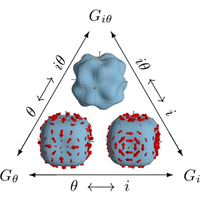
We present a general, systematic, and quantitative theory of electromagnetism and chirality in crystalline solids. Symmetry is its basic guiding principle, enabling us to consider macroscopic multipole densities without reference to any specific microscopic configurations. We use a formal analogy between space inversion and time inversion to identify two complementary, comprehensive classifications of crystals, based on five categories of electric and magnetic multipole order—called polarizations—and five categories of chirality. The five categories of polarizations (parapolar, electropolar, magnetopolar, antimagnetopolar, and multipolar) embody the variety of ways in which electromagnetic multipole order can be realized in solids, thus expanding the familiar notion of electric dipolarization in ferroelectrics and magnetization in ferromagnets to higher-rank multipole densities characterizing, e.g., altermagnets and alterelectrics. Group theory also permits the absolute, gauge-invariant quantification of these multipole densities. The five categories of chirality (parachiral, electrochiral, magnetochiral, antimagnetochiral, and multichiral) extend the notion of enantiomorphism—conventionally associated with the lack of spatial mirror symmetries—to include all possibilities for creating nonsuperposable images by applying the inversions , , and . In particular, multichiral systems lack all inversion symmetries and therefore have four different enantiomorphs. Each category of chirality is shown to arise from particular superpositions of electric and magnetic multipole densities. Our theory has great predictive power by relating electric and magnetic multipolar order with, e.g., distinctive features in the crystal structure, the electronic band structure, property tensors, and response tensors of quantum materials. These findings are critical for a large community working on fundamental and applied aspects of novel quantum materials.