

- Open Access
Non-Hermitian Bethe-Salpeter Equation for Open Systems: Emergence of Exceptional Points in Excitonic Spectra from First Principles
Phys. Rev. X 16, 031020 – Published 28 July, 2026
DOI: https://doi.org/10.1103/4488-tqfp
Abstract
In open quantum systems hosting excitons, dissipation mechanisms critically shape the excitonic dynamics, band structure, and topological properties. A microscopic understanding of excitons in such non-Hermitian settings demands a first-principles generalization of the Bethe-Salpeter equation (BSE). Building on a recently introduced nonequilibrium Green’s function formalism compatible with Lindbladian dynamics, we derive a non-Hermitian BSE from diagrammatic perturbation theory on the Keldysh contour, and obtain a microscopic excitonic Hamiltonian that incorporates dissipation while preserving causality. We apply the formalism to valley excitons in transition metal dichalcogenides coupled to structured photon baths. We uncover a rich landscape of exceptional points in momentum space, forming either discrete sets or continuous manifolds, depending on bath structure. The exceptional points give rise to nonanalytic valley polarization, unusual polarization pattern in photoluminescence, and nontrivial topological signatures. Our results establish a first-principles framework for predicting and controlling excitonic behavior in open quantum materials, showing how engineered environments can be leveraged to induce and manipulate non-Hermitian and topological properties.
Physics Subject Headings (PhySH)
Popular Summary
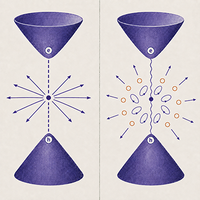
Modeling exciton behavior in open quantum systems remains a major theoretical challenge because conventional frameworks cannot capture the continuous flow of energy between a material and the external environment. We addressed this by developing a first-principles framework that extends the Bethe-Salpeter equation to incorporate the effects of dissipation and decoherence while preserving the causal structure of quantum dynamics. Applying this formalism to valley excitons in transition metal dichalcogenides, we demonstrated that engineered photonic environments can induce a rich landscape of exceptional points where distinct quantum states merge into one. Our calculations show that these spectral singularities lead to striking observable phenomena, including nonanalytic valley polarization and unusual light emission patterns. These results provide a predictive tool for controlling the optical and valleytronic properties of open quantum structures. Our work establishes a rigorous foundation for designing non-Hermitian quantum devices that leverage environmental coupling to manipulate excitonic states.
Article Text
References (123)
- S. Mandal, R. Banerjee, E. A. Ostrovskaya, and T. C. H. Liew, Nonreciprocal transport of exciton polaritons in a non-Hermitian chain, Phys. Rev. Lett. 125, 123902 (2020).
- Y.-M. Robin Hu, E. A. Ostrovskaya, and E. Estrecho, Wave-packet dynamics in a non-Hermitian exciton-polariton system, Phys. Rev. B 108, 115404 (2023).
- Y.-M. R. Hu, E. A. Ostrovskaya, and E. Estrecho, Generalized quantum geometric tensor in a non-Hermitian exciton-polariton system, Opt. Mater. Express 14, 664 (2024).
- F. Toffoletti and E. Collini, Coherent phenomena in exciton–polariton systems, J. Phys. 8, 022002 (2025).
- X. Gan, Y. Gao, K. Fai Mak, X. Yao, R.-J. Shiue, A. van der Zande, M. E. Trusheim, F. Hatami, T. F. Heinz, J. Hone, and D. Englund, Controlling the spontaneous emission rate of monolayer in a photonic crystal nanocavity, Appl. Phys. Lett. 103, 181119 (2013).
- X. Liu, T. Galfsky, Z. Sun, F. Xia, E.-c. Lin, Y.-H. Lee, S. Kéna-Cohen, and V. M. Menon, Strong light–matter coupling in two-dimensional atomic crystals, Nat. Photonics 9, 30 (2015).
- T. Gao, E. Estrecho, K. Bliokh, T. Liew, M. Fraser, S. Brodbeck, M. Kamp, C. Schneider, S. Höfling, Y. Yamamoto et al., Observation of non-Hermitian degeneracies in a chaotic exciton-polariton billiard, Nature (London) 526, 554 (2015).
- M. Wurdack, T. Yun, M. Katzer, A. G. Truscott, A. Knorr, M. Selig, E. A. Ostrovskaya, and E. Estrecho, Negative-mass exciton polaritons induced by dissipative light-matter coupling in an atomically thin semiconductor, Nat. Commun. 14, 1026 (2023).
- T. Low, A. Chaves, J. D. Caldwell, A. Kumar, N. X. Fang, P. Avouris, T. F. Heinz, F. Guinea, L. Martin-Moreno, and F. Koppens, Polaritons in layered two-dimensional materials, Nat. Mater. 16, 182 (2017).
- R. El-Ganainy, K. G. Makris, M. Khajavikhan, Z. H. Musslimani, S. Rotter, and D. N. Christodoulides, Non-Hermitian physics and PT symmetry, Nat. Phys. 14, 11 (2018).
- Y. Ashida, Z. Gong, and M. Ueda, Non-Hermitian physics, Adv. Phys. 69, 249 (2020).
- E. J. Bergholtz, J. C. Budich, and F. K. Kunst, Exceptional topology of non-Hermitian systems, Rev. Mod. Phys. 93, 015005 (2021).
- F. Roccati, G. M. Palma, F. Ciccarello, and F. Bagarello, Non-Hermitian physics and master equations, Open Syst. Inf. Dyn. 29, 2250004 (2022).
- K. Ding, C. Fang, and G. Ma, Non-Hermitian topology and exceptional-point geometries, Nat. Rev. Phys. 4, 745 (2022).
- M. Reitz, C. Sommer, and C. Genes, Cooperative quantum phenomena in light-matter platforms, PRX Quantum 3, 010201 (2022).
- L. M. Sieberer, M. Buchhold, J. Marino, and S. Diehl, Universality in driven open quantum matter, Rev. Mod. Phys. 97, 025004 (2025).
- R. Fazio, J. Keeling, L. Mazza, and M. Schirò, Many-body open quantum systems, SciPost Phys. Lect. Notes 99 (2025), 10.21468/SciPostPhysLectNotes.99.
- M. Stefanini, A. A. Ziolkowska, D. Budker, U. Poschinger, F. Schmidt-Kaler, A. Browaeys, A. Imamoglu, D. Chang, and J. Marino, Is Lindblad for me?, arXiv:2506.22436.
- L. M. Sieberer, S. D. Huber, E. Altman, and S. Diehl, Dynamical critical phenomena in driven-dissipative systems, Phys. Rev. Lett. 110, 195301 (2013).
- L. A. Smirnov, D. A. Smirnova, E. A. Ostrovskaya, and Y. S. Kivshar, Dynamics and stability of dark solitons in exciton-polariton condensates, Phys. Rev. B 89, 235310 (2014).
- E. E. Salpeter and H. A. Bethe, A relativistic equation for bound-state problems, Phys. Rev. 84, 1232 (1951).
- G. Strinati, Application of the Green’s functions method to the study of the optical properties of semiconductors, Riv. Nuovo Cimento 11, 1 (1988).
- G. Onida, L. Reining, and A. Rubio, Electronic excitations: Density-functional versus many-body Green’s-function approaches, Rev. Mod. Phys. 74, 601 (2002).
- T. Sander, E. Maggio, and G. Kresse, Beyond the Tamm-Dancoff approximation for extended systems using exact diagonalization, Phys. Rev. B 92, 045209 (2015).
- E. Perfetto, D. Sangalli, A. Marini, and G. Stefanucci, Nonequilibrium Bethe-Salpeter equation for transient photoabsorption spectroscopy, Phys. Rev. B 92, 205304 (2015).
- X. Leng, F. Jin, M. Wei, and Y. Ma, GW method and Bethe–Salpeter equation for calculating electronic excitations, WIREs Comput. Mol. Sci. 6, 532 (2016).
- X. Blase, I. Duchemin, D. Jacquemin, and P.-F. Loos, The Bethe–Salpeter equation formalism: From physics to chemistry, J. Phys. Chem. Lett. 11, 7371 (2020).
- L. J. Sham and T. M. Rice, Many-particle derivation of the effective-mass equation for the Wannier exciton, Phys. Rev. 144, 708 (1966).
- W. Hanke and L. J. Sham, Dielectric response in the Wannier representation: Application to the optical spectrum of diamond, Phys. Rev. Lett. 33, 582 (1974).
- W. Hanke and L. J. Sham, Local-field and excitonic effects in the optical spectrum of a covalent crystal, Phys. Rev. B 12, 4501 (1975).
- W. Hanke and L. J. Sham, Many-particle effects in the optical spectrum of a semiconductor, Phys. Rev. B 21, 4656 (1980).
- G. Onida, L. Reining, R. W. Godby, R. Del Sole, and W. Andreoni, Ab initio calculations of the quasiparticle and absorption spectra of clusters: The sodium tetramer, Phys. Rev. Lett. 75, 818 (1995).
- W. G. Schmidt, S. Glutsch, P. H. Hahn, and F. Bechstedt, Efficient method to solve the Bethe-Salpeter equation, Phys. Rev. B 67, 085307 (2003).
- A. Marini, C. Hogan, M. Grüning, and D. Varsano, yambo: An ab initio tool for excited state calculations, Comput. Phys. Commun. 180, 1392 (2009).
- J. Deslippe, G. Samsonidze, D. A. Strubbe, M. Jain, M. L. Cohen, and S. G. Louie, BerkeleyGW: A massively parallel computer package for the calculation of the quasiparticle and optical properties of materials and nanostructures, Comput. Phys. Commun. 183, 1269 (2012).
- K. Krause and W. Klopper, Implementation of the Bethe-Salpeter equation in the TURBOMOLE program, J. Comput. Chem. 38, 383 (2017).
- C. Vorwerk, B. Aurich, C. Cocchi, and C. Draxl, Bethe–Salpeter equation for absorption and scattering spectroscopy: implementation in the exciting code, Electron. Struct. 1, 037001 (2019).
- A. H. Romero et al., ABINIT: Overview and focus on selected capabilities, J. Chem. Phys. 152, 124102 (2020).
- M. Wallerberger, H. Shinaoka, and A. Kauch, Solving the Bethe-Salpeter equation with exponential convergence, Phys. Rev. Res. 3, 033168 (2021).
- Q. Wang, C. Li, and Q. Tong, Non-Hermitian theory of valley excitons in two-dimensional semiconductors, Phys. Rev. Lett. 133, 236902 (2024).
- G. Stefanucci and R. van Leeuwen, Nonequilibrium Many-Body Theory of Quantum Systems: A Modern Introduction, 2nd ed. (Cambridge University Press, Cambridge, England, 2025).
- A. Kamenev, Field Theory of Non-Equilibrium Systems (Cambridge University Press, Cambridge, England, 2011).
- G. Stefanucci, R. van Leeuwen, and E. Perfetto, In and out-of-equilibrium ab initio theory of electrons and phonons, Phys. Rev. X 13, 031026 (2023).
- G. Lindblad, On the generators of quantum dynamical semigroups, Commun. Math. Phys. 48, 119 (1976).
- H.-P. Breuer and F. Petruccione, The Theory of Open Quantum Systems (Oxford University Press, New York, 2007).
- L. M. Sieberer, M. Buchhold, and S. Diehl, Keldysh field theory for driven open quantum systems, Rep. Prog. Phys. 79, 096001 (2016).
- H. C. Fogedby, Field-theoretical approach to open quantum systems and the Lindblad equation, Phys. Rev. A 106, 022205 (2022).
- F. Thompson and A. Kamenev, Field theory of many-body Lindbladian dynamics, Ann. Phys. (Amsterdam) 455, 169385 (2023).
- G. Stefanucci, Kadanoff-Baym equations for interacting systems with dissipative Lindbladian dynamics, Phys. Rev. Lett. 133, 066901 (2024).
- H. Aoki, N. Tsuji, M. Eckstein, M. Kollar, T. Oka, and P. Werner, Nonequilibrium dynamical mean-field theory and its applications, Rev. Mod. Phys. 86, 779 (2014).
- Y. Murakami, D. Golež, M. Eckstein, and P. Werner, Photoinduced enhancement of excitonic order, Phys. Rev. Lett. 119, 247601 (2017).
- A. Molina-Sánchez, D. Sangalli, L. Wirtz, and A. Marini, Ab initio calculations of ultrashort carrier dynamics in two-dimensional materials: Valley depolarization in single-layer , Nano Lett. 17, 4549 (2017).
- R. Tuovinen, D. Golež, M. Eckstein, and M. A. Sentef, Comparing the generalized Kadanoff-Baym ansatz with the full Kadanoff-Baym equations for an excitonic insulator out of equilibrium, Phys. Rev. B 102, 115157 (2020).
- E. Perfetto, Y. Pavlyukh, and G. Stefanucci, Real-time GW: Toward an ab initio description of the ultrafast carrier and exciton dynamics in two-dimensional materials, Phys. Rev. Lett. 128, 016801 (2022).
- E. Perfetto and G. Stefanucci, Real-time GW-Ehrenfest-Fan-Migdal method for nonequilibrium 2D Mater., Nano Lett. 23, 7029 (2023).
- S. Park, D. Kim, Y.-S. Choi, A. Baucour, D. Kim, S. Yoon, K. Watanabe, T. Taniguchi, J. Shin, J. Kim, and M.-K. Seo, Customizing radiative decay dynamics of two-dimensional excitons via position- and polarization-dependent vacuum-field interference, Nano Lett. 23, 2158 (2023).
- V. Gorini, A. Kossakowski, and E. C. G. Sudarshan, Completely positive dynamical semigroups of n-level systems, J. Math. Phys. (N.Y.) 17, 821 (1976).
- A. Boudjemâa, Nonequilibrium quench dynamics of Bose-Einstein condensates of microwave-shielded polar molecules, Phys. Rev. A 111, 063315 (2025).
- A. Picano, M. Vanhoecke, and M. Schirò, Heating dynamics of correlated fermions under dephasing, arXiv:2507.21804.
- P. Penc and F. H. L. Essler, Linear response and exact hydrodynamic projections in Lindblad equations with decoupled Bogoliubov hierarchies, SciPost Phys. 20, 058 (2026).
- A. Marché, G. Morettini, L. Mazza, L. Gotta, and L. Capizzi, Exceptional stationary state in a dephasing many-body open quantum system, Phys. Rev. Lett. 135, 020406 (2025).
- C. de Groot, A. Turzillo, and N. Schuch, Symmetry protected topological order in open quantum systems, Quantum 6, 856 (2022).
- S. Lieu, R. Belyansky, J. T. Young, R. Lundgren, V. V. Albert, and A. V. Gorshkov, Symmetry breaking and error correction in open quantum systems, Phys. Rev. Lett. 125, 240405 (2020).
- R. Mittal, T. Zander, J. Lang, and S. Diehl, Fermion quantum criticality far from equilibrium, Phys. Rev. X 16, 011069 (2026).
- A. Chaduteau, Derek K. K. Lee, and F. Schindler, Lindbladian versus postselected non-Hermitian topology, Phys. Rev. Lett. 136, 016603 (2026).
- A. McDonald and A. A. Clerk, Exact solutions of interacting dissipative systems via weak symmetries, Phys. Rev. Lett. 128, 033602 (2022).
- B. Buča and T. Prosen, A note on symmetry reductions of the Lindblad equation: Transport in constrained open spin chains, New J. Phys. 14, 073007 (2012).
- V. V. Albert and L. Jiang, Symmetries and conserved quantities in Lindblad master equations, Phys. Rev. A 89, 022118 (2014).
- K. Yokomizo and S. Murakami, Non-Bloch band theory of non-Hermitian systems, Phys. Rev. Lett. 123, 066404 (2019).
- S. Manna and B. Roy, Inner skin effects on non-Hermitian topological fractals, Commun. Phys. 6, 10 (2023).
- K. Gogoi, T. Nag, and A. K. Ghosh, Dissipation-induced majarona 0- and -modes in a driven Rashba nanowire, Phys. Rev. B 113, 054301 (2026).
- L. Zhou, Non-Hermitian floquet topological superconductors with multiple Majorana edge modes, Phys. Rev. B 101, 014306 (2020).
- A. K. Ghosh and T. Nag, Non-Hermitian higher-order topological superconductors in two dimensions: Statics and dynamics, Phys. Rev. B 106, L140303 (2022).
- I. Carusotto and C. Ciuti, Quantum fluids of light, Rev. Mod. Phys. 85, 299 (2013).
- M. Wouters and I. Carusotto, Excitations in a nonequilibrium Bose-Einstein condensate of exciton polaritons, Phys. Rev. Lett. 99, 140402 (2007).
- X. Feng, A. Zhou, F. Lu, G. Xianlong, and S. Cheng, When homogeneous systems meet dissipation and disorder, arXiv:2502.11383.
- Y. Liu, Z. Wang, C. Yang, J. Jie, and Y. Wang, Dissipation-induced extended-localized transition, Phys. Rev. Lett. 132, 216301 (2024).
- P. C. Martin and J. Schwinger, Theory of many-particle systems. i, Phys. Rev. 115, 1342 (1959).
- D. C. Langreth, in Linear and Nonlinear Electron Transport in Solids, edited by J. T. Devreese and E. van Doren (Plenum, New York, 1976), pp. 3–32.
- T. Blommel, E. Perfetto, G. Stefanucci, and V. Vlček, Unified simulation framework for correlated driven-dissipative quantum dynamics, Phys. Rev. B 112, 155122 (2025).
- Y. Zhang and T. Barthel, A direct algebraic proof for the non-positivity of Liouvillian eigenvalues in Markovian quantum dynamics, arXiv:2504.02256.
- G. Baym and L. P. Kadanoff, Conservation laws and correlation functions, Phys. Rev. 124, 287 (1961).
- C. Attaccalite, M. Grüning, and A. Marini, Real-time approach to the optical properties of solids and nanostructures: Time-dependent Bethe-Salpeter equation, Phys. Rev. B 84, 245110 (2011).
- S. Hirata and M. Head-Gordon, Time-dependent density functional theory within the Tamm–Dancoff approximation, Chem. Phys. Lett. 314, 291 (1999).
- D. F. Munoz-Arboleda, M. Stålhammar, and C. M. Smith, Thermodynamics of analogue black holes in a non-Hermitian tight-binding model, Phys. Rev. B 113, L081110 (2026).
- G. Wang, A. Chernikov, M. M. Glazov, T. F. Heinz, X. Marie, T. Amand, and B. Urbaszek, Colloquium: Excitons in atomically thin transition metal dichalcogenides, Rev. Mod. Phys. 90, 021001 (2018).
- H. Yu, G.-B. Liu, P. Gong, X. Xu, and W. Yao, Dirac cones and Dirac saddle points of bright excitons in monolayer transition metal dichalcogenides, Nat. Commun. 5, 3876 (2014).
- H. Yu, X. Cui, X. Xu, and W. Yao, Valley excitons in two-dimensional semiconductors, Natl. Sci. Rev. 2, 57 (2015).
- D. Y. Qiu, T. Cao, and S. G. Louie, Nonanalyticity, valley quantum phases, and lightlike exciton dispersion in monolayer transition metal dichalcogenides: Theory and first-principles calculations, Phys. Rev. Lett. 115, 176801 (2015).
- F. Wu, F. Qu, and A. H. MacDonald, Exciton band structure of monolayer , Phys. Rev. B 91, 075310 (2015).
- Z. Y. Zhu, Y. C. Cheng, and U. Schwingenschlögl, Giant spin-orbit-induced spin splitting in two-dimensional transition-metal dichalcogenide semiconductors, Phys. Rev. B 84, 153402 (2011).
- J.-D. Lin, P.-Y. Lo, G.-H. Peng, W.-H. Li, S.-Y. Huang, G.-Y. Chen, and S.-J. Cheng, Essential role of momentum-forbidden dark excitons in the energy transfer responses of monolayer transition-metal dichalcogenides, npj 2D Mater. Appl. 7, 51 (2023).
- G.-H. Peng, O. J. G. Sanchez, W.-H. Li, P.-Y. Lo, and S.-J. Cheng, Tailoring the superposition of finite-momentum valley exciton states in transition-metal dichalcogenide monolayers by using polarized twisted light, Phys. Rev. B 106, 155304 (2022).
- I.-T. Lu, M. Ruggenthaler, N. Tancogne-Dejean, S. Latini, M. Penz, and A. Rubio, Electron-photon exchange-correlation approximation for quantum-electrodynamical density-functional theory, Phys. Rev. A 109, 052823 (2024).
- X. Wang, D. Jaksch, and F. Schlawin, Excitonic enhancement of cavity-mediated interactions in a two-band Hubbard model, Phys. Rev. B 109, 115137 (2024).
- H. Liu, F. Troisi, H. Hübener, S. Latini, and A. Rubio, Cavity-mediated electron-electron interactions: Renormalizing Dirac states in graphene, Sci. Adv. 11, eadz1855 (2025).
- R. C. Devlin, A. Ambrosio, N. A. Rubin, J. P. B. Mueller, and F. Capasso, Arbitrary spin-to–orbital angular momentum conversion of light, Science 358, 896 (2017).
- G. Puentes, Spin-orbit angular momentum conversion in metamaterials and metasurfaces, Quantum Rep. 1, 91 (2019).
- L. Marrucci, E. Karimi, S. Slussarenko, B. Piccirillo, E. Santamato, E. Nagali, and F. Sciarrino, Spin-to-orbital conversion of the angular momentum of light and its classical and quantumapplications, J. Opt. 13, 064001 (2011).
- M. Yang, H.-Q. Zhang, Y.-W. Liao, Z.-H. Liu, Z.-W. Zhou, X.-X. Zhou, J.-S. Xu, Y.-J. Han, C.-F. Li, and G.-C. Guo, Topological band structure via twisted photons in a degenerate cavity, Nat. Commun. 13, 2040 (2022).
- L. Zhang, R. Gogna, W. Burg, E. Tutuc, and H. Deng, Photonic-crystal exciton-polaritons in monolayer semiconductors, Nat. Commun. 9, 713 (2018).
- S. B. Jäger, T. Schmit, G. Morigi, M. J. Holland, and R. Betzholz, Lindblad master equations for quantum systems coupled to dissipative bosonic modes, Phys. Rev. Lett. 129, 063601 (2022).
- A. M. Yao and M. J. Padgett, Orbital angular momentum: Origins, behavior and applications, Adv. Opt. Photonics 3, 161 (2011).
- Y. Shen, X. Wang, Z. Xie, C. Min, X. Fu, Q. Liu, M. Gong, and X. Yuan, Optical vortices 30 years on: Oam manipulation from topological charge to multiple singularities, Light Sci. Appl. 8, 90 (2019).
- E. Otte and C. Denz, Optical trapping gets structure: Structured light for advanced optical manipulation, Appl. Phys. Rev. 7, 041308 (2020).
- O. Emile and J. Emile, OAM of light: Origins and applications, Encyclopedia 5, 152 (2025).
- Y. Liu, S. Wang, and L. Lin, Reservoir engineering for nonreciprocal photon coupling in three-dimensional helical waveguides, Phys. Rev. A 111, 033528 (2025).
- H. Zeng, J. Dai, W. Yao, D. Xiao, and X. Cui, Valley polarization in MoS2 monolayers by optical pumping, Nat. Nanotechnol. 7, 490 (2012).
- K. F. Mak, K. He, J. Shan, and T. F. Heinz, Control of valley polarization in monolayer MoS2 by optical helicity, Nat. Nanotechnol. 7, 494 (2012).
- T. Cao, G. Wang, W. Han, H. Ye, C. Zhu, J. Shi, Q. Niu, P. Tan, E. Wang, B. Liu et al., Valley-selective circular dichroism of monolayer molybdenum disulphide, Nat. Commun. 3, 887 (2012).
- A. M. Jones, H. Yu, N. J. Ghimire, S. Wu, G. Aivazian, J. S. Ross, B. Zhao, J. Yan, D. G. Mandrus, D. Xiao et al., Optical generation of excitonic valley coherence in monolayer WSe2, Nat. Nanotechnol. 8, 634 (2013).
- W. Yao, D. Xiao, and Q. Niu, Valley-dependent optoelectronics from inversion symmetry breaking, Phys. Rev. B 77, 235406 (2008).
- D. Xiao, G.-B. Liu, W. Feng, X. Xu, and W. Yao, Coupled spin and valley physics in monolayers of and other group-VI dichalcogenides, Phys. Rev. Lett. 108, 196802 (2012).
- J. R. Schaibley, H. Yu, G. Clark, P. Rivera, J. S. Ross, K. L. Seyler, W. Yao, and X. Xu, Valleytronics in 2D materials, Nat. Rev. Mater. 1, 1 (2016).
- H. Shen, B. Zhen, and L. Fu, Topological band theory for non-Hermitian Hamiltonians, Phys. Rev. Lett. 120, 146402 (2018).
- M. Selig, G. Berghäuser, A. Raja, P. Nagler, C. Schüller, T. F. Heinz, T. Korn, A. Chernikov, E. Malic, and A. Knorr, Excitonic linewidth and coherence lifetime in monolayer transition metal dichalcogenides, Nat. Commun. 7, 13279 (2016).
- A. Thränhardt, S. Kuckenberg, A. Knorr, T. Meier, and S. W. Koch, Quantum theory of phonon-assisted exciton formation and luminescence in semiconductor quantum wells, Phys. Rev. B 62, 2706 (2000).
- S. Brem, M. Selig, G. Berghaeuser, and E. Malic, Exciton relaxation cascade in two-dimensional transition metal dichalcogenides, Sci. Rep. 8, 8238 (2018).
- G. Stefanucci and E. Perfetto, Excitonic Bloch equations from first principles, SciPost Phys. 18, 009 (2025).
- R. Su, E. Estrecho, D. Biegańska, Y. Huang, M. Wurdack, M. Pieczarka, A. G. Truscott, T. C. H. Liew, E. A. Ostrovskaya, and Q. Xiong, Direct measurement of a non-Hermitian topological invariant in a hybrid light-matter system, Sci. Adv. 7, eabj8905 (2021).
- H. Deng, H. Haug, and Y. Yamamoto, Exciton-polariton Bose-Einstein condensation, Rev. Mod. Phys. 82, 1489 (2010).
- E. Davidsson and M. Kowalewski, Simulating photodissociation reactions in bad cavities with the Lindblad equation, J. Chem. Phys. 153, 234304 (2020).
- D. Rosser, T. Fryett, A. Ryou, A. Saxena, and A. Majumdar, Exciton–phonon interactions in nanocavity-integrated monolayer transition metal dichalcogenides, npj 2D Mater. Appl. 4, 20 (2020).

