

- Open Access
Pseudogap, Fermi Liquid, Van Hove Singularity, and Maxima of the Compressibility and of the Knight Shift as a Function of Doping in the Two-Dimensional Hubbard Model
Phys. Rev. X 16, 031034 – Published 11 August, 2026
DOI: https://doi.org/10.1103/7v3y-tbbr
Abstract
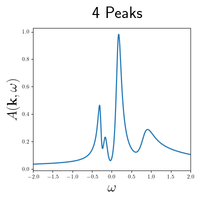
Qualitative changes in thermodynamic and single-particle properties characterize the transition between the pseudogapped electronic liquid and the Fermi liquid. Recent cold-atom experiments on a simulator of the Hubbard model with nearest-neighbor hoppings [L. H. Kendrick et al., arXiv:2509.18075.] showed that the isothermal compressibility has a maximum as a function of doping . Here, we use the two-particle self-consistent plus approach to explain these experiments and connect the maximum in to the transformation of the single-particle spectrum from the pseudogapped to the metallic regime. This elucidates the nature of the pseudogap. Specifically, the maximum in practically coincides with the doping at which the precursor of the lower spin-density-wave (SDW) band at the antinodal point crosses the zero-frequency . The Knight shift , as a function of doping, should also have a maximum. In addition, we demonstrate that two-particle self-consistent plus correctly predicts a maximum in the temperature dependence of the Knight shift , consistent with recent ultracold-atom experiments [T. Chalopin et al., Proc. Natl. Acad. Sci. U.S.A. 123, e2525539123 (2026).]. The maxima in both quantities should exist, at sufficiently low temperatures (), in both the intermediate and weak interaction limits. In both limits, the mechanism is critical thermal SDW fluctuations. At the antinodal pseudogap, the correlation length at can be small, controlled not by static but by dynamic critical thermal fluctuations. We also find that the SDW fluctuations are incommensurate at . We predict that, at low , the multiple peaks in the spin susceptibility in the incommensurate case lead to more than two SDW precursor peaks in the spectral function and density of states. By allowing access to parameter regimes relevant to cuprates—including further-neighbor hopping () and low temperatures, our work provides a high-impact tool for further studies by the broader community.
Physics Subject Headings (PhySH)
Popular Summary
Identifying the boundary of the pseudogap regime is a central challenge in understanding strongly correlated materials because clear thermodynamic signatures for this electronic transition have been difficult to pinpoint. We addressed this challenge by using the two-particle self-consistent plus method to analyze Hubbard model simulations, revealing that a distinct maximum in the isothermal compressibility serves as a definitive thermodynamic marker for the boundary. Our analysis shows that this peak occurs when thermal spin-density-wave fluctuations alter the single-particle spectrum, causing a precursor band to cross the zero-frequency level at the antinodal Van Hove point. We found that these critical magnetic fluctuations drive universal behaviors across weak and intermediate interaction strengths, yielding fresh predictions such as a doping-dependent maximum in the Knight shift and multipeak spectral structures at lower temperatures. These results provide an accessible tool for interpreting cold-atom quantum simulations under conditions that closely mimic real copper oxide superconductors. Our work establishes a rigorous theoretical foundation that guides the community in mapping phase boundaries and searching for unconventional superconductivity in correlated systems.
Article Text
References (198)
- I. Vishik, Photoemission perspective on pseudogap, superconducting fluctuations, and charge order in cuprates: A review of recent progress, Rep. Prog. Phys. 81, 062501 (2018).
- I. T. Clement, J. C. Ayerh, S. A. Muraina, and O. I. John, Unraveling the pseudo gap phase in cuprate superconductors: Experimental signature, theoretical frameworks, and its role in high temperature superconductivity, Asian J. Res. Rev. Phys. 9, 57 (2025).
- C. Proust and L. Taillefer, The remarkable underlying ground states of cuprate superconductors, Annu. Rev. Condens. Matter Phys. 10, 409 (2019).
- A. Kampf and J. R. Schrieffer, Pseudogaps and the spin-bag approach to high- superconductivity, Phys. Rev. B 41, 6399 (1990).
- Y. M. Vilk and A.-M. S. Tremblay, Destruction of Fermi-liquid quasiparticles in two dimensions by critical fluctuations, Europhys. Lett. 33, 159 (1996).
- Y. M. Vilk and A.-M. S. Tremblay, Non-perturbative many-body approach to the Hubbard model and single-particle pseudogap, J. Phys. I (France) 7, 1309 (1997).
- C. Varma, Non-Fermi-liquid states and pairing instability of a general model of copper oxide metals, Phys. Rev. B 55, 14554 (1997).
- M. R. Norman, M. Randeria, H. Ding, and J. C. Campuzano, Phenomenology of the low-energy spectral function in high- superconductors, Phys. Rev. B 57, R11093 (1998).
- M. Franz and A. J. Millis, Phase fluctuations and spectral properties of underdoped cuprates, Phys. Rev. B 58, 14572 (1998).
- Q. Chen, I. Kosztin, B. Jankó, and K. Levin, Pairing fluctuation theory of superconducting properties in underdoped to overdoped cuprates, Phys. Rev. Lett. 81, 4708 (1998).
- J. Schmalian, D. Pines, and B. Stojković, Microscopic theory of weak pseudogap behavior in the underdoped cuprate superconductors: General theory and quasiparticle properties, Phys. Rev. B 60, 667 (1999).
- D. Sénéchal and A.-M. S. Tremblay, Hot spots and pseudogaps for hole-and electron-doped high-temperature superconductors, Phys. Rev. Lett. 92, 126401 (2004).
- B. Kyung, S. S. Kancharla, D. Sénéchal, A.-M. S. Tremblay, M. Civelli, and G. Kotliar, Pseudogap induced by short-range spin correlations in a doped Mott insulator, Phys. Rev. B 73, 165114 (2006).
- M. Ferrero, P. S. Cornaglia, L. De Leo, O. Parcollet, G. Kotliar, and A. Georges, Pseudogap opening and formation of Fermi arcs as an orbital-selective Mott transition in momentum space, Phys. Rev. B 80, 064501 (2009).
- A. Liebsch and N.-H. Tong, Finite-temperature exact diagonalization cluster dynamical mean-field study of the two-dimensional Hubbard model: Pseudogap, non-Fermi-liquid behavior, and particle-hole asymmetry, Phys. Rev. B 80, 165126 (2009).
- G. Sordi, K. Haule, and A.-M. S. Tremblay, Finite doping signatures of the Mott transition in the two-dimensional Hubbard model, Phys. Rev. Lett. 104, 226402 (2010).
- E. Gull, M. Ferrero, O. Parcollet, A. Georges, and A. J. Millis, Momentum-space anisotropy and pseudogaps: A comparative cluster dynamical mean-field analysis of the doping-driven metal-insulator transition in the two-dimensional Hubbard model, Phys. Rev. B 82, 155101 (2010).
- G. Sordi, P. Sémon, K. Haule, and A.-M. Tremblay, Pseudogap temperature as a widom line in doped Mott insulators, Sci. Rep. 2, 547 (2012).
- E. Gull and A. J. Millis, Superconducting and pseudogap effects on the interplane conductivity and Raman scattering cross section in the two-dimensional Hubbard model, Phys. Rev. B 88, 075127 (2013).
- G. Sordi, P. Sémon, K. Haule, and A.-M. S. Tremblay, -axis resistivity, pseudogap, superconductivity, and widom line in doped Mott insulators, Phys. Rev. B 87, 041101(R) (2013).
- K. B. Efetov, H. Meier, and C. Pépin, Pseudogap state near a quantum critical point, Nat. Phys. 9, 442 (2013).
- C. Pépin, V. S. de Carvalho, T. Kloss, and X. Montiel, Pseudogap, charge order, and pairing density wave at the hot spots in cuprate superconductors, Phys. Rev. B 90, 195207 (2014).
- W. Atkinson, A. P. Kampf, and S. Bulut, Charge order in the pseudogap phase of cuprate superconductors, New J. Phys. 17, 013025 (2015).
- D. Chowdhury and S. Sachdev, The enigma of the pseudogap phase of the cuprate superconductors, in Quantum Criticality in Condensed Matter (World Scientific, Singapore, 2015), pp. 1–43.
- L. Fratino, P. Sémon, G. Sordi, and A.-M. S. Tremblay, Pseudogap and superconductivity in two-dimensional doped charge-transfer insulators, Phys. Rev. B 93, 245147 (2016).
- W. Wu, M. S. Scheurer, S. Chatterjee, S. Sachdev, A. Georges, and M. Ferrero, Pseudogap and Fermi-surface topology in the two-dimensional Hubbard model, Phys. Rev. X 8, 021048 (2018).
- C. M. Varma, Pseudogap and Fermi arcs in underdoped cuprates, Phys. Rev. B 99, 224516 (2019).
- Y.-M. Wu, S.-S. Zhang, A. Abanov, and A. V. Chubukov, Interplay between superconductivity and non-Fermi liquid behavior at a quantum-critical point in a metal. V. The model and its phase diagram: The case , Phys. Rev. B 103, 184508 (2021).
- L. Fratino, S. Bag, A. Camjayi, M. Civelli, and M. J. Rozenberg, Doping-driven pseudogap-metal-to-metal transition in correlated electron systems, arXiv:2109.06572.
- C. Gauvin-Ndiaye, P.-A. Graham, and A.-M. S. Tremblay, Disorder effects on hot spots in electron-doped cuprates, Phys. Rev. B 105, 235133 (2022).
- C. Walsh, M. Charlebois, P. Sémon, G. Sordi, and A.-M. S. Tremblay, Prediction of anomalies in the velocity of sound for the pseudogap of hole-doped cuprates, Phys. Rev. B 106, 235134 (2022).
- X.-C. Wang and Y. Qi, Phase fluctuations in two-dimensional superconductors and pseudogap phenomenon, Phys. Rev. B 107, 224502 (2023).
- M. Ye, Z. Wang, R. M. Fernandes, and A. V. Chubukov, Location and thermal evolution of the pseudogap due to spin fluctuations, Phys. Rev. B 108, 115156 (2023).
- Z. Dai, T. Senthil, and P. A. Lee, Modeling the pseudogap metallic state in cuprates: Quantum disordered pair density wave, Phys. Rev. B 101, 064502 (2020).
- M. Ye and A. V. Chubukov, Crucial role of thermal fluctuations and vertex corrections for the magnetic pseudogap, Phys. Rev. B 108, L081118 (2023).
- S. Sakai, Nonperturbative calculations for spectroscopic properties of cuprate high-temperature superconductors, J. Phys. Soc. Jpn. 92, 092001 (2023).
- E. K. Kokkinis and A. V. Chubukov, Pseudogap in electron-doped cuprates: Thermal precursor to magnetism, arXiv:2505.11727.
- P. M. Bonetti, M. Christos, A. Nikolaenko, A. A. Patel, and S. Sachdev, Fractionalized Fermi liquids and the cuprate phase diagram, Rep. Prog. Phys. 89, 044501 (2026).
- Y.-H. Zhang and S. Sachdev, From the pseudogap metal to the Fermi liquid using ancilla qubits, Phys. Rev. Res. 2, 023172 (2020).
- M. Meixner, H. Menke, M. Klett, S. Heinzelmann, S. Andergassen, P. Hansmann, and T. Schäfer, Mott transition and pseudogap of the square-lattice Hubbard model: Results from center-focused cellular dynamical mean-field theory, SciPost Phys. 16, 059 (2024).
- P. A. Lee, N. Nagaosa, and X.-G. Wen, Doping a Mott insulator: Physics of high-temperature superconductivity, Rev. Mod. Phys. 78, 17 (2006).
- M. Qin, T. Schäfer, S. Andergassen, P. Corboz, and E. Gull, The Hubbard model: A computational perspective, Annu. Rev. Condens. Matter Phys. 13, 275 (2022).
- M. Xu, L. H. Kendrick, A. Kale, Y. Gang, C. Feng, S. Zhang, A. W. Young, M. Lebrat, and M. Greiner, A neutral-atom Hubbard quantum simulator in the cryogenic regime, Nature (London) 642, 909 (2025).
- L. H. Kendrick, A. Kale, Y. Gang, A. D. Deters, M. Lebrat, A. W. Young, and M. Greiner, Pseudogap in a Fermi-Hubbard quantum simulator, arXiv:2509.18075.
- T. Chalopin, P. Bojović, S. Wang, T. Franz, A. Sinha, Z. Wang, D. Bourgund, J. Obermeyer, F. Grusdt, A. Bohrdt et al., Observation of emergent scaling of spin–charge correlations at the onset of the pseudogap, Proc. Natl. Acad. Sci. U.S.A. 123, e2525539123 (2026).
- R. Rossi, Direct sampling of the self-energy with connected determinant Monte Carlo, arXiv:1802.04743.
- F. Šimkovic and E. Kozik, Determinant Monte Carlo for irreducible Feynman diagrams in the strongly correlated regime, Phys. Rev. B 100, 121102(R) (2019).
- F. Šimkovic, R. Rossi, A. Georges, and M. Ferrero, Origin and fate of the pseudogap in the doped Hubbard model, Science 385, eade9194 (2024).
- F. Šimkovic IV, J. P. F. LeBlanc, A. J. Kim, Y. Deng, N. V. Prokof’ev, B. V. Svistunov, and E. Kozik, Extended crossover from a Fermi liquid to a quasiantiferromagnet in the half-filled 2D Hubbard model, Phys. Rev. Lett. 124, 017003 (2020).
- T. Schäfer, N. Wentzell, F. Šimkovic, Y.-Y. He, C. Hille, M. Klett, C. J. Eckhardt, B. Arzhang, V. Harkov, F.-M. Le Régent et al., Tracking the footprints of spin fluctuations: A multimethod, multimessenger study of the two-dimensional Hubbard model, Phys. Rev. X 11, 011058 (2021).
- S. Moukouri, S. Allen, F. Lemay, B. Kyung, D. Poulin, Y. M. Vilk, and A.-M. S. Tremblay, Many-body theory versus simulations for the pseudogap in the Hubbard model, Phys. Rev. B 61, 7887 (2000).
- T. Schäfer, F. Geles, D. Rost, G. Rohringer, E. Arrigoni, K. Held, N. Blümer, M. Aichhorn, and A. Toschi, Fate of the false Mott-Hubbard transition in two dimensions, Phys. Rev. B 91, 125109 (2015).
- A. Sinha and A. Wietek, Forestalled phase separation as the precursor to stripe order, Nat. Commun. 16, 10807 (2025).
- H. Xu, H. Shi, E. Vitali, M. Qin, and S. Zhang, Stripes and spin-density waves in the doped two-dimensional Hubbard model: Ground state phase diagram, Phys. Rev. Res. 4, 013239 (2022).
- C. Gauvin-Ndiaye, C. Lahaie, Y. M. Vilk, and A.-M. S. Tremblay, Improved two-particle self-consistent approach for the single-band Hubbard model in two dimensions, Phys. Rev. B 108, 075144 (2023).
- Y. M. Vilk, C. Lahaie, and A.-M. S. Tremblay, Antiferromagnetic pseudogap in the two-dimensional Hubbard model deep in the renormalized classical regime, Phys. Rev. B 110, 125154 (2024).
- W. Wu, M. S. Scheurer, M. Ferrero, and A. Georges, Effect of Van Hove singularities in the onset of pseudogap states in Mott insulators, Phys. Rev. Res. 2, 033067 (2020).
- Y. Vilk, Criteria and analytical results for the pseudogap at the Van Hove point in two dimensions, Phys. Rev. B 108, 235110 (2023).
- G. Sordi, K. Haule, and A.-M. S. Tremblay, Mott physics and first-order transition between two metals in the normal-state phase diagram of the two-dimensional Hubbard model, Phys. Rev. B 84, 075161 (2011).
- J. M. Tranquada, Cuprate superconductors as viewed through a striped lens, Adv. Phys. 69, 437 (2020).
- E. Fradkin, S. A. Kivelson, and J. M. Tranquada, Colloquium: Theory of intertwined orders in high temperature superconductors, Rev. Mod. Phys. 87, 457 (2015).
- F. Šimkovic, R. Rossi, and M. Ferrero, Two-dimensional Hubbard model at finite temperature: Weak, strong, and long correlation regimes, Phys. Rev. Res. 4, 043201 (2022).
- B. Xiao, Y.-Y. He, A. Georges, and S. Zhang, Temperature dependence of spin and charge orders in the doped two-dimensional Hubbard model, Phys. Rev. X 13, 011007 (2023).
- B.-X. Zheng, C.-M. Chung, P. Corboz, G. Ehlers, M.-P. Qin, R. M. Noack, H. Shi, S. R. White, S. Zhang, and G. K.-L. Chan, Stripe order in the underdoped region of the two-dimensional Hubbard model, Science 358, 1155 (2017).
- E. W. Huang, C. B. Mendl, S. Liu, S. Johnston, H.-C. Jiang, B. Moritz, and T. P. Devereaux, Numerical evidence of fluctuating stripes in the normal state of high-tc cuprate superconductors, Science 358, 1161 (2017).
- R. Mushkaev, F. Petocchi, S. Hoshino, and P. Werner, Spin stripes in the Hubbard model: A combined dynamical mean-field theory and Bethe-Salpeter analysis, Phys. Rev. B 112, 245165 (2025).
- T. P. Devereaux and S. A. Kivelson, The significance of “stripes” in the physics of the cuprates, the Hubbard model, and other highly correlated electronic systems, Physica C 632, 1354683 (2025).
- Y. Vilk, Hierarchy of pseudogap crossovers and their evolution with coupling strength in the two-dimensional Hubbard model (unpublished).
- A. J. Millis, H. Monien, and D. Pines, Phenomenological model of nuclear relaxation in the normal state of , Phys. Rev. B 42, 167 (1990).
- A.-M. Daré, Y. M. Vilk, and A.-M. S. Tremblay, Crossover from two-to three-dimensional critical behavior for nearly antiferromagnetic itinerant electrons, Phys. Rev. B 53, 14236 (1996).
- Y. Vilk, L. Chen, and A.-M. Tremblay, Theory of spin and charge fluctuations in the Hubbard model, Phys. Rev. B 49, 13267 (1994).
- A. M. S. Tremblay, Two-particle-self-consistent approach for the Hubbard model, in Strongly Correlated Systems: Theoretical Methods, edited by F. Mancini and A. Avella, Springer Series (Springer, New York, 2011), Chap. 13, pp. 409–455.
- M. R. Hedayati and G. Vignale, Ground-state energy of the one-and two-dimensional Hubbard model calculated by the method of Singwi, Tosi, Land, and Sjölander, Phys. Rev. B 40, 9044 (1989).
- L. P. Kadanoff and P. C. Martin, Theory of many-particle systems. II. superconductivity, Phys. Rev. 124, 670 (1961).
- Q. Chen, J. Stajic, S. Tan, and K. Levin, BCS–BEC crossover: From high temperature superconductors to ultracold superfluids, Phys. Rep. 412, 1 (2005).
- R. Boyack, Q. Chen, A. A. Varlamov, and K. Levin, Cuprate diamagnetism in the presence of a pseudogap: Beyond the standard fluctuation formalism, Phys. Rev. B 97, 064503 (2018).
- H. Shinaoka, J. Otsuki, M. Ohzeki, and K. Yoshimi, Compressing Green’s function using intermediate representation between imaginary-time and real-frequency domains, Phys. Rev. B 96, 035147 (2017).
- M. Wallerberger, S. Badr, S. Hoshino, F. Kakizawa, T. Koretsune, Y. Nagai, K. Nogaki, T. Nomoto, H. Mori, J. Otsuki, S. Ozaki, R. Sakurai, C. Vogel, N. Witt, K. Yoshimi, and H. Shinaoka, sparse-ir: Optimal compression and sparse sampling of many-body propagators, SoftwareX 21, 101266 (2023).
- J. Li, M. Wallerberger, N. Chikano, C.-N. Yeh, E. Gull, and H. Shinaoka, Sparse sampling approach to efficient ab initio calculations at finite temperature, Phys. Rev. B 101, 035144 (2020).
Because of differences in geometry and boundary conditions, finite-size effects manifest themselves somewhat differently in theoretical and experimental small systems. In particular, in a small theoretical system, exhibits a minimum as a consequence of the periodic boundary conditions, whereas small experimental systems do not show such a minimum. However, in both cases, the spread of the values for the same increases with distance, indicating significant finite-size effects for .
- D. C. Johnston, Magnetic susceptibility scaling in , Phys. Rev. Lett. 62, 957 (1989).
- H. Alloul, T. Ohno, and P. Mendels, Y 89 nmr evidence for a Fermi-liquid behavior in , Phys. Rev. Lett. 63, 1700 (1989).
- H. J. Schulz, Incommensurate antiferromagnetism in the two-dimensional Hubbard model, Phys. Rev. Lett. 64, 1445 (1990).
- Y. Vilk, Shadow features and shadow bands in the paramagnetic state of cuprate superconductors, Phys. Rev. B 55, 3870 (1997).
- T. A. Maier, M. Jarrell, T. Pruschke, and M. Hettler, Quantum cluster theories, Rev. Mod. Phys. 77, 1027 (2005).
- G. Kotliar, S. Y. Savrasov, K. Haule, V. S. Oudovenko, O. Parcollet, and C. A. Marianetti, Electronic structure calculations with dynamical mean-field theory, Rev. Mod. Phys. 78, 865 (2006).
- A.-M. S. Tremblay, B. Kyung, and D. Sénéchal, Pseudogap and high-temperature superconductivity from weak to strong coupling. Towards a quantitative theory (review article), Low Temp. Phys. 32, 424 (2006).
- M. Potthoff, Cluster extensions of dynamical meanfield theory, Chap. 5 in (Forschungszentrum Jülich GmbH Zentralbibliothek, Velag, Jülich, 2018), p. getr. Zählung.
- L. Xu, P. Kumar, S. V. Buldyrev, S.-H. Chen, P. H. Poole, F. Sciortino, and H. E. Stanley, Relation between the widom line and the dynamic crossover in systems with a liquid–liquid phase transition, Proc. Natl. Acad. Sci. U.S.A. 102, 16558 (2005).
- P.-O. Downey, O. Gingras, C.-D. Hébert, M. Charlebois, and A.-M. S. Tremblay, Doping the Mott insulating state of the triangular-lattice Hubbard model reveals the sordi transition, Phys. Rev. B 110, L121109 (2024).
- A. Reymbaut, M. Boulay, L. Fratino, P. Sémon, W. Wu, G. Sordi, and A.-M. S. Tremblay, Mott transition and high-temperature crossovers at half-filling, arXiv:2004.02302.
- L. Fratino, P. Sémon, M. Charlebois, G. Sordi, and A.-M. S. Tremblay, Signatures of the Mott transition in the antiferromagnetic state of the two-dimensional Hubbard model, Phys. Rev. B 95, 235109 (2017).
- A. I. Lichtenstein and M. I. Katsnelson, Antiferromagnetism and d-wave superconductivity in cuprates: A cluster dynamical mean-field theory, Phys. Rev. B 62, R9283 (2000).
- G. Biroli and G. Kotliar, Cluster methods for strongly correlated electron systems, Phys. Rev. B 65, 155112 (2002).
- M. Jarrell, T. Maier, C. Huscroft, and S. Moukouri, Quantum Monte Carlo algorithm for nonlocal corrections to the dynamical mean-field approximation, Phys. Rev. B 64, 195130 (2001).
- A. Georges, G. Kotliar, W. Krauth, and M. J. Rozenberg, Dynamical mean-field theory of strongly correlated fermion systems and the limit of infinite dimensions, Rev. Mod. Phys. 68, 13 (1996).
- A. Georges and G. Kotliar, Hubbard model in infinite dimensions, Phys. Rev. B 45, 6479 (1992).
- M. Jarrell, Hubbard model in infinite dimensions: A quantum Monte Carlo study, Phys. Rev. Lett. 69, 168 (1992).
- C. Huscroft, M. Jarrell, T. Maier, S. Moukouri, and A. N. Tahvildarzadeh, Pseudogaps in the 2D Hubbard model, Phys. Rev. Lett. 86, 139 (2001).
- A. Macridin, M. Jarrell, T. Maier, P. R. C. Kent, and E. D’Azevedo, Pseudogap and antiferromagnetic correlations in the Hubbard model, Phys. Rev. Lett. 97, 036401 (2006).
- T. D. Stanescu and G. Kotliar, Fermi arcs and hidden zeros of the Green function in the pseudogap state, Phys. Rev. B 74, 125110 (2006).
- S. Sakai, Y. Motome, and M. Imada, Evolution of electronic structure of doped Mott insulators: Reconstruction of poles and zeros of Green’s function, Phys. Rev. Lett. 102, 056404 (2009).
- N. S. Vidhyadhiraja, A. Macridin, C. Şen, M. Jarrell, and M. Ma, Quantum critical point at finite doping in the 2D Hubbard model: A dynamical cluster quantum Monte Carlo study, Phys. Rev. Lett. 102, 206407 (2009).
- G. Sordi, P. Sémon, K. Haule, and A.-M. S. Tremblay, Strong coupling superconductivity, pseudogap, and Mott transition, Phys. Rev. Lett. 108, 216401 (2012).
- E. Gull, O. Parcollet, and A. J. Millis, Superconductivity and the pseudogap in the two-dimensional Hubbard model, Phys. Rev. Lett. 110, 216405 (2013).
- A. Reymbaut, S. Bergeron, R. Garioud, M. Thénault, M. Charlebois, P. Sémon, and A.-M. S. Tremblay, Pseudogap, van hove singularity, maximum in entropy, and specific heat for hole-doped Mott insulators, Phys. Rev. Res. 1, 023015 (2019).
- S. S. Dash and D. Sénéchal, Pseudogap transition within the superconducting phase in the three-band Hubbard model, Phys. Rev. B 100, 214509 (2019).
- C. Walsh, M. Charlebois, P. Sémon, G. Sordi, and A.-M. S. Tremblay, Prediction of anomalies in the velocity of sound for the pseudogap of hole-doped cuprates, Phys. Rev. B 106, 235134 (2022).
- G. Sordi, C. Walsh, P. Sémon, and A.-M. S. Tremblay, Specific heat maximum as a signature of Mott physics in the two-dimensional Hubbard model, Phys. Rev. B 100, 121105(R) (2019).
- C. Walsh, P. Sémon, G. Sordi, and A.-M. S. Tremblay, Critical opalescence across the doping-driven Mott transition in optical lattices of ultracold atoms, Phys. Rev. B 99, 165151 (2019).
- M. C. O. Aguiar, H. Bragança, I. Paul, and M. Civelli, Pseudogap-induced change in the nature of the Lifshitz transition in the two-dimensional Hubbard model, Braz. J. Phys. 56, 48 (2025).
- H. Oike, Y. Suzuki, H. Taniguchi, Y. Seki, K. Miyagawa, and K. Kanoda, Anomalous metallic behaviour in the doped spin liquid candidate , Nat. Commun. 8, 756 (2017).
- R. Yoshimoto, A. Naito, S. Yamashita, and Y. Nakazawa, Antiferromagnetic fluctuations and proton Schottky heat capacity in doped organic conductor , Physica B 427, 1 (2013).
- H. M. Yamamoto, M. Nakano, M. Suda, Y. Iwasa, M. Kawasaki, and R. Kato, A strained organic field-effect transistor with a gate-tunable superconducting channel, Nat. Commun. 4, 2379 (2013).
- E. Khatami, K. Mikelsons, D. Galanakis, A. Macridin, J. Moreno, R. T. Scalettar, and M. Jarrell, Quantum criticality due to incipient phase separation in the two-dimensional Hubbard model, Phys. Rev. B 81, 201101(R) (2010).
- A. Macridin, M. Jarrell, and T. Maier, Phase separation in the Hubbard model using the dynamical cluster approximation, Phys. Rev. B 74, 085104 (2006).
- D. Galanakis, E. Khatami, K. Mikelsons, A. Macridin, J. Moreno, D. A. Browne, and M. Jarrell, Quantum criticality and incipient phase separation in the thermodynamic properties of the Hubbard model, Phil. Trans. R. Soc. A 369, 1670 (2011).
- J. Zhao, P. Mai, G. Tenkila, and P. W. Phillips, universality of the Mott transition, arXiv:2510.25845.
- A. V. Chubukov, D. Pines, and J. Schmalian, A spin fluctuation model for d-wave superconductivity, arXiv:cond-mat/0201140.
- T. Moriya and K. Ueda, Spin fluctuations and high temperature superconductivity, Adv. Phys. 49, 555 (2000).
- A. V. Chubukov, Theory of the leading edge gap in underdoped cuprates, Europhys. Lett. 44, 655 (1998).
- S. Verret, O. Simard, M. Charlebois, D. Sénéchal, and A.-M. S. Tremblay, Phenomenological theories of the low-temperature pseudogap: Hall number, specific heat, and Seebeck coefficient, Phys. Rev. B 96, 125139 (2017).
- A. Abanov, A. V. Chubukov, and J. Schmalian, Quantum-critical theory of the spin-fermion model and its application to cuprates: Normal state analysis, Adv. Phys. 52, 119 (2003).
- P. A. Lee, T. Rice, and P. Anderson, Fluctuation effects at a Peierls transition, Phys. Rev. Lett. 31, 462 (1973).
- N. D. Mermin and H. Wagner, Absence of ferromagnetism or antiferromagnetism in one- or two-dimensional isotropic Heisenberg models, Phys. Rev. Lett. 17, 1133 (1966).
- P. C. Hohenberg, Existence of long-range order in one and two dimensions, Phys. Rev. 158, 383 (1967).
- For a review of Paramagnon theories, see C. P. Enz, A Course on Many-Body Theory Applied to Solid-State Physics (World Scientific, Singapore, 1992).
- P. C. E. Stamp, Spin fluctuation theory in condensed quantum systems, J. Phys. F 15, 1829 (1985).
- N. E. Bickers and D. J. Scalapino, Conserving approximations for strongly fluctuating electron systems. i. formalism and calculational approach, Ann. Phys. (N.Y.) 193, 206 (1989).
- N. E. Bickers, D. J. Scalapino, and S. R. White, Conserving approximations for strongly correlated electron systems: Bethe-Salpeter equation and dynamics for the two-dimensional Hubbard model, Phys. Rev. Lett. 62, 961 (1989).
- N. E. Bickers and S. R. White, Conserving approximations for strongly fluctuating electron systems. II. Numerical results and parquet extension, Phys. Rev. B 43, 8044 (1991).
- N. E. Bickers, Self-consistent many-body theory for condensed matter systems, in Theoretical Methods for Strongly Correlated Electrons, edited by D. Sénéchal, A.-M. Tremblay, and C. Bourbonnais (Springer, New York, 2004), p. 237–296.
- É. Z. Kuchinskii and M. V. Sadovskii, Models of the pseudogap state of two-dimensional systems, J. Exp. Theor. Phys. 88, 968 (1999).
- T. A. Sedrakyan and A. V. Chubukov, Pseudogap in underdoped cuprates and spin-density-wave fluctuations, Phys. Rev. B 81, 174536 (2010).
- M. Ye, Z. Wang, R. M. Fernandes, and A. V. Chubukov, Location and thermal evolution of the pseudogap due to spin fluctuations, Phys. Rev. B 108, 115156 (2023).
- D. Zanchi and H. J. Schulz, Weakly correlated electrons on a square lattice: Renormalization-group theory, Phys. Rev. B 61, 13609 (2000).
- C. Honerkamp, M. Salmhofer, N. Furukawa, and T. M. Rice, Breakdown of the Landau-Fermi liquid in two dimensions due to umklapp scattering, Phys. Rev. B 63, 035109 (2001).
- D. Rohe and W. Metzner, Pseudogap at hot spots in the two-dimensional Hubbard model at weak coupling, Phys. Rev. B 71, 115116 (2005).
- C. Hille, D. Rohe, C. Honerkamp, and S. Andergassen, Pseudogap opening in the two-dimensional Hubbard model: A functional renormalization group analysis, Phys. Rev. Res. 2, 033068 (2020).
- C. De Dominicis and P. C. Martin, Stationary entropy principle and renormalization in normal and superfluid systems. I. Algebraic formulation, J. Math. Phys. (N.Y.) 5, 14 (1964).
- N. E. Bickers and D. J. Scalapino, Critical behavior of electronic parquet solutions, Phys. Rev. B 46, 8050 (1992).
- O. Gunnarsson, T. Schäfer, J. P. F. LeBlanc, J. Merino, G. Sangiovanni, G. Rohringer, and A. Toschi, Parquet decomposition calculations of the electronic self-energy, Phys. Rev. B 93, 245102 (2016).
- J.-M. Lihm, D. Kiese, S.-S. B. Lee, and F. B. Kugler, The finite-difference parquet method: Enhanced electron-paramagnon scattering opens a pseudogap, Proc. Natl. Acad. Sci. U.S.A. 123, e2525308123 (2026).
- K. V. Houcke, E. Kozik, N. Prokof’ev, and B. Svistunov, Diagrammatic Monte Carlo, Phys. Procedia 6, 95 (2010).
- T. Ayral and O. Parcollet, Mott physics and spin fluctuations: A unified framework, Phys. Rev. B 92, 115109 (2015).
- F. Krien, A. Valli, P. Chalupa, M. Capone, A. I. Lichtenstein, and A. Toschi, Boson-exchange parquet solver for dual fermions, Phys. Rev. B 102, 195131 (2020).
- A. N. Rubtsov, M. I. Katsnelson, and A. I. Lichtenstein, Dual fermion approach to nonlocal correlations in the Hubbard model, Phys. Rev. B 77, 033101 (2008).
- G. V. Astretsov, G. Rohringer, and A. N. Rubtsov, Dual parquet scheme for the two-dimensional Hubbard model: Modeling low-energy physics of high- t c cuprates with high momentum resolution, Phys. Rev. B 101, 075109 (2020).
- F. Krien, P. Worm, P. Chalupa-Gantner, A. Toschi, and K. Held, Explaining the pseudogap through damping and antidamping on the Fermi surface by imaginary spin scattering, Commun. Phys. 5, 336 (2022).
- F. Krien, A. I. Lichtenstein, and G. Rohringer, Fluctuation diagnostic of the nodal/antinodal dichotomy in the Hubbard model at weak coupling: A parquet dual fermion approach, Phys. Rev. B 102, 235133 (2020).
- S. Pairault, D. Sénéchal, and A.-M. S. Tremblay, Strong-coupling perturbation theory of the Hubbard model, Eur. Phys. J. B 16, 85 (2000).
- J. Gukelberger, L. Huang, and P. Werner, On the dangers of partial diagrammatic summations: Benchmarks for the two-dimensional Hubbard model in the weak-coupling regime, Phys. Rev. B 91, 235114 (2015).
- J. Kaufmann, C. Eckhardt, M. Pickem, M. Kitatani, A. Kauch, and K. Held, Self-consistent ladder dynamical vertex approximation, Phys. Rev. B 103, 035120 (2021).
- S. Verret, J. Roy, A. Foley, M. Charlebois, D. Sénéchal, and A.-M. S. Tremblay, Intrinsic cluster-shaped density waves in cellular dynamical mean-field theory, Phys. Rev. B 100, 224520 (2019).
- M. Civelli, M. Capone, S. S. Kancharla, O. Parcollet, and G. Kotliar, Dynamical breakup of the Fermi surface in a doped Mott insulator, Phys. Rev. Lett. 95, 106402 (2005).
- M. Ferrero, P. S. Cornaglia, L. De Leo, O. Parcollet, G. Kotliar, and A. Georges, Valence bond dynamical mean-field theory of doped Mott insulators with nodal/antinodal differentiation, Europhys. Lett. 85, 57009 (2009).
- K. Haule and G. Kotliar, Strongly correlated superconductivity: A plaquette dynamical mean-field theory study, Phys. Rev. B 76, 104509 (2007).
- P. Werner, E. Gull, O. Parcollet, and A. J. Millis, Momentum-selective metal-insulator transition in the two-dimensional Hubbard model: An 8-site dynamical cluster approximation study, Phys. Rev. B 80, 045120 (2009).
- M. Ferrero, P. S. Cornaglia, L. D. Leo, O. Parcollet, G. Kotliar, and A. Georges, Valence bond dynamical mean-field theory of doped Mott insulators with nodal/antinodal differentiation, Europhys. Lett. 85, 57009 (2009).
- E. Gull, O. Parcollet, P. Werner, and A. J. Millis, Momentum-sector-selective metal-insulator transition in the eight-site dynamical mean-field approximation to the Hubbard model in two dimensions, Phys. Rev. B 80, 245102 (2009).
- F. B. Kugler and G. Kotliar, Is the orbital-selective Mott phase stable against interorbital hopping?, Phys. Rev. Lett. 129, 096403 (2022).
- P. Worm, M. Reitner, K. Held, and A. Toschi, Fermi and Luttinger arcs: Two concepts, realized on one surface, Phys. Rev. Lett. 133, 166501 (2024).
- A. Tanaka, The pseudogap and strange metal states in the square-lattice Hubbard model: A comprehensive study, Phys. Rev. B 114, 045114 (2026).
- P. Rosenberg, D. Sénéchal, A.-M. S. Tremblay, and M. Charlebois, Fermi arcs from dynamical variational Monte Carlo, Phys. Rev. B 106, 245132 (2022).
- M. Fleck, A. I. Lichtenstein, and A. M. Oleś, Spectral properties and pseudogap in the stripe phases of cuprate superconductors, Phys. Rev. B 64, 134528 (2001).
- O. Gunnarsson, T. Schäfer, J. P. F. LeBlanc, E. Gull, J. Merino, G. Sangiovanni, G. Rohringer, and A. Toschi, Fluctuation diagnostics of the electron self-energy: Origin of the pseudogap physics, Phys. Rev. Lett. 114, 236402 (2015).
- O. Gunnarsson, J. Merino, T. Schäfer, G. Sangiovanni, G. Rohringer, and A. Toschi, Complementary views on electron spectra: From fluctuation diagnostics to real-space correlations, Phys. Rev. B 97, 125134 (2018).
- T. Schaefer and A. Toschi, How to read between the lines of electronic spectra: The diagnostics of fluctuations in strongly correlated electron systems, J. Phys. Condens. Matter 33, 214001 (2021).
- Y. Yu, S. Iskakov, E. Gull, K. Held, and F. Krien, Pairing boost from enhanced spin-fermion coupling in the pseudogap regime, Phys. Rev. B 112, L041105 (2025).
- P. Forni, P. M. Bonetti, H. Müller-Groeling, D. Vilardi, and W. Metzner, Spin susceptibility in a pseudogap state with fluctuating spiral magnetic order, Phys. Rev. B 113, 045144 (2026).
- V. Hankevych, B. Kyung, A.-M. Daré, D. Sénéchal, and A.-M. S. Tremblay, Strong- and weak-coupling mechanisms for pseudogap in electron-doped cuprates, J. Phys. Chem. Solids 67, 189 (2006).
- C. Weber, K. Haule, and G. Kotliar, Strength of correlations in electron- and hole-doped cuprates, Nat. Phys. 6, 574 (2010).
- C. Gauvin-Ndiaye, M. Setrakian, and A.-M. S. Tremblay, Resilient Fermi liquid and strength of correlations near an antiferromagnetic quantum critical point, Phys. Rev. Lett. 128, 087001 (2022).
- J. Chang, M. Mansson, S. Pailhes, T. Claesson, O. J. Lipscombe, S. M. Hayden, L. Patthey, O. Tjernberg, and J. Mesot, Anisotropic breakdown of Fermi liquid quasiparticle excitations in overdoped , Nat. Commun. 4, 2559 (2013).
- N. P. Armitage, D. H. Lu, C. Kim, A. Damascelli, K. M. Shen, F. Ronning, D. L. Feng, P. Bogdanov, Z.-X. Shen, Y. Onose, Y. Taguchi, Y. Tokura, P. K. Mang, N. Kaneko, and M. Greven, Anomalous electronic structure and pseudogap effects in Nd 1.85 Ce 0.15 CuO 4, Phys. Rev. Lett. 87, 147003 (2001).
- E. M. Motoyama, G. Yu, I. M. Vishik, O. P. Vajk, P. K. Mang, and M. Greven, Spin correlations in the electron-doped high-transition-temperature superconductor , Nature (London) 445, 186 (2007).
- C. Bourbonnais and A. Sedeki, Superconductivity and antiferromagnetism as interfering orders in organic conductors, C.R. Phys. 12, 532 (2011).
- K.-J. Xu, J. He, S.-D. Chen, Y. He, S. N. Abadi, C. R. Rotundu, Y. S. Lee, D.-H. Lu, Q. Guo, O. Tjernberg, T. P. Devereaux, D.-H. Lee, M. Hashimoto, and Z.-X. Shen, Anomalous normal-state gap in an electron-doped cuprate, Science 385, 796 (2024).
- M. Horio, T. Adachi, Y. Mori, A. Takahashi, T. Yoshida, H. Suzuki, L. C. C. Ambolode, K. Okazaki, K. Ono, H. Kumigashira, H. Anzai, M. Arita, H. Namatame, M. Taniguchi, D. Ootsuki, K. Sawada, M. Takahashi, T. Mizokawa, Y. Koike, and A. Fujimori, Suppression of the antiferromagnetic pseudogap in the electron-doped high-temperature superconductor by protect annealing, Nat. Commun. 7, 10567 (2016).
- M. Horio, S. Sakai, H. Suzuki, Y. Nonaka, M. Hashimoto, D. Lu, Z.-X. Shen, T. Ohgi, T. Konno, T. Adachi, Y. Koike, M. Imada, and A. Fujimori, Pseudogap in electron-doped cuprates: Strong correlation leading to band splitting, Proc. Natl. Acad. Sci. U.S.A. 122, e2406624122 (2025).
- C. Lahaie and A.-M. S. Tremblay (unpublished).
- T. Timusk and B. Statt, The pseudogap in high-temperature superconductors: An experimental survey, Rep. Prog. Phys. 62, 61 (1999).
- A. Damascelli, Z. Hussain, and Z.-X. Shen, Angle-resolved photoemission studies of the cuprate superconductors, Rev. Mod. Phys. 75, 473 (2003).
- A. A. Kordyuk, Pseudogap from arpes experiment: Three gaps in cuprates and topological superconductivity, Low Temp. Phys. 41, 319 (2015).
- N. F. Mott, The basis of the electron theory of metals, with special reference to the transition metals, Proc. Phys. Soc. London Sect. A 62, 416 (1949).
- P. A. Lee, N. Nagaosa, and X.-G. Wen, Doping a Mott insulator: Physics of high-temperature superconductivity, Rev. Mod. Phys. 78, 17 (2006).
- B. Keimer, N. Belk, R. J. Birgeneau, A. Cassanho, C. Y. Chen, M. Greven, M. A. Kastner, A. Aharony, Y. Endoh, R. W. Erwin, and G. Shirane, Magnetic excitations in pure, lightly doped, and weakly metallic La 2 CuO 4, Phys. Rev. B 46, 14034 (1992).
- A. Fujimori, E. Takayama-Muromachi, Y. Uchida, and B. Okai, Spectroscopic evidence for strongly correlated electronic states in La-Sr-Cu and y-Ba-Cu oxides, Phys. Rev. B 35, 8814 (1987).
- C. T. Chen, F. Sette, Y. Ma, M. S. Hybertsen, E. B. Stechel, W. M. C. Foulkes, M. Schluter, S.-W. Cheong, A. S. Cooper, L. W. Rupp, B. Batlogg, Y. L. Soo, Z. H. Ming, A. Krol, and Y. H. Kao, Electronic states in La 2—x Sr x CuO probed by soft-x-ray absorption, Phys. Rev. Lett. 66, 104 (1991).
- H. Eskes, M. B. J. Meinders, and G. A. Sawatzky, Anomalous transfer of spectral weight in doped strongly correlated systems, Phys. Rev. Lett. 67, 1035 (1991).
- N. F. Mott, Conduction in non-crystalline systems IX. The minimum metallic conductivity, Philos. Mag. 26, 1015 (1972).
- N. E. Hussey, K. Takenaka, and H. Takagi, Universality of the Mott–Ioffe–Regel limit in metals, Philos. Mag. 84, 2847 (2004).
- N. E. Hussey, Phenomenology of the normal state in-plane transport properties of high-tccuprates, J. Phys. Condens. Matter 20, 123201 (2008).
- X. Deng, J. Mravlje, R. Žitko, M. Ferrero, G. Kotliar, and A. Georges, How bad metals turn good: Spectroscopic signatures of resilient quasiparticles, Phys. Rev. Lett. 110, 086401 (2013).
- P. T. Brown, D. Mitra, E. Guardado-Sanchez, R. Nourafkan, A. Reymbaut, C.-D. Hébert, S. Bergeron, A.-M. S. Tremblay, J. Kokalj, D. A. Huse, P. Schaus s, and W. S. Bakr, Bad metallic transport in a cold atom Fermi-Hubbard system, Science 363, 379 (2018).
- G. Deutscher, A. F. Santander-Syro, and N. Bontemps, Kinetic energy change with doping upon superfluid condensation in high-temperature superconductors, Phys. Rev. B 72, 092504 (2005).
- H. Zhou, T. Xie, A. Ghazaryan, T. Holder, J. R. Ehrets, E. M. Spanton, T. Taniguchi, K. Watanabe, E. Berg, M. Serbyn, and A. F. Young, Half- and quarter-metals in rhombohedral trilayer graphene, Nature (London) 598, 429 (2021).
- Y. Vilk and A.-M. Tremblay, Pseudogap, Fermi liquid, van Hove singularity and maxima of the compressibility and of the knight shift as a function of doping in the two-dimensional Hubbard mode, https://osf.io/w5y49 (2026).

