

- Open Access
Bulklike Costless Domain Walls Driven by Phonon Pair Condensation in
Phys. Rev. X 16, 031041 – Published 18 August, 2026
DOI: https://doi.org/10.1103/63lf-k7zs
Abstract
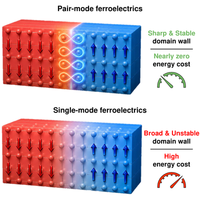
Ferroelectric domain walls are described as interfacial regions between oppositely polarized domains, where the original bulk distortions are suppressed or reconstructed at energetic cost. Here, we demonstrate that exhibits a distinct ferroelectric domain wall where the polarization-reversal boundaries remain structurally bulk compatible and exceptionally low in energy. The central mechanism is a pair-condensation—the simultaneous condensation of the two trilinearly coupled phonon modes located at opposite termini of a single phonon branch. We show that this pair condensation not only establishes the microscopic origin of layer-selective ferroelectricity in bulk but also governs the exceptionally low energy of the 180° domain walls. Specifically, the simultaneous reversal and complementary energetic responses of the paired condensed modes compensate the domain-wall energy cost and facilitates a wall-centered structure where bulk motifs are locally recovered rather than suppressed. This bulklike domain wall is corroborated by the agreement between density-functional-theory calculations and annular-bright-field-STEM measurements of oxygen displacements. This logic extends to suboptimal and higher-energy domain walls which emerge as accessible structural bridges via the selective, energy-minimizing reversal of individual condensed phonon modes. By unifying these structural and energetic observations under the principle of pair condensation, this work provides a generalized predictive framework for engineering domain-wall physics in multimode functional materials.
Physics Subject Headings (PhySH)
Popular Summary
Ferroelectric domain walls are typically regarded as energetically costly interfaces where the bulk lattice distortions associated with polarization are strongly suppressed. We show that ferroelectric exhibits a fundamentally different type of domain wall governed by a mechanism we term pair condensation, in which two trilinearly coupled phonon modes condense simultaneously at opposite ends of the same phonon branch. We demonstrate that this mechanism not only underlies the layer-selective ferroelectricity of orthorhombic but also enables an intrinsic energy-compensation channel during 180° polarization reversal. As a result, domain walls can remain atomically sharp, structurally compatible with the surrounding bulk, and exceptionally low in energy. The predicted wall structures and displacement patterns are validated by quantitative agreement between density-functional-theory calculations and atomic-resolution STEM measurements. This establishes pair condensation as a unifying principle for understanding and engineering domain-wall physics in multimode functional materials.
Article Text
Supplemental Material
References (67)
- C. H. Ahn, K. M. Rabe, and J. M. Triscone, Ferroelectricity at the nanoscale: Local polarization in oxide thin films and heterostructures, Science 303, 488 (2004).
- M. W. Chu, I. Szafraniak, R. Scholz, C. Harnagea, D. Hesse, M. Alexe, and U. Gösele, Impact of misfit dislocations on the polarization instability of epitaxial nanostructured ferroelectric perovskites, Nat. Mater. 3, 87 (2004).
- J. F. Ihlefeld, D. T. Harris, R. Keech, J. L. Jones, J. P. Maria, and S. Trolier-McKinstry, Scaling effects in perovskite ferroelectrics: Fundamental limits and process-structure-property relations, J. Am. Ceram. Soc. 99, 2537 (2016).
- Y. G. Wang, W. L. Zhong, and P. L. Zhang, Lateral size effects on cells in ferroelectric-films, Phys. Rev. B 51, 17235 (1995).
- V. Ginzburg, Some remarks on second order phase transitions and microscopic theory of ferroelectrics, Fiz. Tverd. Tela 2, 2031 (1960).
- F. Bloch and F. Bloch, Zur theorie des austauschproblems und der remanenzerscheinung der ferromagnetika (Springer, New York, 1932).
- L. Néel, Energie des parois de Bloch dans les couches minces, C. R. Hebd. Sean. L Acad. Sci. 241, 533 (1955), https://hal.science/hal-02878458/document.
- J. Wang et al., Ferroelectric domain-wall logic units, Nat. Commun. 13, 3255 (2022).
- I. Stolichnov et al., Bent ferroelectric domain walls as reconfigurable metallic-like channels, Nano Lett. 15, 8049 (2015).
- Z. Y. An et al., Tuning of polar domain boundaries in nonpolar perovskite, Adv. Mater. 35, e2207665 (2023).
- R. Palai, R. S. Katiyar, H. Schmid, P. Tissot, S. J. Clark, J. Robertson, S. A. T. Redfern, G. Catalan, and J. F. Scott, phase and metal-insulator transition in multiferroic , Phys. Rev. B 77, 014110 (2008).
- P. Maksymovych, J. Seidel, Y. H. Chu, P. P. Wu, A. P. Baddorf, L. Q. Chen, S. V. Kalinin, and R. Ramesh, Dynamic conductivity of ferroelectric domain walls in , Nano Lett. 11, 1906 (2011).
- J. Seidel et al., Conduction at domain walls in oxide multiferroics, Nat. Mater. 8, 229 (2009).
- H. Béa and P. Paruch, A way forward along domain walls (vol 8, pg 168, 2009), Nat. Mater. 8, 255 (2009).
- R. Scherwitzl, P. Zubko, C. Lichtensteiger, and J. M. Triscone, Electric-field tuning of the metal-insulator transition in ultrathin films of , Appl. Phys. Lett. 95, 222114 (2009).
- A. Q. Jiang, C. Wang, K. J. Jin, X. B. Liu, J. F. Scott, C. S. Hwang, T. A. Tang, H. Bin Lu, and G. Z. Yang, A resistive memory in semiconducting thin-film capacitors, Adv. Mater. 23, 1277 (2011).
- Y. L. Wang, Y. C. Su, and J. G. Hu, Approach to writing-induced different types of spin vortex structure into ferromagnetic nanostripes, J. Magn. Magn. Mater. 328, 21 (2013).
- I. I. Naumov, L. Bellaiche, and H. X. Fu, Unusual phase transitions in ferroelectric nanodisks and nanorods, Nature (London) 432, 737 (2004).
- T. Choi, Y. Horibe, H. T. Yi, Y. J. Choi, W. D. Wu, and S. W. Cheong, Insulating interlocked ferroelectric and structural antiphase domain walls in multiferroic , Nat. Mater. 9, 253 (2010).
- T. Jungk, A. Hoffmann, M. Fiebig, and E. Soergel, Electrostatic topology of ferroelectric domains in , Appl. Phys. Lett. 97, 012904 (2010).
- D. Meier, J. Seidel, A. Cano, K. Delaney, Y. Kumagai, M. Mostovoy, N. A. Spaldin, R. Ramesh, and M. Fiebig, Anisotropic conductance at improper ferroelectric domain walls, Nat. Mater. 11, 284 (2012).
- W. J. Merz, Domain formation and domain wall motions in ferroelectric single crystals, Phys. Rev. 95, 690 (1954).
- W. J. Merz, Switching time in ferroelectric and its dependence on crystal thickness, J. Appl. Phys. 27, 938 (1956).
- E. D. Grimley, T. Schenk, T. Mikolajick, U. Schroeder, and J. M. LeBeau, Atomic structure of domain and interphase boundaries in ferroelectric , Adv. Mater. Interfaces 5, 1701258 (2018).
- Y. Cheng et al., Reversible transition between the polar and antipolar phases and its implications for wake-up and fatigue in -based ferroelectric thin film, Nat. Commun. 13, 645 (2022).
- Y. Z. Zheng et al., Dynamic structure evolution under invariant lattice framework in fluorite-type ferroelectrics, Nano Lett. 25, 14913 (2025).
- F. Delodovici, P. Barone, and S. Picozzi, Trilinear-coupling-driven ferroelectricity in , Phys. Rev. Mater. 5, 064405 (2021).
- H. J. Lee, M. Lee, K. Lee, J. Jo, H. Yang, Y. Kim, S. C. Chae, U. Waghmare, and J. H. Lee, Scale-free ferroelectricity induced by flat phonon bands in HfO, Science 369, 1343 (2020).
- S. S. Cheema et al., Emergent ferroelectricity in subnanometer binary oxide films on silicon, Science 376, 648 (2022).
- S. Jung and T. Birol, Triggered ferroelectricity in from hybrid phonons and higher-order dynamical charges, Adv. Mater. 38, e21602 (2026).
- See Supplemental Material at http://link.aps.org/supplemental/10.1103/63lf-k7zs for Fig. S1, the mode connection on phonon bands; Fig. S2, the phonon band splitting on the point; Fig. S3, the lattice-distortion modes and trilnear couplings between them; Fig. S4, the energy change as functions of the lattice-distortion modes in the trilinear terms; Fig. S5, the phase-transition path from Pbcn to ; Fig. S6, the corresponding zone-boundary relationships relevant to the local replacements; Fig. S7, the relation between eight structures and switching paths; Fig. S8, atomic structure and domain-wall energy for , , , and domain walls; Fig. S9, the general formalism of domain-wall energy; Fig. S10, the contribution of pair condensation on antipolar Pbca phase; Fig. S11, the comparison between experimental and calculational oxygen displacements in other types of domain walls; Fig. S12, the schematic lattice mode decomposition in a 90° DW in ; Fig. S13, the schematic mode decomposition in the monoclinic twin boundary in ; Fig. S14, the change in dielectric response according to domain-wall formation; Fig. S15, atomic structures and domain-wall energies for , , and domain walls; Note 1 Guide to Phonon-Mode Concepts; Methods. Supplemental Material includes Refs. [32–60].
- G. Kresse and J. Furthmuller, Efficiency of ab-initio total energy calculations for metals and semiconductors using a plane-wave basis set, Comput. Mater. Sci. 6, 15 (1996).
- S. Kambayashi and J. Chihara, Ab initio molecular dynamics for simple liquid metals based on the hypernetted-chain approximation, Mol. Simul. 16, 31 (1996).
- G. Kresse and J. Furthmuller, Efficient iterative schemes for ab initio total-energy calculations using a plane-wave basis set, Phys. Rev. B 54, 11169 (1996).
- G. Kresse and D. Joubert, From ultrasoft pseudopotentials to the projector augmented-wave method, Phys. Rev. B 59, 1758 (1999).
- P. E. Blochl, Projector augmented-wave method, Phys. Rev. B 50, 17953 (1994).
- J. P. Perdew, K. Burke, and M. Ernzerhof, Generalized gradient approximation made simple, Phys. Rev. Lett. 77, 3865 (1996).
- H. J. Monkhorst and J. D. Pack, Special points for brillouin-zone integrations, Phys. Rev. B 13, 5188 (1976).
- J. Müller, T. S. Böscke, U. Schröder, S. Mueller, D. Bräuhaus, U. Böttger, L. Frey, and T. Mikolajick, Ferroelectricity in simple binary and , Nano Lett. 12, 4318 (2012).
- A. S. Foster, F. L. Gejo, A. L. Shluger, and R. M. Nieminen, Vacancy and interstitial defects in hafnia, Phys. Rev. B 65 (2002).
- J. Wang, H. P. Li, and R. Stevens, Hafnia and Hafnia-toughened ceramics, J. Mater. Sci. 27, 5397 (1992).
- T. S. Boescke, J. Müller, D. Bräuhaus, U. Schröder, and U. Böttger, Ferroelectricity in hafnium oxide thin films, Appl. Phys. Lett. 99, 102903 (2011).
- S. Mueller, C. Adelmann, A. Singh, S. Van Elshocht, U. Schroeder, and T. Mikolajick, Ferroelectricity in Gd-doped thin films, ECS J. Solid State Sci. 1, N123 (2012).
- S. Mueller, J. Mueller, A. Singh, S. Riedel, J. Sundqvist, U. Schroeder, and T. Mikolajick, Incipient ferroelectricity in Al-doped thin films, Adv. Funct. Mater. 22, 2412 (2012).
- P. D. Lomenzo et al., Ferroelectric phenomena in Si-doped thin films with TiN and Ir electrodes, J. Vac. Sci. Technol. B 32, 03D123 (2014).
- D. Sheppard, P. H. Xiao, W. Chemelewski, D. D. Johnson, and G. Henkelman, A generalized solid-state nudged elastic band method, J. Chem. Phys. 136, 074103 (2012).
- K. Momma and F. Izumi, for three-dimensional visualization of crystal, volumetric and morphology data, J. Appl. Crystallogr. 44, 1272 (2011).
- S. R. Bakaul et al., Single crystal functional oxides on silicon, Nat. Commun. 7, 10547 (2016).
- L. Jones, H. Yang, T. J. Pennycook, M. S. Marshall, S. Van Aert, N. D. Browning, M. R. Castell, and P. D. Nellist, Smart Align—a new tool for robust non-rigid registration of scanning microscope data, Adv. Struct. Chem. Imag. 1, 1 (2015).
- J. Han, K. J. Go, J. Jang, S. Yang, and S. Y. Choi, Materials property mapping from atomic scale imaging via machine learning based sub-pixel processing, npj Comput. Mater. 8, 196 (2022).
- J. Barthel, Dr. Probe: A software for high-resolution STEM image simulation, Ultramicroscopy 193, 1 (2018).
- S. Kumar, K. P. S. S. Hembram, and U. V. Waghmare, Intrinsic buckling strength of graphene: First-principles density functional theory calculations, Phys. Rev. B 82, 115411 (2010).
- M. Sanati and A. Saxena, Half-kink lattice solution of the model, J. Phys. A 32, 4311 (1999).
- Y. H. Shin, I. Grinberg, I. W. Chen, and A. M. Rappe, Nucleation and growth mechanism of ferroelectric domain-wall motion, Nature (London) 449, 881 (2007).
- H. Aramberri and J. Íñiguez, Theoretical approach to ferroelectricity in hafnia and related materials, Commun. Mater. 4, 95 (2023).
- H. Du, C. Groh, C.-L. Jia, T. Ohlerth, R. E. Dunin-Borkowski, U. Simon, and J. Mayer, Multiple polarization orders in individual twinned colloidal nanocrystals of centrosymmetric , Matter Radiat. Extremes 4, 986 (2021).
- P. Buragohain, C. Richter, T. Schenk, H. Lu, T. Mikolajick, U. Schroeder, and A. Gruverman, Nanoscopic studies of domain structure dynamics in ferroelectric La: capacitors, Appl. Phys. Lett. 112, 222901 (2018).
- H. Mulaosmanovic et al., Switching kinetics in nanoscale hafnium oxide based ferroelectric field-effect transistors, ACS Appl. Mater. Interfaces 9, 3792 (2017).
- C. Zhou et al., Fatigue-free ferroelectricity in ultrathin films via interfacial design, Nat. Commun. 16, 7593 (2025).
- C. Zhou et al., Enhanced polarization switching characteristics of ultrathin films via acceptor-donor co-doping, Nat. Commun. 15, 2893 (2024).
- A. Raeliarijaona and R. E. Cohen, Hafnia is a proper ferroelectric, Phys. Rev. B 108, 094109 (2023); 110, 139901 (2024).
- G. D. Zhao, X. E. Liu, W. Ren, X. N. Zhu, and S. F. Yu, Symmetry of ferroelectric switching and domain walls in hafnium dioxide, Phys. Rev. B 106, 064104 (2022).
- Y. W. Chen, S. T. Fan, and C. W. Liu, Energy preference of uniform polarization switching for by first-principle study, J. Phys. D 54, 085304 (2021).
- Y. B. Qi, S. Singh, and K. M. Rabe, Polarization switching in ferroelectric from first-principles lattice mode analysis, Phys. Rev. B 111, 134106 (2025).
- D. H. Choe, S. Kim, T. Moon, S. Jo, H. Bae, S. G. Nam, Y. S. Lee, and J. Heo, Unexpectedly low barrier of ferroelectric switching in via topological domain walls, Mater. Today 50, 8 (2021).
- D. Fan, T. Y. Zhu, and S. Liu, Unexpected density functional dependence of the antipolar Pbcn phase in , npj Comput. Mater. 11, 140 (2025).
- S. S. Zhou, S. H. Qin, and A. M. Rappe, Domain wall reactions in multiple-order parameter ferroelectrics, Phys. Rev. Lett. 134, 136802 (2025).

