

- Open Access
Fast Algorithm for 2D Rigidity Percolation
Phys. Rev. X 16, 031032 – Published 10 August, 2026
DOI: https://doi.org/10.1103/sv88-j2wj
Abstract
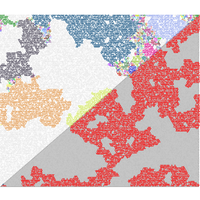
Rigidity percolation is a crucial framework for describing rigidity transitions in amorphous systems. We present an efficient algorithm to study central-force rigidity percolation in two dimensions. This algorithm combines the pebble game algorithm, the Newman-Ziff approach to connectivity percolation, as well as novel rigorous results in rigidity theory, to exactly identify rigid clusters over the full bond concentration range, in a time that scales as for a system of nodes. We perform extensive numerical simulations with systems larger than 500 million nodes, far beyond the previous limitations. We obtain precise estimates for the critical exponents and and locate the critical threshold at . Besides opening the way to further accurate numerical studies of rigidity percolation, our work provides rigorous theoretical insights on specific cluster merging mechanisms that distinguish it from the standard connectivity percolation problem.
Physics Subject Headings (PhySH)
Popular Summary
Gels, biological tissues, and granular materials lack obvious structural order, and retain a liquidlike structure even when they behave like solids. Rigidity percolation provides an elegant explanation for the solidification of amorphous media: As more components randomly bind together, a system-spanning, tortuous rigid structure emerges to provide global mechanical stability. However, this process remains poorly understood theoretically and computationally. This work advances both fronts, focusing on two-dimensional networks with purely central forces (e.g., spring networks). First, we determine how rigid structures evolve when a new bond is added to the network. Using these results, we design a fast, near-linear-time algorithm to efficiently simulate the rigidity percolation transition. Finally, we compute high-accuracy critical exponents characterizing behavior near this fluid-to-solid transition. These advances could improve our understanding of network perturbations and aid the design of efficient algorithms to simulate rigidity transitions on networks with noncentral forces, such as frictional grain packings.
Article Text
Supplemental Material
References (60)
- D. Stauffer and A. Aharony, Introduction to Percolation Theory (Taylor & Francis, London, 1992).
- H. Duminil-Copin, Sixty years of percolation, in Proceedings of the International Congress of Mathematicians (ICM 2018) (World Scientific, Singapore, 2019), pp. 2829–2856.
- J. C. Maxwell F. R. S., L. on the calculation of the equilibrium and stiffness of frames, London, Edinburgh, Dublin Philos. Mag. J. Sci. 27, 294 (1864).
- H. Pollaczek-Geiringer, Über die gliederung ebener fachwerke, Z. Angew. Math. Mech. 7, 58 (1927).
- G. Laman, On graphs and rigidity of plane skeletal structures, J. Eng. Math. 4, 331 (1970).
- D. J. Jacobs and M. F. Thorpe, Generic rigidity percolation: The pebble game, Phys. Rev. Lett. 75, 4051 (1995).
- S. Zhang, L. Zhang, M. Bouzid, D. Z. Rocklin, E. Del Gado, and X. Mao, Correlated rigidity percolation and colloidal gels, Phys. Rev. Lett. 123, 058001 (2019).
- H. Tsurusawa, M. Leocmach, J. Russo, and H. Tanaka, Direct link between mechanical stability in gels and percolation of isostatic particles, Sci. Adv. 5, eaav6090 (2019).
- S. M. Fenton, P. Padmanabhan, B. K. Ryu, T. T. D. Nguyen, R. N. Zia, and M. E. Helgeson, Minimal conditions for solidification and thermal processing of colloidal gels, Proc. Natl. Acad. Sci. U.S.A. 120, e2215922120 (2023).
- N. I. Petridou, B. Corominas-Murtra, C.-P. Heisenberg, and E. Hannezo, Rigidity percolation uncovers a structural basis for embryonic tissue phase transitions, Cell 184, 1914 (2021).
- E. Hannezo and C.-P. Heisenberg, Rigidity transitions in development and disease, Trends Cell Biol. 32, 433 (2022).
- P.-F. Lenne and V. Trivedi, Sculpting tissues by phase transitions, Nat. Commun. 13, 664 (2022).
- M. L. Manning, Rigidity in mechanical biological networks, Curr. Biol. 34, R1024 (2024).
- C. P. Broedersz, X. Mao, T. C. Lubensky, and F. C. MacKintosh, Criticality and isostaticity in fibre networks, Nat. Phys. 7, 983 (2011).
- F. Bolton and D. Weaire, Rigidity loss transition in a disordered 2D froth, Phys. Rev. Lett. 65, 3449 (1990).
- S. Henkes, D. A. Quint, Y. Fily, and J. M. Schwarz, Rigid cluster decomposition reveals criticality in frictional jamming, Phys. Rev. Lett. 116, 028301 (2016).
- K. Liu, S. Henkes, and J. M. Schwarz, Frictional rigidity percolation: A new universality class and its superuniversal connections through minimal rigidity proliferation, Phys. Rev. X 9, 021006 (2019).
- W. G. Ellenbroek, V. F. Hagh, A. Kumar, M. F. Thorpe, and M. van Hecke, Rigidity loss in disordered systems: Three scenarios, Phys. Rev. Lett. 114, 135501 (2015).
- E. Berthier, J. E. Kollmer, S. E. Henkes, K. Liu, J. M. Schwarz, and K. E. Daniels, Rigidity percolation control of the brittle-ductile transition in disordered networks, Phys. Rev. Mater. 3, 075602 (2019).
- M. Bantawa, B. Keshavarz, M. Geri, M. Bouzid, T. Divoux, G. H. McKinley, and E. Del Gado, The hidden hierarchical nature of soft particulate gels, Nat. Phys. 19, 1178 (2023).
- D. Richard and M. Bouzid, How rigidity percolation and bending stiffness shape colloidal gel elasticity, arXiv:2504.19568.
- E. Berthier, J. E. Kollmer, S. E. Henkes, K. Liu, J. M. Schwarz, and K. E. Daniels, Rigidity percolation control of the brittle-ductile transition in disordered networks, Phys. Rev. Mater. 3, 075602 (2019).
- A. Goyal, N. S. Martys, and E. Del Gado, Flow induced rigidity percolation in shear thickening suspensions, J. Rheol. 68, 219 (2024).
- C. Moukarzel and P. M. Duxbury, Comparison of rigidity and connectivity percolation in two dimensions, Phys. Rev. E 59, 2614 (1999).
- A. E. Holroyd, Existence and uniqueness of infinite components in generic rigidity percolation, Ann. Appl. Probab. 8, 944 (1998).
- O. Häggström, Uniqueness of infinite rigid components in percolation models: The case of nonplanar lattices, Probab. Theory Relat. Fields 127, 513 (2003).
- J. Barré, Hierarchical models of rigidity percolation, Phys. Rev. E 80, 061108 (2009).
- T. Jordán and S.-i. Tanigawa, Rigidity of random subgraphs and eigenvalues of stiffness matrices, SIAM J. Discrete Math. 36, 2367 (2022).
- J. Barré, A. R. Bishop, T. Lookman, and A. Saxena, The cavity method for the rigidity transition, J. Stat. Phys. 118, 1057 (2005).
- O. Rivoire and J. Barré, Exactly solvable models of adaptive networks, Phys. Rev. Lett. 97, 148701 (2006).
- N. Javerzat and M. Bouzid, Evidences of conformal invariance in 2D rigidity percolation, Phys. Rev. Lett. 130, 268201 (2023).
- N. Javerzat, Schramm-Loewner evolution in 2D rigidity percolation, Phys. Rev. Lett. 132, 018201 (2024).
- D. J. Jacobs and B. Hendrickson, An algorithm for two-dimensional rigidity percolation: The pebble game, J. Comput. Phys. 137, 346 (1997).
- D. Lester and R. Li, The frictional pebble game: An algorithm for rigidity percolation in saturated frictional assemblies, J. Comput. Phys. 369, 225 (2018).
- R. M. Ziff, J. J. H. Simmons, and P. Kleban, Factorization of correlations in two-dimensional percolation on the plane and torus, J. Phys. A 44, 065002 (2011).
In our work, as well as earlier work [6], bonds are activated in a random, uncorrelated way. Recent work has examined the effect of local correlations [7], but to our knowledge the effect of long-range correlations in the bond activation on the RP universality class has not been addressed. Our algorithm can be generalized to incorporate such correlations, and we plan this for future work.
- H. Dashti, A. A. Saberi, S. Rahbari, and J. Kurths, Emergence of rigidity percolation in flowing granular systems, Sci. Adv. 9, eadh5586 (2023).
- G. Lois, J. Blawzdziewicz, and C. S. O’Hern, Jamming transition and new percolation universality classes in particulate systems with attraction, Phys. Rev. Lett. 100, 028001 (2008).
- M. Latva-Kokko, J. Mäkinen, and J. Timonen, Rigidity transition in two-dimensional random fiber networks, Phys. Rev. E 63, 046113 (2001).
- M. Latva-Kokko and J. Timonen, Rigidity of random networks of stiff fibers in the low-density limit, Phys. Rev. E 64, 066117 (2001).
- M. E. J. Newman and R. M. Ziff, Efficient Monte Carlo algorithm and high-precision results for percolation, Phys. Rev. Lett. 85, 4104 (2000).
- See Supplemental Material at http://link.aps.org/supplemental/10.1103/sv88-j2wj for proofs of results in rigidity theory; details on the performance of the algorithm; and details on the estimation of the critical exponents and threshold. Supplemental Material includes Ref. [43].
- H. Gluck, Almost all simply connected closed surfaces are rigid, in Geometric Topology, edited by L. C. Glaser and T. B. Rushing (Springer, Berlin, Heidelberg, 1975), pp. 225–239.
- J. Machta, Y. S. Choi, A. Lucke, T. Schweizer, and L. M. Chayes, Invaded cluster algorithm for Potts models, Phys. Rev. E 54, 1332 (1996).
Depth-first search can be used as well. JH used BFS, and we do the same in our work.
- M. E. J. Newman and R. M. Ziff, Fast Monte Carlo algorithm for site or bond percolation, Phys. Rev. E 64, 016706 (2001).
Inactive nodes have by definition.
- J. Graver, B. Servatius, and H. Servatius, Combinatorial Rigidity, Graduate Studies in Mathematics (American Mathematical Society, Providence, 1993).
Note that happens only if both and are active; hence, each of them belongs to at least one rigid cluster.
- M. F. Sykes and J. W. Essam, Exact critical percolation probabilities for site and bond problems in two dimensions, J. Math. Phys. (N.Y.) 5, 1117 (1964).
- D. Notarmuzi and N. Javerzat, 10.5281/zenodo.15584520, https://github.com/NinaJaverzat/NZRP/tree/main (2025), simulation code, v1.
We preferred sets to unordered sets, as we observed the former to perform better than the latter. Indeed, the complexity of basic operations on sets is guaranteed to be . In contrast, while unordered sets offer complexity, their performance can degrade to due to rehashing of the underlying hash table.
- M. Boguñá, C. Castellano, and R. Pastor-Satorras, Langevin approach for the dynamics of the contact process on annealed scale-free networks, Phys. Rev. E 79, 036110 (2009).
- De Gennes and P. G., On a relation between percolation theory and the elasticity of gels, J. Phys. Lett. 37, 1 (1976).
While concluding the first version of this work, we became aware of the preprint [56] that proposes a similar dynamic approach to RP. The algorithm has not been published but is reported to perform slightly worse than the standard pebble game.
- M. Lu, Y.-F. Song, M. Li, and Y. Deng, Self-similar gap dynamics in percolation and rigidity percolation, arXiv:2411.04748.
- W. G. Ellenbroek, V. F. Hagh, A. Kumar, M. F. Thorpe, and M. van Hecke, Rigidity loss in disordered systems: Three scenarios, Phys. Rev. Lett. 114, 135501 (2015).
- D. A. Head, Predicting rigidity and connectivity percolation in disordered particulate networks using graph neural networks, Phys. Rev. E 111, 045411 (2025).
- K. Kim and J. M. Schwarz, Rigidity condition for gluing two bar-joint rigid graphs embedded in , arXiv:2410.00317.
- M. Lu, Y. Song, Q. Shi, M. Li, and Y. Deng, Dynamic Monte Carlo study of rigidity percolation using an event-based ensemble approach, Phys. Rev. E 113, 064141 (2026).

