

- Open Access
Riemannian Geometric Classification and Emergent Phenomena of Magnetic Textures
Phys. Rev. X 16, 031026 – Published 4 August, 2026
DOI: https://doi.org/10.1103/2szj-s2nx
Abstract
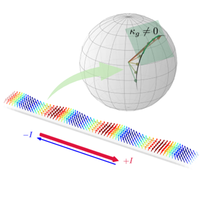
We propose a new classification of magnetic textures from a differential-geometric viewpoint. Magnetic textures are conventionally classified into collinear, coplanar, and noncoplanar magnets according to the relative arrangement of spins. These classes are typically characterized by the vector spin chirality (VSC) and the scalar spin chirality (SSC), which serve as indicators of noncollinearity and noncoplanarity, respectively. However, this conventional classification is incomplete: in particular, noncoplanar textures cannot be fully characterized by the SSC alone, as exemplified by conical magnets. To refine this classification, we analyze the curves and surfaces traced by spins in real space using differential geometry and introduce two novel scalar spin chiralities that properly characterize noncoplanarity: the geodesic scalar spin chirality and the torsional scalar spin chirality. These quantities are directly connected to the differential geometry of curves on surfaces: the former is associated with the geodesic curvature, which quantifies the deviation from a geodesic, while the latter is related to the torsion. Based on these chiralities, we identify three distinct classes of noncoplanar magnetic textures. Furthermore, in close analogy with the roles of the VSC and the conventional SSC in emergent electrodynamics, the geodesic SSC gives rise to novel emergent phenomena. By constructing a semiclassical theory that incorporates nonadiabatic effects and higher-order gradients of the spatial modulation of spins, we demonstrate that the geodesic SSC induces an emergent band asymmetry, leading to a nonreciprocal response as a quantum geometric effect. This mechanism is a purely orbital effect, requiring no spin-orbit coupling, and the resulting discussion runs in parallel with the conventional picture of the topological Hall effect driven by the SSC. The geometric viewpoint developed here will provide broad new insights into classification, quantum geometry, emergent electrodynamics, and a wider variety of emergent phenomena.
Physics Subject Headings (PhySH)
Popular Summary
Classifying complex magnetic textures has become increasingly challenging because conventional frameworks based solely on vector and scalar spin chiralities cannot capture their full structural variety or the phenomena they generate. We addressed this limitation by introducing a classification framework for magnetic structures rooted in differential geometry, identifying two new geometric quantities called the geodesic and torsional scalar spin chiralities. Our framework refines the taxonomy of magnetic textures and reveals previously overlooked geometric contributions to electron transport. We demonstrated that the geodesic scalar spin chirality enters directly into the semiclassical equations of motion of electrons as a distinct quantum geometric effect, playing a role analogous to how conventional scalar spin chirality acts as an effective magnetic field to drive the topological Hall effect. These results provide an analytical language capable of describing emergent electronic phenomena that fall outside the scope of conventional emergent electrodynamics. Our work establishes differential geometry as a predictive tool for analyzing complex ordered states and engineering nonreciprocal electronic responses in magnetic materials.
Article Text
References (85)
- Y. Tokura, S. Seki, and N. Nagaosa, Multiferroics of spin origin, Rep. Prog. Phys. 77, 076501 (2014).
- M. Fiebig, T. Lottermoser, D. Meier, and M. Trassin, The evolution of multiferroics, Nat. Rev. Mater. 1, 16046 (2016).
- N. A. Spaldin and R. Ramesh, Advances in magnetoelectric multiferroics, Nat. Mater. 18, 203 (2019).
- L. Šmejkal, J. Sinova, and T. Jungwirth, Emerging research landscape of altermagnetism, Phys. Rev. X 12, 040501 (2022).
- N. Nagaosa and Y. Tokura, Topological properties and dynamics of magnetic skyrmions, Nat. Nanotechnol. 8, 899 (2013).
- B. Göbel, I. Mertig, and O. A. Tretiakov, Beyond skyrmions: Review and perspectives of alternative magnetic quasiparticles, Phys. Rep. 895, 1 (2021).
- S. Koraltan et al., The 2026 skyrmionics roadmap, arXiv:2601.16575.
- N. Nagaosa, J. Sinova, S. Onoda, A. H. MacDonald, and N. P. Ong, Anomalous Hall effect, Rev. Mod. Phys. 82, 1539 (2010).
- Y. Tokura and N. Nagaosa, Nonreciprocal responses from non-centrosymmetric quantum materials, Nat. Commun. 9, 3740 (2018).
- R. R. Birss, Symmetry and Magnetism (North-Holland Publishing Company, Amsterdam, 1964).
- J. Zang, V. Cros, and A. Hoffmann, Topology in Magnetism (Springer, New York, 2018), Vol. 192.
- G. E. Volovik, Linear momentum in ferromagnets, J. Phys. C 20, L83 (1987).
- N. Nagaosa and Y. Tokura, Emergent electromagnetism in solids, Phys. Scr. 2012, 014020 (2012).
- H. Katsura, N. Nagaosa, and A. V. Balatsky, Spin current and magnetoelectric effect in noncollinear magnets, Phys. Rev. Lett. 95, 057205 (2005).
- M. Mostovoy, Ferroelectricity in spiral magnets, Phys. Rev. Lett. 96, 067601 (2006).
- T. Kimura, T. Goto, H. Shintani, K. Ishizaka, T.-h. Arima, and Y. Tokura, Magnetic control of ferroelectric polarization, Nature (London) 426, 55 (2003).
- Y. Aharonov and A. Stern, Origin of the geometric forces accompanying Berry’s geometric potentials, Phys. Rev. Lett. 69, 3593 (1992).
- J. Ye, Y. B. Kim, A. J. Millis, B. I. Shraiman, P. Majumdar, and Z. Tešanović, Berry phase theory of the anomalous Hall effect: Application to colossal magnetoresistance manganites, Phys. Rev. Lett. 83, 3737 (1999).
- P. Bruno, V. K. Dugaev, and M. Taillefumier, Topological Hall effect and Berry phase in magnetic nanostructures, Phys. Rev. Lett. 93, 096806 (2004).
- K. Ohgushi, S. Murakami, and N. Nagaosa, Spin anisotropy and quantum Hall effect in the kagomé lattice: Chiral spin state based on a ferromagnet, Phys. Rev. B 62, R6065 (2000).
- Y. Taguchi, Y. Oohara, H. Yoshizawa, N. Nagaosa, and Y. Tokura, Spin chirality, Berry phase, and anomalous Hall effect in a frustrated ferromagnet, Science 291, 2573 (2001).
- Y. Machida, S. Nakatsuji, S. Onoda, T. Tayama, and T. Sakakibara, Time-reversal symmetry breaking and spontaneous Hall effect without magnetic dipole order, Nature (London) 463, 210 (2010).
- A. Neubauer, C. Pfleiderer, B. Binz, A. Rosch, R. Ritz, P. G. Niklowitz, and P. Böni, Topological Hall effect in the phase of , Phys. Rev. Lett. 102, 186602 (2009).
- J. Zang, M. Mostovoy, J. H. Han, and N. Nagaosa, Dynamics of skyrmion crystals in metallic thin films, Phys. Rev. Lett. 107, 136804 (2011).
- T. Schulz, R. Ritz, A. Bauer, M. Halder, M. Wagner, C. Franz, C. Pfleiderer, K. Everschor, M. Garst, and A. Rosch, Emergent electrodynamics of skyrmions in a chiral magnet, Nat. Phys. 8, 301 (2012).
- S. E. Barnes and S. Maekawa, Generalization of Faraday’s law to include nonconservative spin forces, Phys. Rev. Lett. 98, 246601 (2007).
- S. A. Yang, Geoffrey S. D. Beach, C. Knutson, D. Xiao, Q. Niu, M. Tsoi, and J. L. Erskine, Universal electromotive force induced by domain wall motion, Phys. Rev. Lett. 102, 067201 (2009).
- P. N. Hai, S. Ohya, M. Tanaka, S. E. Barnes, and S. Maekawa, Electromotive force and huge magnetoresistance in magnetic tunnel junctions, Nature (London) 458, 489 (2009).
- N. Nagaosa, Emergent inductor by spiral magnets, Jpn. J. Appl. Phys. 58, 120909 (2019).
- T. Yokouchi, S. Hoshino, N. Kanazawa, A. Kikkawa, D. Morikawa, K. Shibata, T. hisa Arima, Y. Taguchi, F. Kagawa, N. Nagaosa, and Y. Tokura, Current-induced dynamics of skyrmion strings, Sci. Adv. 4, eaat1115 (2018).
- T. Hori, N. Kanazawa, K. Matsuura, H. Ishizuka, K. Fujiwara, A. Tsukazaki, M. Ichikawa, M. Kawasaki, F. Kagawa, M. Hirayama, and Y. Tokura, Strongly pinned skyrmionic bubbles and higher-order nonlinear Hall resistances at the interface of bilayer, Phys. Rev. Mater. 8, 044407 (2024).
- T. Yokouchi, N. Kanazawa, A. Kikkawa, D. Morikawa, K. Shibata, T. Arima, Y. Taguchi, F. Kagawa, and Y. Tokura, Electrical magnetochiral effect induced by chiral spin fluctuations, Nat. Commun. 8, 866 (2017).
- A. Kitaori, N. Kanazawa, H. Ishizuka, T. Yokouchi, N. Nagaosa, and Y. Tokura, Enhanced electrical magnetochiral effect by spin-hedgehog lattice structural transition, Phys. Rev. B 103, L220410 (2021).
- M. Akaike, Y. Nii, H. Masuda, and Y. Onose, Nonreciprocal electronic transport in : Implication of spatial inversion symmetry breaking, Phys. Rev. B 103, 184428 (2021).
- R. Aoki, Y. Kousaka, and Y. Togawa, Anomalous nonreciprocal electrical transport on chiral magnetic order, Phys. Rev. Lett. 122, 057206 (2019).
- A. H. Mayo, D.-A. Deaconu, H. Masuda, Y. Nii, H. Takahashi, R. V. Belosludov, S. Ishiwata, M. S. Bahramy, and Y. Onose, Band asymmetry–driven nonreciprocal electronic transport in a helimagnetic semimetal , Proc. Natl. Acad. Sci. U.S.A. 122, e2405839122 (2025).
- D. Nakamura, M.-K. Lee, K. Karube, M. Mochizuki, N. Nagaosa, Y. Tokura, and Y. Taguchi, Nonreciprocal transport in a room-temperature chiral magnet, Sci. Adv. 11, eadw8023 (2025).
- H. Masuda, J. I. Ohe, Y. Nii, S. Kimura, and Y. Onose, Critically-enhanced nonreciprocal electronic transport at magnetic phase boundary in a room temperature helimagnet , Phys. Rev. Res. 7, 033019 (2025).
- N. Jiang, Y. Nii, H. Arisawa, E. Saitoh, and Y. Onose, Electric current control of spin helicity in an itinerant helimagnet, Nat. Commun. 11, 1601 (2020).
- D. Yamaguchi, A. Kitaori, N. Nagaosa, and Y. Tokura, Current control of spin helicity and nonreciprocal charge transport in a multiferroic conductor, Adv. Mater. 37, 2420614 (2025).
- Y. Hirokane, Y. Nii, H. Masuda, and Y. Onose, Nonreciprocal thermal transport in a multiferroic helimagnet, Sci. Adv. 6, eabd3703 (2020).
- S. Kobayashi, Differential Geometry of Curves and Surfaces, Springer Undergraduate Mathematics Series (Springer, Singapore, 2019).
- S. Hayami, T. Okubo, and Y. Motome, Phase shift in skyrmion crystals, Nat. Commun. 12, 6927 (2021).
- Y.-M. Xie and N. Nagaosa, Phase shifts, band geometry, and responses in triple-q charge and spin density waves, Phys. Rev. B 110, L241108 (2024).
- M. Yatsushiro, H. Kusunose, and S. Hayami, Multipole classification in 122 magnetic point groups for unified understanding of multiferroic responses and transport phenomena, Phys. Rev. B 104, 054412 (2021).
- B. Göbel, C. A. Akosa, G. Tatara, and I. Mertig, Topological Hall signatures of magnetic hopfions, Phys. Rev. Res. 2, 013315 (2020).
- S. S. Pershoguba, D. Andreoli, and J. Zang, Electronic scattering off a magnetic hopfion, Phys. Rev. B 104, 075102 (2021).
- Y. Liu, H. Watanabe, and N. Nagaosa, Emergent magnetomultipoles and nonlinear responses of a magnetic hopfion, Phys. Rev. Lett. 129, 267201 (2022).
- S. Muhlbauer, B. Binz, F. Jonietz, C. Pfleiderer, A. Rosch, A. Neubauer, R. Georgii, and P. Boni, Skyrmion lattice in a chiral magnet, Science 323, 915 (2009).
- M. Hirschberger, T. Nakajima, S. Gao, L. Peng, A. Kikkawa, T. Kurumaji, M. Kriener, Y. Yamasaki, H. Sagayama, H. Nakao et al., Skyrmion phase and competing magnetic orders on a breathing kagomé lattice, Nat. Commun. 10, 5831 (2019).
- M. S. Reis, R. M. Rubinger, N. A. Sobolev, M. A. Valente, K. Yamada, K. Sato, Y. Todate, A. Bouravleuv, P. J. von Ranke, and S. Gama, Influence of the strong magnetocrystalline anisotropy on the magnetocaloric properties of single crystal, Phys. Rev. B 77, 104439 (2008).
- S. Mehboodi, V. Ukleev, C. Luo, R. Abrudan, F. Radu, C. Back, and A. Aqeel, Observation of distorted tilted conical phase at the surface of a bulk chiral magnet with resonant elastic x-ray scattering, Sci. Technol. Adv. Mater. 26, 2532366 (2025).
- E. A. Karhu, U. K. Rößler, A. N. Bogdanov, S. Kahwaji, B. J. Kirby, H. Fritzsche, M. D. Robertson, C. F. Majkrzak, and T. L. Monchesky, Chiral modulations and reorientation effects in thin films, Phys. Rev. B 85, 094429 (2012).
- D. Xiao, M.-C. Chang, and Q. Niu, Berry phase effects on electronic properties, Rev. Mod. Phys. 82, 1959 (2010).
- G. Sundaram and Q. Niu, Wave-packet dynamics in slowly perturbed crystals: Gradient corrections and Berry-phase effects, Phys. Rev. B 59, 14915 (1999).
- Y. Onishi, N. Paul, and L. Fu, Emergent curved space and gravitational lensing in quantum materials, Phys. Rev. B 113, 024401 (2026).
- E. Wigner, On the quantum correction for thermodynamic equilibrium, Phys. Rev. 40, 749 (1932).
- C. Zachos, D. Fairlie, and T. Curtright, Quantum Mechanics in Phase Space: An Overview with Selected Papers (World Scientific, Singapore, 2005).
- J. E. Moyal, Quantum mechanics as a statistical theory, in Mathematical Proceedings of the Cambridge Philosophical Society (Cambridge University Press, Cambridge, England, 1949), Vol. 45, pp. 99–124.
- Y. Ren and M. E. Sanchez Barrero, Nonadiabatic wave-packet dynamics: Nonadiabatic metric, quantum geometry, and gravitational analogy, Phys. Rev. B 113, 235107 (2026).
- H. Yoshida and T. Yokoyama, Emergent-gravity Hall effect from quantum geometry, arXiv:2507.18458.
- L. Maranzana, K. Shinada, Y.-M. Xie, S. Artyukhin, and N. Nagaosa, Semiclassical wave-packet dynamics in phase-space geometry: Quantum metric effects, arXiv:2603.21262.
- D.-A. Deaconu, A. Agarwal, R. V. Belosludov, R.-J. Slager, and M. S. Bahramy, Field-driven band asymmetry and nonreciprocal transport in a helimagnet, Phys. Rev. Lett. 135, 096701 (2025).
- S. Hayami and M. Yatsushiro, Nonreciprocal transport in noncoplanar magnetic systems without spin–orbit coupling, net scalar chirality, or magnetization, J. Phys. Soc. Jpn. 91, 094704 (2022).
- S. Hayami and M. Yatsushiro, Nonlinear nonreciprocal transport in antiferromagnets free from spin-orbit coupling, Phys. Rev. B 106, 014420 (2022).
- S. Hayami, Nonreciprocal transport driven by noncoplanar magnetic ordering with meron-antimeron spin textures, Solids 6, 40 (2025).
- A. Belavin and A. Polyakov, Metastable states of two-dimensional isotropic ferromagnets, JETP Lett. 22, 245 (1975), http://jetpletters.ru/ps/1529/article_23383.shtml.
- S. Takayoshi, J. Wu, and T. Oka, Nonadiabatic nonlinear optics and quantum geometry—Application to the twisted Schwinger effect, SciPost Phys. 11, 075 (2021).
- H. Wang and K. Chang, Geodesic nature and quantization of shift vector, Chin. Phys. Lett. 43, 020703 (2026).
- S. Rousseau, G. Seyfarth, G. Knebel, D. Aoki, Y. Ōnuki, and A. Pourret, Metastability of the topological magnetic orders in the chiral antiferromagnet , Phys. Rev. B 113, 115160 (2026).
- N. D. Khanh, T. Nakajima, X. Yu, S. Gao, K. Shibata, M. Hirschberger, Y. Yamasaki, H. Sagayama, H. Nakao, L. Peng et al., Nanometric square skyrmion lattice in a centrosymmetric tetragonal magnet, Nat. Nanotechnol. 15, 444 (2020).
- R. Takagi, N. Matsuyama, V. Ukleev, L. Yu, J. S. White, S. Francoual, J. R. Mardegan, S. Hayami, H. Saito, K. Kaneko et al., Square and rhombic lattices of magnetic skyrmions in a centrosymmetric binary compound, Nat. Commun. 13, 1472 (2022).
- H. Yoshimochi, R. Takagi, J. Ju, N. D. Khanh, H. Saito, H. Sagayama, H. Nakao, S. Itoh, Y. Tokura, T. Arima, S. Hayami, T. Nakajima, and S. Seki, Multistep topological transitions among meron and skyrmion crystals in a centrosymmetric magnet, Nat. Phys. 20, 1001 (2024).
- H. Ishizuka and N. Nagaosa, Anomalous electrical magnetochiral effect by chiral spin-cluster scattering, Nat. Commun. 11, 2986 (2020).
- M. Li, Q. Wang, G. Wang, Z. Yuan, W. Song, R. Lou, Z. Liu, Y. Huang, Z. Liu, H. Lei et al., Dirac cone, flat band and saddle point in kagome magnet , Nat. Commun. 12, 3129 (2021).
- Q. Wang, K. J. Neubauer, C. Duan, Q. Yin, S. Fujitsu, H. Hosono, F. Ye, R. Zhang, S. Chi, K. Krycka, H. Lei, and P. Dai, Field-induced topological Hall effect and double-fan spin structure with a -axis component in the metallic kagome antiferromagnetic compound , Phys. Rev. B 103, 014416 (2021).
- A. H. Mayo, H. Takahashi, M. S. Bahramy, A. Nomoto, H. Sakai, and S. Ishiwata, Magnetic generation and switching of topological quantum phases in a trivial semimetal , Phys. Rev. X 12, 011033 (2022).
- K. Hamamoto, M. Ezawa, and N. Nagaosa, Quantized topological Hall effect in skyrmion crystal, Phys. Rev. B 92, 115417 (2015).
- G. Tatara and H. Kawamura, Chirality-driven anomalous Hall effect in weak coupling regime, J. Phys. Soc. Jpn. 71, 2613 (2002).
- N. Verma, Z. Addison, and M. Randeria, Unified theory of the anomalous and topological Hall effects with phase-space Berry curvatures, Sci. Adv. 8, eabq2765 (2022).
- H. Watanabe, K. Shinohara, T. Nomoto, A. Togo, and R. Arita, Symmetry analysis with spin crystallographic groups: Disentangling effects free of spin-orbit coupling in emergent electromagnetism, Phys. Rev. B 109, 094438 (2024).
- S.-S. Zhang, H. Ishizuka, H. Zhang, G. B. Halász, and C. D. Batista, Real-space Berry curvature of itinerant electron systems with spin-orbit interaction, Phys. Rev. B 101, 024420 (2020).
- M. Naka, S. Hayami, H. Kusunose, Y. Yanagi, Y. Motome, and H. Seo, Anomalous Hall effect in -type organic antiferromagnets, Phys. Rev. B 102, 075112 (2020).
- S. Nakatsuji, N. Kiyohara, and T. Higo, Large anomalous Hall effect in a non-collinear antiferromagnet at room temperature, Nature (London) 527, 212 (2015).
- J. R. Schrieffer and P. A. Wolff, Relation between the Anderson and Kondo Hamiltonians, Phys. Rev. 149, 491 (1966).

