Browse Issues:

HIGHLIGHTED ARTICLES

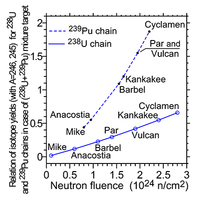
Neutron fluence and relation of yields for transuranium nuclei during nucleosynthesis under conditions of thermonuclear explosions

V. I. Lyashuk

Phys. Rev. C 114, 044603 (2026) - Published 1 October, 2026

There is much interest and activity in identifying transuranium isotopes and determining their cosmological origins, such as neutron star mergers. This paper studies how one could determine the production of transuranium isotopes in pulse nucleosynthesis based on isotopic yield ratios, a process that is very dependent on neutron fluence. The relationship between the neutron flux and abundances is determined in a rather unique way: by looking at yields from nuclear tests conducted during the Plowshares program. Making use of these nuclear tests (indicated in the figure) may help determine whether the periodic table has been extended in natural events in space.

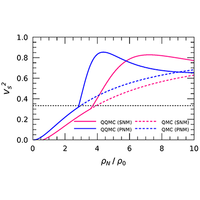
Quarkyonic quark-meson coupling model for nuclear and neutron matter

Koichi Saito, Tsuyoshi Miyatsu, and Myung-Ki Cheoun

Phys. Rev. C 114, 045201 (2026) - Published 1 October, 2026

We have constructed a quark-based nuclear model that extends from low densities into the crossover region where nucleonic matter begins to evolve into quark matter. It combines the quark-meson coupling model with the dual quarkyonic picture. A relativistic treatment of quark wave functions within nucleons ensures that quarkyonic matter emerges above nuclear saturation density, preserving consistency with conventional low-energy nuclear physics. Nuclear interactions are crucial for quantitative predictions in the quarkyonic regime. The predicted sound speed exhibits a pronounced peak and is consistent with constraints inferred from neutron-star observations using neural networks and Bayesian inference. The calculated pressures in symmetric nuclear matter and pure neutron matter also lie within the ranges inferred from high-energy heavy-ion collisions. This framework can help address the hyperon puzzle in massive neutron stars.

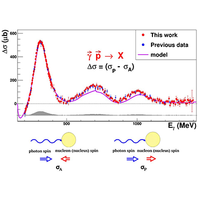
Measurement of the Gerasimov-Drell-Hearn integrand for the proton and deuteron from 200 to 1400 MeV

P. Pedroni et al. (A2 Collaboration at MAMI)

Phys. Rev. C 114, 045203 (2026) - Published 1 October, 2026

The Gerasimov-Drell-Hearn (GDH) sum rule establishes a fundamental link between the total absorption cross section of circularly polarized photons on longitudinally polarized nucleons and nuclei and their static properties. The two relative spin configurations, parallel or antiparallel, determine the absorption cross sections, σP and σA. The sum rule relates the difference of the cross sections (Δσ) to the mass, spin, and anomalous magnetic moment of the nucleon (nucleus). It implies that a non-zero anomalous magnetic moment is connected to the excitation spectrum of the nucleon (nucleus) and, therefore, to its composite nature. Thus, measuring the GDH sum rule integral for different nuclear targets is a sensitive tool for studying both the nucleon resonance properties and the modifications of nucleon properties inside the nuclear medium. We present new precise data on the helicity-dependent total inclusive photoabsorption cross section for the proton and the deuteron, verifying the validity of the GDH sum rule. These new data provide a precise experimental benchmark for theoretical models of nucleons, both free and embedded in the nuclear medium.

Measurement of the neutron incoherent scattering length of Hg199 using stored ultracold neutrons

C. Abel et al. (nEDM Collaboration)

Phys. Rev. C 114, 045501 (2026) - Published 1 October, 2026

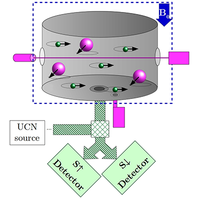
The imbalance between matter and antimatter in our Universe remains one of the great mysteries of modern physics. The neutron’s electric dipole moment (EDM) is a sensitive probe of new sources of CP violation that could help explain this asymmetry. Searches for an EDM rely on extraordinarily precise measurements of the neutron spin precession, using polarized mercury atoms to monitor the applied magnetic field. But the mercury atoms themselves can interact with neutrons in a way that produces a tiny, spin-dependent frequency shift, potentially mimicking an EDM signal. In this study, the nEDM Collaboration, with the experiment based at the Paul Scherrer Institute, directly investigates this subtle neutron-mercury interaction. The results provide a precise characterization of an important systematic effect, improving the control of a key source of uncertainty in EDM measurements.

ARTICLES

Nuclear Structure

Mean-field proton-neutron pairing correlations with the Gogny D1S energy density functional

Miguel de la Fuente, Tomás R. Rodríguez, Luis M. Robledo, Benjamin Bally, and Nathalie Pillet

Phys. Rev. C 114, 044301 (2026) - Published 1 October, 2026

Structure of the neutron-rich N=126 isotones: A shell model analysis

Zsolt Podolyák and Callum J. Wilson

Phys. Rev. C 114, 044302 (2026) - Published 1 October, 2026

Nuclear Reactions

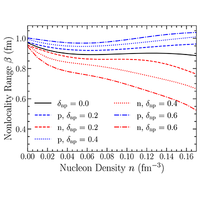
Nonlocality function of microscopic optical potentials from Skyrme-based nuclear structure models at low energies

Do Quang Tam, N. Hoang Tung, Nguyen Hoang Phuc, and T. V. Nhan Hao

Phys. Rev. C 114, 044601 (2026) - Published 1 October, 2026

Evaporation residue cross sections for O16+Yb170,172 reactions: Sub-barrier fusion enhancement and the role of hexadecapole deformation

K. V. Jinu, A. M. Vinodkumar, B. R. S. Babu, S. Nath, J. Gehlot, Gonika, Rishabh Kumar, Alankar Singh, E. Prasad, B. Ashna, K. V. Varsha, P. P. Panchami, Shiva Prasad Nayak, P. V. Madhusudhana Rao, Rajesh K. Sahoo, and Monuj Gogoi

Phys. Rev. C 114, 044602 (2026) - Published 1 October, 2026

Neutron fluence and relation of yields for transuranium nuclei during nucleosynthesis under conditions of thermonuclear explosions

V. I. Lyashuk

Phys. Rev. C 114, 044603 (2026) - Published 1 October, 2026

There is much interest and activity in identifying transuranium isotopes and determining their cosmological origins, such as neutron star mergers. This paper studies how one could determine the production of transuranium isotopes in pulse nucleosynthesis based on isotopic yield ratios, a process that is very dependent on neutron fluence. The relationship between the neutron flux and abundances is determined in a rather unique way: by looking at yields from nuclear tests conducted during the Plowshares program. Making use of these nuclear tests (indicated in the figure) may help determine whether the periodic table has been extended in natural events in space.

Hadronic Physics and QCD

Quarkyonic quark-meson coupling model for nuclear and neutron matter

Koichi Saito, Tsuyoshi Miyatsu, and Myung-Ki Cheoun

Phys. Rev. C 114, 045201 (2026) - Published 1 October, 2026

We have constructed a quark-based nuclear model that extends from low densities into the crossover region where nucleonic matter begins to evolve into quark matter. It combines the quark-meson coupling model with the dual quarkyonic picture. A relativistic treatment of quark wave functions within nucleons ensures that quarkyonic matter emerges above nuclear saturation density, preserving consistency with conventional low-energy nuclear physics. Nuclear interactions are crucial for quantitative predictions in the quarkyonic regime. The predicted sound speed exhibits a pronounced peak and is consistent with constraints inferred from neutron-star observations using neural networks and Bayesian inference. The calculated pressures in symmetric nuclear matter and pure neutron matter also lie within the ranges inferred from high-energy heavy-ion collisions. This framework can help address the hyperon puzzle in massive neutron stars.

Massive Thirring / sine-Gordon model with nonzero current density

Eric Oevermann and Thomas D. Cohen

Phys. Rev. C 114, 045202 (2026) - Published 1 October, 2026

Measurement of the Gerasimov-Drell-Hearn integrand for the proton and deuteron from 200 to 1400 MeV

P. Pedroni et al. (A2 Collaboration at MAMI)

Phys. Rev. C 114, 045203 (2026) - Published 1 October, 2026

The Gerasimov-Drell-Hearn (GDH) sum rule establishes a fundamental link between the total absorption cross section of circularly polarized photons on longitudinally polarized nucleons and nuclei and their static properties. The two relative spin configurations, parallel or antiparallel, determine the absorption cross sections, σP and σA. The sum rule relates the difference of the cross sections (Δσ) to the mass, spin, and anomalous magnetic moment of the nucleon (nucleus). It implies that a non-zero anomalous magnetic moment is connected to the excitation spectrum of the nucleon (nucleus) and, therefore, to its composite nature. Thus, measuring the GDH sum rule integral for different nuclear targets is a sensitive tool for studying both the nucleon resonance properties and the modifications of nucleon properties inside the nuclear medium. We present new precise data on the helicity-dependent total inclusive photoabsorption cross section for the proton and the deuteron, verifying the validity of the GDH sum rule. These new data provide a precise experimental benchmark for theoretical models of nucleons, both free and embedded in the nuclear medium.

Electroweak Interaction, Symmetries

Measurement of the neutron incoherent scattering length of Hg199 using stored ultracold neutrons

C. Abel et al. (nEDM Collaboration)

Phys. Rev. C 114, 045501 (2026) - Published 1 October, 2026

The imbalance between matter and antimatter in our Universe remains one of the great mysteries of modern physics. The neutron’s electric dipole moment (EDM) is a sensitive probe of new sources of CP violation that could help explain this asymmetry. Searches for an EDM rely on extraordinarily precise measurements of the neutron spin precession, using polarized mercury atoms to monitor the applied magnetic field. But the mercury atoms themselves can interact with neutrons in a way that produces a tiny, spin-dependent frequency shift, potentially mimicking an EDM signal. In this study, the nEDM Collaboration, with the experiment based at the Paul Scherrer Institute, directly investigates this subtle neutron-mercury interaction. The results provide a precise characterization of an important systematic effect, improving the control of a key source of uncertainty in EDM measurements.

Nuclear Astrophysics

Thermodynamic versus dynamical description of the neutron-star crust-core instability: Implications for crustal observables

Athul Kunjipurayil and J. Piekarewicz

Phys. Rev. C 114, 045801 (2026) - Published 1 October, 2026

Sign In to Your Journals Account

Filter

Filter

Article Lookup

Enter a citation