Recent Articles

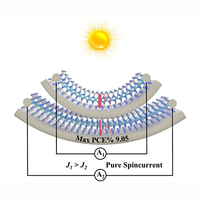
Strain gradient engineered flexophotovoltaics and spin polarization in bent MoSi2N4 nanoribbons

Helong Chen, Meng Ge, Yang Xiao, Degao Xu, Jianing Tan, and Gang Ouyang

Phys. Rev. B 112, 245407 (2025) - Published 5 December, 2025

The authors demonstrate here that strain-gradient engineering in bent MoSi2N4 nanoribbons induces not only self-doping and a nonzero Berry curvature dipole, but also achieves an outstanding flexoelectric power conversion efficiency of 9.05%, the highest among 2D flexophotovoltaic systems. Under circularly polarized light, the bent MoSi2N4 photodetector generates a self-powered spin photocurrent. These results advance the fundamental understanding of mechanical-electronic coupling in 2D materials and highlight the potential of MoSi2N4 for high-efficiency solar cells, optoelectronics, and spintronic applications.

Short-range spin freezing in the double trillium lattice spin-liquid candidate KSrFe2(PO4)3 revealed via P31 NMR

Sebin J. Sebastian, Q.-P. Ding, A. A. Tsirlin, R. Nath, and Y. Furukawa

Phys. Rev. B 112, L220406 (2025) - Published 5 December, 2025

The authors investigate here the double-trillium lattice antiferromagnet KSrFe2(PO4)3 using 31P NMR, thermodynamic measurements, and first-principles calculations to elucidate its unconventional ground state. Below the characteristic temperature T* ~ 3.5 K, the results reveal a short-range spin freezing state with persistent antiferromagnetic fluctuations, contradicting earlier proposals of a gapless spin-liquid state. A nearly field-independent NMR linewidth, strong enhancement of 1/T2 below T*, and sizeable antiferromagnetic exchange interactions collectively position KSrFe2(PO4)3 as a rare three-dimensional frustrated magnet hosting intertwined static and dynamic correlations.

Dominant Kitaev interaction and field-induced quantum disordered phase in the cobaltate Na2Co2TeO6

Xu-Guang Zhou, Han Li, Chaebin Kim, Akira Matsuo, Kavita Mehlawat, Kazuki Matsui, Zhuo Yang, Atsuhiko Miyata, Gang Su, Koichi Kindo, Je-Geun Park, Yoshimitsu Kohama, Wei Li, and Yasuhiro H. Matsuda

Phys. Rev. B 112, L241108 (2025) - Published 5 December, 2025

Flat band and many-body gap in chirally twisted triple bilayer graphene

Wenlu Lin, Wenxuan Wang, Shimin Cao, Miao Liang, Lili Zhao, Kenji Watanabe, Takashi Taniguchi, Jinhua Gao, Jianhao Chen, Xiaobo Lu, and Yang Liu

Phys. Rev. B 112, L241109 (2025) - Published 5 December, 2025

One-parameter scaling function for Anderson localization transitions in high-dimensional lattices with nonreciprocity

C. Wang, Wenxue He, X. R. Wang, and Hechen Ren

Phys. Rev. B 112, 214206 (2025) - Published 4 December, 2025

Entanglement area law and Lieb-Schultz-Mattis theorem in long-range interacting systems, and symmetry-enforced long-range entanglement

Ruizhi Liu, Jinmin Yi, Shiyu Zhou, and Liujun Zou

Phys. Rev. B 112, 214408 (2025) - Published 4 December, 2025

Ratchet motion of magnetic skyrmions driven by surface acoustic sawtooth waves

Philipp Schwenke, Ephraim Spindler, Vitaliy I. Vasyuchka, Alexandre Abbass Hamadeh, Philipp Pirro, and Mathias Weiler

Phys. Rev. B 112, 214409 (2025) - Published 4 December, 2025

Spin and pair density waves in two-dimensional altermagnetic metals

Nikolaos Parthenios, Pietro M. Bonetti, Rafael González-Hernández, Warlley H. Campos, Libor Šmejkal, and Laura Classen

Phys. Rev. B 112, 214410 (2025) - Published 4 December, 2025

What happens in a correlated altermagnet at low temperatures? Due to the exchange origin of the unconventional spin splitting, the altermagnetic state can set in at relatively high temperatures. Motivated by recent experiments, the authors use here renormalization group and ab initio calculations to demonstrate how altermagnets can act as a parent state for secondary many-body instabilities, including spin-density waves and unconventional superconductivity driven by electronic correlations.

Three-dimensional lattice modulations in the charge density wave system Lu2Ir3Si5

V. Petkov, A. Zafar, M. Jakhar, AM Milinda Abeykoon, and Z. Hegedüs

Phys. Rev. B 112, 224108 (2025) - Published 4 December, 2025

Electron affinity and binding energy of excitons in disordered organic semiconductors. I. Simulation-assisted analysis of field-induced exciton dissociation experiments

E. J. de Jong, S. Gottardi, H. van Eersel, and R. Coehoorn

Phys. Rev. B 112, 224202 (2025) - Published 4 December, 2025

Electron affinity and binding energy of excitons in disordered organic semiconductors. II. First-principles simulations and inverse photoemission studies for MADN

Gianluca Tirimbò, O. Nagaoka, S. Fukushima, Clint van Hoesel, Hiroyuki Yoshida, Reinder Coehoorn, and Björn Baumeier

Phys. Rev. B 112, 224203 (2025) - Published 4 December, 2025

Electron affinity and binding energy of excitons in disordered organic semiconductors. III. Multimethod study for films of the blue fluorescent emitter MADN

E. J. de Jong, N. G. de Rooij, W. F. M. van Geel, C. Hauenstein, H. Tomita, G. Tirimbò, M. Berghuis, S. Gottardi, B. Baumeier, and R. Coehoorn

Phys. Rev. B 112, 224204 (2025) - Published 4 December, 2025

Unconventional lattice thermal transport and high thermoelectric performance in eight alkali-metal half-Heusler compounds AMgX (A=Li, Na, K, Rb; X=As, Sb, Bi)

Longchao Lv, Yinchang Zhao, Jun Ni, and Zhenhong Dai

Phys. Rev. B 112, 224304 (2025) - Published 4 December, 2025

Spin fluctuation induced anomalous Hall effect in the distorted kagome antiferromagnet DyAgGe

Tomomi Furuhashi, Keita Nagasawa, Yuichi Yamasaki, Hironori Nakao, Yusuke Kozuka, Yoshihiro Tsujimoto, Kazunari Yamaura, and Jun Fujioka

Phys. Rev. B 112, 224408 (2025) - Published 4 December, 2025

Temporal coupled mode theory: From bound states in the continuum to uniguided resonances

Dmitrii N. Maksimov, Pavel S. Pankin, Dong-Wook Kim, Mingzhao Song, Chao Peng, and Andrey A. Bogdanov

Phys. Rev. B 112, 235303 (2025) - Published 4 December, 2025

Transition metal dichalcogenide surfaces as scattering targets in spin-polarization detectors: A case study of MoS2

C. Angrick, A. Henriksen, N. Edossa, A. Reimann, M. Ewert, L. Buß, J. Falta, J. I. Flege, and M. Donath

Phys. Rev. B 112, 235408 (2025) - Published 4 December, 2025

The authors investigate here the suitability of transition metal dichalcogenide (TMDC) surfaces as scattering targets in spin-polarization detectors. These detectors are essential for revealing the spin texture of electronic bands in photoemission experiments. A well-proven approach uses the spin-dependent electron reflection from surfaces influenced by exchange and/or spin-orbit interaction. This paradigmatic study of spin-orbit-influenced MoS2 samples comprises maps for the spin-dependent reflection asymmetry and the efficiency of spin separation. The results show promising features, which emphasize the potential of TMDC-based spin-polarization detectors.

Electric field modulation of plasmons in charge-neutral bilayer MoS2

Wenqian Feng, Lanting Feng, Yunhua Wang, Guodong Yu, and Shengjun Yuan

Phys. Rev. B 112, 245405 (2025) - Published 4 December, 2025

Shock absorption by multilayer carbon nanotube packings

Alexander V. Savin

Phys. Rev. B 112, 245406 (2025) - Published 4 December, 2025

Fractional quantum Hall edge polaritons

Lucas Winter and Oded Zilberberg

Phys. Rev. B 112, L241105 (2025) - Published 4 December, 2025

Room-temperature broad-band radiofrequency rectification in epitaxial SrIrO3 films

Liang Zhou, Zongzheng Du, Jinhua Wang, Pingbo Chen, Bicong Ye, Tao Feng, Jiahao Yang, Zehao Xiao, Meng Yang, Junxue Li, Wenqing Zhang, Hai-Zhou Lu, and Hongtao He

Phys. Rev. B 112, L241106 (2025) - Published 4 December, 2025

Sign In to Your Journals Account

Filter

Recent Issues

Vol. 114, Iss. 24
15 October 2026
Vol. 114, Iss. 23
15 October 2026
Vol. 114, Iss. 22
15 October 2026
Vol. 114, Iss. 21
1 October 2026
Category
Article Type
Section

Filter

Article Lookup

Enter a citation